


So you're ready to move from demo trading and open a forex real account with your own money? Good.

David van der Merwe
Emerging Markets Trader ·  South Africa
☕ 11 min read
What you'll learn:
- 1Is Forex Trading Legal in South Africa? (The FSCA Rules)
- 2Choosing the Right Forex Broker: My Picks and Pitfalls
- 3The Account Opening Process: Documents & Verification
- 4Funding Your Account: ZAR Options & Real Costs
- 5Your First Trades & Non-Negotiable Risk Management
- 6Common Mistakes I've Made (So You Don't Have To)
- 7What Now? Your First 30-Day Action Plan
So you're ready to move from demo trading and open a forex real account with your own money? Good. That's where the real learning starts, and where most people get it wrong. I've been trading from SA for over a decade, and I've seen every mistake in the book - including my own. This isn't just a click-through tutorial; it's a survival guide for the South African market. We'll cut through the broker marketing, explain the FSCA's 30:1 use cap (and why it's a good thing), and I'll tell you exactly how much you should really start with. Let's get your account set up the right way, so you don't blow it up in a week.
First things first: yes, forex trading is completely legal here. But it's not the wild west. We have one of the more sensible regulatory frameworks in Africa, run by the Financial Sector Conduct Authority (FSCA). Think of them as the referees. Their job is to keep the brokers honest, which directly protects you.
A few years back, you could get use of 500:1 or even 1000:1 from offshore brokers. It was a recipe for disaster for retail traders. In 2021, the FSCA stepped in and capped use for retail clients at 30:1 on major forex pairs. Some new traders moan about this, but trust me, it's a lifesaver. It forces you to use proper position sizing. I learned that the hard way early on, blowing a R5,000 account in 2012 by using insane use on a GBP/USD trade. The 30:1 rule would have stopped that stupidity.
The FSCA also mandates that brokers keep your money in segregated accounts. This means your deposit isn't just part of the broker's operating cash. If the broker goes under (it happens), your funds should be safer. Always, and I mean always, verify a broker's FSCA license number on the regulator's website before you deposit a cent.

Warning: It is illegal to buy or sell currency outside authorized channels (like some 'black market' forex schemes). Always use a licensed broker. Your profits are also subject to tax - SARS will find you if you're successful, so keep records from day one.

💡 Winston's Tip
Your first deposit isn't trading capital. It's tuition fee. Expect to pay it to learn. The goal is to make that fee as small as possible through insane risk control.
This is the most critical step in learning how to open a forex real account. The wrong broker will bleed you dry with hidden fees or disappear with your money. You want an FSCA-regulated broker, full stop. Many international giants like IC Markets and Pepperstone also accept SA clients through their global entities, which is fine, but an FSCA license offers that local recourse.
What to Look For (Beyond the License)
Don't just look at the shiny "Welcome Bonus." Look at the cost structure. There are two main types: commission-free accounts with wider spreads, and raw spread accounts with a small commission per trade. If you're a scalper or high-volume trader, the raw spread account is almost always cheaper. For example, on a typical R10,000 account trading one mini lot, a 2-pip spread on EUR/USD costs you $2 per round turn. A 0.1 pip spread plus a $3.50 commission costs you $3.60. Slightly more, but you get faster execution, which is worth it.
I made the mistake of choosing a broker with "tight spreads" that constantly requoted me during news events. My stop-losses were ignored, and I took bigger losses than I should have. Execution quality matters.
A Quick Comparison of Popular Choices
| Broker | FSCA Regulated? | Min. Deposit (ZAR approx.) | Key Feature for SA Traders |
|---|---|---|---|
| FP Markets | Yes | ~R900 (AUD 100) | Raw ECN spreads from 0.0 pips, solid ZAR support. My main account for years. |
| Tickmill | Yes | ~R1,800 ($100) | Consistently low spreads. Their Raw account had EUR/USD at 0.11 pips in 2023. |
| IC Markets | Via Global Entity | ~R900 ($50) | Legendary for raw liquidity and 0.0 pip spreads. A favorite for serious traders. |
| XM | Yes | As low as ~R90 ($5) | Great for beginners with cent accounts to practice real money psychology. |
| AvaTrade | Yes | ~R1,800 ($100) | Offers fixed spreads, good if you hate variable costs. |
Read our deep-dive IC Markets review and XM review for more specifics. Your choice depends on your style. Starting out? A cent account with XM isn't a bad idea. Ready to get serious? Look at FP Markets or IC Markets.
“Opening the account is just the entry ticket. The real work starts now.”
It's straightforward but requires real documents. Here’s the typical flow, which I've done a dozen times:
- Online Application: Fill in your personal details – name, ID number, physical address, employment, trading experience. Be 100% truthful. Lying about your experience or finances can get your account closed later.
- Submit Your Docs: You'll need a clear colour copy/scan of:
- Your South African ID Book or Smart Card.
- Proof of Residence. This must be recent (last 3 months) and show your name and address. A utility bill, bank statement, or municipal rates invoice works. A cellphone bill often doesn't.
- Financial Assessment: The broker will ask about your annual income, net worth, and trading objectives. This isn't nosiness; it's FSCA-mandated KYC (Know Your Client) to ensure they don't offer you unsuitable products. If you earn R20,000 a month, they shouldn't let you trade like a hedge fund.
- Agree to Terms: Read the client agreement. Seriously. It outlines their policies on withdrawals, inactivity fees, and margin calls.
- Verification: This can take from a few hours to a couple of days. Once approved, you're ready to fund.

Pro Tip: Have your PDF scans or clear phone-camera pics ready before you start the application. Speeds up the process massively. Also, use the exact same name that's on your ID and bank account to avoid withdrawal headaches later.
This is where many South Africans get a nasty surprise. You're funding in Rands, but your trading account is likely in USD, EUR, or another major currency. The conversion happens, and there are costs.
Common Deposit Methods:
- Bank Transfer (EFT): The most common. It's secure but can be slow (1-3 business days). Some brokers absorb the fees, some don't. Check.
- Credit/Debit Card (Visa/Mastercard): Almost instant. Your bank will do the ZAR to USD conversion, often at a retail markup of 2-3% above the interbank rate. This is a hidden cost.
- E-Wallets (Skrill, Neteller, PayPal): Fast. But they have their own fee structures and conversion costs. I've found Skrill can be expensive for smaller amounts.
The Real Cost Example: Let's say you deposit R10,000 via credit card to trade USD pairs. Your bank's exchange rate might be R18.50/USD when the real rate is R18.00. That R10,000 only gets you about $540 instead of $555. You've instantly paid a R270 "fee" via a poor exchange rate.
My Advice: For larger deposits (over R5,000), use a broker that accepts direct ZAR deposits into a South African bank account, like some FSCA-licensed brokers offer. They convert at better wholesale rates. For smaller amounts, a card is fine for convenience, just be aware of the cost.
Withdrawals work the same way in reverse. Plan for it to take 1-5 business days. Always use our position size calculator to ensure your first trade isn't too big for your actual deposited capital, after fees.
💡 Winston's Tip
The FSCA's 30:1 use cap isn't a limit on your potential. It's a governor on your idiocy. Thank them for it later.
“The 30:1 use cap isn't a limit on your potential. It's a governor on your idiocy.”
Your account is funded. The market is moving. The urge to jump in is huge. Resist it. This is where 90% of accounts die.
Start Stupidly Small
If you deposited R5,000, your first trade should risk no more than R50-R100 (1-2% of your account). I don't care if you see the "perfect setup." This is about discipline, not profits. In 2014, I funded a new account with R15,000. My first trade was a "sure thing" on gold, risking R750 (5%). It went against me. The psychological pressure was immense, and I held the loss until it hit R3,000. I was wrecked before I even started.
The Three Rules Before You Click "Buy"
- Set Your Stop-Loss (SL) FIRST. Decide where you're wrong before you're right. Place it at a logical technical level, not an arbitrary "I can only lose R100" level that's too tight.
- Set Your Take-Profit (TP). Have a target based on the chart, not greed. A good starting risk-reward ratio is 1:1.5 or better. If you risk R100, aim for R150+.
- Calculate Your Position Size. This is the magic. If your SL is 20 pips away on EUR/USD, and you can only risk R100, your position size must be small enough that a 20-pip loss equals R100. A proper position size calculator does this math for you.

Example: You have a R10,000 account. You risk 1% (R100). Your SL on a EUR/USD trade is 25 pips. Since 1 pip on a standard lot is about $10, you need to find the lot size where 25 pips = R100 (~$5.50). That's a 0.02 micro lot. That's how small you start.
This discipline is what separates the 10% who survive from the 90% who don't. Tools that help you manage this mechanically are useful. For instance, managing multiple take-profit levels and moving stops to breakeven is a hassle on vanilla MT5. Automating that process lets you focus on analysis, not order management.
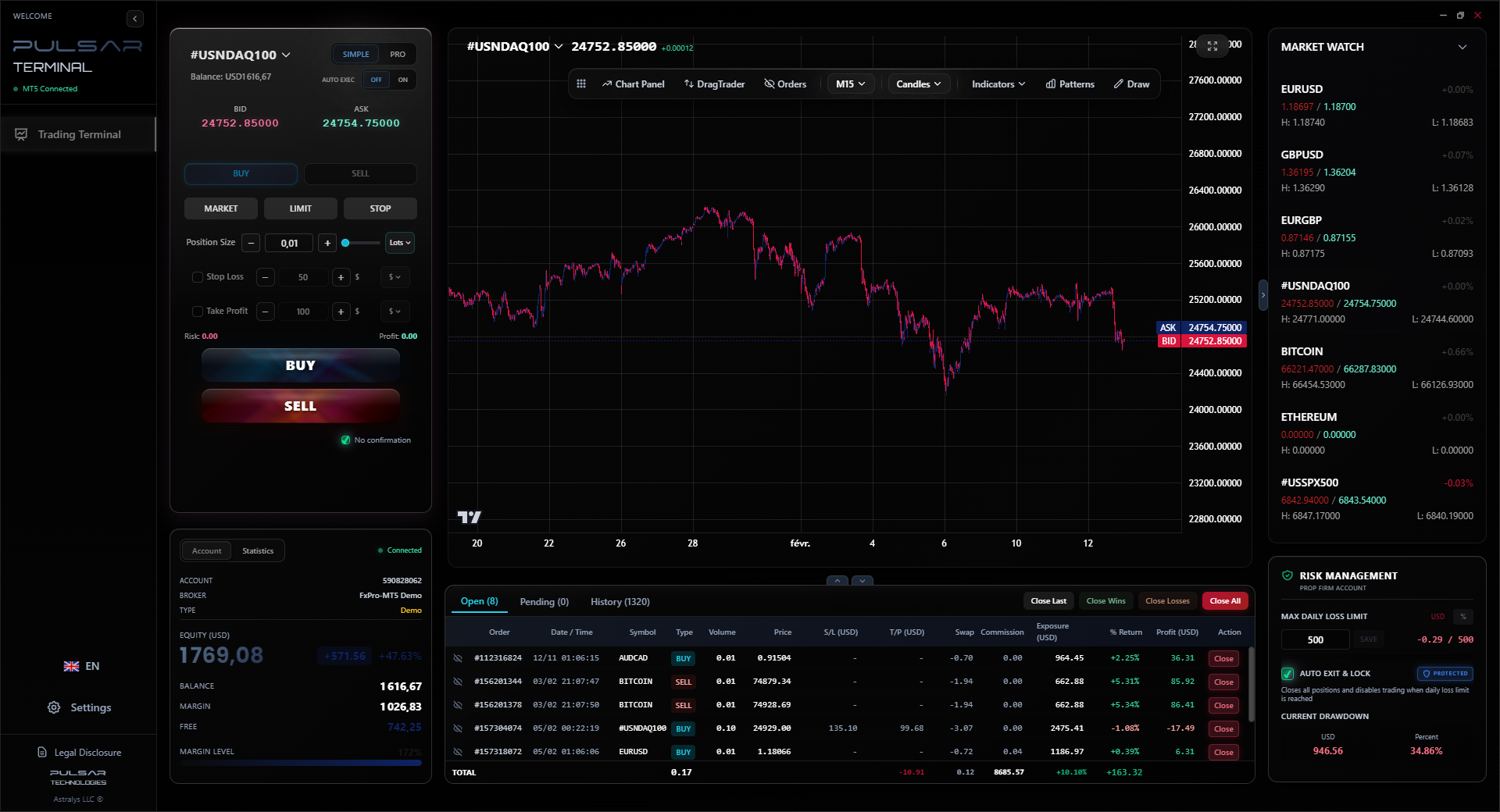
Manually moving stops to breakeven and managing multiple take-profit levels is a distraction; Pulsar Terminal automates these risk management tasks directly on your MT5 chart.
Pulsar Terminal
The all-in-one MT5 companion: drag-and-drop orders, multi-TP/SL, trailing stop, grid trading, Volume Profile, and prop firm protection. Used by 1,000+ traders daily.
Let's get personal. Here are my blunders, with numbers, from over a decade in the trenches. Learn from my wallet's pain.
Mistake 1: Chasing the "Hot" Pair. When everyone was talking about the USD/ZAR crashing or soaring, I'd jump in without a plan. In 2016, I went long USD/ZAR at 13.80 because "it had to go higher." It didn't. It dropped to 13.20. I didn't have a stop-loss because "it's just a retracement." Loss: R8,000 on a R25,000 account. The lesson? Trade the chart, not the chatter. Have a guide like our EUR/USD guide to understand a pair's behavior before you trade it.
Mistake 2: Over-trading on a Small Account. With a R3,000 account, I'd try to make R300 a day. That's 10%. To do that, I had to use huge use and take low-probability trades. The account was dead in two weeks. A realistic target is 2-5% per month, not per day.
Mistake 3: Ignoring Swap Fees on Long-Term Holds. I once held a AUD/JPY carry trade for 3 months in a small account. I made 120 pips, but the negative swap fees ate 45 of those pips. On a swing trading account, always check the swap rates.
Mistake 4: Not Understanding the Platform. I placed a market order during a high-volatility news event on a broker with slow execution. The slippage was 15 pips on a trade where my SL was only 10 pips away. I lost 1.5 times my planned risk instantly. Know your broker's execution model.
The core of all these mistakes? Poor risk management and a lack of a defined strategy. Before you open a forex real account, have a written plan for how you'll enter, exit, and size every single trade.
💡 Winston's Tip
If you feel your heart thumping when you click 'buy' or 'sell', your position is too large. Cut it in half. Psychology is the final boss of trading.
“Your first deposit isn't trading capital. It's a tuition fee.”
Your account is live. Here's what your next month should look like:
Week 1: Paper Trade on Your Live Platform. That's right. Use your real broker's platform with real quotes and execution speeds, but use the demo function or trade tiny cent lots. Get a feel for the order placement, the speed, the charts. Practice setting stops and limits. This gets you comfortable with the mechanics without financial risk.
Week 2-3: Execute Your Plan with Micro Lots. Start trading your actual strategy, but with the smallest possible position size. For most brokers, that's 0.01 lots (a micro lot). Your goal is not profit. Your goal is to execute 10-20 trades exactly according to your plan. Did you set the SL and TP every time? Did you stick to your 1% risk rule? The P&L is irrelevant at this stage.
Week 4: Review & Adjust. Analyze your trades. Not just the losers - the winners too. Did you take profit too early? Did your stop-losses get hit just before price reversed? This is where you refine your strategy. Maybe you need to use the RSI indicator to filter out weak signals, or the MACD indicator for better trend confirmation.
After 30 days of disciplined, small-lot trading, you'll have real data on your strategy's performance and, more importantly, on your own psychology. You'll know if you can handle the drawdowns. Only then should you consider gradually increasing your position size to your planned risk level.
Opening the account is just the entry ticket. The real work starts now. Be patient, be disciplined, and for goodness' sake, keep a trade journal.
FAQ
Q1What is the minimum amount to open a forex real account in South Africa?
Technically, you can start with as little as R70-R150 ($5-$10) with some brokers offering micro or cent accounts. But let's be real: that's for learning the platform mechanics, not meaningful trading. To properly apply risk management and not get wiped out by a single trade, a realistic minimum is R1,500 to R5,000. For serious, long-term trading, I'd recommend starting with at least R5,000 to R20,000.
Q2Can I use a foreign broker, or must they be FSCA-regulated?
You can use a foreign broker (like the global entities of IC Markets or Pepperstone), and many South Africans do. However, there's a significant advantage to using an FSCA-regulated broker: local legal recourse. If you have a dispute about withdrawals or execution, you can lodge a complaint with the FSCA. With an offshore broker, you're dealing with a regulator in Cyprus, the Seychelles, or elsewhere. It's not impossible, but it's harder. Always prioritize strong regulation, with FSCA being the gold standard for SA residents.
Q3How long does it take to open and fund an account?
The online application takes 10-15 minutes. Verification of your ID and proof of residence can take anywhere from a few hours to 2 business days. Funding time depends on your method: Credit/debit card deposits are almost instant. Bank EFTs can take 1-3 business days. So, from start to being ready to trade, it can be as quick as a few hours or up to 3-4 days.
Q4What are the tax implications of forex trading profits in SA?
Forex trading profits are considered taxable income by SARS. If you trade frequently, it's likely to be seen as revenue from a business (trading income) and taxed at your marginal income tax rate. If you trade less frequently, it might be considered capital gains. The key is to keep careful records of every trade (entry, exit, profit/loss in ZAR) from day one. Consult a tax professional who understands trading. Don't ignore this.
Q5Why is use limited to 30:1 in South Africa?
The FSCA imposed the 30:1 use cap for retail traders in 2021 to protect them. Higher use (like 500:1) massively amplifies both gains and losses. For inexperienced traders, it acts like a trap, allowing them to take positions far too large for their account size, leading to rapid losses. The 30:1 limit forces more sensible position sizing. As a veteran, I see it as a positive rule that helps new traders survive long enough to learn.
Q6What's the difference between a standard and a raw spread/ECN account?
A standard (or commission-free) account has no per-trade commission, but the broker's profit is built into a wider spread (e.g., 1.5 pips on EUR/USD). A raw spread or ECN account offers much tighter spreads (often 0.0 to 0.2 pips) but charges a small commission per lot traded (e.g., $3.50 per side). For active traders, the ECN account is usually cheaper overall. Beginners might prefer the simplicity of a standard account, but should be aware they're paying for it in the spread.
Prof. Winston's Lesson
Key Takeaways:
- ✓Verify FSCA license before any deposit.
- ✓Start with at least R5,000 for realistic trading.
- ✓Never risk more than 1-2% of capital per trade.
- ✓Use a position size calculator for every entry.
- ✓Your first 30 days are for execution practice, not profit.
How useful was this article?
Click a star to rate
Weekly Trading Insights
Free weekly analysis & strategies. No spam.
About the Author
David van der Merwe
Emerging Markets Trader
Johannesburg-based trader with 11 years in emerging market currencies. Specializes in ZAR pairs, FSCA-regulated trading, and South African market analysis.
Comments
Risk Disclaimer
Trading financial instruments carries significant risk and may not be suitable for all investors. Past performance does not guarantee future results. This content is for educational purposes only and should not be considered investment advice. Always conduct your own research before trading.
You Might Also Like

Cara Trading Forex Sukses: 7 Prinsip dari Trader Profesional
Cara trading forex sukses dengan 7 prinsip trader pro: manajemen modal, disiplin, journal trading, backtest. Data nyata, bukan janji profit palsu.
Jam Trading Forex Terbaik untuk Trader Indonesia: Panduan Lengkap dengan Tabel Waktu
Panduan jam trading forex untuk trader Indonesia. Tabel 4 sesi dunia, jam emas 20:00-00:00, sesi mana yang harus dihindari. Data akurat + tips dari trader berpengalaman.
Top 5 Sàn Forex Uy Tín Nhất 2026: Review Jujur dari Trader Indonesia
Top 5 sàn forex uy tín 2026 untuk trader Indonesia. Review jujur: spread, deposit, withdraw, dukungan lokal. Exness, XM, IC Markets & lebih.
Get Pulsar Terminal
All these calculators are built into Pulsar Terminal with real-time data from your MT5 account. One-click position sizing, automatic risk management, and instant calculations.
Get Pulsar Terminal