


You want to know how to play forex for beginners, right? You've seen the ads promising fast money, and you're wondering if it's real or just another scam.

David van der Merwe
Emerging Markets Trader ·  South Africa
☕ 11 min read
What you'll learn:
- 1Forex is Not a Gambling Den (It's a Regulated Market)
- 2The Real Costs of Trading in South Africa
- 3Picking Your First Broker: What Actually Matters
- 4Your First Trade: A Step-by-Step Walkthrough
- 5Mistakes You Will Be Tempted to Make (And Must Avoid)
- 6Developing a Simple, Boring Strategy That Works
- 7Managing Your Mind (It's Harder Than the Charts)
You want to know how to play forex for beginners, right? You've seen the ads promising fast money, and you're wondering if it's real or just another scam. Let me be straight with you: it's real, but it's also a minefield where most people blow up their accounts within months. I've been there. I lost R15,000 in my first six months trading USD/ZAR because I didn't understand the rules of the game. This guide won't sugarcoat it. We'll talk about the FSCA, why your Rand matters, how much things actually cost, and the brutal mistakes you need to avoid from day one.
First thing you need to get through your head: this isn't a backroom casino. In South Africa, forex trading is regulated by the Financial Sector Conduct Authority (FSCA). That's our watchdog. They're the reason you can't get 500:1 use anymore (and that's a good thing).
A broker operating here legally must have an FSCA license, also called an FSP number. You check this on their public register. If a "broker" can't show you that number, walk away. They're not playing by the rules, and your money won't be safe. The FSCA also forces brokers to keep your money in a separate account from their own company funds. It's called client fund segregation, and it means they can't just use your deposit to pay their office rent if they go bust.
Now, about that use. The FSCA capped it at 30:1 for retail traders. You'll see international brokers offering more, but if they're FSCA-regulated for South African clients, they have to stick to this limit. It feels restrictive when you're starting out and think you need huge use to make money. Trust me, it's there to stop you from losing your shirt in one bad trade. I learned this the hard way on a GBP/USD trade years ago. I used excessive use on a small move against me, and my margin call came faster than I could blink.

Warning: Just because a broker has a .co.za website doesn't mean it's FSCA-regulated. Plenty of offshore outfits target South Africans. Always, always verify the FSP number.
“Using all your 30:1 use on every trade is a shortcut to a margin call, not riches.”
Brokers make it sound free. It's not. You pay in sneaky ways, and if you don't know where, you'll be leaking money before you even make a profit. Let's break down the real numbers you'll face.
The Spread: Your First and Biggest Cost
This is the difference between the buy and sell price. It's how most brokers make their bread and butter. For EUR/USD, you might see spreads as low as 0.2 pips with a good broker. For our beloved local pair, USD/ZAR? Don't be shocked to see 5 pips or more. That's R50 gone on a standard lot before the market even moves in your favour. Exotic pairs like EUR/ZAR can be 14 pips wide. You need a much bigger price move just to break even.
Commissions, Swaps, and Other Fees
Some brokers offer "raw" accounts with tiny spreads but charge a commission per lot. For example, you might pay $3.50 per lot traded. Do the math on your position size calculator to see which is cheaper for your style.
Then there's the swap fee, or overnight financing. If you hold a trade past the daily cut-off time (usually 10pm SA time), you pay or receive interest. If you're buying a currency with a lower interest rate than the one you're selling, you pay. It adds up, especially for swing trading positions held for weeks.
Don't forget currency conversion. If you fund your account in Rands but trade USD pairs, your broker might slap a 1-2% fee on the conversion. This is why many local brokers now offer ZAR-denominated accounts.

Example: Let's say you trade 1 mini lot (10,000 units) of USD/ZAR with a 5-pip spread. Each pip on USD/ZAR is roughly R1. So, right at the open, you're down R5 (5 pips * R1). You need the market to move 5 pips in your direction just to get back to zero.

💡 Winston's Tip
Your first R10,000 in the market is tuition, not investment. Expect to pay it to learn. The goal is to make the lessons as cheap as possible.
“A 5-pip spread on USD/ZAR means you need the market to move 5 pips in your favour just to break even.”
Forget the flashy bonuses. Here’s what a beginner in South Africa should care about, in order:
- FSCA Regulation: Non-negotiable. Safety first.
- Low Minimum Deposit: You should practice with real money, but not a lot. Brokers like XM offer accounts from $5, Khwezi Trade from R500. This is perfect. Don't start with R20,000.
- ZAR Accounts & Local Payments: Can you deposit via EFT in Rands without crazy fees? This is a game-saver. Khwezi Trade, for instance, is built for this. Others like FP Markets and HFM also support ZAR accounts.
- Platform: You'll likely start on MetaTrader 4 or 5 (MT4/MT5). It's the industry standard. Make sure your broker offers it.
- Spreads & Costs: Compare the real costs on the pairs you want to trade, especially USD/ZAR if you're going local.
Here’s a quick comparison of some FSCA-regulated options for beginners:
| Broker | Min. Deposit (Approx.) | Key Feature for Beginners | Watch Out For |
|---|---|---|---|
| Khwezi Trade | R500 | Local SA broker, ZAR focus, easy EFT | Smaller international brand |
| XM | $5 | Tiny minimum, lots of educational tools | Spreads can be wider on standard accounts |
| IG | Not fixed | Fantastic education, great platform | Might be complex for total newbies |
| AvaTrade | $100 | User-friendly, fixed spreads | Fixed spreads are usually higher on average |
| Tickmill | $100 | Very clear low-cost structure | Less hand-holding |
My personal mistake? I started with an international broker that had slick marketing but terrible customer support for SA. When I had a withdrawal issue, I was on hold for hours. I later switched to a broker with a local presence, and problems got solved in a 10-minute phone call.

Pro Tip: Open a demo account with at least two brokers. Test their platforms, see their real-time spreads on the USD/ZAR chart at 9am SA time (when liquidity kicks in), and pretend to make a deposit and withdrawal. The hassle-free experience is worth its weight in gold.
“A 5-pip spread on USD/ZAR means you need the market to move 5 pips in your favour just to break even.”
Let's make this concrete. You've got your broker, you've funded your account with R1000 (a sensible starting amount), and you're logged into MT4. Now what?
Step 1: Choose Your Pair. As a beginner, stick to the majors. EUR/USD is the most liquid and often has the tightest spreads. Forget about exotic pairs for now. I know the ZAR pairs are tempting because it's "local," but that 5-pip spread on USD/ZAR is a beginner killer. Start with EUR/USD or GBP/USD. Here’s a detailed EUR/USD guide to understand its movements.
Step 2: Decide Direction. Are you buying (going long) or selling (going short)? This should be based on a simple idea, not a gut feeling. Maybe you see the price bouncing off a level it's hit three times before (support). That's a plan.
Step 3: Determine Position Size. This is THE most important step. With R1000 and 30:1 use, you might be tempted to trade 1 mini lot (10,000 units). Don't. That's too big. Use your position size calculator. A good rule is to risk no more than 1% of your account on a single trade. For R1000, that's R10.
Step 4: Set Stop Loss and Take Profit. BEFORE you click buy. Your stop loss is where you admit you're wrong. If you buy EUR/USD at 1.0850, maybe you set your stop at 1.0830, risking 20 pips. Your take profit is where you bank your profit, maybe at 1.0890 (a 40 pip target). This gives you a 1:2 risk-to-reward ratio. You're risking R10 to make R20.
Step 5: Execute and Manage. Place the trade. Now, leave it alone. Don't move your stop loss further away because you're scared. That's how small losses become account-blowing losses. This discipline is what separates players from gamblers.
I remember my first "proper" trade. I bought GBP/USD, risked exactly 1% of my account, set my stop and limit, and walked away. It hit my take profit while I was making coffee. The profit was small, but the validation of following a plan was huge. It’s a feeling you can’t get from reckless scalping.
💡 Winston's Tip
If you can't explain your trade setup in one simple sentence, you don't have a setup. You have a hope.
“Trading is 80% psychology, 20% method. Your brain is your worst enemy.”
I've made most of these. Consider this a list of shortcuts to losing money.
Chasing Losses: You lose R100 on a trade. Your brain says, "Double up on the next one to get it back fast." This is how you lose R500. When you lose, step away. Review what happened tomorrow.
Trading Without a Stop Loss: You think, "It'll come back." Sometimes it doesn't. I once watched a USD/JPY trade go 80 pips against me because I was too proud to use a stop. That loss took me two weeks of good trading to recover from.
Over-leveraging: The 30:1 limit is there for a reason. Using all of it on every trade is insane. On a R1000 account, 30:1 lets you control R30,000. That's massive volatility on your tiny balance. Start with 5:1 or 10:1 effective use until you're consistently profitable.
Trading on Emotion or News Hype: You see a headline "Rand crashes!" and jump into USD/ZAR. By the time you get in, the move is often over, and you're buying the top. Have a strategy, and stick to it. Don't let the news cycle dictate your entries.
Ignoring the Total Cost: You take 10 small scalping trades a day, each with a 2-pip spread. You've paid 20 pips in spreads, which might be more than your total profit for the day. You're just working for your broker.
The common thread? A lack of a written plan. Before you click buy, write down: Why am I entering? Where is my stop? Where is my target? What is my position size? If you can't answer these, you're not trading, you're guessing.
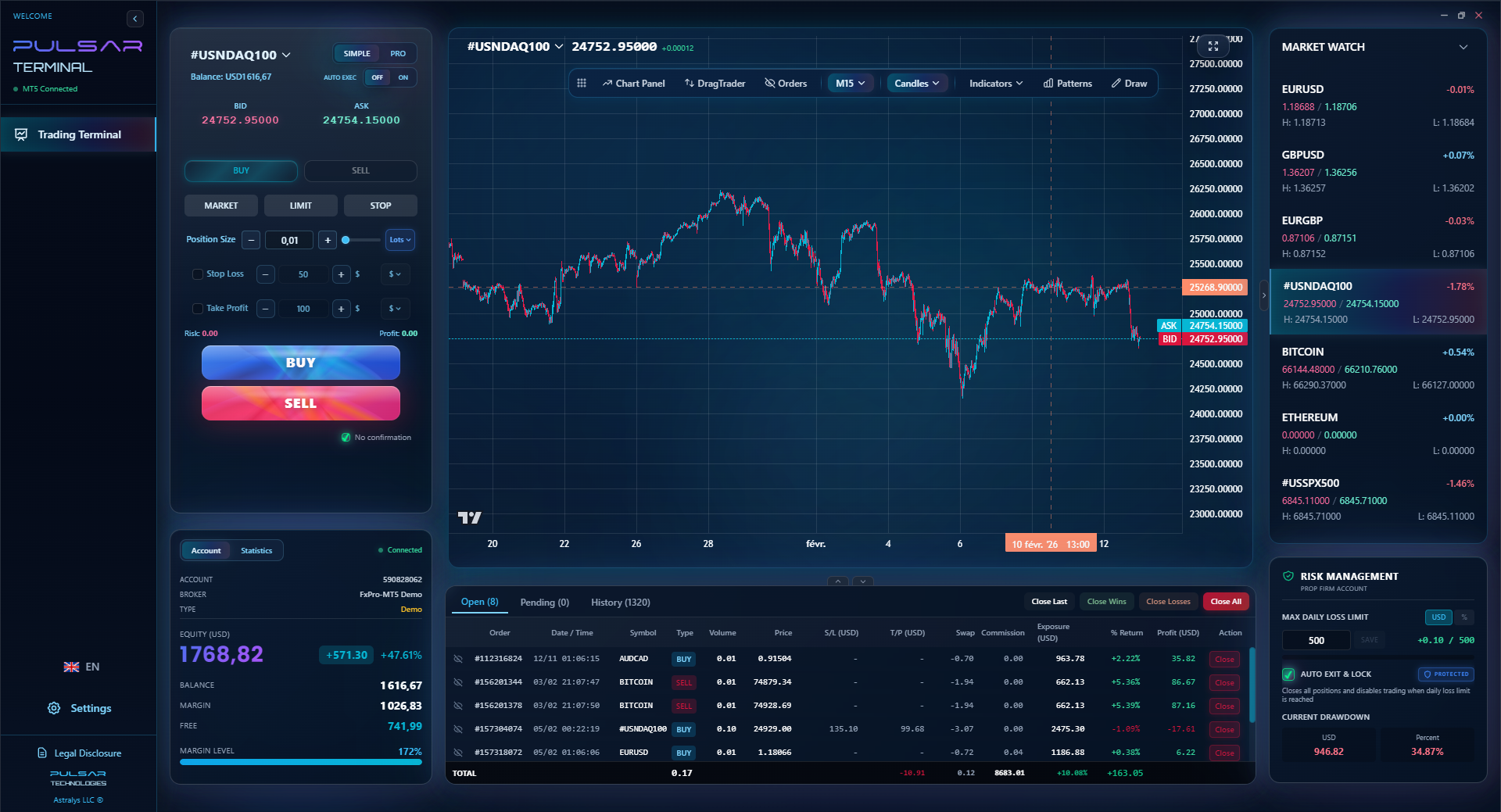
Sticking to your stop loss and take profit plan is critical, and Pulsar Terminal lets you set and manage these orders visually right on your MT5 chart, removing the emotional hassle.
Pulsar Terminal
The all-in-one MT5 companion: drag-and-drop orders, multi-TP/SL, trailing stop, grid trading, Volume Profile, and prop firm protection. Used by 1,000+ traders daily.
“Trading is 80% psychology, 20% method. Your brain is your worst enemy.”
You don't need a complicated system with 15 indicators. In fact, that's worse. Start with price action and one or two indicators to confirm.
Here's a basic framework you can build on:
- Find the Trend: Use the daily chart. Is the price generally making higher highs and higher lows (uptrend)? Or lower highs and lower lows (downtrend)? Only look for trades in the direction of the trend. It increases your odds.
- Find an Entry on a Lower Timeframe: Switch to the 1-hour or 4-hour chart. Wait for the price to pull back to a key level in the direction of the trend. This could be a moving average (like the 50-period EMA) or a previous support/resistance area.
- Get Confirmation: Use a momentum indicator like the RSI indicator to see if the pullback is overdone. In an uptrend, you want to see the RSI dip near 40 (oversold) and start turning back up.
- Execute Your Plan: Place your trade with your pre-determined stop loss (just below the pullback low) and take profit.
Let me give you a real example from last month. On the daily chart, EUR/USD was in a clear uptrend. On the 4-hour chart, it pulled back to the 50 EMA and a previous resistance-turned-support level around 1.0720. The RSI indicator touched 42. That was my signal. I went long at 1.0725. Stop at 1.0700 (25 pips risk). Target at 1.0775 (50 pip reward). It hit my target two days later. Simple, boring, effective.
Pro Tip: Backtest this. Go to your MT4, open the EUR/USD chart, and go back in time. Practice spotting these setups without risking money. Write down what you would have done. This is how you build experience without losing capital.
💡 Winston's Tip
The market doesn't know you exist. It doesn't care about your rent or your goals. Trade the price you see, not the outcome you need.
“Your first goal should be to not lose money over a 3-month period. Consistency before ambition.”
Trading is 80% psychology, 20% method. Your brain is your worst enemy. It will convince you to break your rules.
You need a trading journal. Not optional. Every trade gets logged: entry, exit, reason, screenshot, and most importantly, your emotional state. Were you bored? Were you angry from a previous loss? Were you overconfident? After 20 trades, you'll see patterns. I found that 70% of my losing trades happened on Monday mornings when I was trying to "catch up" from the weekend. Now, I don't trade on Mondays.
Define your weekly loss limit. Say you start with R5000. Your weekly loss limit might be R500 (10%). If you hit that, you stop trading for the week. Full stop. Go for a walk. This prevents the death spiral of trying to trade your way out of a hole.
Detach from the money. This sounds impossible, but it's key. Think in terms of percentages and pips, not Rands. A 20-pip loss on a 0.01 lot is R4. It's not a personal failure; it's the cost of doing business. If you can't stomach losing R4, you shouldn't be in this game.
I'll be vulnerable here. After a big winning streak, I got cocky. I broke my own position sizing rule, traded three times my normal size on a "sure thing," and gave back a month's profits in two days. The journal entry for that trade simply said: "Ego trade. Knew it was wrong. Did it anyway." The lesson cost me thousands, but it was worth it.
FAQ
Q1Is forex trading legal in South Africa?
Yes, absolutely. It's regulated by the Financial Sector Conduct Authority (FSCA). The key is to use an FSCA-licensed broker to ensure your funds are protected under South African law.
Q2How much money do I need to start forex trading in South Africa?
You can start with very little. Brokers like XM allow accounts from $5 (about R90), and local broker Khwezi Trade starts at R500. However, I recommend starting with an amount you can afford to lose completely - R1000 to R2000 is a sensible practice stake. The real focus should be on learning, not the initial balance.
Q3What is the best currency pair for beginners in South Africa?
Start with major pairs like EUR/USD or GBP/USD. They have the highest liquidity and the tightest spreads (often below 1 pip). Avoid USD/ZAR or other exotic pairs at first - their wider spreads (5+ pips) make it much harder for a beginner to be profitable.
Q4Can I make a living from forex trading as a beginner?
No. Absolutely not. Anyone who tells you that is selling you a dream. Treat it as a skill to be developed over years. Your first goal should be to not lose money over a 3-month period. Then aim for small, consistent profits. Thinking about a 'living' in the first year is a surefire way to blow up your account.
Q5How are forex profits taxed in South Africa?
Profits from forex trading are considered taxable income by SARS. You are responsible for declaring them in your annual tax return. It's wise to keep careful records of all your trades, deposits, and withdrawals. Consult with a tax professional who understands trading income.
Q6What's more important for a beginner: strategy or psychology?
Psychology, by a mile. You can have the world's best strategy, but if you can't follow it because of fear, greed, or impatience, you'll lose. Developing discipline, patience, and emotional control is the foundational work of a successful trader. The strategy is just the tool you use.
Prof. Winston's Lesson
Key Takeaways:
- ✓Verify FSCA license before depositing any money.
- ✓Start with majors like EUR/USD, not exotic pairs.
- ✓Risk a maximum of 1% of your account per trade.
- ✓Use a trading journal to track your psychology.
- ✓Treat your first R10k as tuition, not investment.
How useful was this article?
Click a star to rate
Weekly Trading Insights
Free weekly analysis & strategies. No spam.
About the Author
David van der Merwe
Emerging Markets Trader
Johannesburg-based trader with 11 years in emerging market currencies. Specializes in ZAR pairs, FSCA-regulated trading, and South African market analysis.
Comments
Risk Disclaimer
Trading financial instruments carries significant risk and may not be suitable for all investors. Past performance does not guarantee future results. This content is for educational purposes only and should not be considered investment advice. Always conduct your own research before trading.
You Might Also Like

Cara Trading Forex Sukses: 7 Prinsip dari Trader Profesional
Cara trading forex sukses dengan 7 prinsip trader pro: manajemen modal, disiplin, journal trading, backtest. Data nyata, bukan janji profit palsu.
Jam Trading Forex Terbaik untuk Trader Indonesia: Panduan Lengkap dengan Tabel Waktu
Panduan jam trading forex untuk trader Indonesia. Tabel 4 sesi dunia, jam emas 20:00-00:00, sesi mana yang harus dihindari. Data akurat + tips dari trader berpengalaman.
Top 5 Sàn Forex Uy Tín Nhất 2026: Review Jujur dari Trader Indonesia
Top 5 sàn forex uy tín 2026 untuk trader Indonesia. Review jujur: spread, deposit, withdraw, dukungan lokal. Exness, XM, IC Markets & lebih.
Get Pulsar Terminal
All these calculators are built into Pulsar Terminal with real-time data from your MT5 account. One-click position sizing, automatic risk management, and instant calculations.
Get Pulsar Terminal