


I remember sitting in a coffee shop in Sandton in late 2023, watching the USD/ZAR chart on my phone.

David van der Merwe
Emerging Markets Trader ·  South Africa
☕ 9 min read
What you'll learn:
I remember sitting in a coffee shop in Sandton in late 2023, watching the USD/ZAR chart on my phone. It was hovering around 19.20, and a client of mine - a successful prop trader - was asking me about setting up his own brokerage. He had the capital and the trading chops, but the regulatory maze looked like a nightmare. He wasn't wrong. The process of registering a forex trading company here is less about placing clever trades and more about navigating a complex, expensive, and paperwork-heavy journey with the Financial Sector Conduct Authority (FSCA). If you're thinking about it, you need to go in with your eyes wide open. This isn't a side hustle; it's a serious financial services business from day one.
You can't just hang a shingle that says 'Forex Broker' and start taking client money. The first, non-negotiable step is creating a proper legal entity. You'll register a company with the Companies and Intellectual Property Commission (CIPC). This part is relatively straightforward and cheap - you can do it for under R2,000. Think of it as getting the empty shell of your business.
But the shell is useless without the engine: the FSCA license. The Financial Sector Conduct Authority is the main watchdog. They don't just hand out licenses to anyone. You'll need a Financial Services Provider (FSP) license under the FAIS Act. For a forex brokerage, you're typically looking at a Category II license. This allows you to act as a counterparty to client trades, which is exactly what a broker does.
There's another critical layer: the Over-The-Counter Derivatives Provider (ODP) license. Since 2018, if you're offering CFDs or forex contracts (which are OTC derivatives), you need this authorization. The FSCA has been cracking down, and by now, every legitimate broker has it or is deep in the process of getting it. Don't even think about operating without both the FSP and ODP licenses. The fines are brutal, and they will shut you down.

Warning: Operating without the proper FSCA licenses isn't just risky; it's illegal. You'd be personally liable, and the reputational damage in our tight-knit financial community would be permanent. I've seen two promising startups try to skirt the rules in the early days, and neither exists today.
Let's talk numbers, because this is where dreams meet reality. The application fees are just the entry ticket to the casino.
Upfront and Official Costs:
- FSP Application Fee: Around R13,971 (roughly $850) for a Category II license.
- Regulatory Exams: Your Key Individuals need to pass these. Budget about R1,300 per person, per exam.
- Professional Indemnity Insurance: This is mandatory. You need cover of at least R5 million. The annual premium for this can easily run into six figures.
The Big One: Capital Requirements The FSCA is smart about this. They don't give a single, fixed number like some regulators. Instead, they require you to maintain sufficient financial resources to meet your obligations. In practice, for a forex brokerage that holds client money, 'sufficient' starts at around R5 million in liquid capital. Some lawyers and consultants I've spoken to recommend having R10 million ready to be truly comfortable and cover all operational runways. This isn't trading capital; this is locked-up, proof-of-solvency capital.
The Hidden Tech Bill You need a trading platform. A white-label MetaTrader 4 or MetaTrader 5 solution - where you rebrand an existing platform - can cost you anywhere from $10,000 to $50,000 upfront, plus a hefty monthly fee per active client. Then add liquidity provider connections, a client portal, a website, and compliance software. All in, the total startup cost to be taken seriously is rarely under $120,000 (over R2 million), and it can easily push past $200,000.

Example: A friend's startup budget in 2024 looked like this: R5m capital reserve, R200k for CIPC and FSCA fees/consultants, R1.2m for first-year tech/platform costs, R400k for professional indemnity. Total initial outlay before even opening: nearly R7 million. They didn't break even for 18 months.

💡 Winston's Tip
The capital requirement isn't a suggestion. Have the R5 million in the bank, untouched, before you even file the application. The FSCA will check.
“The total startup cost to be taken seriously is rarely under $120,000, and it can easily push past $200,000.”
The FSCA cares deeply about who runs the show. They assess the 'fit and proper' status of your directors and Key Individuals (KIs). This isn't a box-ticking exercise. They look at qualifications, experience, and integrity. You need at least one KI who is a permanent resident in South Africa.
Building Your Compliance Framework
This is the heart of your operational burden. You must build systems from scratch that prove you're a responsible business:
- Anti-Money Laundering (AML) & Know Your Customer (KYC): You need automated systems to verify client identities, screen them against sanctions lists, and monitor transactions for suspicious activity. This isn't optional.
- Risk Management Framework: A formal document outlining how you manage market risk, credit risk, and operational risk. How do you handle a margin call cascade? You need a plan.
- Client Fund Segregation: This is non-negotiable. Client deposits must be held in separate, trust accounts at a reputable bank. Their money can never be mixed with your company's operational funds. This is the single biggest protection for retail traders.
- External Audit: Every year, an independent auditor must go through your books, especially those client money accounts. This cost is ongoing.
I made a mistake early in my career consulting for a small broker by underestimating the compliance workload. We thought one part-time consultant would do it. We were wrong. You need a dedicated, experienced compliance officer, or you will drown in FSCA reporting requirements.
With the license in hand (or in process), you now have to build the shop.
Choosing a Platform: MT4 and MT5 are the kings in South Africa. Most local traders know them inside out. You'll typically get a white-label from a provider. The choice here affects everything from the user experience to your back-office reporting. You also need to connect to one or more liquidity providers to get tight spreads and fill orders. This relationship is critical; your broker's execution quality depends on it.
Handling the ZAR Your clients will want to deposit in Rands. You need a solid relationship with a South African bank for corporate and client trust accounts. Offering instant EFTs is almost expected. Remember, any significant movement of funds offshore will need attention from the South African Reserve Bank (SARB) under exchange control regulations. It's another layer of admin.
Defining Your Risk Parameters You must decide your use offering. While there's no hard national cap, the FSCA expects responsible risk management. Many regulated brokers offer up to 1:500, but there's a growing expectation (and some internal broker policies) to limit retail clients to lower use like 1:30. You also need to set your own rules on bonuses and marketing - areas the FSCA watches closely.
Managing this risk in real-time is where technology saves you. Using a platform that allows sophisticated order types is key for both you and your clients. For example, a tool that lets you or your clients set multi-level take-profits or automated trailing stops directly on the MT5 chart can prevent a lot of headaches. It turns complex risk management into a simple drag-and-drop task.
💡 Winston's Tip
Your first hire shouldn't be a star trader. It should be a seasoned compliance officer. They are the guardians of your license.
“Your job is no longer just analysing the EUR/USD chart. Your job is managing a regulated entity.”
Getting the license feels like the finish line. It's not. It's the starting block. Now you have to attract clients in a competitive market where giants like Exness and XM are already well-established.
Marketing on a Tightrope: The FSCA has strict rules about advertising financial products. You can't promise the moon. Your marketing must be fair, clear, and not misleading. This limits a lot of the flashy, get-rich-quick angles you see from unregulated offshore brokers.
The Revenue Model: You'll make money from spreads, commissions, or a markup on the liquidity provider's price (a 'mark-up' model). You need volume to survive. With high fixed costs (compliance, tech, staff), your first 100 active clients might not make you profitable. This is a scale business.
The Never-Ending Compliance: This is the biggest shift from being a trader. Your job is no longer just analysing the EUR/USD chart. Your job is managing a regulated entity. Monthly reports to the FSCA, annual audits, updating compliance manuals, training staff, handling client complaints formally... it's a completely different skillset.
I learned this the hard way helping a client. We celebrated the license approval, but the real work - the grinding, administrative, unglamorous work of running the business - is what consumed 80% of our time for the next two years. The actual forex markets almost became a background concern.
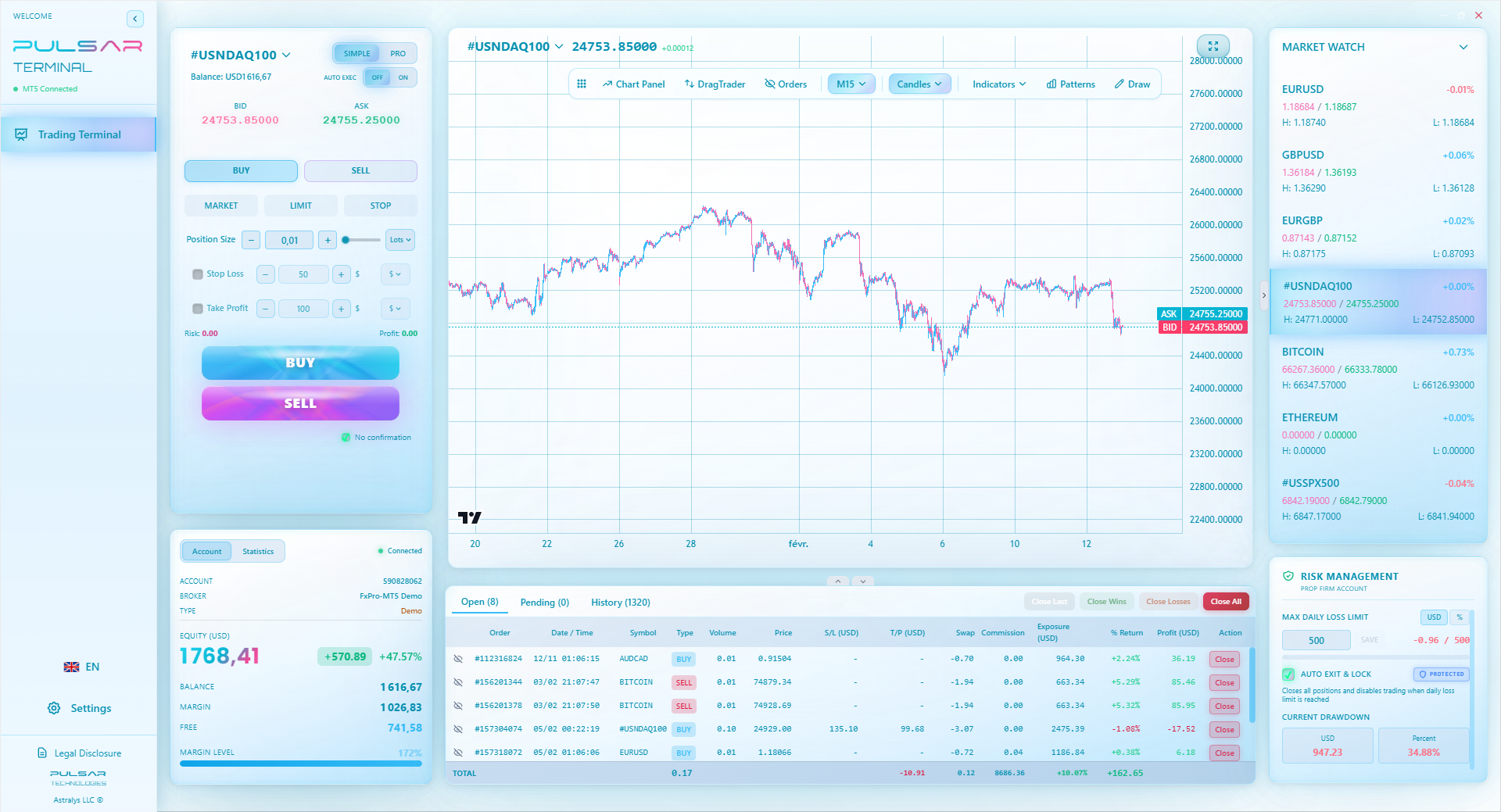
Managing complex client and house risk requires precise tools, and Pulsar Terminal's drag-and-drop order system with multi-TP/SL and trailing stops makes executing sophisticated strategies on MT5 simple and visual.
Pulsar Terminal
The all-in-one MT5 companion: drag-and-drop orders, multi-TP/SL, trailing stop, grid trading, Volume Profile, and prop firm protection. Used by 1,000+ traders daily.
Given the high barrier to entry, ask yourself: is this the only way?
For most talented traders with capital, the answer is no. Here are more accessible paths:
- Join or Start a Prop Firm: Use your track record to trade a larger pool of capital. The regulatory burden is on the firm, not you as the trader. Your focus stays on trading.
- Become a Registered FSP as an Individual: If you want to manage money for others (discretionary or advisory), you can get a Category I FSP license as an individual or small company. The capital requirements are far lower, and the process is simpler. It lets you offer managed accounts or signals legally.
- Partner with an Existing Broker: Become an introducing broker (IB) or a white-label partner under their license. You get to brand your own 'shopfront' and earn commission, while they handle the heavy regulatory and tech infrastructure. It's a way to test the waters.
Starting a full-blown brokerage is for entrepreneurs with significant capital (R5m+), patience for a 6-12 month licensing process, and a passion for building a financial services business, not just trading. If your primary love is the markets, consider swing trading your own capital or the other options above. They're far less painful.

Pro Tip: Before spending a cent on the brokerage route, talk to a specialised financial services attorney and a compliance consultant. Pay for a few hours of their time. A good one will immediately tell you if your plan is viable or if you're about to waste a fortune. I didn't do this with my first venture idea, and it cost me R50,000 in dead-end preparations.
💡 Winston's Tip
The ZAR 10 million you think you need for capital? Add 30% for unexpected legal, tech, and operational overruns. They always happen.
FAQ
Q1What is the minimum capital needed to start a forex brokerage in South Africa?
There's no official fixed minimum, but in practice, the FSCA expects you to have sufficient capital to operate safely. For a brokerage that holds client money, this typically starts at R5 million. Most consultants will advise having R5-10 million in liquid capital reserved specifically for meeting regulatory financial resource requirements, separate from your operational startup costs.
Q2How long does the FSCA licensing process take?
Brace yourself. A complete application for an FSP and ODP license, if perfectly prepared, can take the FSCA 6 to 12 months to process. Any deficiencies or requests for more information will extend this timeline. This isn't a quick process; it's a detailed vetting.
Q3Can I offer crypto trading with my FSCA forex license?
Not automatically. Crypto-asset services require a separate license as a Crypto Asset Service Provider (CASP) from the FSCA. However, since the FSCA now regulates crypto (having approved over 138 CASP licenses by 2024), your existing corporate structure and compliance experience could make applying for this additional license more straightforward.
Q4What's the difference between a Category I and Category II FSP license?
A Category I license is for intermediaries who give advice or render intermediary services (like being a forex signal provider or financial advisor). A Category II license is for discretionary financial services providers and institutions that hold client assets or act as a counterparty to trades - this is the category for a forex brokerage that executes trades against its clients.
Q5Do I need a physical office in South Africa?
While the FSCA doesn't explicitly mandate a physical office, you must have a registered business address. More importantly, you must have at least one Key Individual who is a permanent resident in South Africa. Having a professional office lends credibility during the 'fit and proper' assessment and is practically necessary for housing staff and meeting clients.
Q6What are the tax implications for a forex trading company?
Your company's profits will be subject to the standard corporate income tax rate of 28%. It's crucial to work with an accountant who understands financial services and forex. They'll help you navigate deductible expenses (like platform costs, compliance fees, and salaries) and the treatment of client funds, which are not considered company revenue.
Q7Is client money really safe with an FSCA-regulated broker?
It's significantly safer. The core rule is client fund segregation. This means your deposit must be held in a separate trust account, legally distinct from the broker's company funds. If the broker goes bankrupt, your money should be protected from their creditors. This is the single most important protection offered by FSCA regulation.
Prof. Winston's Lesson
Key Takeaways:
- ✓Regulatory capital starts at R5 million, not including setup costs.
- ✓The licensing process takes 6-12 months with the FSCA.
- ✓Client fund segregation is a non-negotiable legal requirement.
- ✓Annual compliance and audit costs are a permanent overhead.
- ✓Consider a Category I license or prop firm partnership first.
How useful was this article?
Click a star to rate
Weekly Trading Insights
Free weekly analysis & strategies. No spam.
About the Author
David van der Merwe
Emerging Markets Trader
Johannesburg-based trader with 11 years in emerging market currencies. Specializes in ZAR pairs, FSCA-regulated trading, and South African market analysis.
Comments
Risk Disclaimer
Trading financial instruments carries significant risk and may not be suitable for all investors. Past performance does not guarantee future results. This content is for educational purposes only and should not be considered investment advice. Always conduct your own research before trading.
You Might Also Like

Cara Trading Forex Sukses: 7 Prinsip dari Trader Profesional
Cara trading forex sukses dengan 7 prinsip trader pro: manajemen modal, disiplin, journal trading, backtest. Data nyata, bukan janji profit palsu.
Jam Trading Forex Terbaik untuk Trader Indonesia: Panduan Lengkap dengan Tabel Waktu
Panduan jam trading forex untuk trader Indonesia. Tabel 4 sesi dunia, jam emas 20:00-00:00, sesi mana yang harus dihindari. Data akurat + tips dari trader berpengalaman.
Top 5 Sàn Forex Uy Tín Nhất 2026: Review Jujur dari Trader Indonesia
Top 5 sàn forex uy tín 2026 untuk trader Indonesia. Review jujur: spread, deposit, withdraw, dukungan lokal. Exness, XM, IC Markets & lebih.
Get Pulsar Terminal
All these calculators are built into Pulsar Terminal with real-time data from your MT5 account. One-click position sizing, automatic risk management, and instant calculations.
Get Pulsar Terminal