


Thinking about how to start a prop firm? You're probably picturing a slick website, traders paying you fees, and a steady stream of profits.

James Mitchell
Senior Trading Analyst
☕ 10 min read
What you'll learn:
- 1The Real Costs Nobody Talks About
- 2Navigating the US Regulatory Crackdown (It's Already Here)
- 3Building Your Business Model: Profit Splits and Fees
- 4Technology and Risk Infrastructure: Your Operational Spine
- 5Marketing and Acquiring Traders: The Funnel of Failure
- 6Why Most New Prop Firms Fail (And How Not To)
Thinking about how to start a prop firm? You're probably picturing a slick website, traders paying you fees, and a steady stream of profits. Let me stop you right there. The reality is a minefield of six-figure startup costs, a regulatory crackdown that's already begun, and a business model where 90% of your 'customers' (the traders) will fail. I've consulted for firms that launched and folded within 18 months. This isn't a get-rich-quick scheme; it's a capital-intensive, compliance-heavy operation. If you're still serious, here's exactly what you're getting into.
Forget the fantasy of launching with $10K and a WordPress site. To understand how to start a prop firm that doesn't implode in six months, you need to budget for reality. The numbers below aren't guesses; they're compiled from invoices and failed balance sheets I've seen firsthand.
The Non-Negotiable Upfront Investment
Your initial capital isn't for payouts; it's to build the machine. A bare-minimum, no-frills operation will eat at least $50,000 before you see a dime from trader profits. A realistic, scalable setup? Plan for $150,000 to $250,000. Here's where it goes:
- Legal & Corporate Structure: You're not selling lemonade. Proper company registration, contracts, and payment gateway integration (Stripe, PayPal won't touch you) will run you around $10,000 minimum. Trying to skip this is asking for a lawsuit.
- The Technology Trap: This is your biggest sinkhole. You need a trading platform (usually a white-label MetaTrader 4/5 solution), a trader dashboard, a CRM, and a risk management system. A basic white-label package starts at $5,000 for setup, but that's the tip of the iceberg. Monthly fees for data feeds, liquidity bridges, and server hosting? Easily $10,000+ per month. I watched a firm burn $35,000 on a "custom" dashboard that crashed during its first challenge payout cycle.
- The Payout Reserve: This is critical. You must have liquid capital set aside solely to pay successful traders. If you can't cover withdrawals, your reputation is dead. A realistic reserve starts at $30,000 and should scale quickly to $100,000+. This isn't profit; it's a liability on your balance sheet until it's paid out.

Warning: If your business plan relies on using evaluation fees to fund operations, you're already doomed. That's a Ponzi-esque model. Fees should cover challenge resets and admin, not your liquidity.
The Ongoing Burn Rate
Your annual operating cost will be at least $50,000, and that's for a skeleton crew. Marketing is the real beast. Acquiring a trader costs money - a lot of it. In competitive markets like the US or EU, you might spend $200-$300 to acquire a single evaluation sign-up. Budget 20-30% of your projected revenue for marketing, and double it for your launch quarter.
Let's talk about a specific mistake. In 2021, I advised a startup that allocated $5,000 for "tech." They bought a cheap, off-shore white-label solution. The platform latency was horrific, their spread definition feeds were unreliable, and traders rightly accused them of sabotage. They lost every single user within three months. The $5,000 saved upfront cost them $80,000 in lost fees and killed the brand.

💡 Winston's Tip
Your first $50k should go to a lawyer and a tech audit, not marketing. A solid foundation is boring but keeps the doors open.
“The "regulatory gray area" is turning black and white, fast.”
The "regulatory gray area" is turning black and white, fast. If you're figuring out how to start a prop firm in the US today, you're walking into a rulebook that's being rewritten in real-time. The days of calling yourself an "educational service" and flying under the radar are numbered.
The SEC dropped a bomb in early 2024 with new rules (3a5-4 and 3a44-2) that broadly redefine who is a "dealer." If your firm's trading activity looks like you're providing liquidity to the market, you could be forced to register as a dealer with the SEC and FINRA. That means net capital requirements, regular exams, and a mountain of compliance. The compliance clock started in 2024.
Over at the CFTC, they're squinting hard at futures prop firms. The question is whether you're acting as an unregistered Commodity Trading Advisor (CTA). The CFTC finalized amendments to Rule 4.7 in late 2024, and the compliance date is March 2025. The path to avoid CFTC registration is narrow: you must only use proprietary funds, not act as a broker, not solicit orders, and never, ever accept client money for futures trades.

Pro Tip: Engage a financial services lawyer on Day One. Don't use a generic business attorney. The $500/hour fee will seem cheap compared to an SEC enforcement action or a CFTC fine that shuts you down. Your legal budget should start at $15,000.
By 2026, expect more: mandatory licensing, strict capital adequacy rules, and enforced transparency (think: publicly reporting your trader success and payout times). This isn't speculation; it's the direction of travel. If your model can't survive under the glare of real oversight, don't start.
“If your business plan relies on using evaluation fees to fund operations, you're already doomed.”
Your revenue comes from two places: evaluation fees and a cut of trader profits. Getting this balance wrong is a classic failure point.
Evaluation Fees: These range from $50 for a small account to over $1,000 for large capital allocations. Some firms offer refundable fees upon first payout, which is a great marketing tool but increases your upfront cash flow risk. The key is to price it so it deters unserious gamblers but doesn't prohibit genuine talent. A $200 fee for a $50,000 account is a common sweet spot.
Profit Splits: This is your bread and butter. The industry standard for forex/CFD firms is an 80/20 or 90/10 split in the trader's favor. Any firm offering a 100% split is a major red flag - they're almost certainly making all their money from failed challenges, which isn't a sustainable or ethical long-term model. For US equity prop desks, splits start lower (50-70%) but can scale to 80-90% with proven performance.
Your risk management rules directly feed your profitability. Standard rules include a 5% maximum total drawdown and a 2-3% daily loss limit. These rules, while necessary, are why the pass rate is so brutally low. You need a strong system to enforce these in real-time to avoid a margin call scenario on your own liquidity. Tools that automate this, like certain features in Pulsar Terminal, are becoming essential, as manual monitoring is impossible at scale.
Here's a hard truth: Your business thrives when traders succeed moderately. A trader who blows up in week one only gives you one fee. A trader who consistently makes 5-10% a month and shares profits with you for a year is your golden goose. Your entire operation - from education to platform stability - should be geared towards creating these consistent performers, not just harvesting failure fees.
💡 Winston's Tip
Model your worst-case payout month. Assume 5% of your funded traders hit their max profit target. Can you cover it? If not, you're under-capitalized.
“Your business thrives when traders succeed moderately, not when they fail immediately.”
This is the engine room. If it fails, you sink.
The Platform: Most firms use a white-label MetaTrader 4 or 5 solution. You're not just buying software; you're buying a relationship with a liquidity provider and a technology partner. Ask about: latency, uptime guarantees, the ease of integrating your own risk plugins, and the cost of price feeds. The monthly bill here will shock you.
Risk Management Systems: This is non-negotiable. You need software that can monitor every open position, in real-time, against each trader's specific drawdown rules. It must automatically close trades and suspend accounts when limits are breached. There is no room for manual intervention or "grace." I once saw a firm lose $22,000 in 90 seconds because their risk system lagged during a news event. They were manually monitoring 50 accounts. It was pure insanity.
The Trader Dashboard: This is your traders' home base. It needs to show their progress, drawdown, available capital, and payout history clearly. A clunky, confusing dashboard leads to a flood of support tickets and angry traders accusing you of hiding information.

Example: Let's say a trader has a $100,000 account with a 5% ($5,000) max drawdown. They start at $100,000 equity. They lose $3,000. Their current equity is $97,000, but their drawdown is calculated from the peak equity. If they then gain to $102,000, their new peak is $102,000. If they lose again, drawdown is calculated from $102k, not $100k. Your system must track this "peak equity" flawlessly for every account, every second. This is the core of prop firm risk management.
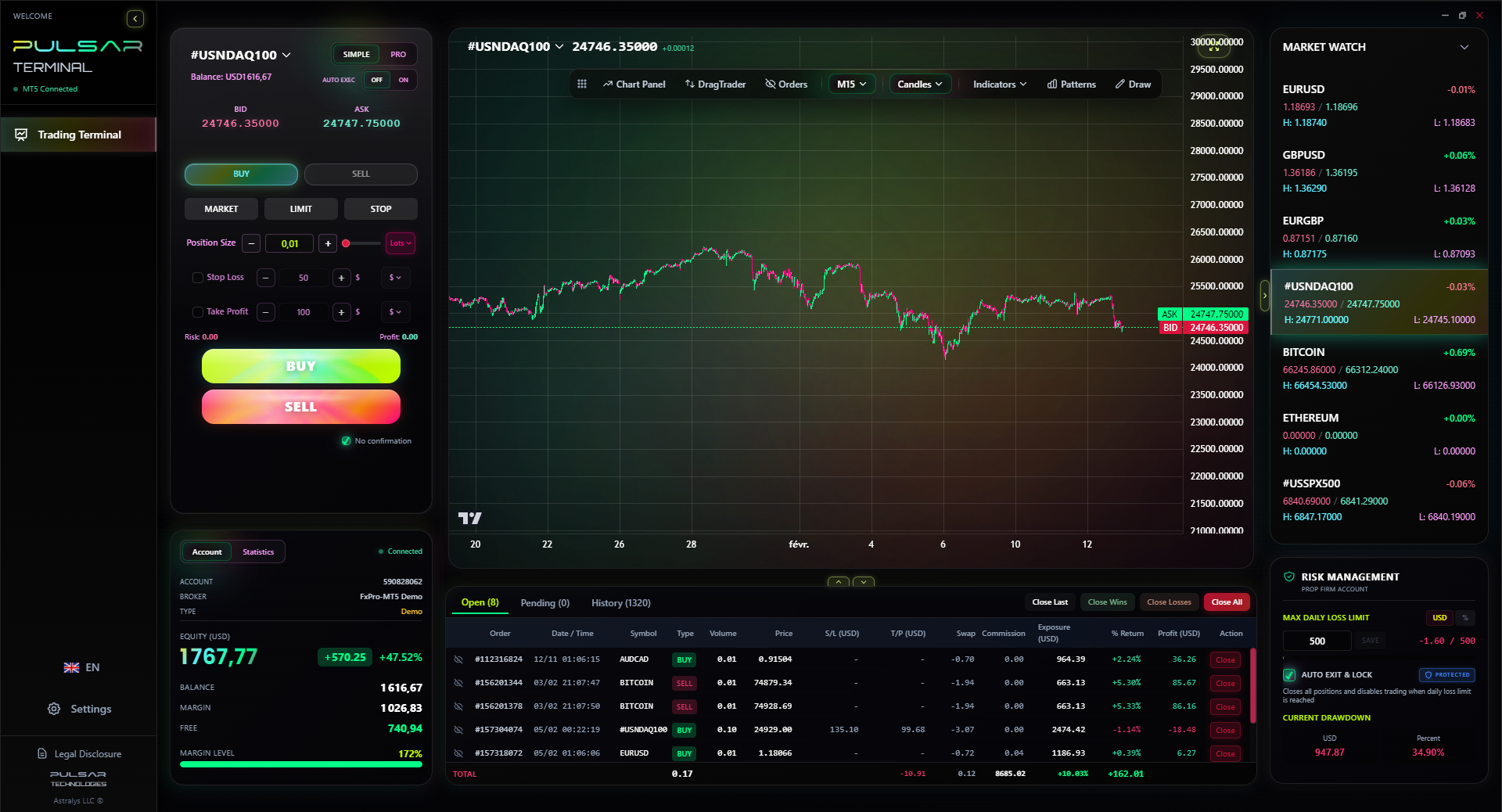
Managing prop firm risk rules manually is impossible; Pulsar Terminal automates drawdown tracking, partial closures, and daily loss protection directly on your MT5 charts.
Pulsar Terminal
The all-in-one MT5 companion: drag-and-drop orders, multi-TP/SL, trailing stop, grid trading, Volume Profile, and prop firm protection. Used by 1,000+ traders daily.
“Your business thrives when traders succeed moderately, not when they fail immediately.”
You can have the best platform in the world, but if no one knows about it, you're bankrupt. Marketing a prop firm is uniquely challenging because you're selling a dream (funded trading) with a very high probability of failure.
The Numbers Game: Industry data shows only 5-10% of traders pass initial challenges. About 7% get a payout. You need to be brutally transparent about this. Marketing that says "Anyone can do it!" is lying and will bury you in refund requests and bad reviews.
Effective Channels:
- Affiliate Marketing: This is the big one. You pay influencers and educators a commission (30-50%) for every evaluation they sell. It's expensive but effective. Vet your affiliates carefully - aligning with a "get rich quick" charlatan will trash your brand.
- Content & Community: Build a YouTube channel or blog that provides genuine value - real trading education, market analysis. This builds trust. A Discord community where your successful traders hang out is powerful social proof.
- Performance Transparency: Consider publicly sharing your payout stats (aggregated, anonymized). It builds credibility in an industry riddled with skepticism.
I made a mistake early on, pouring $12,000 into broad Google Ads. The click-through rate was decent, but the conversion was terrible. We attracted complete novices who blew up in days. The cost-per-acquisition was unsustainable. We shifted focus to targeted content and affiliate partnerships with known swing trading educators, and our pass rate improved dramatically because we were attracting slightly more skilled traders.
💡 Winston's Tip
Spend a week pretending to be a trader on your own platform. Every bug you find, a real trader will find ten. Fix them before launch.
“Starting a prop firm isn't a trade; it's a marathon through a field of landmines.”
Let's end with the cold shower. Most attempts at how to start a prop firm end in failure within 12-18 months. Here are the fatal flaws:
- Under-Capitalization: The #1 killer. They run out of money for payouts or operational costs before the business gains traction.
- Ignoring Compliance: Treating regulations as an afterthought. One letter from a regulator can freeze your bank accounts and end everything.
- Poor Technology: A buggy platform, slow executions, or a weak risk system destroys trader trust instantly. In this business, your tech is your product.
- Unrealistic Payout Modeling: They don't model the scenario where 5% of traders are wildly successful and claim large, repeated payouts, draining the reserve.
- Ethical Lapses: Hiding rules, manipulating spreads during challenges, delaying payouts. The prop firm community is small and vocal. A bad reputation spreads like wildfire and is permanent.
The firms that survive? They treat it like a real financial services business. They have deep capital reserves. They invest in legal compliance from day one. They see their traders as partners, not marks. And they have the stomach for a long, expensive grind before seeing real profitability. If that doesn't sound like your plan, save your money and stick to trading your own account. Starting a prop firm isn't a trade; it's a marathon through a field of landmines.
FAQ
Q1How much money do I really need to start a prop firm?
You need two pools of money. First, startup capital for legal, tech, and marketing: a bare minimum of $50,000, with $150,000-$250,000 being realistic for a professional launch. Second, a separate payout reserve solely for trader withdrawals, starting at $30,000-$100,000. Do not commingle these funds.
Q2Do I need to be regulated by the SEC or CFTC?
The rules are changing fast. Currently, many operate as "educational" services, but new SEC and CFTC rules are actively narrowing this loophole. You must consult a financial lawyer. Planning to avoid regulation entirely is a high-risk strategy that could see your firm shut down by 2026.
Q3What's a fair profit split to offer traders?
For retail-focused forex/CFD firms, 80/20 or 90/10 (trader gets the larger share) is the competitive standard. Be wary of firms offering 100% splits; their revenue model likely depends too heavily on failure fees. For equity trading, 50-70% to start is common.
Q4What percentage of traders actually pass the challenges?
Industry-wide, it's brutally low: only 5% to 10% pass the initial evaluation. Only about 7% of those who start ever receive a payout. Some firms with better education or rules report first-attempt pass rates of 15-20%.
Q5What's the biggest operational risk for a new prop firm?
Inadequate risk management technology. If your system cannot monitor and automatically enforce drawdown rules on every trade in real-time, a single volatile event can see multiple traders blow through their limits simultaneously, creating a massive, instantaneous liability you must cover.
Q6Can I use evaluation fees to fund my operations?
Absolutely not. This is a classic red flag and a path to failure. Evaluation fees should cover the cost of administering challenges and resets. Your operational costs and payout reserves must be funded by your own capital. Relying on fees for liquidity is an unsustainable, Ponzi-like structure.
Prof. Winston's Lesson
Key Takeaways:
- ✓Startup capital needed: $150k minimum
- ✓Trader pass rate is only 5-10%
- ✓Legal compliance is non-negotiable
- ✓Tech is your biggest ongoing cost
How useful was this article?
Click a star to rate
Weekly Trading Insights
Free weekly analysis & strategies. No spam.
About the Author
James Mitchell
Senior Trading Analyst
Based in New York with over 9 years of trading experience. Focuses on major USD pairs, prop firm challenges, and the US regulatory landscape.
Comments
Risk Disclaimer
Trading financial instruments carries significant risk and may not be suitable for all investors. Past performance does not guarantee future results. This content is for educational purposes only and should not be considered investment advice. Always conduct your own research before trading.
You Might Also Like

Cara Trading Forex Sukses: 7 Prinsip dari Trader Profesional
Cara trading forex sukses dengan 7 prinsip trader pro: manajemen modal, disiplin, journal trading, backtest. Data nyata, bukan janji profit palsu.
Jam Trading Forex Terbaik untuk Trader Indonesia: Panduan Lengkap dengan Tabel Waktu
Panduan jam trading forex untuk trader Indonesia. Tabel 4 sesi dunia, jam emas 20:00-00:00, sesi mana yang harus dihindari. Data akurat + tips dari trader berpengalaman.
Top 5 Sàn Forex Uy Tín Nhất 2026: Review Jujur dari Trader Indonesia
Top 5 sàn forex uy tín 2026 untuk trader Indonesia. Review jujur: spread, deposit, withdraw, dukungan lokal. Exness, XM, IC Markets & lebih.
Get Pulsar Terminal
All these calculators are built into Pulsar Terminal with real-time data from your MT5 account. One-click position sizing, automatic risk management, and instant calculations.
Get Pulsar Terminal