


I remember staring at the screen on March 18, 2020.

Olumide Adeyemi
West African Trading Pioneer ·  Nigeria
☕ 13 min read
What you'll learn:
- 1Understanding the Nigerian Landscape (It's Not What You Think)
- 2Your First Naira: The Starting Capital Dilemma
- 3The Mindset Shift: Professional vs. Gambler
- 4A Simple Strategy That Actually Works (Forget the Hype)
- 5Risk Management: Your Only Superpower
- 6Navigating Nigerian Practicalities
- 7Common Pitfalls (And How I Fell Into Them)
- 8Putting It All Together: Your Action Plan
I remember staring at the screen on March 18, 2020. The EUR/USD chart was a vertical red line, dropping 300 pips in minutes. My stop-loss was 20 pips away. I was long. The margin call notification popped up, and just like that, $1,200 was gone. That moment taught me more about how to trade forex successfully than any book ever could. It wasn't about the analysis I got wrong; it was about everything I hadn't prepared for. Here's what I've learned trading from Lagos for over a decade.
Let's get the legal stuff out of the way first. Yes, forex trading is legal for individuals here. No, the CBN doesn't have a specific rulebook for what we do on MT5. The real regulators for most of us are international bodies like the UK's FCA or Cyprus's CySEC, because that's who oversees the brokers we use.
The government's main interest? Your profits. Forget all the noise online. The FIRS wants 10% of your gross trading gains as Capital Gains Tax. You file that return by March 31st for the previous year. I learned this the hard way in 2017. I had a great year, withdrew $8,000 in profits, and spent it. Come tax season, I owed ₦460,000 (at the rate then) and had to scramble. Always set aside that 10% first. Treat it like a guaranteed loss on every winning trade.
Then there's funding. You can't use the official CBN window to fund your trading account. Your bank will block it, labeling it 'sabotage.' You'll use your naira card, bank transfer, or e-wallets like Skrill. This adds a layer of friction and cost. Finding a broker with a Naira account, like HFM or Exness, can save you on conversion fees. It's a small thing, but those fees eat into your edge over time.

Warning: The 10% capital gains tax is on gross profits. If you make $10,000 and lose $4,000 in the same year, you still owe tax on the full $10,000. Your losses aren't deductible. Keep impeccable records.
I see this question every day: 'How much do I need to start?' Brokers will tell you $1. Gurus will tell you $100. I'm telling you, based on a decade of scars, you need at least $500. Let me explain why.
In 2014, I started with $50 at a broker offering 1:1000 use. I thought I was smart. I could control a $50,000 position! My first trade was a 0.1 lot on GBP/USD. The spread was 2 pips. The price moved 1 pip against me, and with the spread, I was already down $3. That's 6% of my account gone before the trade even started. I was wiped out in a week. I was trading, but I wasn't learning anything about proper position size calculator use.
With $500, you can breathe. You can trade a 0.01 lot (a micro lot) on EUR/USD. One pip movement is worth $0.10. If you set a sensible 30-pip stop-loss, your risk is $3. That's 0.6% of your account. That's sustainable. You can make mistakes, review them, and learn without blowing up. The goal of your first $500 isn't to get rich. It's to pay for an education you can't get anywhere else.
The Broker Choice
Where you put that $500 matters. You need a broker that's a gateway, not a gatekeeper. Low minimum deposits are good, but look deeper. I've used many, but for a Nigerian starting out, I look for three things: Naira account support, reliable withdrawals, and clear fees.
- Exness: My go-to for raw spreads. I've had Standard account spreads on EUR/USD as low as 0.8 pips. Their withdrawal to my Nigerian bank account has never taken more than 4 hours. Check our full Exness review for more.
- XM: Fantastic for beginners. Their $5 minimum is almost too low, but their educational materials are top-tier. Spreads are a bit higher, around 1.7 pips on EUR/USD, but you're paying for stability.
- IC Markets: When I graduated to more serious volume, their raw ECN pricing was a game-changer. Spreads from 0.0 pips, but you pay a $7 round-turn commission per lot. Not ideal for a $500 account, but something to grow into. Our IC Markets review details this.
Don't get sucked in by unlimited use. It's a trap. Start with 1:30 or 1:50 max, even if your broker offers 1:2000. Your future self will thank you.

💡 Winston's Tip
The spread isn't just a cost; it's a headwind. If your average winning trade is 8 pips, a 2-pip spread means you need to be 33% more accurate just to break even. Hunt for tight spreads like a hawk.
“The professional's high doesn't come from the win, but from executing the plan. Even if it's a loss.”
This is the core of how to trade forex successfully. The market doesn't care about your rent, your dreams, or your ego. I had to unlearn everything I thought I knew about 'winning.'
Early on, I'd have a winning trade. I'd feel like a genius. I'd immediately jump into another trade, chasing that feeling. That's not trading; that's gambling. The professional's high doesn't come from the win, but from executing the plan. Even if it's a loss.
My worst losing streak was 7 trades in a row in 2019. I lost $420. My plan was solid - swing trading USD/CAD pullbacks - but the market was in a relentless trend. After the 5th loss, I broke my own rule. I doubled my lot size on trade #6, trying to win back my losses quickly. I lost twice as much. That's the gambler's mindset. It cost me two months of profits.
The shift happened when I started treating it like a business. I have a daily 'risk budget.' Let's say it's 2% of my account. If my account is $5,000, that's $100. I can split that $100 across 2-3 trades. Once that $100 is lost for the day, I'm done. I close the platform. No excuses, no 'just one more trade.' This single rule saved my account more times than any indicator.

Pro Tip: Keep a trading journal. Not just 'bought EUR/USD at 1.0850.' Write your emotion. 'Felt anxious because I missed the earlier move. Entered early.' After 100 entries, you'll see your own psychological patterns clearer than any chart.
You don't need a 10-indicator system that looks like a spaceship dashboard. Complexity is the enemy of execution. Here's the simple price action framework I've used for 8 years. It works on any timeframe, but I use the 4-hour chart for direction and the 1-hour for entries.
Step 1: Find the Trend (The 4-Hour Chart) I ignore news and predictions. I just look at the chart. Is price making higher highs and higher lows? That's an uptrend. Lower highs and lower lows? Downtrend. If it's just chopping sideways, I stay out. I only want to trade with the trend. In an uptrend, I only look for buys. In a downtrend, only sells. This filters out 50% of the noise.
Step 2: Wait for a Pullback (The 1-Hour Chart) Markets don't go straight up or down. They rise, pull back, then rise again. I wait for that pullback. I draw a simple Fibonacci retracement from the last major swing low to high (in an uptrend). My buy zone is between the 50% and 61.8% retracement levels.
Step 3: The Trigger I don't buy just because price hits the 50% level. I wait for a sign of momentum returning. My trigger is a bullish engulfing candlestick pattern on the 1-hour chart, right in my Fib zone. That's my signal to enter.
Step 4: The Trade Management
- Stop-Loss: I place it just below the recent swing low that formed during the pullback (or below the 61.8% Fib if the swing is too far).
- Take-Profit: I aim for at least a 1:2 risk-to-reward ratio. If my stop is 30 pips away, my target is 60 pips away. Often, I'll take half my position off at 1:1 (30 pips) and move my stop to breakeven on the rest.
I used this exact setup on XAU/USD (Gold) on April 2nd this year. The 4H trend was up. It pulled back to the 50% Fib level at $2238. A bullish engulfing candle formed on the 1H chart. I entered at $2240. Stop at $2229 (11 pips risk). Took half off at $2251 (1:1) and let the rest run. It hit my final target at $2262 for a full 1:2. Simple. Boring. Profitable.
This strategy won't win every time. But with solid risk management, it keeps you in the game long enough to catch the big moves. For faster, more precise entries, I sometimes use the MACD indicator to confirm momentum, but the price action is the boss.
💡 Winston's Tip
Your first profit target should always be to get to breakeven. Move your stop-loss to your entry price once the trade is in profit by the size of your original risk. This turns a potential loss into a free trade.
“Complexity is the enemy of execution.”
Your analysis can be wrong 60% of the time and you can still be profitable. I'm serious. If you risk 1% per trade and aim for 2% in reward (1:2 R:R), you only need to be right 34% of the time to break even. Be right 40% of the time, and you're making money. This math changed everything for me.
Let's talk numbers. Your account is $1,000.
- The Gambler: Sees a 'sure thing,' risks $300 (30%). He wins a few times, feels invincible. Then one loss wipes out 3 previous wins.
- The Professional: Risks a maximum of $10 per trade (1%). A 10-trade losing streak (it happens) costs $100. It hurts, but the account survives to fight another day.
I use a fixed percentage risk model. It grows with my wins and shrinks with my losses, which is psychologically easier.
The Tools You Need
- A Position Size Calculator: Never guess. I have ours bookmarked: position size calculator. You input your account size, risk percentage, stop-loss in pips, and it tells you the exact lot size. This is non-negotiable.
- Stop-Loss Orders: Always. Before you even think about your profit target, know where you're wrong. A stop-loss isn't a failure; it's the cost of doing business.
- Take-Profit Orders: Greed kills accounts. Decide your profit target based on the chart's structure (like a previous resistance level), not a random number.
The biggest mistake I see? Moving your stop-loss further away because the trade is going against you. That's not managing risk; that's refusing to admit you're wrong. I've done it. It turns a $50 loss into a $500 loss. Every single time.

Example: Account: $2,000. Risk per trade: 1% = $20. Trading EUR/USD. Your stop-loss is 25 pips away. Pip value for a 0.01 lot is ~$0.10. To risk $20, you can trade: $20 / (25 pips * $0.10) = 8 micro lots (0.08 standard lots). The calculator does this instantly.
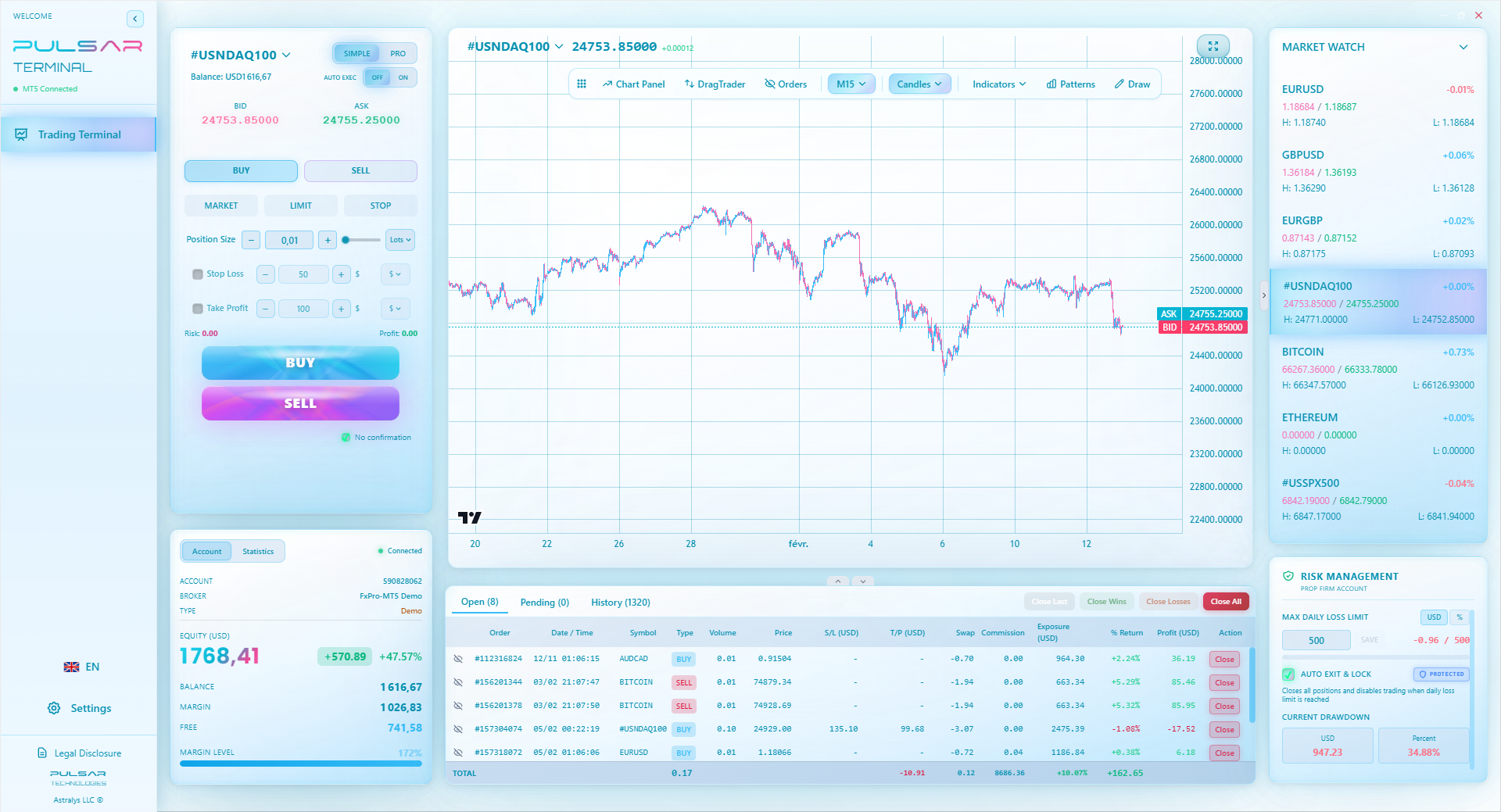
Managing multiple take-profit levels and moving stops to breakeven manually is stressful and error-prone; Pulsar Terminal automates this directly on your MT5 chart with drag-and-drop ease.
Pulsar Terminal
The all-in-one MT5 companion: drag-and-drop orders, multi-TP/SL, trailing stop, grid trading, Volume Profile, and prop firm protection. Used by 1,000+ traders daily.
Trading from Nigeria comes with its own flavour. The power will go out. The internet will fail. You need a plan for that.
I was in a great scalping strategy trade on USD/JPY in 2021. Up 15 pips in minutes. Then, 'NEPA has taken light.' By the time my inverter kicked in and my router reconnected, 90 seconds later, the trade had reversed and hit my stop-loss. I learned to never scalp during typical 'light-out' hours in my area. I also got a cheap 4G MiFi as a permanent backup.
Withdrawals are another critical point. Test a broker's withdrawal before you deposit serious money. Make a small deposit, trade a bit, and try to withdraw your initial capital. How long does it take? What are the fees? I stick with brokers known for fast, reliable payouts to Nigerian banks. Delays of weeks are a red flag.
Finally, community is everything, but choose wisely. Avoid Telegram groups where the 'guru' is always showing off Lamborghini pictures (probably rented). Find a small group of serious traders who talk about losses as openly as wins. This job can be lonely; having a few people who get it makes a huge difference.
💡 Winston's Tip
The most reliable indicator on your chart is the previous day's high and low. Markets often test these levels. Watch price action there for your next trade signal.
“Your analysis can be wrong 60% of the time and you can still be profitable. I'm serious.”
Let me save you some money and heartache by listing my most expensive lessons.
1. Overtrading: This isn't about the number of trades, but trading without an edge. In 2016, I'd sometimes take 10 trades a day. I was just reacting to every little wiggle. Most were tiny losses or breakevens, but the commissions and spreads killed me. Now, 2-3 high-quality setups a week is plenty.
2. Revenge Trading: After a loss, the urge to 'get it back now' is overwhelming. This is when you're most likely to ignore your rules, increase your lot size, and blow up. My rule: After two consecutive losses, I walk away for the rest of the day. No arguments.
3. Ignoring the Economic Calendar: I once held a long GBP/USD trade into a Bank of England interest rate decision. I was up 40 pips. The announcement came, volatility spiked, my stop was hunted, and I was stopped out for a 25-pip loss before price rocketed in my original direction. I didn't get the direction wrong; I got the environment wrong. Now, I either close trades before major news or widen my stop significantly (and reduce position size).
4. Chasing 'The Secret': I spent over ₦200,000 on courses, signals, and indicators promising '95% accuracy.' The secret doesn't exist. The only edge is your discipline. All the knowledge you need is free. Spend your money on a stable internet connection and a good laptop, not magic formulas.
5. Misunderstanding use: use amplifies your gains and your losses. Using high use with poor risk management is the fastest path to a margin call. I treat use as a margin requirement tool, not a profit multiplier. If 1:100 use lets me hold my 0.01 lot position, I don't need 1:1000.
So, how do you trade forex successfully? You build a system, brick by brick.
Month 1-3: The Demo Phase Open a demo account with a broker like Pepperstone or XM. Don't aim for profit. Aim for consistency. Practice the trend-pullback-strategy I outlined. Your goal is to execute 50 trades with perfect risk management (1% risk, 1:2 R:R) on your demo. Log every single one.
Month 4-6: The Micro-Live Phase Deposit $100-$200. Trade 0.01 lots only. Your goal is not to grow the account to $1000. Your goal is to make 20 consecutive trades following your plan, managing the real emotion of real money. If you can do that, you're ahead of 80% of starters.
Month 7 Onward: The Scaling Phase Now, deposit your serious capital ($500+). Gradually increase your position size as your account grows, but keep your risk per trade at 1-2%. This is where the real journey begins.
Remember, this is a marathon. The market will be here tomorrow. Your job is to make sure you are too. Protect your capital like it's the last Naira in your pocket, because in this game, it is. Good luck, and trade smart.
FAQ
Q1Is forex trading legal and taxable in Nigeria?
Yes, it's legal for individuals. Your trading profits are subject to a 10% Capital Gains Tax, which you must file with the FIRS. You pay tax on your gross profits for the year, not your net profit after losses.
Q2What is a realistic amount of money I need to start trading forex successfully in Nigeria?
While you can technically start with $5 or $10, I strongly recommend a minimum of $500. This allows you to trade sensible micro-lot sizes (0.01) and practice proper risk management without being wiped out by a single spread or small move. Think of it as tuition for your trading education.
Q3Which broker is best for Nigerian traders?
There's no single 'best,' but look for brokers with reliable Naira deposit/withdrawal options, good customer support for Africa, and solid international regulation. Exness, XM, and HFM are popular choices due to their local support. Always check recent reviews like our XM review for up-to-date details on spreads and withdrawal times.
Q4What's the most important skill for a beginner trader?
Risk management. Before you learn to pick winning trades, learn how to lose. This means using a position size calculator, always using a stop-loss, and never risking more than 1-2% of your account on a single trade. Good analysis can make you money, but poor risk management will take you out of the game.
Q5How much time do I need to dedicate to trading?
It depends on your style. If you're a swing trader using 4-hour charts like I often do, you might only need 30-60 minutes a day to check charts and manage trades. If you're scalping, you'll need hours of focused screen time. Start with swing trading; it's more forgiving and fits better around a job or studies.
Q6Can I make a living from forex trading in Nigeria?
It's possible, but it's incredibly difficult and takes years of disciplined practice. Don't quit your job to trade. Start part-time. Build your account and your skill set slowly. Aim to consistently make 5-10% per month on your capital before you even consider it a primary income. Most people should view it as a way to grow savings, not replace a salary.
Prof. Winston's Lesson
Key Takeaways:
- ✓Start with at least $500, not $50.
- ✓Never risk more than 2% of your account per trade.
- ✓Always aim for a 1:2 risk-to-reward ratio.
- ✓File and pay your 10% capital gains tax first.
How useful was this article?
Click a star to rate
Weekly Trading Insights
Free weekly analysis & strategies. No spam.
About the Author
Olumide Adeyemi
West African Trading Pioneer
One of Nigeria's most active forex trading educators. 8 years of experience trading from Lagos. Specializes in low-capital strategies and prop firm challenges for African traders.
Comments
Risk Disclaimer
Trading financial instruments carries significant risk and may not be suitable for all investors. Past performance does not guarantee future results. This content is for educational purposes only and should not be considered investment advice. Always conduct your own research before trading.
You Might Also Like

Cara Trading Forex Sukses: 7 Prinsip dari Trader Profesional
Cara trading forex sukses dengan 7 prinsip trader pro: manajemen modal, disiplin, journal trading, backtest. Data nyata, bukan janji profit palsu.
Jam Trading Forex Terbaik untuk Trader Indonesia: Panduan Lengkap dengan Tabel Waktu
Panduan jam trading forex untuk trader Indonesia. Tabel 4 sesi dunia, jam emas 20:00-00:00, sesi mana yang harus dihindari. Data akurat + tips dari trader berpengalaman.
Top 5 Sàn Forex Uy Tín Nhất 2026: Review Jujur dari Trader Indonesia
Top 5 sàn forex uy tín 2026 untuk trader Indonesia. Review jujur: spread, deposit, withdraw, dukungan lokal. Exness, XM, IC Markets & lebih.
Get Pulsar Terminal
All these calculators are built into Pulsar Terminal with real-time data from your MT5 account. One-click position sizing, automatic risk management, and instant calculations.
Get Pulsar Terminal