


I was short on GBP/USD in early 2022, convinced the UK economy was a mess.

Olumide Adeyemi
West African Trading Pioneer ·  Nigeria
☕ 11 min read
What you'll learn:
- 1What Fundamental Analysis Really Is (And Isn't)
- 2The Indicators That Actually Move Markets
- 3Building a Fundamental Trading Plan That Works
- 4The Nigerian Angle: Trading NGN & Local Factors
- 5Risk Management: Your News Event Survival Kit
- 6Marrying Fundamentals with Technicals
- 7The Classic Pitfalls (And How I Fell Into Them)
I was short on GBP/USD in early 2022, convinced the UK economy was a mess. The trade was up 80 pips. Then the Bank of England hiked rates by 0.5% unexpectedly, more than anyone predicted. The cable ripped higher 250 pips in 90 seconds. My stop-loss was vaporized, and I lost 3.2% of my account in a single news spike. That's the raw power of fundamentals. In Nigeria, where our own Naira swings on CBN whispers and oil prices, ignoring this side of trading is financial suicide. This isn't about predicting the future, it's about managing the explosive risk that news creates.
Forget the textbook definition. Fundamental analysis in forex is the study of why a currency's purchasing power changes. It's not about finding a magic number that tells you to buy or sell. It's about understanding the narrative that moves big money - pension funds, central banks, multinational corporations.
For us in Nigeria, it starts at home. You can't trade USD/NGN without one eye on the Central Bank of Nigeria's MPC meetings and the other on Brent crude prices. When the CBN governor speaks, the Naira moves. It's that simple. But it's also global. The US Federal Reserve's interest rate decisions move every major pair, including ones that don't involve the USD, through complex correlations.

Warning: A common mistake is treating a single data release as a trade signal. A "good" US jobs number doesn't automatically mean buy USD. The market's reaction depends on what was expected versus what was released. You're trading the surprise, not the headline.
The core idea is interest rate differentials. Money flows to where it earns the highest (perceived) real return. If the US is hiking rates while Europe is on hold, that yield advantage pulls capital toward the dollar. This is the slow, grinding trend that fundamentals create, which is perfect for swing trading strategies. The news spikes are just the volatile punctuation marks.
“You're trading the market's surprise, not the headline number.”
You don't need to watch every data point. Focus on the big three categories: inflation, growth, and central bank policy. Everything else is usually noise.
Inflation Data: The Central Bank's Mandate
This is job number one for most central banks. In the US, it's the Consumer Price Index (CPI) and the Fed's preferred PCE index. In the Eurozone, watch the Harmonised Index of Consumer Prices (HICP). High inflation typically forces a central bank to raise rates, which can strengthen the currency. I learned this the hard way ignoring Eurozone CPI in 2021, thinking the ECB would stay dovish forever. A string of high prints finally forced their hand, and EUR/USD rallied 500 pips over two months.
Growth and Employment
Gross Domestic Product (GDP) is the big one, but it's a lagging indicator. Employment data, like the US Non-Farm Payrolls (NFP), is more immediate and volatile. A strong jobs report suggests a healthy economy that can handle higher rates. Remember, 80% of the time, the initial NFP spike reverses within 15 minutes as algorithms overreact. I don't trade the release; I wait for the dust to settle and the real trend to emerge.
Central Bank Decisions & Communication
This is the most important one. The actual rate decision is often less important than the forward guidance - what the bank says it will do next. The "dot plot" from the Fed, the statement from the CBN's MPC, the press conference from the ECB's Lagarde. The language here moves markets for weeks. A single word change - "transitory" to "persistent" - can redefine a trend.
| Indicator | Why It Matters | Typical Market Reaction |
|---|---|---|
| Interest Rate Decision | Directly affects yield. | Sharp, immediate move in the currency. |
| CPI / Inflation Report | Dictates future rate policy. | Sustained trend movement. |
| Non-Farm Payrolls (US) | Gauges economic health. | Extreme volatility, often a false spike. |
| Retail Sales | Measures consumer strength. | Moderate, short-term moves. |

Example: If US CPI comes in at 3.1% year-over-year, but the market expected 2.9%, that's a bullish surprise for the USD (all else equal). The market prices in a higher chance of Fed rate hikes. The pair might drop 30-50 pips instantly.

💡 Winston's Tip
The market's reaction to news is more important than the news itself. A 'good' number that sells off tells you everything you need to know.
“In Nigeria, a weakening Naira increases your real cost of living and can pressure you to take bigger risks. It's a psychological trap.”
You need a system, not just a reaction. Here’s how I structure my approach to how to trade fundamentals in forex.
Step 1: The Calendar is Your Bible. Every Sunday, I open my economic calendar. I highlight only the high-impact events for the currencies I trade (USD, EUR, GBP, NGN). I ignore medium and low-impact news. For each event, I note the previous figure, the forecast (consensus), and the time. Brokers like Exness and XM have decent built-in calendars.
Step 2: Pre-News Positioning. This is critical. I either:
- Close all positions 30 minutes before a high-impact news release. This is the safest play.
- Intentionally take a position based on my analysis well before the news, with a wide stop-loss that can survive the volatility. This is higher risk. I never, ever open a new trade in the 5 minutes before a major release. That's gambling, not trading.
Step 3: The Post-News Play. After the news hits, I wait. I let the initial algorithmic frenzy die down - usually 5 to 15 minutes. I look for the price to settle and establish a new mini-range. Then, I assess: did the price break a key technical level on the news? Has the narrative fundamentally changed? My best trades come from entering in the direction of the news after the pullback. For instance, if a hawkish ECB comment sends EUR/USD soaring 40 pips, then it pulls back 20, that's often a better long entry.

Pro Tip: Use an RSI indicator on a 5-minute chart post-news. If the news causes a massive spike and the RSI goes above 80 or below 20, wait for it to cross back inside before considering a trade in the direction of the trend. It helps filter out exhaustion.
“In Nigeria, a weakening Naira increases your real cost of living and can pressure you to take bigger risks. It's a psychological trap.”
Trading from Nigeria adds unique layers to fundamental analysis. First, your cost base is in Naira. A weakening Naira increases your real cost of living and can pressure you to take bigger risks to keep profits meaningful. It's a psychological trap.
The most direct fundamental trade for a Nigerian is USD/NGN. The drivers are hyper-local:
- CBN Monetary Policy Committee (MPC) Meetings: The rate decision and the governor's speech are everything. A hike to defend the Naira? A surprise cut to stimulate growth?
- Foreign Exchange Reserves: Weekly CBN data. Falling reserves often precede Naira weakness.
- Brent Crude Oil Price: Our primary export. Higher oil prices = more USD inflow = potential Naira strength. I once made a 5% account gain over two weeks simply by buying USD/NGN on a local platform when oil dipped below $75 and CBN reserves data was weak. The fundamental link was clear.
- Inflation Rate (Nigeria): Our own CPI is staggering. It forces the CBN's hand, but often too late.
Funding your account is a fundamental reality check. With CBN restrictions on using Naira cards for international brokers, you're likely using a local transfer or P2P. This adds friction and cost. Factor that into your profit targets. A 5% gain might only be 3.5% after funding and withdrawal costs. Always check a broker's specific deposit options for Nigeria, like those detailed in our IC Markets review.
Finally, remember the 10% Capital Gains Tax. The FIRS wants a share of your profits. Your fundamental analysis must generate enough edge to cover taxes, costs, and still beat inflation. It's a higher bar than traders in more stable economies face.
💡 Winston's Tip
If you're sweating in the 5 minutes before a major data release, your position is too big. Get smaller or get out.
“Halve your position size for news events. The volatility is doubled, so your risk should be halved.”
This is where most traders blow up. They see a big news event, trade with normal size, and get wiped out by the spread widening or a sudden spike.
Rule 1: Halve Your Position Size. If you normally risk 1% of your account on a technical trade, risk only 0.5% on a trade you're holding through news, or one taken immediately after news. The volatility is doubled, so your size should be halved. Use a position size calculator religiously.
Rule 2: Expect Slippage and Widened Spreads. Your stop-loss is not a guarantee. During NFP or a CBN announcement, the spread on EUR/USD can blow out from 0.6 pips to 20 pips or more. Your broker (Pepperstone, XM, etc.) isn't cheating you; liquidity simply vanishes. A stop at 1.0800 might get filled at 1.0785. If your risk calculation can't handle that, don't be in the trade.
Rule 3: The No-Trade Zone. Identify the 30-minute windows around major events on your calendar. These are no-trade zones. Use this time to analyze, not execute. I missed a few good entries this way, but I also avoided a dozen catastrophic ones.
A Personal Mistake: In 2023, I was long on gold (XAU/USD) before a US CPI report. I had a 15-pip stop. The news hit, gold whipsawed, my stop was triggered, and then the price rocketed in my original direction for a 100-pip move. I lost 1.5% and missed the winner. The lesson? My stop was too tight for the event. Either use a wider stop (and thus a smaller position) or be flat.
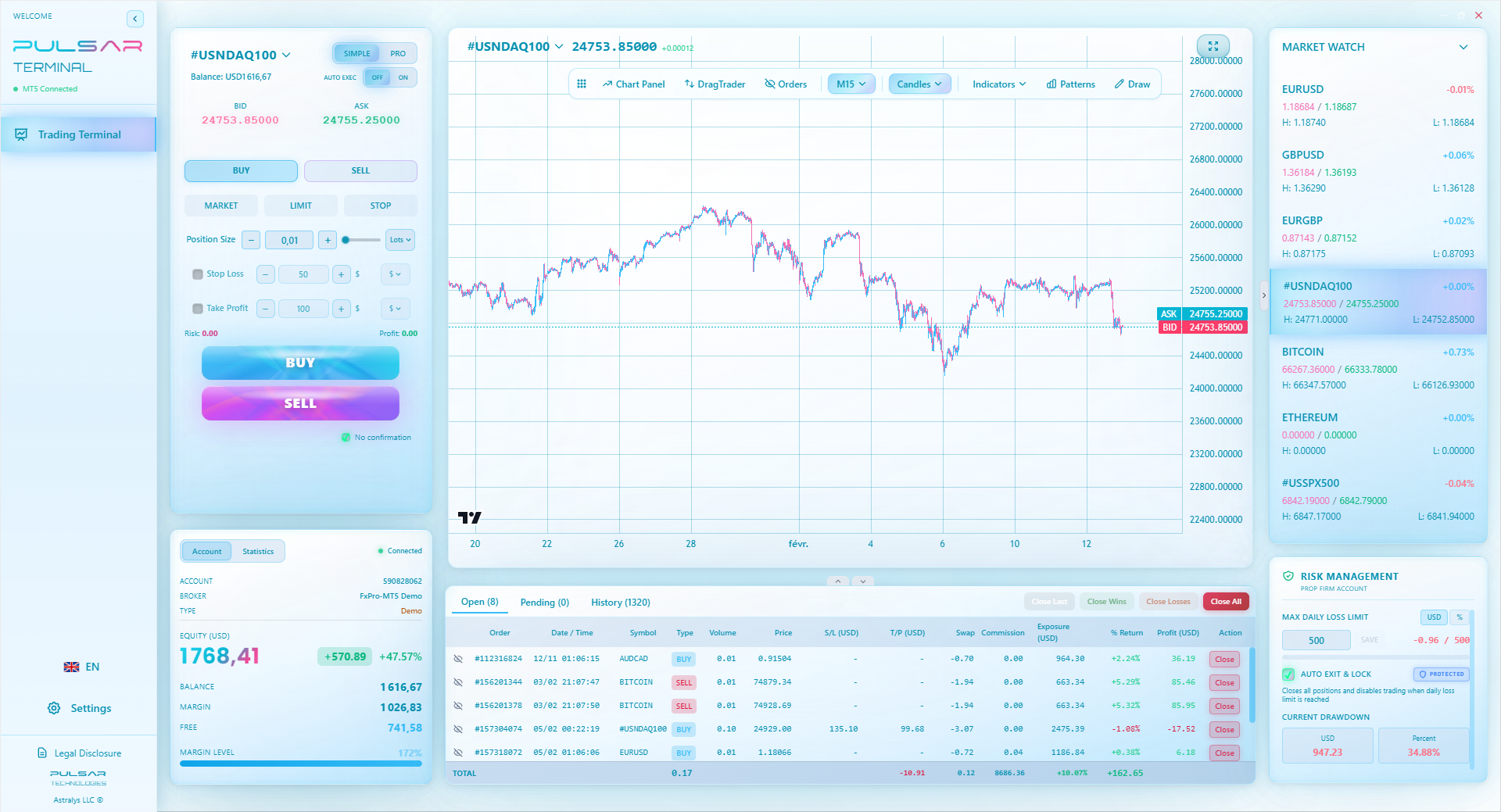
Managing multiple trades and tight stops around news events is chaotic, which is why a tool like Pulsar Terminal that lets you drag-and-drop orders and set multi-level take-profits directly on your MT5 chart is a lifesaver.
Pulsar Terminal
The all-in-one MT5 companion: drag-and-drop orders, multi-TP/SL, trailing stop, grid trading, Volume Profile, and prop firm protection. Used by 1,000+ traders daily.
“Halve your position size for news events. The volatility is doubled, so your risk should be halved.”
Pure fundamental trading is for central bankers. We need price. Fundamentals give us the direction, technicals give us the location.
Here's my simple fusion model:
- Fundamental Bias: The MPC is hawkish, oil is rising. My bias is for Naira strength (USD/NGN down).
- Technical Zone: I wait for USD/NGN to rally up to a key resistance level on the chart - maybe a previous high or a Fibonacci retracement level.
- Entry Trigger: I look for a bearish price action signal (like a pin bar or a bearish engulfing pattern) at that resistance zone.
- Confirmation: The fundamental story is the backdrop. The technical setup is the invitation. The price action is the green light.
This approach keeps you out of trouble. The fundamentals told me to sell GBP/USD in 2022, but the technicals were in a brutal uptrend. I was trying to pick a top against the momentum. Bad idea. Now, I only take fundamental-based trades that are at least not opposed by the technical trend. A hawkish Fed is a better reason to buy USD/JPY if the pair is already above its 200-day moving average, not if it's crashing through support.
Tools like the MACD indicator can help gauge momentum alignment. Is the MACD above zero and rising? That's bullish momentum. If your fundamental bias is also bullish, you have confluence. This is how you build conviction without arrogance.
💡 Winston's Tip
Your fundamental thesis isn't wrong until your stop-loss is hit. Price is the only fundamental truth that pays you.
“Pure fundamental trading is for central bankers. We need price.”
Let's be honest about where we fail.
Pitfall 1: Trading the Rumor, Selling the Fact. The market often prices in an expected event before it happens. When the "dovish" ECB statement finally arrives, EUR might already be down 100 pips and then bounce. I lost money for a year trying to trade the headline. Now, I ask: "How much of this is already priced in?"
Pitfall 2: Overleveraging on 'Sure Things.' A 95% forecast for a rate hike feels like a lock. So you pile in with 5x your normal size. Then the 5% happens - they don't hike - and you're facing a margin call. No news event is a sure thing. Ever.
Pitfall 3: Ignoring Correlations. You go long USD/JPY because the Fed is hawkish. But that day, risk sentiment sours, and everyone buys the Japanese Yen as a safe haven. Your USD strength is overridden by JPY strength. You lose. Always check the broader market mood.
Pitfall 4: Analysis Paralysis. You watch every speech, read every report, and end up with contradictory views. You're frozen. My fix: I have a hierarchy. Central Bank policy > Inflation data > Growth data > everything else. If the top-tier signals align, I act. If they conflict, I stay out.
The biggest pitfall? Thinking you know what the news should do. The market is the final judge. Your job is to listen, assess, and manage your risk accordingly. It's a reaction game, not a prediction game.
FAQ
Q1Is forex trading legal in Nigeria?
Yes, individual forex trading is legal. It's regulated by the Central Bank of Nigeria (CBN) and the Securities and Exchange Commission (SEC). However, you cannot source foreign exchange from official CBN windows to fund trading accounts. Use brokers that offer local Naira deposit methods.
Q2What is the best time to trade forex news in Nigeria?
The most volatile overlaps are during European and US sessions (1:30 PM - 10:00 PM Nigerian time). This is when major data like US CPI, GDP, and NFP are released. Nigerian-specific news (MPC, FX reserves) is usually announced during local business hours.
Q3How much money do I need to start trading forex with fundamentals?
While some brokers like Exness or JustMarkets allow starts with $1, a realistic amount for fundamental trading is $500-$1000. This lets you withstand volatility and use proper position sizing without overleveraging on a tiny account. Remember, you'll be holding through wider spreads.
Q4Do I pay tax on forex trading profits in Nigeria?
Yes. The Federal Inland Revenue Service (FIRS) levies a 10% Capital Gains Tax on your net trading profits. You are responsible for declaring and paying this, regardless of whether your broker is local or international.
Q5Can I trade the Naira (NGN) on international platforms?
Directly, it's rare. Major pairs like USD/NGN are primarily traded on the local interbank market or through local broker platforms. International brokers offer majors (EUR/USD, GBP/USD) and exotics, but rarely NGN pairs. Your fundamental analysis of Nigeria still applies to your overall risk and capital management.
Q6What's more important for a beginner, technical or fundamental analysis?
Start with risk management and basic technicals. Fundamentals add context but are harder to quantify. Learn to place a stop-loss and calculate position size first. Then, use fundamentals to understand why the trends on your charts are happening. They work best together.
Q7How do I avoid slippage during high-impact news?
You can't avoid it entirely, but you can manage it. Use wider stop-loss orders, reduce your position size significantly, or simply avoid having orders open during the news release. Accept that your execution price might be worse than you planned and size your trade so that outcome doesn't break you.
Prof. Winston's Lesson
Key Takeaways:
- ✓Trade the market's reaction, not the headline figure.
- ✓Always check the economic calendar for high-impact news.
- ✓During major news, spreads widen - expect and plan for slippage.
- ✓Use fundamentals for direction, technicals for entry location.
- ✓In Nigeria, factor in 10% tax and funding challenges.
How useful was this article?
Click a star to rate
Weekly Trading Insights
Free weekly analysis & strategies. No spam.
About the Author
Olumide Adeyemi
West African Trading Pioneer
One of Nigeria's most active forex trading educators. 8 years of experience trading from Lagos. Specializes in low-capital strategies and prop firm challenges for African traders.
Comments
Risk Disclaimer
Trading financial instruments carries significant risk and may not be suitable for all investors. Past performance does not guarantee future results. This content is for educational purposes only and should not be considered investment advice. Always conduct your own research before trading.
You Might Also Like

Cara Trading Forex Sukses: 7 Prinsip dari Trader Profesional
Cara trading forex sukses dengan 7 prinsip trader pro: manajemen modal, disiplin, journal trading, backtest. Data nyata, bukan janji profit palsu.
Jam Trading Forex Terbaik untuk Trader Indonesia: Panduan Lengkap dengan Tabel Waktu
Panduan jam trading forex untuk trader Indonesia. Tabel 4 sesi dunia, jam emas 20:00-00:00, sesi mana yang harus dihindari. Data akurat + tips dari trader berpengalaman.
Top 5 Sàn Forex Uy Tín Nhất 2026: Review Jujur dari Trader Indonesia
Top 5 sàn forex uy tín 2026 untuk trader Indonesia. Review jujur: spread, deposit, withdraw, dukungan lokal. Exness, XM, IC Markets & lebih.
Get Pulsar Terminal
All these calculators are built into Pulsar Terminal with real-time data from your MT5 account. One-click position sizing, automatic risk management, and instant calculations.
Get Pulsar Terminal