


It was 9:05 AM Lagos time on a Monday, and my screen was flashing red.

Olumide Adeyemi
West African Trading Pioneer ·  Nigeria
☕ 13 min read
What you'll learn:
- 1What Exactly Is a Forex Gap? (It's Not What You Think)
- 2The Three Gaps You Need to Know (And Which One to Trade)
- 3The Gap Fill Strategy: The Nigerian Trader's Favorite (For Better or Worse)
- 4The Gap & Go Strategy: Trading with the Momentum
- 5The Exhaustion Gap Reversal: Catching the Turn
- 6Risk Management: The Only Thing That Makes Gap Trading Work
- 7Broker Considerations for Nigerian Gap Traders
- 8Putting It All Together: Your Gap Trading Checklist
It was 9:05 AM Lagos time on a Monday, and my screen was flashing red. GBP/JPY had opened nearly 90 pips below Friday's close. My heart sank. I was holding a long position over the weekend, a stupid move I'd promised myself I'd never make again. That gap wiped out a week's worth of careful profits in seconds. That loss, painful as it was, taught me more about how to trade gaps in forex than any textbook ever could. It's not about avoiding them, it's about understanding the vacuum they create and learning to trade the reaction.
Most new traders picture a gap like a stock market gap - a clean jump with no trades in between. In the 24-hour forex market, it's different. A forex gap happens when the price opens at a significantly different level from where it closed the previous trading session, usually after the weekend or a major holiday. There's still trading happening in other global sessions, but your specific broker's price feed 'jumps' because liquidity is thin during that handover period.
Think of it like this: the market closed on Friday at 1.2850 on EUR/USD. You come back on Monday, and your platform shows the first candle opened at 1.2920. That 70-pip space between 1.2850 and 1.2920? That's the gap. It's a zone where, for your broker and chart, no price discovery happened. These gaps are most common on Sunday evening or Monday morning (Lagos time) after the Sydney market opens, following major geopolitical events or economic data releases over the weekend.

Warning: Don't confuse a gap with normal volatility. A true gap on a 1-hour or 4-hour chart will show a clear space between the closing wick of one candle and the opening wick of the next. If the candles overlap, that's just a strong move, not a tradable gap in the classic sense.

💡 Winston's Tip
The market's first move after a gap is often a false one. Wait for the first hour's price action to settle before you commit your capital. Let the amateurs fight it out in the opening volatility.
Not all gaps are created equal. Identifying the type of gap you're looking at is 80% of the battle. Getting this wrong is why most blow up on gap trades.
Common Gaps
These are the 'noise' gaps. They usually occur in quiet markets, have no major news behind them, and get filled quickly - often within the same day. They're small, usually 10-25 pips on majors like EUR/USD. Frankly, they're not worth trading. The spread and commission will eat into your profit on a move that small. I used to chase these, thinking every gap must fill. I'd be right 7 times out of 10, but the 3 losses would wipe out all those small wins because my stop was too tight. Lesson learned: ignore the small stuff.
Breakaway Gaps
This is the big one. A breakaway gap occurs after a period of consolidation (like a triangle or a rectangle pattern) and signals the start of a strong new trend. The price gaps and keeps going. The gap area becomes a key support (if it's a gap up) or resistance (if it's a gap down) zone. Trying to fade a true breakaway gap - trading against it - is a surefire way to lose money. I learned this the hard way with USD/ZAR in 2020. A massive gap up on a political announcement, I shorted it for a fill. It never looked back, and I took a 2% account loss waiting for a reversal that never came.
Exhaustion Gaps
This is a trap that looks like an opportunity. An exhaustion gap appears near the end of a long trend. It's like the market's last gasp of energy. The price gaps in the direction of the trend, but the move lacks conviction and quickly reverses, filling the gap and often reversing the trend. Spotting these requires looking at the bigger picture. Was the pair in a strong, extended uptrend for weeks? Did it just gap up on seemingly exhausted momentum? That's your clue.

Example: Imagine GBP/USD has rallied from 1.2500 to 1.3200 over two months. It then gaps up from 1.3200 to open at 1.3250 on a Monday. The price struggles to hold above 1.3260 all day and starts drifting down. That 1.3200-1.3250 gap zone is now a magnet, and a short entry as price fails to make new highs post-gap could be an exhaustion play.
“Gap trading isn't about predicting the gap; it's about trading the market's reaction to the vacuum it creates.”
This is the most talked-about strategy in Nigerian trading forums: "The gap must fill!" The logic is simple: price often retraces to fill the vacuum left by the gap before continuing in its primary direction. It's a mean reversion play. But 'often' is not 'always,' and that's the critical distinction.
Here's how I apply it now, after years of refining (and blowing up accounts):
- Identify a Suitable Gap: I only look for gaps larger than 30 pips on major pairs. Anything smaller is market noise. The gap should also NOT be a clear breakaway gap from a major chart pattern.
- Wait for a Rejection Signal: I never, ever enter immediately at the open. I wait for the first 1-4 hours of the new session (depending on the timeframe). I'm looking for price to show weakness if it was a gap up. A bearish engulfing candle on the 1-hour chart, a failure to make a new high, or a rejection from a key Fibonacci level. For a gap fill scalping strategy, some enter quicker, but I need confirmation.
- Entry and Risk Management: My entry is on a retest of the gap's edge. For a gap up, I short on a retest of the high of the gap candle. My stop-loss goes just above the entire gap range. My take-profit? The other side of the gap. Not a pip more.
Let me give you a real trade from my journal. January 15, 2024. USD/CHF had closed Friday at 0.8520. It gapped down Monday to open at 0.8485 (a 35-pip gap). Price drifted up for two hours, retested 0.8500 (the Friday low/gap edge), formed a small bearish pin bar on the 1-hour chart, and stalled. I went short at 0.8498. Stop at 0.8535 (above Friday's close). Target at 0.8485 (the Monday open). It filled the gap two hours later. Profit: 13 pips. Risk: 37 pips. Not a great risk/reward (roughly 1:0.35), but it was a high-probability setup. This is where a good position size calculator is non-negotiable. I risked 0.5% of my account, so the win was small but positive.
The brutal truth? In trending markets, this strategy fails. You'll get stopped out repeatedly as gaps don't fill for weeks. It works best in ranging or mildly volatile markets.
While everyone is waiting for the gap to fill, the 'Gap & Go' strategy bets on continuation. It says, "This gap is so powerful, it's the start of something new." This is a trend-following strategy and is typically used with breakaway gaps.
The rules are simpler but require more guts:
- Confirm Strength: The price must open with a gap and then continue moving in the gap direction within the first 1-2 candles of the new session. No hesitation.
- Aggressive Entry: Enter a long (on a gap up) or short (on a gap down) on a small pullback to the opening price level or a break of the first minor consolidation.
- Stop Placement: Your stop-loss goes inside the gap. For a gap up long, place your stop just below the low of the gap candle. You're betting the gap won't fill immediately.
- Profit Taking: This is where it gets tricky. You can aim for a measured move (the height of the prior consolidation projected from the gap), or use trailing stops. I often use a 1:2 risk-reward as a minimum.
My most successful gap trade ever was a Gap & Go. It was on XAU/USD (Gold) during the early COVID panic in March 2020. Gold had been consolidating. It gapped up massively on a Sunday open (over $50). I waited 30 minutes. It didn't pull back much, just consolidated near the highs. I bought on a small 15-minute breakout. Stop placed $20 below the gap. I rode that trend for days, using a trailing stop, and eventually banked over $180 per ounce move. That one trade made my quarter. But for every one of those, there are five failed attempts where the gap was just an overreaction.

Pro Tip: Combine the Gap & Go with a momentum indicator like the MACD indicator on a 15-minute chart. Look for the MACD to be above zero and turning up sharply after a gap up. It adds a layer of confirmation that the momentum is real.
💡 Winston's Tip
Map the gap zone on your chart as a rectangle. That zone becomes future support or resistance. A true breakaway gap will see price reject from that zone on subsequent retests. A common gap will see price slice through it.
“Your stop-loss must be placed where your gap thesis is completely invalidated, not where your pain threshold ends.”
This is an advanced strategy, but incredibly rewarding when you nail it. You're looking to catch a major trend reversal. An exhaustion gap occurs after a sustained move, represents the final push, and then the trend exhausts itself.
How to spot it:
- Context is King: The pair must be in a clear, strong, and extended trend. Look at the weekly chart.
- The Gap: A final, often large gap appears in the direction of the trend.
- The Failure: Post-gap, the price fails to make significant new progress. It might make a minor new high/low and then start to stall or pull back sharply.
- The Signal: A strong reversal candlestick pattern (like an engulfing or evening star) forms after the gap, preferably on a 4-hour or daily chart.
The trade is to enter against the gap direction once the reversal signal is confirmed. Your stop goes beyond the extreme of the exhaustion move (beyond the high if you're shorting). Your target is the entire gap fill, and often much further as the trend reverses.
Why Nigerian traders struggle with this: We love a good bargain. Seeing a pair at a 'high' and gapping up makes us want to short. But without the context of an exhausted trend, you're just picking a top in a bull market - a guaranteed losing strategy. Patience and higher timeframe analysis are everything here. This is more of a swing trading play, holding for days or weeks, not hours.
I can teach you the patterns, but if you don't master this, you will lose. Period. Gap trading is inherently risky because you're often trading against initial momentum or betting on its continuation in a volatile environment.
- Position Size is Sacred: This is your life raft. A gap can widen against you before it fills. You must use a position size calculator and risk a maximum of 1% of your account on any single gap trade. For volatile pairs like GBP/JPY, I risk 0.5%. In 2019, I risked 3% on a USD/CAD gap fill trade. The gap widened another 40 pips on unexpected oil news before eventually filling. I hit my stop and lost N150,000 in minutes. That loss took me months to recover emotionally.
- Stop-Loss Placement is Strategic: Your stop must be placed where the gap thesis is invalidated. For a gap fill trade, that's beyond the gap range. For a gap and go, it's inside the gap. Never place a stop based on a random number of pips. Place it based on market structure.
- Beware of the 'Black Swan' Gap: Some gaps, caused by unforeseen geopolitical events or central bank surprises, never look back. If your stop is hit, accept it. Do not move your stop further away hoping for a comeback. That's how a 1% loss becomes a 10% margin call.
- Weekend Risk: Holding positions over the weekend is a form of gap trading you don't control. If you must hold, ensure your account equity can withstand a 2-3% gap against you without triggering a stop out. Better yet, just don't do it. Close your positions on Friday.
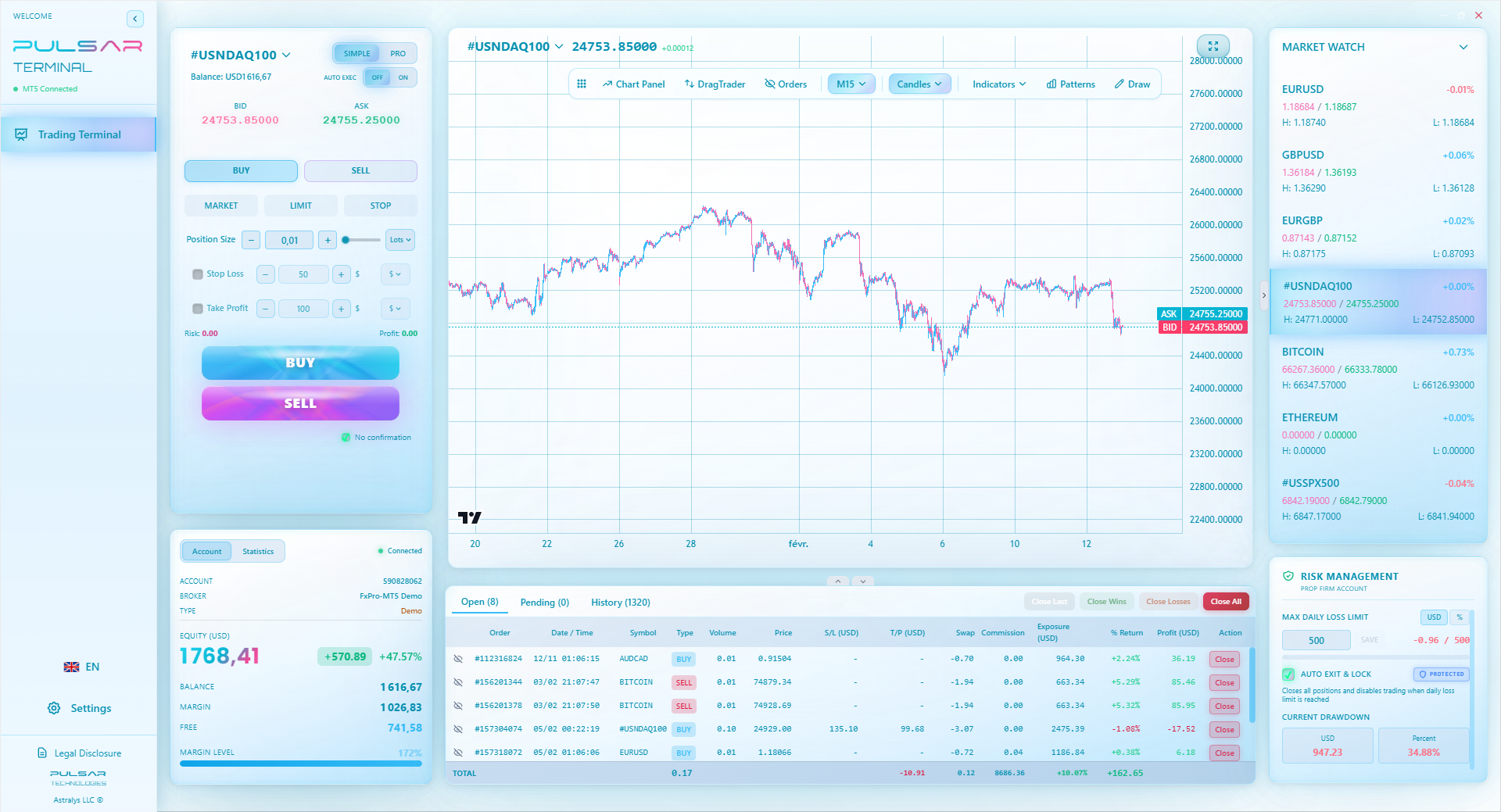
Managing multiple gap trades with precise stop-loss and take-profit levels is critical, and Pulsar Terminal's drag-and-drop order tools on MT5 make executing these complex risk management plans instantaneous.
Pulsar Terminal
The all-in-one MT5 companion: drag-and-drop orders, multi-TP/SL, trailing stop, grid trading, Volume Profile, and prop firm protection. Used by 1,000+ traders daily.
“For every successful exhaustion gap reversal you catch, there are five failed attempts that looked exactly the same.”
Your broker choice directly impacts your gap trading success. Here’s what matters most for us in Nigeria:
Spreads & Slippage: When a market gaps, the spread definition can widen dramatically at the open. If you're using a broker with high variable spreads, your fill price on a market order could be terrible. Look for brokers known for tight, stable spreads even during volatile opens. Brokers like IC Markets review or Pepperstone review (on their Razor accounts) are built for this. I once had a 15-pip spread on EUR/GBP at a Sunday open with a sub-par broker. My planned 20-pip profit trade was dead on arrival.
Execution Speed: You need fast execution, especially for Gap & Go strategies. A delay of a few seconds can mean missing the entry or getting a worse price.
use: High use is a double-edged sword. While brokers like Exness review offer very high use, using it all on a gap trade is suicidal. A small move against you will liquidate you. Use use conservatively, always.
Deposits & Withdrawals: This is the Nigerian-specific headache. Ensure your broker supports reliable deposit methods for Nigeria (like bank transfer, credit/debit cards, or popular e-wallets). Test the withdrawal process with a small amount first. The profit from a perfect gap trade is useless if you can't get it into your Nigerian bank account.
Regulation: While many Nigerian traders use internationally regulated brokers (CySEC, FSCA, ASIC), understand that your primary recourse is with that foreign regulator. The local framework is still developing, so your own risk management is your first and most important regulator.
💡 Winston's Tip
If you're unsure whether a gap is a breakaway or exhaustion, stand aside. The best trade is often the one you don't take. There will be another gap, another day.
Before you place a single trade based on a gap, run through this list. I have it printed next to my screen.
- Classify the Gap: Common, Breakaway, or Exhaustion? What is the context on the 4-hour and daily chart?
- Choose Your Strategy: Does the context support a Fade (Fill), a Follow (Go), or a Reversal (Exhaustion)? Only one will be correct.
- Wait for Confirmation: Never enter at the market open. Give it 1-4 candles. Look for a price action signal (rejection, continuation pattern).
- Calculate Your Risk: Use your calculator. What is 1% of my account? Where is my logical stop? What position size does that give me?
- Place the Trade: Enter, set stop-loss, set take-profit. Do not use a mental stop.
- Manage the Trade: If it's a Gap & Go, consider moving to breakeven after 1:1 risk-reward is hit. If it's a fill trade, let it run to your target and don't get greedy.
- Review: Win or lose, note down what type of gap it was, your strategy, and the outcome. This log is how you learn.
Gap trading isn't a magic bullet. It's a specialized approach that requires discipline, patience, and an iron-clad risk management plan. Start by paper trading these setups on a demo account for a month. Identify them, classify them, and practice your entries. When you can consistently identify the gap type correctly on a demo, then and only then, consider risking real capital. The gap will always be there. Your capital won't be if you're not prepared.
FAQ
Q1What time do forex gaps usually occur for Nigerian traders?
The most common and significant gaps occur at the Sunday/Monday open, around 10:00 PM Lagos time (when the Sydney session begins after the weekend close). Smaller gaps can also happen at the daily 10:00 PM Lagos open (Sydney) or after major news events that break when the London or NY sessions are closed.
Q2Is the 'gap must fill' theory always true?
No, it's a dangerous myth. While many common gaps do fill, breakaway gaps often don't fill for weeks, months, or even years. Trading every gap expecting a fill is a sure way to lose money in a strong trending market.
Q3What is the best timeframe for trading gaps?
Use the 1-hour and 4-hour charts for analysis and entry. The daily chart is for context. The gap must be visible on at least the 1-hour chart to be considered significant. Avoid using very low timeframes (like 1-minute) as the noise will be overwhelming.
Q4Can I trade gaps on all currency pairs?
You can, but they are most reliable on major pairs (like EUR/USD, GBP/USD) and common crosses (like EUR/GBP). Exotic pairs involving the Naira or other illiquid currencies can have massive, erratic gaps that are nearly impossible to trade systematically due to huge spreads and slippage.
Q5How much should I risk on a single gap trade?
Never more than 1% of your trading account capital. Given the volatility, many professional traders risk only 0.5% on gap setups. This strict rule protects you from a single bad trade or a gap that widens unexpectedly from a news event.
Q6Do I need a special type of broker account to trade gaps?
You need a broker with fast execution and tight, stable spreads. An ECN or Raw Spread account type is often best, as it typically offers lower spreads (though with a commission). This minimizes the cost of entering and exiting around the gap zone.
Q7What's the biggest mistake Nigerian traders make with gaps?
Two mistakes: 1) Trading without confirming the gap type (just shorting every gap up), and 2) Using excessive use. A 30-pip move against you with 1:500 use can wipe out a large portion of your margin. Discipline and small position sizing are non-negotiable.
Prof. Winston's Lesson
Key Takeaways:
- ✓Classify the gap first: Common, Breakaway, or Exhaustion.
- ✓Never risk more than 1% of your capital on any gap trade.
- ✓Wait for 1-4 hours of price action confirmation before entering.
- ✓Your broker's spread and execution speed are part of your edge.
How useful was this article?
Click a star to rate
Weekly Trading Insights
Free weekly analysis & strategies. No spam.
About the Author
Olumide Adeyemi
West African Trading Pioneer
One of Nigeria's most active forex trading educators. 8 years of experience trading from Lagos. Specializes in low-capital strategies and prop firm challenges for African traders.
Comments
Risk Disclaimer
Trading financial instruments carries significant risk and may not be suitable for all investors. Past performance does not guarantee future results. This content is for educational purposes only and should not be considered investment advice. Always conduct your own research before trading.
You Might Also Like

Cara Trading Forex Sukses: 7 Prinsip dari Trader Profesional
Cara trading forex sukses dengan 7 prinsip trader pro: manajemen modal, disiplin, journal trading, backtest. Data nyata, bukan janji profit palsu.
Jam Trading Forex Terbaik untuk Trader Indonesia: Panduan Lengkap dengan Tabel Waktu
Panduan jam trading forex untuk trader Indonesia. Tabel 4 sesi dunia, jam emas 20:00-00:00, sesi mana yang harus dihindari. Data akurat + tips dari trader berpengalaman.
Top 5 Sàn Forex Uy Tín Nhất 2026: Review Jujur dari Trader Indonesia
Top 5 sàn forex uy tín 2026 untuk trader Indonesia. Review jujur: spread, deposit, withdraw, dukungan lokal. Exness, XM, IC Markets & lebih.
Get Pulsar Terminal
All these calculators are built into Pulsar Terminal with real-time data from your MT5 account. One-click position sizing, automatic risk management, and instant calculations.
Get Pulsar Terminal