


Here's a fact that might surprise you: in 2025, the Central Bank of Nigeria bought over $5 million worth of locally mined gold to boost our reserves.

Olumide Adeyemi
West African Trading Pioneer ·  Nigeria
☕ 12 min read
What you'll learn:
- 1What is XAU/USD and Why Do Nigerians Trade It?
- 2The Legal, Tax, and Broker Setup for Nigeria
- 3The Real Costs of Trading Gold: Spreads, Swaps, and Slippage
- 4How Gold's Price Really Moves: Key Drivers
- 5Practical Trading Strategies and Real Examples
- 6Risk Management: The Nigerian Context is Everything
- 7Common Mistakes Nigerian Gold Traders Make
Here's a fact that might surprise you: in 2025, the Central Bank of Nigeria bought over $5 million worth of locally mined gold to boost our reserves. While they're stacking physical bars, retail traders like us have a different playground: the XAU/USD pair on our forex platforms. Trading 'digital gold' is huge here, but it's not just another currency pair. It moves to its own beat, influenced by global fear, central bank policies, and the value of the dollar. I've made good money with it, and I've also taken some painful losses that taught me more than any win. If you want to learn how to trade gold in forex from a Nigerian perspective - covering everything from the new SEC rules to managing your position size with a volatile Naira - you're in the right place.
On your trading platform, you won't find 'GOLD'. You'll find XAU/USD. XAU is the code for one troy ounce of gold, and USD is the US dollar. The price tells you how many dollars it takes to buy that single ounce.
So why is it so popular in Lagos, Abuja, and Port Harcourt? First, it's a classic hedge. When there's global uncertainty - think inflation scares or geopolitical tension - money often flows into gold. It's seen as a 'safe haven' asset. For us in Nigeria, with our own economic volatility, having an asset that sometimes moves opposite to market panic is attractive.
Second, it's accessible. You don't need a vault or to worry about purity. With a broker like Exness or IC Markets, you're trading a Contract for Difference (CFD) on the price. You're speculating on the price movement, not owning the physical metal.

Warning: Trading gold CFDs is not the same as investing in physical gold. With Dukia Gold, you can buy actual bullion from ₦10,000. With a CFD, you're using use, which magnifies both profits and losses. They are fundamentally different products.
Finally, it's liquid and trades nearly 24/5. The major session for gold is during the London and New York overlaps, but you'll see action in the Asian session too. The volatility can create opportunities, but you need to respect it. A $20 move in a day (over 1%) isn't uncommon, and that can wipe out an account fast if you're over-leveraged.
This is the most important section. Getting the foundation wrong can ruin everything before you even place a trade.
The New Regulatory Reality
For years, online forex trading operated in a grey area. The SEC basically said 'trade at your own risk.' That changed in 2025 with the Investments and Securities Act (ISA 2025). Now, any platform offering online forex or CFD trading to Nigerians must be registered with the SEC. This is a big step towards consumer protection.
What does this mean for you? You should prioritize brokers that are making efforts to comply with this new local framework, even if they are primarily regulated offshore (like by CySEC in Cyprus or the FSA in Seychelles). It adds a layer of safety for your funds.
Taxes You Can't Ignore
If you make a profit, it's considered a capital gain. For individuals, the tax rate is 10%. Keep a clean record of your trades. The taxman may not be knocking on every retail trader's door yet, but as the market formalizes, this will become more standard. There's also a 7.5% VAT on platform fees, though many brokers absorb this cost.
Choosing and Funding Your Broker
You need a broker that accepts Nigerian clients, offers XAU/USD, and has reasonable deposit methods. I've used several. XM has been solid for me, with local bank transfer options. Pepperstone has razor-thin spreads, which is crucial for a scalping strategy.
Funding is key. Most accounts are in USD. When you deposit Naira, your bank converts it at their rate (around ₦1383/$1 as I write this). That rate adds a hidden cost. Some brokers now offer NGN-denominated accounts, which simplifies things. Use bank transfers for larger amounts (expect a 1-2 day delay and maybe a ₦2000 fee). For smaller, quicker top-ups, cards or e-wallets like Skrill work.

Pro Tip: Before you deposit a large amount, do a test withdrawal. The true test of a broker isn't how easy it is to put money in, but how easy and fast it is to get it back out to your Nigerian bank account.

💡 Winston's Tip
Gold's daily range is your friend. Calculate the average true range (ATR) over 14 days. If it's $25, don't place a stop loss only $10 away from entry. You'll get stopped out by noise.
“Trading gold CFDs is not the same as investing in physical gold. With use, they are fundamentally different products.”
Let's talk numbers, because this is where many new traders get a nasty shock. Trading gold isn't free, and the costs eat into your profits if you're not careful.
The Spread: This is the broker's cut. It's the difference between the buy (ask) and sell (bid) price. For major forex pairs like EUR/USD, spreads can be under 1 pip. For gold, they're wider because it's a commodity. A 'good' spread might be 0.3 to 0.6 (which is $0.30 to $0.60 per ounce). During high volatility or off-peak hours, it can widen to $1.00 or more. On a 1-lot trade (100 ounces), that's a $100 cost just to enter the trade!
Overnight Financing (Swap Fees): If you hold a position past the broker's daily rollover time (usually 10-11 PM GMT), you pay or receive a swap fee. For gold, these can be significant. I once held a long XAU/USD position for two weeks as a swing trade. The daily swap was about -$4 per lot. Over 14 days, that was -$56, which seriously dented my profit. Always check your broker's swap rate table.
Slippage: Gold can gap. If major news hits when the market is closed, the price can open dramatically higher or lower. Your stop-loss order gets filled at the available price, not necessarily your exact price. I learned this the hard way during a Fed announcement. My stop was at $1810, but the market opened at $1795. I lost an extra $15 per ounce.
Here’s a quick cost comparison for a 1-lot trade, assuming a $1850 price:
| Cost Type | Typical Range | Impact on 1-Lot (100 oz) Trade |
|---|---|---|
| Spread | $0.30 - $1.00 | $30 - $100 immediate cost |
| Swap (per night) | +/- $2 - $8 | Can add up quickly on holds |
| Slippage (on news) | Variable, can be $10+ | Unplanned additional loss/profit |
The lesson? For short-term trades, the spread is your main enemy. For long-term holds, the swap can kill you. Always factor these in before you click 'buy' or 'sell'.
Gold doesn't care about a company's earnings report. It listens to a different set of masters. If you want to know how to trade gold in forex successfully, you need to understand these drivers.
1. The US Dollar (USD): This is the big one. XAU/USD is priced in dollars. When the USD gets stronger (DXY index up), gold usually gets cheaper in dollar terms (price down). When the USD weakens, gold often rallies. It's an inverse relationship about 70-80% of the time.
2. Real Interest Rates: This is more subtle but powerful. Gold pays no interest. When real interest rates (bond yield minus inflation) are high, money flows to interest-bearing assets. When real rates are low or negative, gold becomes more attractive. Watch the US 10-year Treasury yield and inflation expectations.
3. Geopolitical & Market Fear: War, elections, banking crises - these send traders scrambling for safety. Gold often spikes on these headlines. The trick is these moves can reverse just as fast when the panic fades.
4. Central Bank Demand: Since 2022, central banks (like China, India, and yes, Nigeria's CBN) have been net buyers of gold. This structural demand puts a floor under prices.
5. Technical Levels: Gold respects technical analysis. Key psychological levels ($1900, $2000), moving averages (like the 200-day MA), and previous highs/lows act as magnets for price action. I combine this with the fundamental picture. For example, if price is approaching a major support zone like $1800 AND the Fed is hinting at pausing rate hikes, that's a much stronger case for a long trade.
💡 Winston's Tip
The most reliable gold trades often come after it tests and holds the weekly opening price. Watch that level like a hawk on Monday.
“The true test of a broker isn't how easy it is to put money in, but how easy and fast it is to get it back out to your Nigerian bank account.”
Enough theory. Let's get into what you can actually do on the chart. I'll share two approaches I use, with real numbers from my own trades.
Strategy 1: Breakout Retest (Swing Trade)
Gold loves to make big moves then pull back to test the breakout level. This is my bread and butter.
My Trade (March 2024): Gold broke above a key resistance at $2050 after a weak US jobs report. It rallied to $2075, then started pulling back. I waited. Three days later, it dipped back to $2052, touched the old resistance (now support), and showed a bullish pin bar on the 4-hour chart. That was my signal.
- Entry: $2053
- Stop Loss: $2045 (just below the support zone)
- Take Profit 1: $2070 (previous high)
- Take Profit 2: $2085 (measured move)
I used a position size calculator to risk 1% of my account. The trade hit TP1 two days later, and I moved my stop to breakeven. It eventually hit TP2. A clean 32-pip gain on half the position.
Strategy 2: News Scalping with RSI
Around major US data (CPI, NFP), gold can become a scalper's dream. The key is patience and tight risk management.
A Trade That Didn't Work (Jan 2024): US CPI came in hotter than expected. Gold instantly dropped $15. The RSI indicator on the 5-minute chart plunged below 20 (oversold). I thought 'oversold bounce!' and bought at $1821. I was wrong. The selling pressure was relentless. It was a fundamental shift, not a technical bounce. I got stopped out at $1818 for a 3-pip loss. The lesson? Don't fight the fundamental tide right after news. Wait for the dust to settle.

Example: Always know your risk per pip. For XAU/USD, 1 pip = $0.01 per ounce. So, on a 0.1 lot (10 oz) trade, 1 pip = $0.10. If your stop is 50 pips away, you're risking $5 on that trade. Use this to work backwards from your acceptable dollar risk to find your position size.
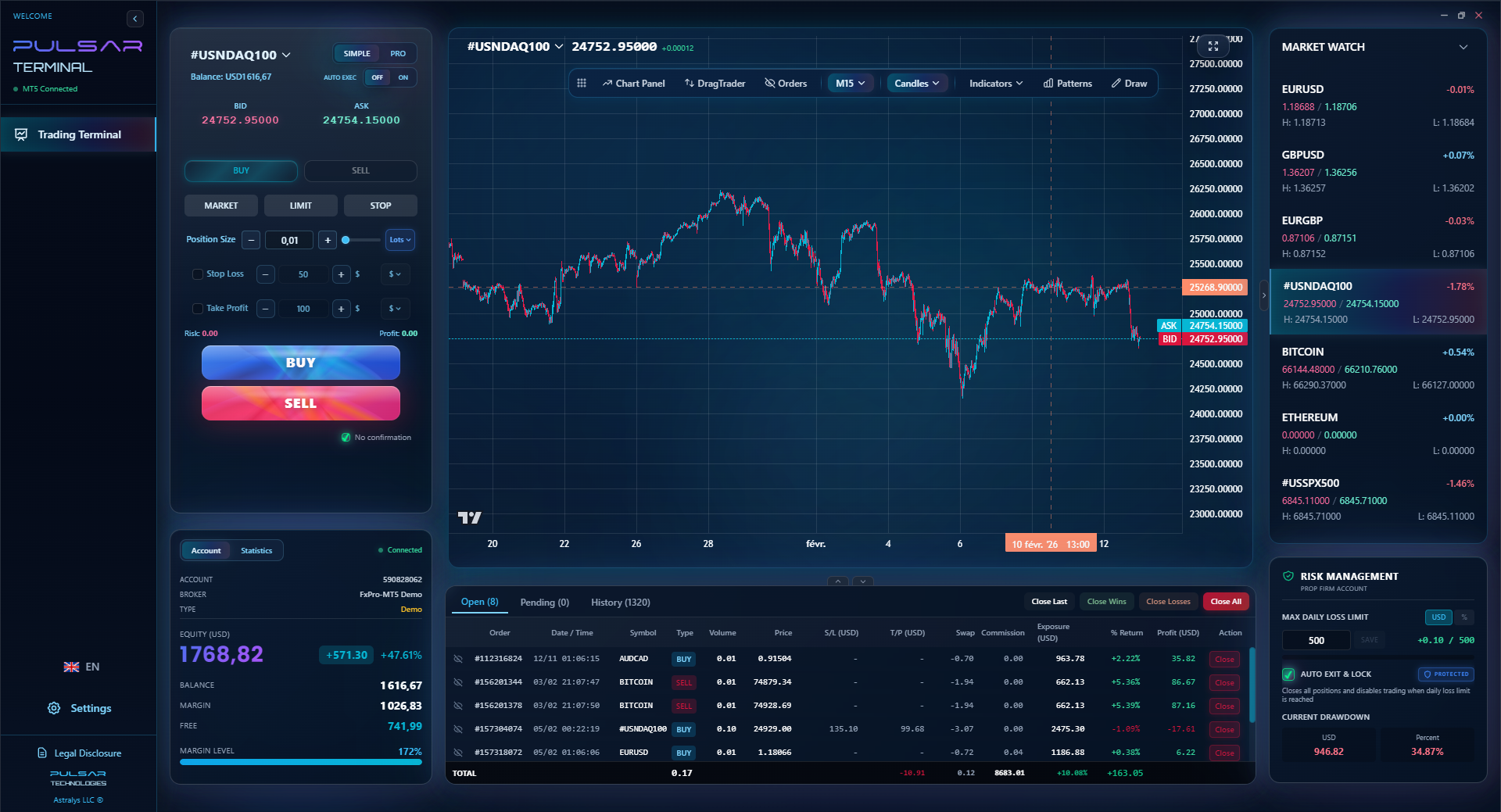
These strategies work on platforms like MT5, but managing multiple take-profit levels and moving stops to breakeven manually can be a hassle in fast markets.
Managing multiple take-profit levels and moving stops to breakeven on volatile gold trades is much easier when you can automate it directly on your MT5 chart.
Pulsar Terminal
The all-in-one MT5 companion: drag-and-drop orders, multi-TP/SL, trailing stop, grid trading, Volume Profile, and prop firm protection. Used by 1,000+ traders daily.
This is non-negotiable. The volatility of gold, combined with our local economic pressures, makes strict rules essential.
1. use is a Double-Edged Sword: Nigerian brokers often offer high use (1:500, even 1:1000). This is a trap for the undisciplined. On a 1:500 use, a 0.2% move against you wipes out your entire margin. I never use more than 1:50 for gold. It's just too jumpy.
2. The Naira Factor: Your account is in USD, but your living expenses are in Naira. A 10% profit in dollars could be wiped out by a 10% devaluation of the Naira if you need to withdraw for bills. Don't trade with money you'll need to convert back in the short term. Consider your trading capital as 'dollar-denominated' for the long haul.
3. Avoid the Margin Call: A margin call happens when your losses eat up your available margin. Your broker will start closing positions. To avoid this, never risk more than 1-2% of your account on a single trade. Use a stop loss on EVERY trade, no exceptions. Gold can have wicked false spikes that hunt for stops, so place your stop a bit beyond obvious technical levels.
4. Emotional Discipline: When you see gold shooting up $30, the fear of missing out (FOMO) is real. But chasing a move is how you get burned at the top. Have a plan, write it down, and stick to it. The market will always be there tomorrow.
My personal rule: If I have two losing trades in a row on gold, I switch off the platform for the day. It means my read on the market is wrong, and forcing a trade to 'get back' my loss is a recipe for disaster.
💡 Winston's Tip
If you're long gold and the S&P 500 starts to sell off sharply, check your position. In a true 'risk-off' panic, gold can sell off too as people raise cash to cover losses elsewhere.
“Don't trade just because you're bored. Wait for a fundamental catalyst or a clear technical setup.”
I've made most of these. Let me save you the tuition fees.
Mistake 1: Trading Without a Catalyst. Gold can sit in a $20 range for days, slowly eating your account with spreads and swaps. Don't trade just because you're bored. Wait for a fundamental catalyst (Fed speech, CPI data) or a clear technical setup.
Mistake 2: Ignoring the USD. You're trading XAU/USD. Spend as much time analyzing the dollar index (DXY) as you do looking at gold charts. A strong dollar trend will override most bullish gold patterns.
Mistake 3: Overcomplicating the Chart. I used to have 10 indicators on my screen: MACD, Stochastics, Bollinger Bands, you name it. It was noise. Now I use price action (support/resistance, trendlines) and maybe one or two indicators like the MACD indicator for trend confirmation. Clean charts lead to clearer decisions.
Mistake 4: Not Accounting for Swap on Long-Term Holds. As I mentioned earlier, I once saw a third of my paper profit vanish to swap fees. If you're going long-term, you must factor this in or look for brokers with better swap rates (sometimes called 'swap-free' accounts, though they may have other fees).
Mistake 5: Using Gold as a 'Get-Rich-Quick' Scheme. It's not. It's a sophisticated market. Respect it. Start with a demo account, then a very small live account. Build your skill and confidence over months and years, not days.
FAQ
Q1Is trading gold (XAU/USD) legal for individuals in Nigeria?
Yes, it is legal for individuals to trade forex and CFDs like XAU/USD. The regulatory environment is becoming more structured with the new Investments and Securities Act 2025, which requires platforms to register with the SEC. You are responsible for paying a 10% capital gains tax on your profits.
Q2What is the best time of day to trade gold in Nigeria?
The most volatile and liquid sessions are when London and New York are open (2 PM - 10 PM Nigerian Time). This is when you'll see the biggest moves and the tightest spreads. Trading during the Asian session or late New York session often leads to wider spreads and slower, choppier price action.
Q3How much money do I need to start trading gold?
You can start with as little as $10-$50 with some brokers, but I strongly advise against it. With such a small amount, proper risk management is nearly impossible. A more realistic starter amount that allows you to practice sane position sizing is $200-$500. Always use a broker's demo account first to test your strategy.
Q4What's the difference between trading XAU/USD and buying physical gold from Dukia Gold?
They are completely different. Buying from Dukia Gold is a physical investment: you own a piece of bullion, store it, and its value changes with the spot price. Trading XAU/USD is a speculative CFD trade using use. It's short-term, you never own the gold, and you can profit from prices falling (going short). The CFD carries a much higher risk due to use.
Q5Why does my gold trade sometimes close with a loss even though the price didn't hit my stop loss?
This is likely due to a 'margin call'. If other open trades are losing money or if the gold price moves sharply against you, your used margin can exceed your available margin. The broker's system will automatically close positions (starting with the biggest loser) to protect itself from further loss. This is why managing your overall account risk is critical.
Q6Can I use the same strategies for gold that I use for EUR/USD?
You can use similar technical principles (support/resistance, trends), but you must adapt. Gold is more volatile, has wider spreads, and is driven more by macro fundamentals and fear than relative interest rates between two currencies. Strategies need wider stop-losses and a greater focus on the US dollar's overall strength.
Prof. Winston's Lesson
Key Takeaways:
- ✓Never risk more than 1% per trade on XAU/USD.
- ✓Swap fees can destroy a long-term hold; always check the rate.
- ✓The US Dollar Index (DXY) is your most important chart.
- ✓A clean chart with 1-2 indicators beats a cluttered one.
How useful was this article?
Click a star to rate
Weekly Trading Insights
Free weekly analysis & strategies. No spam.
About the Author
Olumide Adeyemi
West African Trading Pioneer
One of Nigeria's most active forex trading educators. 8 years of experience trading from Lagos. Specializes in low-capital strategies and prop firm challenges for African traders.
Comments
Risk Disclaimer
Trading financial instruments carries significant risk and may not be suitable for all investors. Past performance does not guarantee future results. This content is for educational purposes only and should not be considered investment advice. Always conduct your own research before trading.
You Might Also Like

Cara Trading Forex Sukses: 7 Prinsip dari Trader Profesional
Cara trading forex sukses dengan 7 prinsip trader pro: manajemen modal, disiplin, journal trading, backtest. Data nyata, bukan janji profit palsu.
Jam Trading Forex Terbaik untuk Trader Indonesia: Panduan Lengkap dengan Tabel Waktu
Panduan jam trading forex untuk trader Indonesia. Tabel 4 sesi dunia, jam emas 20:00-00:00, sesi mana yang harus dihindari. Data akurat + tips dari trader berpengalaman.
Top 5 Sàn Forex Uy Tín Nhất 2026: Review Jujur dari Trader Indonesia
Top 5 sàn forex uy tín 2026 untuk trader Indonesia. Review jujur: spread, deposit, withdraw, dukungan lokal. Exness, XM, IC Markets & lebih.
Get Pulsar Terminal
All these calculators are built into Pulsar Terminal with real-time data from your MT5 account. One-click position sizing, automatic risk management, and instant calculations.
Get Pulsar Terminal