


Most guides on how to trade in MCX gold make it sound like a simple, patriotic alternative to forex.

Rajesh Sharma
Senior Forex Analyst ·  India
India
☕ 12 min read
What you'll learn:
- 1What Exactly Are You Trading?
- 2Picking Your Weapon: Contracts and The Real Cost of Trading
- 3Getting Started: Account, Broker, and Platform
- 4What Moves MCX Gold? (It's Not Just Global Prices)
- 5Practical Trading Strategies and Setups
- 6Risk Management: The Only Thing That Matters
- 7Why MCX Gold Over SGBs, ETFs, or Forex?
- 8Your First Steps: A Concrete Plan
Most guides on how to trade in MCX gold make it sound like a simple, patriotic alternative to forex. They're wrong. Trading gold futures on the Multi Commodity Exchange is a unique beast, governed by local rules that will eat your capital if you don't respect them. I learned this the hard way, confusing it with trading international gold (XAU/USD) and paying for it. This isn't just about charts; it's about navigating SEBI rules, compulsory delivery, and a market that dances to the tune of the rupee. Let me walk you through what twelve years of trading has taught me about surviving and profiting in MCX gold.
First, let's clear the air. When you trade MCX gold, you're not buying a piece of jewelry or a digital CFD. You're entering a standardized futures contract. It's a binding agreement to buy or sell a specific amount of gold, of a specific purity (995 fineness), at a set price, on a future date. The exchange, MCX, acts as the middleman, guaranteeing the trade.
The biggest shock for newcomers is the compulsory delivery rule. If you hold your Gold Mini or Big Gold contract into the final five days (the Tender Period), you are legally obligated to either take delivery of physical gold or make delivery if you're short. I once forgot this rule on a small Gold Mini position back in 2018. I got a frantic call from my broker asking if I had arranged for ₹15 lakhs to take delivery of 100 grams of gold or needed to pay hefty penalties to square off. I scrambled and closed at a loss, just to avoid the logistical nightmare. Most retail traders, myself included, purely trade for price speculation and always square off before expiry. Never, ever get caught in the delivery trap.

Warning: Your trading platform will NOT automatically close your position before expiry. Mark your contract expiry dates on your calendar. It's your responsibility.

💡 Winston's Tip
The 'rupee filter' is your alpha and your risk. A strong view on gold must be paired with a view on USD/INR, or you're only half-prepared.
MCX offers tiers, so you don't need a crore to start. This is where you choose your battlefield size.
| Contract | Size | Approx. Margin Needed | Who It's For |
|---|---|---|---|
| Gold (Big) | 1 kg | ₹1,25,000+ | Institutions, very high-net-worth individuals. 1 tick = ₹100 P&L. |
| Gold Mini | 100 grams | ₹15,000 | The retail favorite. Balanced size for serious trading. |
| Gold Guinea | 8 grams | ~₹1,250 | Beginners testing the waters. |
| Gold Petal | 1 gram | ~₹150 | Practicing with tiny stakes. |
I trade the Gold Mini 99% of the time. The margin is sensible, and the liquidity is excellent. The Guinea and Petal are great for learning, but the tick value is small, which can distort your sense of risk if you graduate to the Mini.
The Hidden Tax Bite
Your profit isn't just entry price minus exit price. India has specific taxes on commodity futures. Here’s what gets deducted:
- Brokerage: This varies. Some like Zerodha charge a flat fee per trade. Others charge a percentage. Shop around.
- Commodity Transaction Tax (CTT): 0.01% on the sell side turnover. You only pay this when you sell a futures contract. If you buy first and then sell, CTT applies to the selling trade. If you short first and then buy to cover, CTT applies to the initial short sale.
- Exchange, SEBI, GST Charges: Adds another small layer. All-in, expect total costs of 0.05% to 0.1% per round trip.
Let’s make it real. Say you buy 1 Gold Mini contract at ₹62,000 per 10 grams. Contract value is ₹6,20,000 (62,000 x 10). You sell at ₹62,500. Your gross profit is ₹5,000 (500 x 10). Now, deduct CTT on the sell value (0.01% of ₹6,25,000 = ₹62.5), brokerage (say ₹20), and other fees (~₹30). Your net profit is roughly ₹4,887. The costs ate ₹113. It seems small, but if you're a frequent trader, it adds up fast. You must factor this into your position size calculator and profit targets.

Example: A ₹5,000 gross profit on a Gold Mini trade gets reduced by ~₹110 in taxes and fees. Your system needs a win rate and risk/reward that accounts for this friction.
“MCX Gold (INR) = International Gold (USD) x USD/INR Exchange Rate. Two drivers, not one.”
You can't just walk in. You need a SEBI-registered broker that offers MCX trading. I've used accounts with several over the years.
Choosing a Broker: Look beyond just low brokerage. Check their platform's reliability during volatile opens (like at 9:00 AM), the ease of funding/withdrawal, and customer service. Brokers like Angel One, Upstox, and Zerodha are popular choices. Some, like ICICI Direct, are full-service but might have higher costs.
The process is straightforward:
- Complete KYC: Provide PAN, Aadhaar, bank details, income proof.
- Sign Agreements: You'll sign a risk disclosure document. Read it.
- Fund Your Account: Transfer money via UPI, NEFT, or IMPS. Your trading capital is separate from the margin; the broker blocks the margin from your available funds when you place a trade.
- Use the Platform: Most brokers have decent web and mobile platforms with basic charts. For serious analysis, I feed data into advanced charting software. Many integrate with TradingView.
Trading Hours: Remember, the market isn't 24/5 like forex. It runs Monday to Friday, 9:00 AM to 11:30 PM (or 11:55 PM). The most volatility often comes at the open, reacting to overnight global moves, and around major international economic data releases.
💡 Winston's Tip
Trade the Gold Mini. It's the sweet spot: enough liquidity for clean fills, enough tick value to matter, but not so large that a single trade threatens your account.
This is the critical lesson I had to learn. You can't just look at the international gold chart and place a trade. MCX Gold (INR) = International Gold (USD) x USD/INR Exchange Rate.
Two drivers, not one.
I made a classic error in 2020. International gold (XAU/USD) was in a strong uptrend, breaking highs. I bought MCX Gold Mini, confident it would follow. What happened? The rupee strengthened sharply against the dollar. So, while gold in dollars went up, gold in rupees went sideways, as a stronger rupee made dollar-denominated gold cheaper in INR terms. My trade went nowhere for days, and I exited with just brokerage and taxes to show for it.
Key Price Drivers:
- International Gold (XAU/USD): The primary driver. US Fed policy, real yields, geopolitical risk. You need to watch this.
- USD/INR Exchange Rate: The crucial local filter. A falling rupee (USD/INR rising) boosts MCX gold prices, and a rising rupee caps gains. Watch RBI policy, oil prices (India's major import), and broad dollar strength.
- Local Demand/Supply: Festive season demand (Diwali, weddings) can provide seasonal lifts.
- MCX-Specific Factors: Expiry dynamics. As a contract nears expiry, its price converges with the MCX spot price.
For analysis, I keep four charts open: MCX Gold Mini continuous chart, XAU/USD (international gold), USD/INR, and the MCX Spot Gold price. The relationship isn't perfect minute-to-minute, but the trend alignment is essential.
“Never use all your margin. A margin call is a professional failure, not bad luck.”
Forget complex theories. Here’s what has actually worked for me on the MCX Gold charts.
The Trend-Following Bounce
MCX gold trends can be beautiful and persistent. I use a simple 20-period and 50-period Exponential Moving Average (EMA) combo on the hourly chart. When the price is above both EMAs and the 20 EMA is above the 50, I only look for buy setups. The opposite for sells.
My favorite entry is a pullback to the 20 EMA with a momentum confirmation. I’ll wait for the pullback, then watch for a bullish candlestick pattern (like a hammer or bullish engulfing) forming near the EMA. I’ll use the RSI indicator dipping near 40 (not oversold) and turning up as confluence. My stop loss goes a few ticks below the recent swing low of the pullback.
Breakout with Volume Confirmation
Gold often consolidates in tight ranges before big news. I draw clear horizontal support and resistance lines. The key is the break. I don't jump in the moment price pierces the line. I wait for the candle to close beyond the level on the 30-minute or 1-hour chart. Even better if the breakout happens with a visible spike in trading volume (most platforms show a volume bar). False breakouts are common, so this patience saves capital.
A Real Trade Example
In Jan 2023, MCX Gold Mini was in an uptrend (above 20 & 50 EMA on H1). It pulled back from ~₹56,800 to the 20 EMA near ₹56,400. A bullish pin bar formed right on the EMA, and the 1-hour RSI bounced from 45. I entered a buy at ₹56,420. Stop loss at ₹56,250 (below the pullback low). Target? I aimed for a test of the previous high, around ₹57,000. I used a trailing stop method as it climbed, eventually getting stopped out at ₹56,920. Net profit: about ₹500 per 10 grams, minus costs. It was clean, rule-based, and didn't require watching the screen all day.

Pro Tip: Align your timeframes. If you take a signal from the 1-hour chart, place your stop and target based on that chart's structure. Don't put a 5-minute stop on a 1-hour trade; you'll get whipsawed out.
This is non-negotiable. MCX gold can gap open based on global moves. Your stop loss is a market order, not a guaranteed price.
Rule 1: Never Risk More Than 1-2% Per Trade. If your trading account has ₹1,00,000, your max risk per trade is ₹1,000-₹2,000. For Gold Mini, with a tick value of ₹10 per 10 grams, that means your stop loss in rupees divided by 10 gives you the number of ticks you can afford. If your stop is 50 ticks away (₹500 risk per contract), you can only trade 2 contracts (₹1000 total risk). Use a position size calculator religiously.
Rule 2: Respect the Margin, Avoid the Margin Call. Margin is not a fee; it's a security deposit. If your trade moves against you, your loss is deducted from your available capital. If your losses eat into the required margin for your open positions, you'll get a margin call - a demand to add more funds immediately. If you don't, the broker will forcibly close your positions, often at the worst possible price. I learned this early by over-leveraging. With a ₹50,000 account, I put on 3 Gold Mini trades (margin ~₹45,000). A small adverse move wiped out my free balance and triggered a margin call. I was liquidated. It was humiliating and avoidable. Never use all your margin.
Rule 3: Have a Pre-Defined Exit Plan. Before you click buy or sell, know:
- Where your stop loss is.
- Where your profit target(s) are.
- What you'll do if the price just sits there (a time-based exit). Emotion has no place in this step.
💡 Winston's Tip
Your pre-trade checklist must include: 'What is this contract's expiry date?' Mark it in red. Forgetting this is an amateur mistake you only make once, expensively.
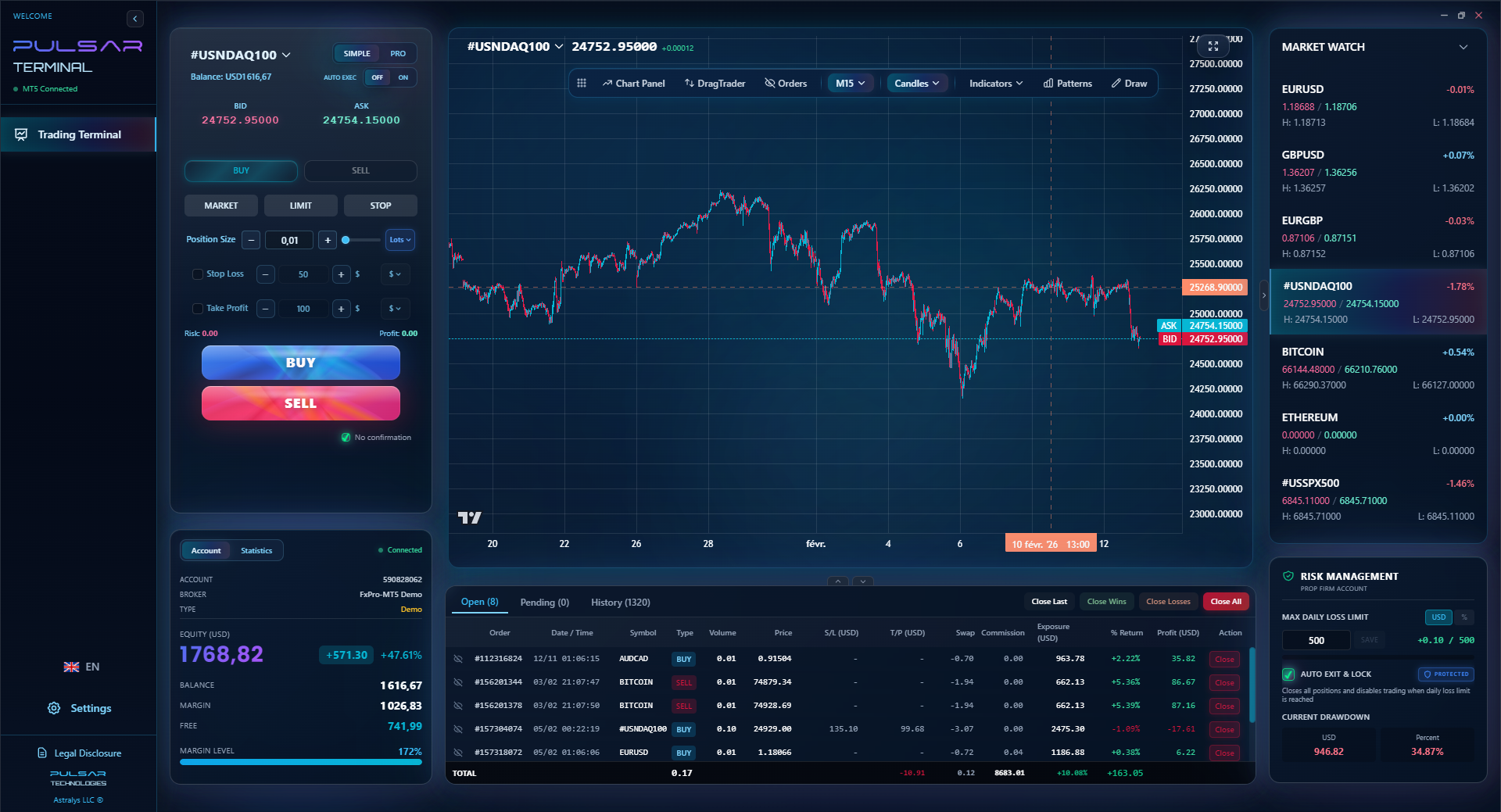
Managing multiple contracts and precise stop-losses in a fast market is critical; Pulsar Terminal's drag-and-drop order management on MT5 makes this execution seamless.
Pulsar Terminal
The all-in-one MT5 companion: drag-and-drop orders, multi-TP/SL, trailing stop, grid trading, Volume Profile, and prop firm protection. Used by 1,000+ traders daily.
“Your goal with your first live trades is not to make money, but to execute your plan flawlessly.”
It's a fair question. Here’s my blunt take:
- vs. Sovereign Gold Bonds (SGBs): SGBs are for long-term saving (8-year lock-in) with an interest bonus. MCX is for active trading and speculation. Different tools for different jobs.
- vs. Gold ETFs: ETFs track domestic physical gold prices (which now use MCX spot prices!). They're for passive, buy-and-hold investing on the stock exchange. No use, no expiry. MCX futures are for active, leveraged trading with defined expiry.
- vs. Forex/International Gold (XAU/USD): This is the big one. Trading XAU/USD on a forex broker gives you 24/5 markets, often higher use, and no compulsory delivery. But it's in dollars, subject to international broker rules, and your profit/loss is in forex, which adds another layer for Indian traders. MCX is regulated by SEBI, in rupees, and operates within Indian market hours. It's accessible. The use is lower and more regulated, which I now see as a safety feature.
I trade both. I use MCX for playing rupee-specific gold dynamics and shorter-term Indian market hours setups. I use international gold for longer-term swing trading based purely on global macro trends. MCX is my home turf.
If you're starting from zero, here's the sequence I wish I had followed:
- Open a Demat/Trading Account with a broker offering MCX. Fund it with an amount you can afford to lose completely. Start with ₹25,000-₹50,000.
- Paper Trade for a Month. Use the broker's practice platform or just a notebook. Track your hypothetical trades in the Gold Guinea or Mini contract. Test your understanding of margins, costs, and expiry. Did you remember to square off before the tender period?
- Start Live with Micro-Size. Once paper trading is consistent, go live with 1 Gold Guinea contract (8 grams). The financial risk is tiny (margin ~₹1200), but the emotional and procedural experience is real. Your goal here is not to make money, but to execute your plan flawlessly: calculate position size, place stop loss, manage the trade, square off before expiry, and review the contract note with all charges.
- Scale Up Gradually. Only move to the Gold Mini contract after you have at least 10-20 live micro trades under your belt and are comfortably profitable on paper after all costs. This patience will save you a fortune.
MCX gold trading is a serious business. It's regulated, transparent, and offers a genuine way to trade a major asset class from India. But it demands respect for its rules, an understanding of the rupee's role, and iron-clad discipline. Master those, and you have a powerful tool in your trading arsenal. Ignore them, and the market will remind you, just as it reminded me.
FAQ
Q1What is the minimum amount needed to start trading MCX gold?
There's no official minimum, but practically, you need enough to cover the margin for your chosen contract plus a buffer for losses. For the popular Gold Mini (100g), the margin is roughly ₹15,000. Most brokers recommend starting with at least ₹25,000-₹50,000 in your trading account to allow for sensible position sizing and to withstand normal market fluctuations without an immediate margin call.
Q2Can I hold MCX gold futures for the long term like an investment?
No, you cannot. Gold futures contracts have monthly expiry dates. If you hold a position into the final 'Tender Period,' you are obligated for physical delivery. Retail traders almost always square off (close) their positions before expiry and then, if they wish to maintain exposure, enter the next month's contract. This process is called 'rolling over.' It's a trading instrument, not a buy-and-hold investment like SGBs or ETFs.
Q3Why does MCX gold price sometimes not follow international gold price?
Because MCX gold is priced in Indian Rupees (INR). Its price formula is: International Gold (in USD) x USD/INR Exchange Rate. If international gold rises by 1% but the Indian rupee strengthens against the dollar by 1%, the two effects can cancel out, leaving MCX gold flat. You must always watch both the global gold trend and the USD/INR pair.
Q4What are the trading hours for MCX gold?
Trading is conducted from Monday to Friday. The standard hours are from 9:00 AM to 11:30 PM. During periods when other countries observe daylight saving time, the session is often extended to 11:55 PM. There is no trading on weekends or MCX-specified holidays.
Q5How is profit and loss calculated in MCX gold?
P&L is calculated in ticks. For the standard 1kg Gold contract, 1 tick (price movement of ₹1 per 10 grams) equals ₹100 P&L. For the Gold Mini (100g), 1 tick equals ₹10 P&L. So, if you buy Gold Mini at ₹62,000 and sell at ₹62,500, that's a 500-tick move. 500 ticks x ₹10/tick = ₹5,000 gross profit before brokerage and taxes.
Q6Which is better for a beginner: MCX Gold or Forex Gold (XAU/USD)?
For an Indian resident beginner, MCX Gold is often more accessible. It's regulated by SEBI, traded in INR, and involves well-known local brokers. Forex gold (XAU/USD) involves international brokers, currency conversion, and 24/5 markets which can be overwhelming. Start with MCX to learn the fundamentals of gold trading in a familiar environment. You can explore XAU/USD later.
Q7What happens if I don't square off my MCX gold futures before expiry?
If you hold a long position, you will be obligated to pay the full contract value and take delivery of physical gold. If you hold a short position, you must deliver physical gold. For retail traders without the intent or means to handle physical metal, this results in severe penalties, forced squaring off by the broker at potentially terrible prices, and significant financial loss. Always, always square off before the contract's tender period begins.
Prof. Winston's Lesson
Key Takeaways:
- ✓MCX gold is a futures contract with compulsory delivery; always square off before expiry.
- ✓Your true cost includes CTT (0.01% on sell side), brokerage, GST, and exchange fees.
- ✓Price is driven by global gold trends AND the USD/INR exchange rate equally.
- ✓Start with the Gold Mini contract; it's the retail trader's workhorse.
- ✓Risk a maximum of 1-2% of your capital on any single trade.
How useful was this article?
Click a star to rate
Weekly Trading Insights
Free weekly analysis & strategies. No spam.
About the Author
Rajesh Sharma
Senior Forex Analyst
Trading Indian and South Asian markets for over 10 years. Started with NSE currency derivatives before moving to international forex. Specializes in USD/INR and emerging market pairs.
Comments
Risk Disclaimer
Trading financial instruments carries significant risk and may not be suitable for all investors. Past performance does not guarantee future results. This content is for educational purposes only and should not be considered investment advice. Always conduct your own research before trading.
You Might Also Like

Cara Trading Forex Sukses: 7 Prinsip dari Trader Profesional
Cara trading forex sukses dengan 7 prinsip trader pro: manajemen modal, disiplin, journal trading, backtest. Data nyata, bukan janji profit palsu.
Jam Trading Forex Terbaik untuk Trader Indonesia: Panduan Lengkap dengan Tabel Waktu
Panduan jam trading forex untuk trader Indonesia. Tabel 4 sesi dunia, jam emas 20:00-00:00, sesi mana yang harus dihindari. Data akurat + tips dari trader berpengalaman.
Top 5 Sàn Forex Uy Tín Nhất 2026: Review Jujur dari Trader Indonesia
Top 5 sàn forex uy tín 2026 untuk trader Indonesia. Review jujur: spread, deposit, withdraw, dukungan lokal. Exness, XM, IC Markets & lebih.
Get Pulsar Terminal
All these calculators are built into Pulsar Terminal with real-time data from your MT5 account. One-click position sizing, automatic risk management, and instant calculations.
Get Pulsar Terminal