


Most Nigerian traders I meet think trading oil is just about guessing if the price will go up or down.

Olumide Adeyemi
West African Trading Pioneer ·  Nigeria
☕ 12 min read
What you'll learn:
- 1What You're Actually Trading: It's Not a Barrel of Crude
- 2Choosing a Broker in Nigeria: Regulation, Naira Accounts & Reality
- 3What Moves the Oil Price? The Fundamentals You Can't Ignore
- 4Trading Strategies & Setups That Work for Oil
- 5Risk Management: This is What Keeps You in the Game
- 6Taxes & Reporting in Nigeria: Keeping It Straight
- 7Common Mistakes to Avoid (I've Made Them All)
Most Nigerian traders I meet think trading oil is just about guessing if the price will go up or down. They jump into XTI/USD (West Texas Intermediate) or XBR/USD (Brent) without understanding the unique forces that move crude. I made that exact mistake in 2018, losing over ₦450,000 in a week by ignoring inventory reports and trading purely on chart patterns. This guide is my attempt to set the record straight. I'll show you how to trade oil in forex properly, factoring in everything from OPEC+ decisions to how Nigeria's own oil exports can ripple through your CFD positions.
Let's clear this up first. When you trade oil on a forex platform like MT4 or MT5, you're not buying physical barrels. You're trading a Contract for Difference (CFD). This is a critical distinction. You're speculating on the price movement of an underlying oil benchmark, usually Brent Crude (XBR/USD) or West Texas Intermediate (XTI/USD).
The profit or loss is the difference between your entry and exit price, multiplied by your position size. If you buy at $80.00 and sell at $81.50, you profit from that $1.50 move. It's that simple, and that complex. Because while the mechanics are straightforward, the factors moving that price are a global storm of geopolitics, supply data, and economic forecasts.
For us in Nigeria, there's an added layer. Our economy is heavily tied to oil exports. News about Nigeria's production quotas within OPEC, or pipeline disruptions in the Niger Delta, can directly impact global benchmarks, especially Brent. Trading oil from here means you have a front-row seat to some of the fundamental drivers, if you know where to look.

Warning: A CFD is a derivative. You don't own the asset. This means you can profit from prices falling (going short) as easily as from them rising. But it also means all profits and losses are cash-settled. There's no delivery date like with futures, but your broker will charge an overnight financing fee (swap) if you hold a position past the daily rollover time.

💡 Winston's Tip
Oil doesn't trade in a vacuum. Before you place a trade, check the US Dollar Index (DXY). A surging dollar can cap oil rallies, even on bullish news.
This is where many get tripped up. Forex trading is legal for individuals in Nigeria, but the local regulatory framework for online brokers is still developing. The SEC and CBN oversee the space, but most Nigerian traders I know use internationally regulated platforms. It's the practical reality.
You need a broker that accepts Nigerian residents, offers competitive conditions for commodities, and understands our local payment hurdles. Don't just chase the highest use. I learned that the hard way with a broker offering 1:2000. The use amplified my losses just as fast as it could have amplified gains. A reasonable cap, like 1:200 or 1:500, is more than enough for oil's volatility.
Key Factors for Nigerian Traders
1. Naira-Denominated Accounts: This is a game-changer for managing psychology. Seeing your balance in ₦, not $, removes the mental conversion tax. Brokers like HFM and Exness offer this. Depositing and withdrawing in Naira through local bank transfers or cards saves you from CBN's fluctuating official/parallel market rates eating into your capital.
2. Payment Methods: Can you fund your account easily? Look for brokers supporting:
- Local bank transfers (sometimes with USSD)
- Visa/Mastercard from Nigerian banks
- E-wallets like Skrill, Neteller, or Perfect Money
- Cryptocurrency (USDT is popular for its speed)
3. Costs That Matter for Oil:
- Spreads: Oil spreads aren't like EUR/USD. They're wider, often 5-10 pips during active hours. A "raw spread" account that charges a commission might be cheaper overall. Check the broker's typical spread on XTI/USD.
- Overnight Fees (Swap): Holding oil CFDs overnight incurs a fee. It can be significant. If you're a long-term swing trading oil, these fees add up. Some brokers have lower swap rates than others.
4. Platform & Tools: You'll likely use MetaTrader 5 (MT5 is better for commodities than MT4). Ensure the broker supports it. Also, check if they offer tools like an economic calendar that highlights oil-specific events (API/EIA crude inventories, OPEC meetings).
Based on my experience and community chatter, brokers like XM, Exness, and Pepperstone are consistently mentioned for reliable service here. IC Markets is another strong contender for its raw spreads. Always verify their current regulatory status and Nigeria-specific terms before depositing.

Pro Tip: Open a demo account first. Test the broker's execution speed on oil during major news events (like EIA data at 3:30 PM Nigerian time). Slippage on a demo will tell you what to expect with real money.
“Trading oil from Nigeria means you have a front-row seat to some of the fundamental drivers, if you know where to look.”
You can't trade oil successfully by just looking at an RSI indicator and calling it a day. The fundamentals are non-negotiable. Here’s what moves the needle:
1. Supply & Inventory Data: This is the weekly pulse. The American Petroleum Institute (API) and U.S. Energy Information Administration (EIA) release weekly crude oil inventory reports. A larger-than-expected build (more oil in storage) typically pushes prices down. A larger-than-expected draw (less oil) pushes prices up. I have a recurring calendar alert for Wednesdays at 3:30 PM WAT for the EIA report. The volatility in the 5 minutes after can be wild.
2. OPEC+ Decisions: The Organization of the Petroleum Exporting Countries and its allies (OPEC+) control a massive portion of global supply. Their meetings to increase, decrease, or hold production quotas are major market movers. As a Nigerian, you should pay extra attention here. Our country's production quota within OPEC directly impacts government revenue and, by extension, the Naira's strength.
3. Geopolitical Tensions: Wars, sanctions, and unrest in major oil-producing regions (Middle East, Russia, Nigeria's Niger Delta) threaten supply. Fear of disruption can spike prices even before a single barrel is lost.
4. Global Economic Health: Oil is the lifeblood of industry. Strong global economic growth suggests higher demand (bullish). Recessions suggest lower demand (bearish). Watch data from China (the largest importer) and the US.
5. The US Dollar: Oil is priced in USD. A stronger dollar makes oil more expensive for buyers using other currencies, which can dampen demand and push prices lower. It's an inverse relationship I check daily.
A Personal Lesson: In March 2026, the CBN announced that International Oil Companies (IOCs) in Nigeria could now repatriate 100% of their export earnings immediately, reversing a previous hold policy. This was a huge deal for Naira liquidity. I saw the news and immediately considered its bullish implications for global supply confidence. I didn't trade it blindly, but it framed my analysis for the week. Local news is global news for oil.
Oil has a personality. It trends strongly but can reverse violently on a headline. You need strategies that respect its volatility.
1. News Trading the EIA/API Reports
This is pure adrenaline. The strategy is to position yourself just before the data release (3:28 PM WAT) based on anticipation, or trade the immediate spike after. It's high-risk. My method is to wait 30-60 seconds after the number hits, let the initial chaotic spike settle, and then trade in the direction of the breakout from that first minute's range. Stops must be tight. I risk no more than 0.5% of my account on any single news trade.
2. Swing Trading with Trend Confirmation
This suits my style better. Oil often sets up clear trends on the 4-hour (H4) and daily charts.
- Entry: I wait for a pullback to a key support (in an uptrend) or resistance (in a downtrend) on the H4 chart. I confirm with a momentum indicator like the MACD showing a slowdown in the pullback.
- Stop Loss: I place my stop just beyond the recent swing low (for a long) or swing high (for a short). On a daily chart swing, this can be 150-300 pips away. That's why position sizing is everything. Use a position size calculator religiously.
- Take Profit: I use a risk-reward ratio of at least 1:2. For a more advanced approach, I might take partial profits at 1:1 risk, move my stop to breakeven, and let the rest run.
3. Range Trading in Consolidation
When oil isn't trending, it can box between clear support and resistance for days. The play is to sell near the top of the range and buy near the bottom. The key is identifying a genuine range, not just a small pause in a trend. I only do this on the H1 or H4 charts when the daily chart shows clear horizontal levels.

Example: In January, XTI/USD was range-bound between $72.50 and $75.00. I shorted at $74.80 with a stop at $75.30 (50 pips risk). I took half profit at $73.50 (130 pips) and moved stop to breakeven. Price hit my final target at $72.70 for a total gain of 210 pips on the second half. The position size calculator told me to trade 0.15 lots to keep my risk at ₦15,000 (1% of my account).
Remember, oil's average true range (ATR) is high. A 200-pip day is normal. Your stop losses must give the trade room to breathe, which means trading smaller lot sizes. This isn't the place for scalping 5-pip moves unless you have ice in your veins and a direct news feed.
💡 Winston's Tip
The 'spread' is your first opponent. If your broker's typical spread on XTI/USD is 8 pips, you need the market to move 8 pips just to break even. Factor this into every entry and exit plan.
“A broker offering 1:1000 use on oil is offering you a rope. You decide if it's a lifeline or a noose.”
I'll be blunt: poor risk management is why most traders blow up their accounts trading oil. The volatility is seductive but deadly. Here's my non-negotiable framework.
1. Position Sizing is Sacred: Never risk more than 1-2% of your trading capital on a single trade. For oil, I stick to 1%. If my account is ₦1,500,000, my max risk per trade is ₦15,000. If my stop loss is 200 pips away, I use a calculator to determine the lot size that makes a 200-pip loss equal to ₦15,000. This is the most important step. Do it every time.
2. Use Stop Losses. Always. There is no "let's see if it comes back." Oil can gap on weekend news. If you're long at $80 with a stop at $78.50, and it opens Sunday at $76.50, you're thankful for that stop. A mental stop is a stop you won't take. Make it an order.
3. Beware of use. A broker offering 1:1000 use on oil is offering you a rope. You decide if it's a lifeline or a noose. For a ₦100,000 account, 1:100 use means you can control a $10,000 position. That's already massive. Higher use increases your chance of a margin call. I rarely use more than 1:50 on oil trades.
4. Correlation Risk. If you have a long position on oil (XTI/USD) and you're also long on USD/CAD (as the Canadian dollar is oil-linked), you have correlated risk. A drop in oil could hit both positions. Be aware of your total market exposure.
My Worst Trade: I once risked 5% on an oil short before an OPEC meeting, convinced they would raise production. They didn't. They cut. Price spiked 400 pips against me in minutes. I lost ₦75,000 in one trade, a devastating blow to my confidence and capital. I broke every rule above. The lesson cost me dearly.
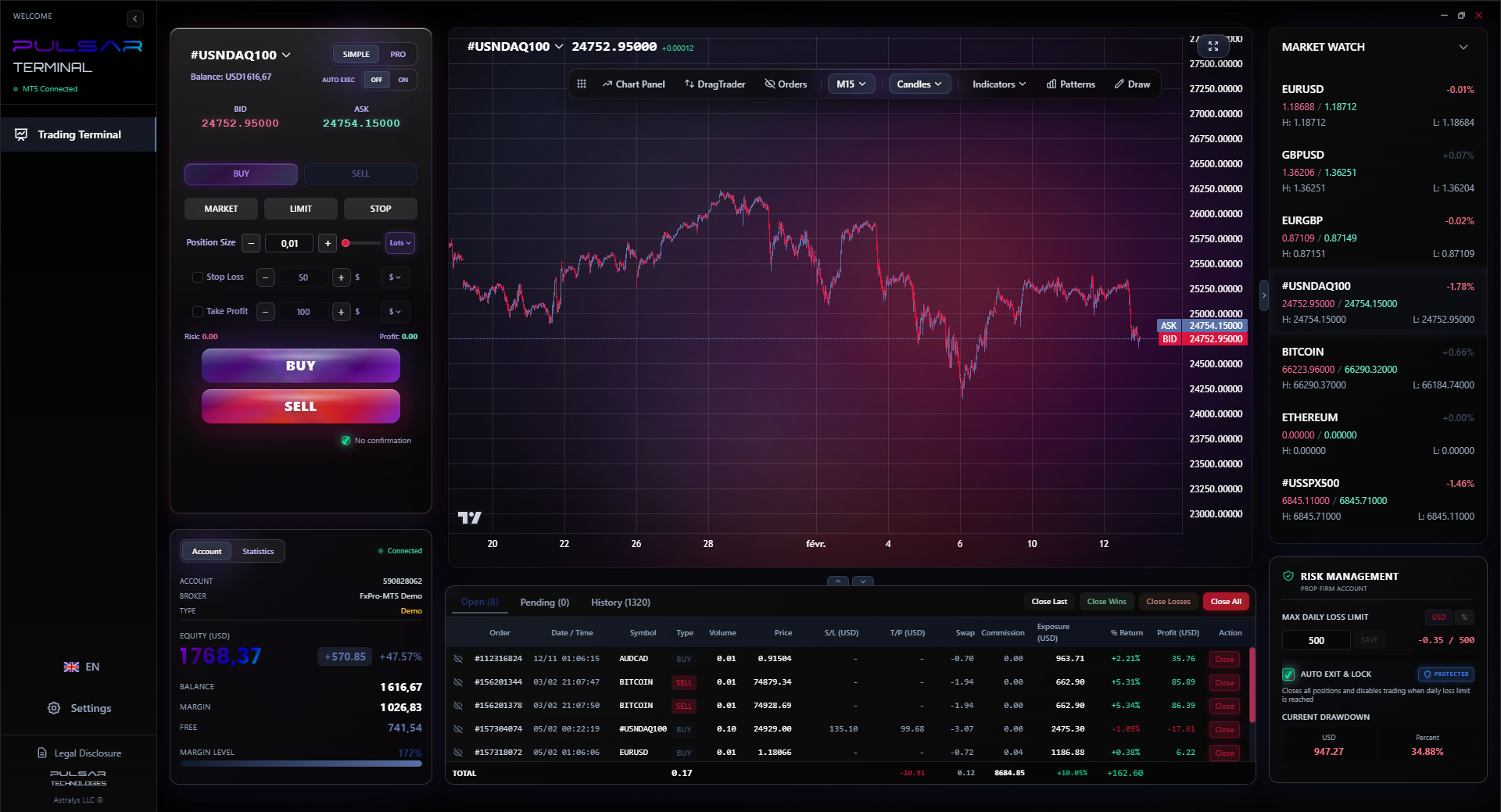
Managing multiple take-profit levels and a trailing stop on a volatile oil trade is stressful, but Pulsar Terminal lets you set the entire plan with a single drag-and-drop order directly on your MT5 chart.
Pulsar Terminal
The all-in-one MT5 companion: drag-and-drop orders, multi-TP/SL, trailing stop, grid trading, Volume Profile, and prop firm protection. Used by 1,000+ traders daily.
This is the boring but essential part. According to Nigerian law, profits from trading, including forex and CFD trading with international brokers, are considered taxable income.
Capital Gains Tax (CGT): You are typically subject to a 10% Capital Gains Tax on your net trading profits. This is payable to the Federal Inland Revenue Service (FIRS).
How to Handle It:
- Keep careful Records: Your broker statements are your source of truth. Export them monthly. Track every deposit, withdrawal, and closed trade (entry, exit, P&L).
- Calculate Net Profit Annually: At the end of the tax year, calculate your total profits minus total losses. That's your net gain.
- Consult a Professional: I am not a tax advisor. The rules can be complex, especially regarding deductions for trading expenses (internet, data, trading courses?). For significant profits, hire a Nigerian accountant familiar with forex trading. It's worth the fee for peace of mind.
The key is to be prepared. Set aside a portion of your profits (I put 15% in a separate savings account) to cover any potential tax liability. Trading successfully only to have a tax issue later is a preventable nightmare.
“Poor risk management is why most traders blow up their accounts trading oil. The volatility is seductive but deadly.”
Let me save you some pain and money.
1. Trading Around Nigerian Fuel Subsidy Announcements: The local price of petrol in Nigeria is politically set, not directly linked to Brent. A local news headline about "subsidy removal" might cause social unrest, but it doesn't necessarily mean the global Brent price will move in that moment. Don't conflate local fuel issues with global CFD prices.
2. Ignoring the Spread on Entry/Exit: Oil's spread can widen dramatically during low liquidity (Asian session, weekends). Entering a trade when the spread is 15 pips instead of 5 means you're already 10 pips in the red. Check the live spread before clicking buy or sell.
3. Chasing the News Spike: You see the EIA number is bullish and price rockets 100 pips in 10 seconds. FOMO kicks in and you buy at the top. Then it reverses and stops you out. This is the oldest trick in the book. Have a plan before the news, or stay out.
4. Not Accounting for Swap Fees for Long Holds: If you're swing trading and holding for weeks, the daily swap fee (which can be negative for longs) will eat into your profits. Factor it into your risk-reward calculation.
5. Using the Wrong Lot Size for Volatility: Treating a 50-pip stop on oil the same as a 50-pip stop on EUR/USD is a mistake. Oil's pip value is different, and its volatility is higher. Always calculate risk based on your account currency, not just pips.
Learning how to trade oil in forex is a marathon. It requires patience, discipline, and a relentless focus on the details that matter. Start small, keep a journal, and treat every trade as a lesson. The black gold isn't going anywhere, and neither should your trading capital if you manage it wisely.
FAQ
Q1Is forex and oil trading legal in Nigeria?
Yes, forex trading is legal for individuals in Nigeria. The trading of oil CFDs falls under this umbrella. The regulatory environment for local online brokers is still evolving, which is why many Nigerian traders use internationally regulated brokers that accept clients from Nigeria.
Q2What is the best time to trade oil in Nigeria?
The most volatile and liquid sessions overlap with London and New York market hours. This is from 9:00 AM WAT onwards. The key news events (EIA/API reports, OPEC announcements) typically occur in the afternoon (2:00 PM - 4:00 PM WAT). This is when you'll find the best opportunities and the tightest spreads.
Q3Should I trade Brent (XBR/USD) or WTI (XTI/USD)?
For Nigerian traders, Brent Crude (XBR/USD) is often more relevant as it's the global benchmark that prices a lot of Nigeria's crude oil exports. It's also slightly more sensitive to geopolitical events in Europe, Africa, and the Middle East. WTI is more US-focused. I suggest focusing on one to understand its specific behavior.
Q4How much money do I need to start trading oil?
You can start with a small amount due to fractional lot sizes (micro lots). Some brokers like XM or FBS allow deposits as low as $5. However, to trade oil safely with proper risk management (e.g., a 200-pip stop loss), a more realistic starting capital is at least ₦100,000 - ₦200,000. This allows you to trade small lot sizes without being wiped out by a single normal swing.
Q5How are my oil trading profits taxed in Nigeria?
Trading profits are generally subject to Capital Gains Tax (CGT) at a rate of 10%. You are responsible for declaring your net profits (total gains minus losses) to the Federal Inland Revenue Service (FIRS) and paying the applicable tax. Keep all your broker statements for record-keeping.
Q6Can I use a strategy that works for gold on oil?
Be careful. While both are commodities, they have different drivers. Gold (XAU/USD) is a safe-haven asset driven by interest rates and fear. Oil is an industrial commodity driven by supply, demand, and growth. A trend-following strategy may work on both, but the fundamental analysis behind the trade is completely different. Don't assume what works for XAU/USD will automatically work for crude.
Prof. Winston's Lesson
Key Takeaways:
- ✓Trade Brent (XBR/USD) for its direct link to Nigeria's oil economy.
- ✓Never risk more than 1% of capital on a single volatile oil trade.
- ✓Fundamentals (EIA, OPEC+) are non-negotiable for oil analysis.
- ✓Use a Naira-denominated account to simplify psychology and payments.
- ✓Set aside 15% of profits for potential 10% capital gains tax.
How useful was this article?
Click a star to rate
Weekly Trading Insights
Free weekly analysis & strategies. No spam.
About the Author
Olumide Adeyemi
West African Trading Pioneer
One of Nigeria's most active forex trading educators. 8 years of experience trading from Lagos. Specializes in low-capital strategies and prop firm challenges for African traders.
Comments
Risk Disclaimer
Trading financial instruments carries significant risk and may not be suitable for all investors. Past performance does not guarantee future results. This content is for educational purposes only and should not be considered investment advice. Always conduct your own research before trading.
You Might Also Like

Cara Trading Forex Sukses: 7 Prinsip dari Trader Profesional
Cara trading forex sukses dengan 7 prinsip trader pro: manajemen modal, disiplin, journal trading, backtest. Data nyata, bukan janji profit palsu.
Jam Trading Forex Terbaik untuk Trader Indonesia: Panduan Lengkap dengan Tabel Waktu
Panduan jam trading forex untuk trader Indonesia. Tabel 4 sesi dunia, jam emas 20:00-00:00, sesi mana yang harus dihindari. Data akurat + tips dari trader berpengalaman.
Top 5 Sàn Forex Uy Tín Nhất 2026: Review Jujur dari Trader Indonesia
Top 5 sàn forex uy tín 2026 untuk trader Indonesia. Review jujur: spread, deposit, withdraw, dukungan lokal. Exness, XM, IC Markets & lebih.
Get Pulsar Terminal
All these calculators are built into Pulsar Terminal with real-time data from your MT5 account. One-click position sizing, automatic risk management, and instant calculations.
Get Pulsar Terminal