


Most guides on how to use forex trading in Nigeria sell you a dream.

Olumide Adeyemi
West African Trading Pioneer ·  Nigeria
☕ 12 min read
What you'll learn:
- 1The Legal Reality: Trading Forex in Nigeria
- 2Brokers, Spreads, and the True Cost of Trading
- 3first-steps-platform-basics
- 4The Only Strategy That Matters: Risk Management
- 5Developing Your Edge: Price Action & Simple Indicators
- 6The Nigerian Trader's Mindset: Common Pitfalls
- 7Your Path Forward: Continuous Learning
Most guides on how to use forex trading in Nigeria sell you a dream. They talk about Lambos and quitting your job in six months. I'm here to tell you the truth: 80% of traders lose money, and in Nigeria, that number might be higher. The problem isn't a lack of opportunity - it's a lack of real, gritty, risk-first education. This guide won't make you a millionaire overnight. It will show you how to trade legally, manage your capital like a pro, and build a process that might just keep you in the game long enough to succeed.
Let's clear this up first. Yes, forex trading is legal in Nigeria. No, the government isn't about to shut down your MT5 account. The confusion comes from mixing up regulations for banks with rules for retail traders like you and me.
The Central Bank of Nigeria (CBN) cares about big-picture monetary stability and how dollars flow in and out of the country. The Securities and Exchange Commission (SEC) regulates capital markets. For you, the individual trader using your own money with an international broker? The specific rules are still developing.
Here’s what you absolutely must know:
You can use international brokers. There's no law stopping you from opening an account with a firm regulated in Cyprus, Australia, or South Africa. In fact, most serious Nigerian traders I know use brokers like IC Markets or Exness because of their tighter spreads and better platforms. The key is ensuring that broker accepts Nigerian clients, which most major ones do.
Tax is non-negotiable. This is where many get it wrong. The Federal Inland Revenue Service (FIRS) expects a 10% Capital Gains Tax on your gross trading profits. It doesn't matter if your broker is in Mauritius or your money is in a USD account. If you're making consistent income, it's taxable. Treating this as a hobby is a fast track to problems later.
Avoid 'fund management' schemes. If someone promises to trade for you with guaranteed returns, run. The SEC has been shutting down these unregistered operations. You are responsible for your own trades.

Warning: Just because you can use high use (like 1:1000 offered by some brokers) doesn't mean you should. use is the quickest way to a margin call. We'll talk about sizing later, but for now, know that legal doesn't mean safe.

💡 Winston's Tip
The market doesn't care about your rent, your bills, or your dreams. Trade the chart in front of you, not the money you need.
“You can be wrong about the market direction more often than you're right and still be profitable.”
Your broker is your gateway to the market, and your costs are your silent partner on every trade. In Nigeria, you have two main paths: a local broker regulated by the CBN, or an international broker. For active traders, international brokers usually win on cost and technology.
Let's talk numbers. When you see a price quote, the difference between the buy and sell price is the spread. This is how many "commission-free" brokers make their money.
| Broker Type | Typical EUR/USD Spread | Commission (per lot) | Real Cost for 1 Standard Lot |
|---|---|---|---|
| Standard/Commission-Free | 0.9 - 1.5 pips | $0 | $9 - $15 |
| Raw/ECN Account | 0.0 - 0.3 pips | $3 - $7 per side | $6 - $10 (spread + commission) |
A standard lot is 100,000 units of the base currency. 1 pip on EUR/USD is roughly $10.
As you can see, the "free" account often costs more. For a scalping strategy where you're in and out quickly, those wider spreads eat your profit. An ECN account with a raw spread and a small commission is usually cheaper for active trading.
My personal setup: I use a Raw Spread account with Pepperstone. On EUR/USD, I typically get a spread of 0.0 pips with a commission of $3.50 per lot, per side. So, opening and closing a 1-lot trade costs me $7. That's a known, fixed cost I can plan for.
Depositing your Naira: This is straightforward. Most brokers accept bank transfers, and many now integrate with local fintech platforms. You deposit Naira, it's converted to USD (or EUR) at a competitive rate, and you're ready to trade. Withdrawal is the reverse process. Always check your broker's specific payment page for Nigerian options.

Pro Tip: Don't choose a broker based on a $1 minimum deposit or insane use. Choose based on reliable execution, clear pricing, and a platform that doesn't freeze during news events. Read our deep XM review and others to compare.
“use is the quickest way to a margin call.”
You've got your broker. Now, the software. MetaTrader 4 (MT4) or MetaTrader 5 (MT5) are the industry standards in Nigeria and worldwide. They're reliable, and every broker supports them. Don't overcomplicate this part.
Understanding the Platform
When you open MT5, you'll see a chart, a bunch of numbers, and a ticket window. Here’s the 90% you need:
- Symbol: The pair you're trading (e.g., EURUSD).
- Bid/Ask: The price you sell at / the price you buy at.
- Volume: Trade size. Start with 0.01 lots (a micro lot). This is 1,000 units. On EUR/USD, 1 pip movement on a 0.01 lot is about $0.10. This is your training wheels size.
- Stop Loss (SL) and Take Profit (TP): These are your survival tools. You set them when you place the trade, not after. A Stop Loss automatically closes your trade at a predetermined loss level. A Take Profit does the same for a win.
My early, expensive mistake: I used to trade without a stop loss, thinking I could "watch it closely." In 2018, I was long GBP/USD. I went to make tea, and a news headline hit. In 12 minutes, I was down $1,200 on a $2,000 account. A hard lesson. Now, I never, ever place a trade without a stop loss. Use the position size calculator to figure out where to put it based on how much you're willing to risk.
What to Trade First
Stick to the majors: EUR/USD, GBP/USD, USD/JPY. They have the tightest spreads and the most liquidity, meaning the price moves smoothly. Avoid exotic pairs involving the Naira from offshore brokers; the liquidity is often poor, and spreads are massive. For a deep dive, read our specific guide on EUR/USD.
Best trading times for Nigeria: The sweet spot is between 1:00 PM and 6:00 PM West Africa Time (WAT). This is when the London session is in full swing and the New York session overlaps. The market is most active, spreads are tightest, and you get clear price movement.
“use is the quickest way to a margin call.”
Forget the fancy indicators for a second. This is the core of how to use forex trading without destroying your account. You can be wrong about the market direction more often than you're right and still be profitable. How? By risking less on losing trades than you make on winning ones.
Here’s the golden rule: Risk a maximum of 1-2% of your account balance on any single trade.
Let's say you have a ₦500,000 account (about $360). 1% of that is ₦5,000 (about $3.60). That ₦5,000 is your maximum allowed loss on the trade.
How it works in practice:
- You see a setup on EUR/USD. You decide to buy at 1.0850.
- You identify a logical level where your idea is wrong, say 1.0820. That's a 30-pip stop loss.
- You calculate your position size: Max Risk ($3.60) / (Stop Loss in Pips * Pip Value).
- Pip value for a micro lot (0.01) on EUR/USD is ~$0.10.
- $3.60 / (30 pips * $0.10) = 1.2 micro lots.
- You round down to 0.01 lots (1 micro lot). Your actual risk is now 30 pips * $0.10 = $3.00.
You've just controlled your destiny. Even if you hit 10 losing trades in a row (it happens), you're only down 10-20% of your account, not blown out. This is the discipline that separates gamblers from traders.

Example: A ₦200,000 account risking 2% per trade. Max loss per trade = ₦4,000. With a 50-pip stop loss on GBP/USD (pip value ~$0.10 for a micro lot), your max position size is ₦4,000 / (50 * ₦80 per pip approx.) = 1 micro lot. This keeps you alive.
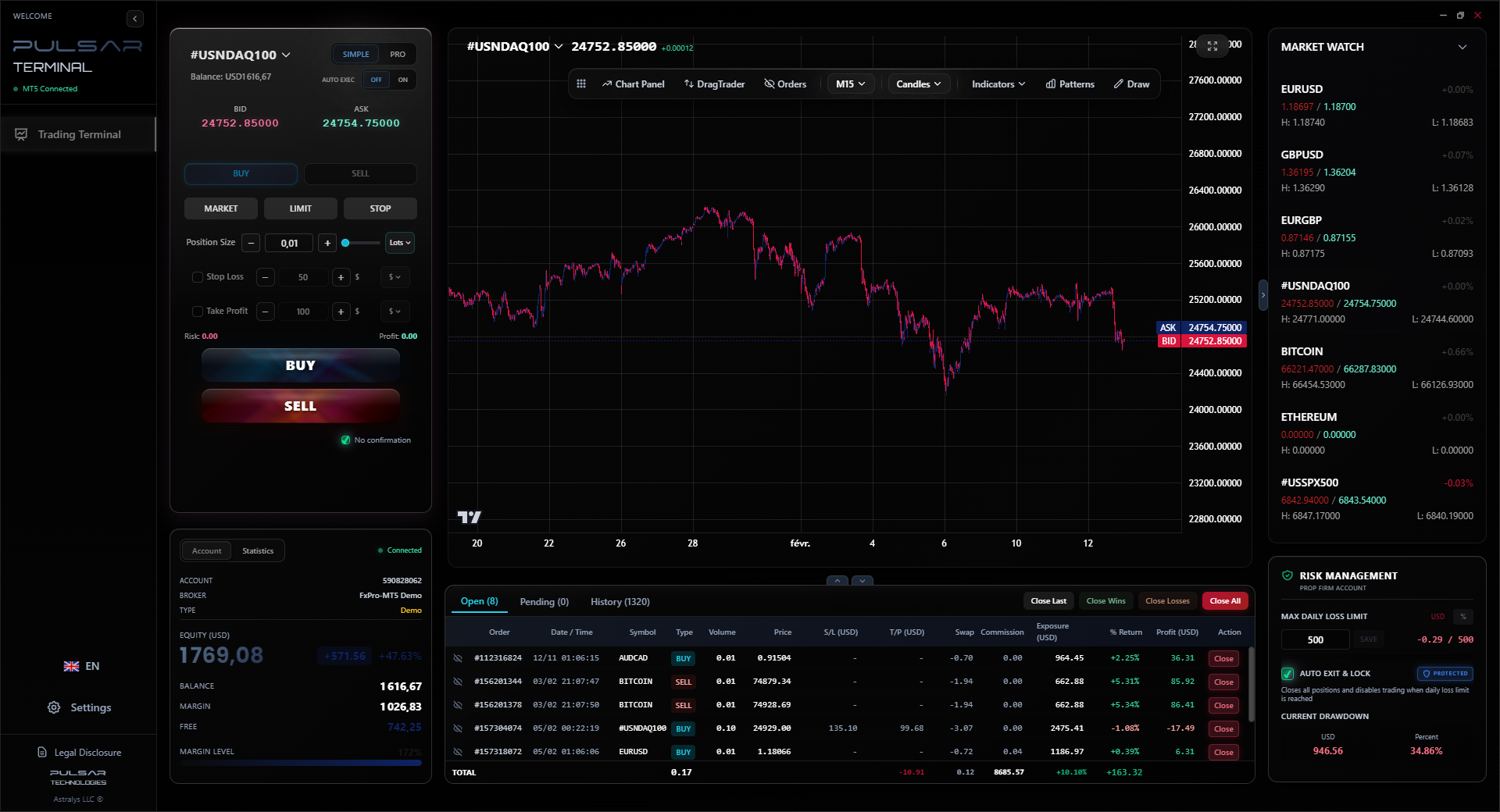
Profit Targets: Aim for a risk-to-reward ratio of at least 1:1.5. If you risk 30 pips, your take profit should be 45 pips away. This means you can be profitable even if you win only 40% of your trades. Tools like Pulsar Terminal let you set multiple take-profit levels and move your stop loss to breakeven automatically, which is a game-saver.
💡 Winston's Tip
Your first profitable system will be boring. It will involve waiting for one clear setup and repeating it. Excitement is expensive in this business.
Managing multiple take-profit levels and moving stops to breakeven manually is error-prone; Pulsar Terminal automates these risk management tasks directly on your MT5 chart.
Pulsar Terminal
The all-in-one MT5 companion: drag-and-drop orders, multi-TP/SL, trailing stop, grid trading, Volume Profile, and prop firm protection. Used by 1,000+ traders daily.
“Trade to follow a good process, not to hit a monetary target.”
Now for the analysis part. You don't need 20 indicators cluttering your screen. You need to learn to read what price is telling you. This is called price action.
Start with support and resistance. These are price levels where the market has historically paused or reversed. Draw horizontal lines on your chart where price has bounced multiple times. That's it. Trade the bounces or the breaks of these levels.
Combine with one or two indicators for confirmation:
- Moving Averages: I use a simple 50-period and 200-period Exponential Moving Average (EMA) on the 1-hour chart. If price is above both, the short-term and long-term trend is up. I only look for buy setups. This keeps me on the right side of the market.
- RSI Indicator: I use it to spot potential reversals when price hits a key support or resistance. If price is at a strong resistance level and the RSI is above 70 (overbought), it might be a signal to look for a sell, not a buy.
A real trade from last month: EUR/USD was in a clear uptrend on the 4-hour chart, trading above the 50 EMA. It pulled back to a previous support level at 1.0720. The RSI dipped near 40 (not oversold, but showing a pullback). I placed a buy order at 1.0725 with a stop loss at 1.0695 (30 pips risk). My take profit was at 1.0785 (60 pips target, a 1:2 risk-reward). The trade hit my target in about 36 hours. I risked 1.5% of my account to make 3%. That's the process.
Avoid the noise. Economic calendars are important, but as a beginner, maybe avoid trading the minute major US employment data drops. The volatility is insane. For a swing trading approach, you can place trades based on your analysis and hold for days, avoiding intraday chaos.
“Trade to follow a good process, not to hit a monetary target.”
The charts are the same in Lagos as in London. The psychology traps are universal, but some have a local flavor.
1. The 'Get-Rich-Quick' Pressure: With economic pressures, there's a temptation to turn a small account into life-changing money fast. This leads to over-trading and massive position sizes. I've seen guys try to turn ₦100k into ₦1 million in a month. They're usually out of the game in two weeks. Trade to follow a good process, not to hit a monetary target.
2. Revenge Trading: You take a loss. It stings. So you jump right back in with a bigger size to "make it back." This is emotional, not analytical. It's a surefire way to compound losses. After a loss, my rule is to close the platform for at least an hour.
3. Following 'Signals' Blindly: WhatsApp and Telegram groups are full of self-proclaimed gurus selling signals. Even if they are legit sometimes, you don't learn anything, and you have no idea about their risk management. If you must follow a signal, apply your own risk rules to it. Use your 1% rule on their idea.
4. Ignoring the Tax Man: Thinking, "It's just $100 profit, who will know?" is short-sighted. Build the habit of tracking your trades from day one. A simple spreadsheet with entry, exit, profit/loss, and running total is enough. When the time comes, you're prepared.
The market is a mirror. It exposes your impatience, greed, and fear. The goal isn't to eliminate emotion but to build a system (like the 1% risk rule) that operates despite it.
💡 Winston's Tip
Track your net profit/loss weekly, but only review your trade *decisions* monthly. Daily P/L is just noise that leads to emotional reactions.
“The goal isn't to eliminate emotion but to build a system that operates despite it.”
This guide is a foundation, not the finish line. How to use forex trading is a skill you refine over years, not weeks.
Build a Trading Journal: This is non-negotiable. For every trade, note:
- Date, pair, direction (buy/sell)
- Entry price, Stop Loss, Take Profit
- Position size and % risked
- Reason for the trade (e.g., "Bounce off 50 EMA at support")
- Screenshot of the chart
- Outcome and P/L
- What you learned. This last one is key. Did you move your stop loss? Did you exit early? Be brutally honest.
Educate Yourself with Quality Resources:
- Books: Trading in the Zone by Mark Douglas (for psychology). The Candlestick Trading Bible for price action basics.
- Analyze Your Trades: Once a month, review your journal. Look for patterns. Are your losing trades all from a certain type of setup? Are you consistently cutting winners short? The journal holds the answers.
Consider Gold (XAU/USD): Once you're comfortable with forex, you might look at commodities. Gold (XAU/USD) often moves inversely to the US dollar and can be a good diversifier. It's more volatile, so adjust your position sizing accordingly. We have a dedicated XAU/USD guide when you're ready.
Finally, remember this is a marathon. There will be losing months. The goal is to end the year in the green. Protect your capital first, be patient, and let the profits come as a result of your discipline. That's how you really use forex trading.
FAQ
Q1Is forex trading illegal in Nigeria?
No, it is perfectly legal for individuals to trade forex with their personal funds using licensed local brokers or reputable international brokers that accept Nigerian clients. The illegality comes from unregistered entities soliciting public funds for trading with guaranteed returns.
Q2How much money do I need to start forex trading in Nigeria?
You can start with a very small amount, as some brokers have minimum deposits as low as $5 or $10. However, to practically apply proper risk management (like the 1% rule), a more realistic starting capital is at least ₦100,000 - ₦200,000. This allows you to trade micro lots and withstand normal market volatility without being wiped out by a few losses.
Q3How do I pay taxes on my forex trading profits in Nigeria?
You are required to pay a 10% Capital Gains Tax on your gross trading profits to the Federal Inland Revenue Service (FIRS). It is your responsibility to keep accurate records of all your trades and declare the income. Consult with a local tax professional for specific filing procedures.
Q4What is the best time of day to trade forex in Nigeria?
The most active and liquid trading session for Nigerian traders is between 1:00 PM and 6:00 PM West Africa Time (WAT). This overlaps with the late London session and the opening of the New York session, leading to higher volatility and better trading opportunities, especially on major pairs like EUR/USD and GBP/USD.
Q5Which is better for beginners, MT4 or MT5?
For a pure forex beginner, MT4 is simpler and has all the necessary tools. MT5 is more powerful and can handle more asset classes (like stocks), but its interface is slightly more complex. Most educational material is based on MT4. You can't go wrong starting with MT4.
Q6Can I trade the Naira (NGN) on international forex platforms?
Generally, no. Major international brokers like IC Markets or Pepperstone do not offer NGN-based currency pairs (like NGN/USD) for speculative trading. You trade major, minor, and exotic pairs involving other global currencies. You deposit and withdraw in Naira, but your trading account is denominated in USD, EUR, or GBP.
Q7What is a pip and how is it calculated?
A pip (percentage in point) is the standard unit for measuring price movement. For most pairs (like EUR/USD), a pip is a 0.0001 change. For JPY pairs (like USD/JPY), it's a 0.01 change. The monetary value of a pip depends on your trade size (lot size). On a standard lot (100,000 units), 1 pip on EUR/USD is worth about $10. On a micro lot (0.01 lots), it's about $0.10. Use our pip definition guide for more detail.
Prof. Winston's Lesson
Key Takeaways:
- ✓Risk a maximum of 1-2% of your account per trade.
- ✓Always use a stop loss. No exceptions.
- ✓Aim for a risk-to-reward ratio of at least 1:1.5.
- ✓Trade major pairs (EUR/USD) during the 1 PM - 6 PM WAT overlap.
- ✓Pay your 10% capital gains tax. Keep records.
How useful was this article?
Click a star to rate
Weekly Trading Insights
Free weekly analysis & strategies. No spam.
About the Author
Olumide Adeyemi
West African Trading Pioneer
One of Nigeria's most active forex trading educators. 8 years of experience trading from Lagos. Specializes in low-capital strategies and prop firm challenges for African traders.
Comments
Risk Disclaimer
Trading financial instruments carries significant risk and may not be suitable for all investors. Past performance does not guarantee future results. This content is for educational purposes only and should not be considered investment advice. Always conduct your own research before trading.
You Might Also Like

Cara Trading Forex Sukses: 7 Prinsip dari Trader Profesional
Cara trading forex sukses dengan 7 prinsip trader pro: manajemen modal, disiplin, journal trading, backtest. Data nyata, bukan janji profit palsu.
Jam Trading Forex Terbaik untuk Trader Indonesia: Panduan Lengkap dengan Tabel Waktu
Panduan jam trading forex untuk trader Indonesia. Tabel 4 sesi dunia, jam emas 20:00-00:00, sesi mana yang harus dihindari. Data akurat + tips dari trader berpengalaman.
Top 5 Sàn Forex Uy Tín Nhất 2026: Review Jujur dari Trader Indonesia
Top 5 sàn forex uy tín 2026 untuk trader Indonesia. Review jujur: spread, deposit, withdraw, dukungan lokal. Exness, XM, IC Markets & lebih.
Get Pulsar Terminal
All these calculators are built into Pulsar Terminal with real-time data from your MT5 account. One-click position sizing, automatic risk management, and instant calculations.
Get Pulsar Terminal