


Thinking about parking some cash in gold through an ETF? You're probably looking at the IDBI Gold Exchange Traded Fund and wondering if it's the smart move.

Rajesh Sharma
Senior Forex Analyst ·  India
India
☕ 10 min read
What you'll learn:
- 1What Exactly Is the IDBI Gold ETF?
- 2The Real Cost: Fees, Taxes, and What Eats Your Returns
- 3Performance & The Tracking Error Trap
- 4IDBI Gold ETF vs. The Alternatives
- 5The 2026 SEBI Rule Change: What It Means For You
- 6How to Buy, Sell, and a Simple Trading Strategy
- 7Final Verdict: Pros, Cons, and Who Should Buy It
Thinking about parking some cash in gold through an ETF? You're probably looking at the IDBI Gold Exchange Traded Fund and wondering if it's the smart move. As someone who's traded everything from physical bullion to futures, I can tell you Indian Gold ETFs are a different beast. They're convenient, sure, but the devil's in the details - the expense ratios, the tracking error, and now, a massive regulatory shift that changes how they're priced. Let's cut through the marketing and see what this fund is really made of.
Forget the fancy terminology. The IDBI Gold Exchange Traded Fund is basically a basket. When you buy a unit, you're buying a tiny, tradable slice of physical gold bars sitting in a vault. One unit is meant to represent one gram of gold. You don't have to worry about purity, storage, or insurance - the fund does that. You just buy and sell it on the NSE or BSE like any other stock, through your demat account.
The key here is that it's a passive fund. Its only job is to mirror the price of domestic gold. It doesn't try to beat the market. Its success is measured by how closely it tracks that price, minus its fees. That's where terms like 'tracking error' become critical, which we'll get to.

Warning: Don't confuse this with a Gold Fund of Funds (FoF). That's a mutual fund that invests in this ETF. You pay two layers of fees. If you want direct exposure, you buy the ETF itself.
This is where most investors get blindsided. The headline return is never what you pocket.
The Obvious Fee: Expense Ratio The IDBI Gold ETF charges 0.35% per year. On a ₹1 lakh investment, that's ₹350 gone annually, whether the price goes up or down. It's deducted from the fund's Net Asset Value (NAV) daily, so you never see a bill. Compared to some actively managed funds, it's low. But in the world of passive tracking, every basis point matters. A 0.5% difference over 20 years can gut your final return.
The Hidden Transaction Costs You'll pay brokerage when you buy and sell (often around 0.5% or less). There's the Securities Transaction Tax (STT). Then there's the bid-ask spread - the difference between the buying and selling price at any moment. In a liquid ETF like this, it's usually tight, but during volatile market opens, it can widen.
The Tax Man Cometh This is crucial for your profit calculation. Gold ETF taxation changed recently.
- Short-Term Capital Gains (STCG): Sell within 24 months? Your profit gets added to your income and taxed at your slab rate. Could be 30%+. Ouch.
- Long-Term Capital Gains (LTCG): Hold for over 24 months? It's a flat 12.5% tax on the gain. No indexation benefit anymore. You need significant growth to offset this.

Example: You buy at ₹5,000/unit, sell at ₹7,000/unit after 3 years. Gain = ₹2,000. LTCG Tax = 12.5% of ₹2,000 = ₹250. Your real gain after this tax is ₹1,750.
Always run your potential trade through a position size calculator that includes transaction costs and taxes. What looks like a 10% win might only be 6% in your pocket.

💡 Winston's Tip
Gold ETFs are for price exposure, not for yield. If you're buying it, you're betting purely on the price of gold going up. Don't expect dividends to cushion your wait.

“The IDBI Gold ETF is a sharp tool for a specific job: providing efficient, liquid access to Indian gold prices.”
Look at the numbers: 48.94% over one year (as of Sep '25), 28.64% over five. Impressive, right? But you must ask: did it match the actual price of gold?
That's what tracking error measures. It's the standard deviation of the difference between the fund's returns and the gold price it's supposed to follow. A lower number is better. IDBI's 1-year tracking error was 0.128. That's actually pretty decent in the ETF world. It means the fund is doing its job efficiently.
But here's the new twist, and it's a big one. Starting April 1, 2026, SEBI has forced all Gold ETFs to ditch the London (LBMA) benchmark price. They now have to use domestic spot prices from Indian exchanges like MCX.
Why this matters: The LBMA price was a global benchmark. The MCX price includes local factors - import duties, GST, and regional supply/demand. This change should, in theory, make the NAV more accurate to what it would actually cost to replace the gold in India. For a fund like IDBI Gold ETF, it means its tracking target has shifted. Its historical tracking error data is based on the old system. We need to watch the first few months of 2026 to see how smoothly it adapts. A period of higher tracking error is possible as the system beds in.
I made a mistake early on by not monitoring tracking error on a commodity ETF I traded. I assumed the 2% annual underperformance was just 'noise.' It wasn't. It was consistent fund drag. Don't ignore it.

Gold isn't just gold in India. You've got options. Let's stack them up.
| Feature | IDBI Gold ETF | Physical Gold (Jewellery/Coins) | Sovereign Gold Bonds (SGBs) |
|---|---|---|---|
| Ownership | Paper unit backed by physical | Direct physical possession | Government bond linked to gold |
| Purity/Quality | Assured (99.5%) | Varies, making charges apply | Not applicable |
| Liquidity | High (Sell on exchange instantly) | Low (Finding a buyer, valuation issues) | Moderate (Trade on exchange after lock-in) |
| Storage Risk | None (Fund's vault) | High (Theft, damage) | None |
| Extra Costs | Expense Ratio (0.35%), Brokerage | Making charges (8-15%), Storage insurance | None |
| Additional Return | None | None (Sentimental value only) | 2.5% annual interest |
| Taxation (LTCG) | 12.5% (No indexation) | 12.5% (With indexation benefit) | Tax-free if held to maturity (8 yrs) |
| Best For | Short-to-medium term traders, liquidity seekers | Cultural/ceremonial needs, distrust of paper | Long-term (8-year) buy-and-hold investors |
The Verdict: If you're a trader or want tactical exposure to gold prices over a few months to a couple of years, the IDBI Gold ETF is your tool. The liquidity is unmatched. You can get in and out with a click.
If you're investing for a decade or more, SGBs are mathematically superior due to the interest and tax-free maturity. But you're locked in. Physical gold is an emotional and cultural asset, not a financially efficient one.
For active traders, the intraday moves in an ETF can be paired with strategies like scalping on liquid instruments, though the spread needs watching.
“A 0.5% difference in fees over 20 years can gut your final return. In passive investing, every basis point is a war.”
This isn't just bureaucratic noise. The SEBI mandate effective April 1, 2026, changes the foundation.
1. New Valuation: Domestic Price. As mentioned, NAV is now based on MCX/BSE prices, not London. This should reduce a hidden risk: currency mismatch. Before, the fund held gold in India but valued it in USD via LBMA. Rupee volatility could cause the NAV to diverge from local gold prices. Now, it's aligned. For you, the investor, the reported NAV should more accurately reflect what you'd pay for gold at a local jeweller (excluding making charges).
2. Stricter Asset Rules. The fund must hold at least 95% in physical gold or approved instruments (Gold Deposit Scheme, etc.). There are caps on how much can be in these alternative instruments. This rule tightens the link between the paper unit and the real metal. It's meant to prevent fund managers from getting cute and taking on extra risk.
The Bottom Line: These changes increase transparency and reduce structural risks. They make Gold ETFs like IDBI's a purer play on Indian gold prices. It's a positive for investors. However, during the transition, keep an eye on that tracking error. Any operational hiccups at the fund level will show up there.

Pro Tip: After April 2026, when you check gold prices to compare, use the MCX Spot Gold quote, not an international website. That's your new benchmark.
💡 Winston's Tip
The new domestic pricing rule is a silent killer for international gold price comparisons. Your charting software default might be wrong. Always verify your benchmark.
Getting Started:
- You need a demat and trading account. Most folks use Zerodha, Groww, or their traditional bank's brokerage.
- Fund the account via UPI or net banking.
- Search for "IDBIGOLD" or its ISIN on your trading platform.
- Buy at least 1 unit. That's it.
A Basic, Risk-Aware Strategy: I'm not a fan of blindly buying and holding gold. It can go sideways for years. Here's a more tactical approach using simple tools.
The 200-Day SMA Filter:
- Plot a 200-day Simple Moving Average (SMA) on the IDBI Gold ETF chart.
- Rule: Only consider long positions when the ETF price is above the 200-day SMA. This keeps you on the right side of the medium-term trend.
- Entry/Exit: Don't get fancy. Use a break of a recent swing high (for entry) or a break below a recent swing low (for exit). Combine this with the RSI indicator to avoid buying when it's wildly overbought (>70).
My Experience: In late 2023, the ETF was grinding below its 200-day SMA. I stayed out. It finally broke and closed above in Jan 2024 around ₹5,400. I took a position. The trend was firm, so I used a trailing stop loss (a tool that automatically moves the stop loss up as the price rises). I exited in April near ₹6,100 when the price broke its steep uptrend line. Not a home run, but a clean 13% gain in the direction of the trend.
The key is patience and avoiding the urge to 'catch the bottom.' Let the trend confirm itself. This is a form of swing trading applied to a passive asset. And for god's sake, always know your margin call level if you're using any use, though I don't recommend it with this asset.

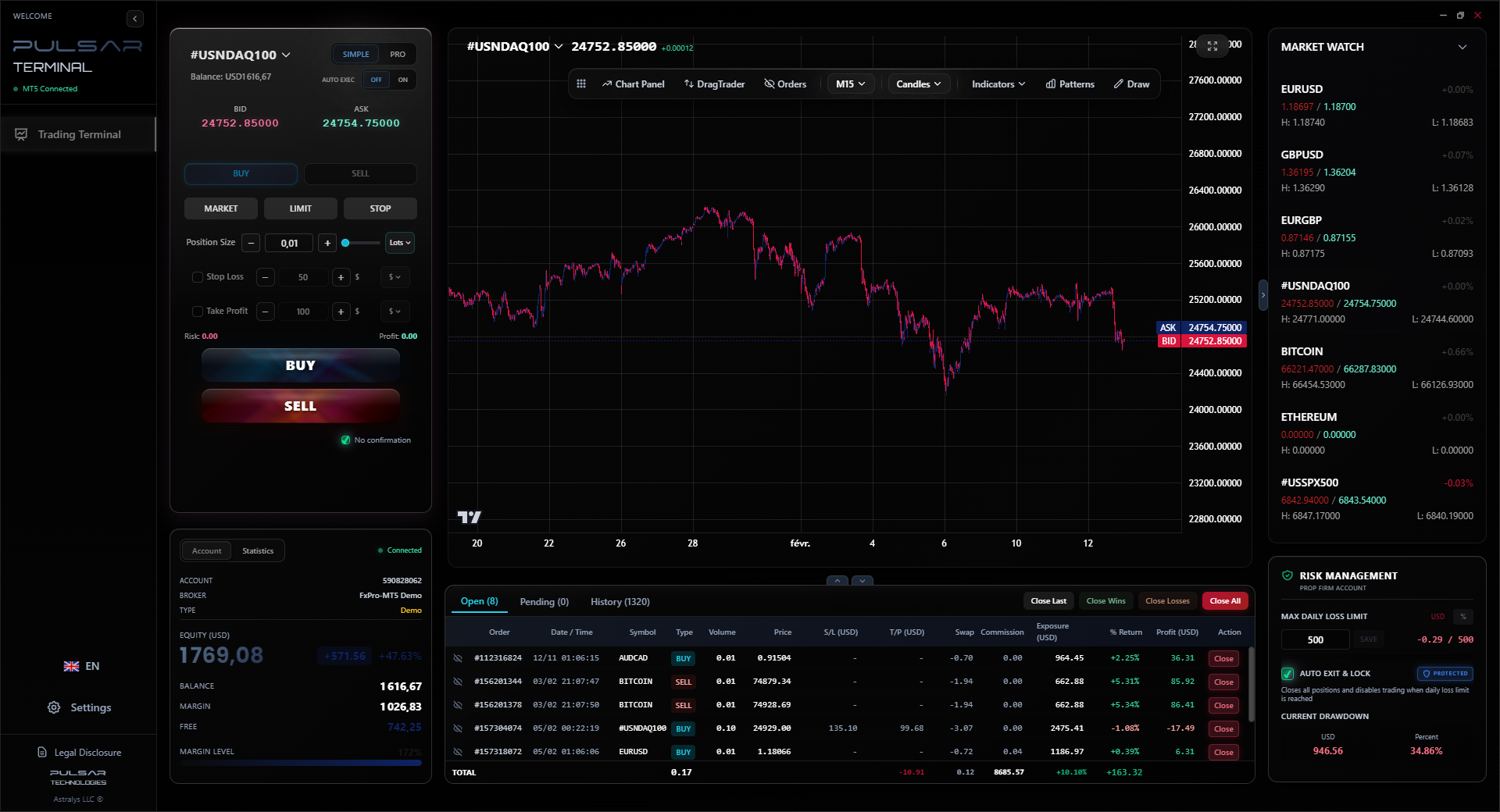
Executing a disciplined trend-following strategy on an ETF like this requires precise order management, which is where a tool like Pulsar Terminal for MT5 shines.
Pulsar Terminal
The all-in-one MT5 companion: drag-and-drop orders, multi-TP/SL, trailing stop, grid trading, Volume Profile, and prop firm protection. Used by 1,000+ traders daily.
“Jewellery is for adornment; the ETF is for financial exposure. Confuse the two and your portfolio will pay the making charges.”
After all this, is the IDBI Gold Exchange Traded Fund a buy?
Pros:
- High Liquidity: You're not stuck. Sell anytime the market's open.
- Low Cost (Relatively): 0.35% is competitive in the Indian Gold ETF space.
- Convenience & Safety: No physical handling. Purity is guaranteed.
- Transparent: Holdings are disclosed, and new SEBI rules make pricing clearer.
- Good Tracker: Historically low tracking error means it does its job well.
Cons:
- No Extra Yield: It's just gold. No dividends, no interest.
- Tax Inefficiency: LTCG at 12.5% without indexation is worse than physical gold or SGBs.
- Still a Fee: 0.35% annually is a drag that compounds over time.
- Paper Asset Risk: You rely on the fund's integrity and custody. (Extremely low risk, but non-zero).
Who is this for?
- The short-to-medium term trader who wants exposure to gold price moves.
- The portfolio diversifier looking to allocate 5-15% to gold for hedging, without the hassle of physical.
- Someone using a tactical asset allocation model, moving in and out of gold based on macroeconomic views.
Who should avoid it?
- The ultra-long-term (10+ year) investor. Go for Sovereign Gold Bonds.
- Anyone seeking income from their investment.
- Investors who get psychological comfort from holding physical metal.
My take? The IDBI Gold Exchange Traded Fund is a solid, well-run vehicle. It's a sharp tool for a specific job. It's not the best long-term store of value (SGBs win), nor is it a thrilling trade like XAU/USD. But for what it aims to do - provide efficient, liquid access to Indian gold prices - it does it very well. Just go in with your eyes open to the costs and tax implications.
💡 Winston's Tip
Liquidity is the ETF's superpower. Use it. Have an exit plan before you enter. A trapped position in an illiquid asset is a nightmare you can avoid here.

FAQ
Q1What is the minimum investment in IDBI Gold ETF?
You can buy just one unit, which is roughly equivalent to one gram of gold. With the NAV around ₹14,400 (as of Mar '26), that's your minimum entry point. Some brokers also offer SIPs in Gold ETFs, where you can start with smaller periodic amounts, but that's often through a Fund of Funds structure, not direct ETF units.
Q2How is the IDBI Gold ETF taxed?
If you sell units within 24 months of purchase, the profit is added to your income and taxed at your income tax slab rate. If you hold for more than 24 months, it's considered a Long-Term Capital Gain (LTCG) and taxed at a flat rate of 12.5%. There is no benefit of indexation for Gold ETFs. Remember, Securities Transaction Tax (STT) also applies on both buy and sell transactions.
Q3Can I get physical gold from my IDBI Gold ETF units?
As a retail investor, almost certainly not. The direct redemption of units for physical gold is a process reserved for large entities called Authorised Participants, who deal in massive 'Creation Unit' sizes (often worth crores of rupees). You, the retail investor, will simply sell your units on the stock exchange for cash. The liquidity is designed to make this cash sale your exit route.
Q4What is tracking error and why does it matter?
Tracking error measures how closely the ETF's returns follow the returns of the underlying asset (domestic gold price). A low tracking error (like IDBI's 0.128 for 1-year) means the fund is efficient. A high one means it's consistently lagging or deviating from the gold price, which erodes your returns over time. It's a critical metric for any passive fund.
Q5How does the new SEBI rule (April 2026) affect my investment?
The rule changes the benchmark price from London (LBMA) to Indian exchanges (MCX/BSE). This should make the ETF's Net Asset Value (NAV) more accurately reflect the true local cost of gold, including duties and taxes. For you, it means the price you see should be more transparent. It's a positive change, but monitor the fund's tracking error during the transition period to ensure a smooth shift.
Q6Is IDBI Gold ETF better than buying gold jewellery?
As a financial investment, yes, unequivocally. Jewellery has making charges (8-15% loss upfront), storage risk, and purity concerns. The ETF has a low expense ratio (0.35%), assured purity, and instant liquidity. Jewellery is for adornment and ceremony; the ETF is for financial exposure to gold's price.
Q7Can I trade the IDBI Gold ETF intraday?
Yes, absolutely. Since it trades on the stock exchange like a share, you can buy and sell it within the same trading day (9:15 AM to 3:30 PM IST). This makes it suitable for very short-term trading strategies, though you must be mindful of the bid-ask spread and brokerage costs on such frequent trades.
Prof. Winston's Lesson
Key Takeaways:
- ✓The 0.35% expense ratio is a silent annual drag on returns.
- ✓LTCG tax is 12.5% with no indexation benefit for Gold ETFs.
- ✓Post-April 2026, benchmark is domestic MCX price, not London.
- ✓Tracking error below 0.15% is efficient; monitor it post-rule change.
- ✓Superior liquidity allows for tactical entry and exit.
How useful was this article?
Click a star to rate
Weekly Trading Insights
Free weekly analysis & strategies. No spam.
About the Author
Rajesh Sharma
Senior Forex Analyst
Trading Indian and South Asian markets for over 10 years. Started with NSE currency derivatives before moving to international forex. Specializes in USD/INR and emerging market pairs.
Comments
Risk Disclaimer
Trading financial instruments carries significant risk and may not be suitable for all investors. Past performance does not guarantee future results. This content is for educational purposes only and should not be considered investment advice. Always conduct your own research before trading.
You Might Also Like

Cara Trading Forex Sukses: 7 Prinsip dari Trader Profesional
Cara trading forex sukses dengan 7 prinsip trader pro: manajemen modal, disiplin, journal trading, backtest. Data nyata, bukan janji profit palsu.
Jam Trading Forex Terbaik untuk Trader Indonesia: Panduan Lengkap dengan Tabel Waktu
Panduan jam trading forex untuk trader Indonesia. Tabel 4 sesi dunia, jam emas 20:00-00:00, sesi mana yang harus dihindari. Data akurat + tips dari trader berpengalaman.
Top 5 Sàn Forex Uy Tín Nhất 2026: Review Jujur dari Trader Indonesia
Top 5 sàn forex uy tín 2026 untuk trader Indonesia. Review jujur: spread, deposit, withdraw, dukungan lokal. Exness, XM, IC Markets & lebih.
Get Pulsar Terminal
All these calculators are built into Pulsar Terminal with real-time data from your MT5 account. One-click position sizing, automatic risk management, and instant calculations.
Get Pulsar Terminal