


Let's be real.

Olumide Adeyemi
West African Trading Pioneer ·  Nigeria
☕ 11 min read
What you'll learn:
- 1What 'Instant Forex' Really Means (And What It Doesn't)
- 2The Legal Grey Area & Choosing Your Broker
- 3Setting Up for Success: Realistic Expectations & Mindset
- 4Practical Trading Strategies for the Instant Environment
- 5Risk Management: The Non-Negotiable Pillar
- 6Technology & Tools You Actually Need
- 7Common Pitfalls Every Nigerian Trader Must Avoid
- 8Your First Steps to Get Started (The Right Way)
Let's be real. The promise of 'instant forex' in Nigeria is a magnet for get-rich-quick dreams. Everywhere you look, there's an ad showing a guy on a new iPhone, chilling in a fancy car, all thanks to 'trading'. I'm here to tell you that 90% of that is pure fantasy, and chasing it will burn your capital faster than a power surge fries a phone charger. But here's the other side of the coin: the ability to trade global markets from your phone in Lagos or Port Harcourt is a real, powerful tool. This guide isn't about selling you a dream. It's about showing you the actual, gritty path to using instant forex properly - covering the legal murkiness, the brokers that actually work here, and the strategies that don't rely on luck.
When Nigerians talk about 'instant forex', we're usually mixing two things together. First, there's the technological side: the ability to open and close trades in seconds using a broker's app or platform like MT5. That part is genuinely instant. The second, more dangerous meaning is the illusion of instant wealth. That's the one that gets people into trouble.
Technologically, it's incredible. I remember sitting in traffic on the Third Mainland Bridge, watching a news alert about US inflation data. Within 30 seconds, I had my phone out, analyzed the EUR/USD reaction on a 5-minute chart, and placed a short trade. The trade was open and running before the traffic even moved. That's the power we have access to.
But the moment you confuse fast execution with fast profits, you've lost. The market doesn't care how quickly you can tap your screen. It moves on its own time. Thinking 'instant' applies to your account balance is the number one reason new traders blow up their first, second, and third deposits.

Warning: The most dangerous phrase in trading is 'just one more trade to get back to even.' Instant access makes this trap infinitely easier to fall into. You can revenge-trade your entire account away in an afternoon if you're not disciplined.

💡 Winston's Tip
Your first profit is luck. Your hundredth profit is a system. Never confuse the two.
This is the part that confuses everyone. Is forex trading legal in Nigeria? Yes, for you as an individual, it is. The Central Bank of Nigeria (CBN) isn't going to kick down your door because you're trading GBP/USD. Their focus is on the official exchange rate and the banking system. The Securities and Exchange Commission (SEC) is more relevant, but their specific rules for retail forex brokers are still, let's say, 'under development'.
What does this mean for you? It means you are largely on your own when it comes to broker safety. There is no Nigerian 'NSE' for forex that guarantees your funds. This makes your choice of broker the most important financial decision you'll make, even before your first trade.
You must use an international broker with a strong, external regulatory license (like ASIC in Australia or FSCA in South Africa). These entities have client money protection rules. I learned this the hard way early on. I funded an account with a 'broker' that had a slick .ng website and local ads. When I tried to withdraw $500 of my $700 profit, the process took weeks, involved endless 'verification,' and I finally got a partial payment before they stopped responding. That was a cheap lesson. Some have lost millions of Naira.
Brokers That Actually Work for Nigerians
Based on my experience and that of a network of serious traders here, these international brokers reliably accept Nigerian clients and have decent withdrawal processes:
- Exness: Popular for its variety of account types. Their withdrawals to Nigerian bank accounts have been consistently reliable for me, often within a few hours for smaller amounts.
- IC Markets: Known for raw spreads and good execution. A favorite for scalping strategies.
- XM: Offers good educational resources for beginners.
- Pepperstone: Another solid, well-regulated option with a strong platform.
Your funding route will typically be through cryptocurrency (USDT is king) or sometimes direct bank card payments. Withdrawals are usually back to your crypto wallet or, with some brokers, directly to your Nigerian bank account in Naira (they handle the conversion).

Pro Tip: Before you deposit a single kobo, test the withdrawal process. Open a demo account, then open a live account with the minimum deposit (maybe $50). Try to withdraw $30 back out. If that process is smooth, you've passed the first major test.
“Your mindset needs to be that of a business owner, not a gambler. You are managing capital.”
If you approach instant forex thinking you'll turn 50k Naira into 5 million Naira in a month, please, close this tab and go watch a movie instead. You'll be happier and wealthier. The goal is consistent, sustainable growth. Aim for 3-5% a month. That sounds boring, right? But compound 5% monthly over a year, and you'll see why the tortoise wins.
The biggest weapon you have isn't a secret indicator, it's a position size calculator. I don't care if you're a genius analyst. If you risk 10% of your account on one trade, a string of five losses - which happens to everyone - will cut your account in half. I made this exact mistake in 2019. I was on a hot streak, felt invincible, and put 8% of my account on a gold trade. The news shifted against me, I didn't have a stop loss (another rookie error), and I watched a $1,200 loss pile up in real-time. That was a brutal, but necessary, lesson in humility and risk management.
Your mindset needs to be that of a business owner, not a gambler. You are managing capital. Your trading plan is your business plan. Each trade is a business transaction with a predefined cost (your risk) and a projected reward. Emotion has no seat at this table.
Okay, let's talk about what to actually do on those charts. Instant execution favors certain styles and punishes others.
Scalping: This is trading for quick, small profits on low timeframes (1-minute, 5-minute charts). It's high-intensity and requires total focus. It's not checking your phone between meetings. Because you're dealing with tiny moves, the spread is your enemy. You need a broker with razor-thin spreads, like IC Markets or Pepperstone. A simple scalping method is using price action around key support/resistance levels or a combination of the RSI indicator and a fast moving average. The key is a strict 1:1 risk-reward ratio and getting out quickly.
Swing Trading: This is my personal preference. It's better suited for Nigerians who have jobs or other commitments. You're looking at 1-hour, 4-hour, or daily charts, holding trades for hours or days. You catch bigger moves with less screen time. This is where swing trading fundamentals really shine. You can use the MACD indicator on the 4H chart to gauge momentum and look for entries on pullbacks. The instant part comes in managing your trade: you can set alerts and then use your phone to move your stop loss to breakeven or take partial profits when your target is hit, no matter where you are.

Example: Let's say you're swing trading XAU/USD (Gold). You buy at $2,180 with a stop loss at $2,170 (risking $10 per ounce). Your first target is $2,200. When price hits $2,190, you can instantly move your stop loss to $2,181 (breakeven plus a tiny profit). Now, the trade is risk-free. You can let the rest run to your second target without stress. This active management is the superpower of instant trading.
💡 Winston's Tip
The market's job is to find the most people wrong at the same time. If a trade feels obvious and easy, be very suspicious.
“Instant access without instant risk controls is a suicide mission.”
We have to circle back to this because it's that important. Instant access without instant risk controls is a suicide mission.
- Always Use a Stop Loss (SL): Every. Single. Trade. If you don't, you are not trading, you are praying. A stop loss is your pre-accepted cost of being wrong. Set it the moment you enter the trade.
- Risk Per Trade: Never risk more than 1-2% of your total account balance on any one trade. If your account is 200,000 Naira (about $130), your max risk per trade is 2,000-4,000 Naira. Use your position size calculator to figure out the lot size that matches this.
- Beware of use: Brokers might offer you 1:500 or even 1:1000. This is a trap for new traders. use amplifies both gains AND losses. Start with 1:10 or 1:20 maximum until you are consistently profitable for at least 6 months. High use is the fastest route to a margin call.
- Daily/Weekly Loss Limits: This saved my account. I have a rule: if I lose 3% of my account in a day, I shut it down. No more trades. Go for a walk. If I lose 6% in a week, I stop for the week. This prevents a bad day from turning into a catastrophic month.
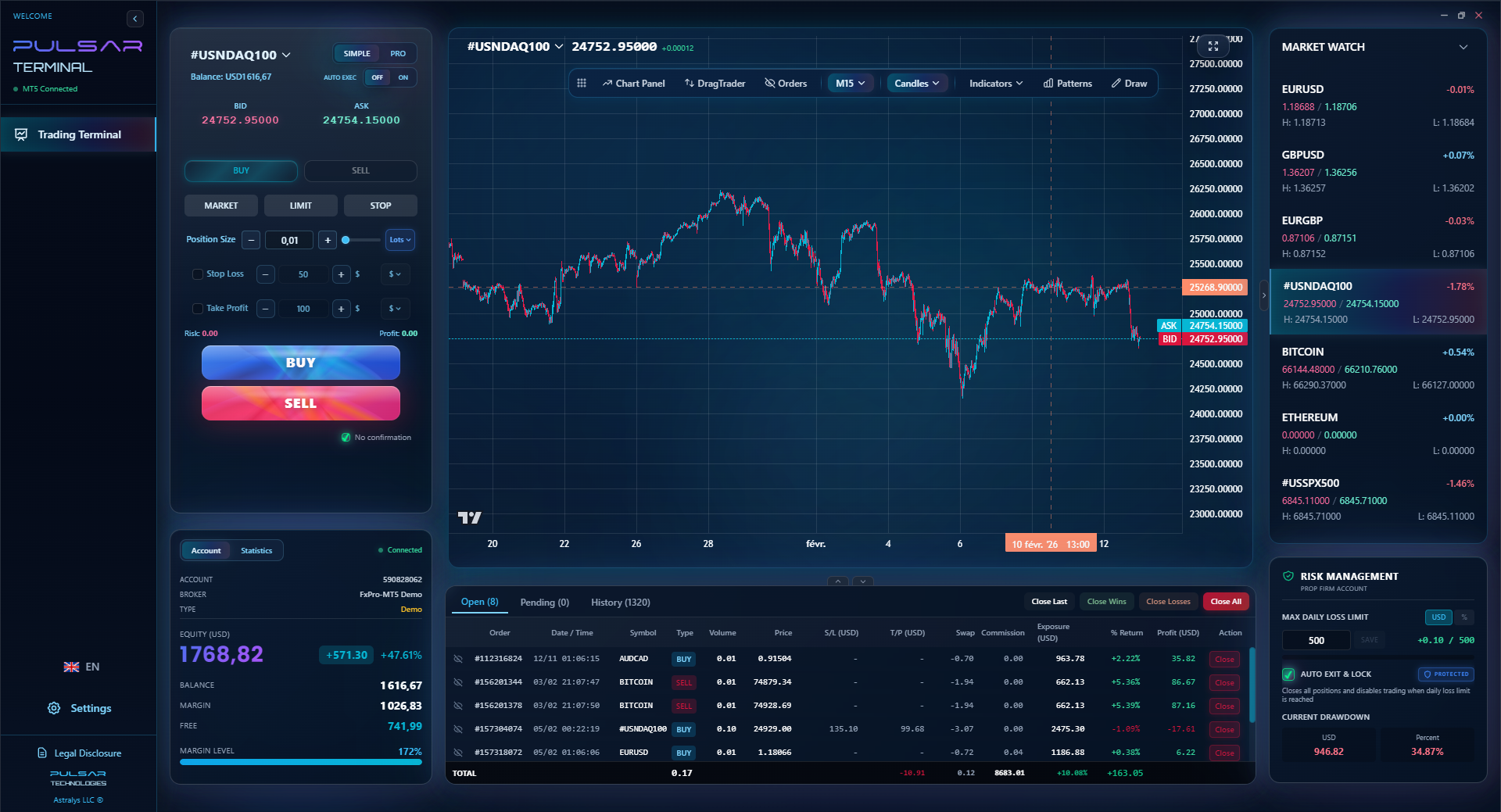
Managing multiple trades and complex exits with instant speed is tough, which is why tools like Pulsar Terminal that integrate with MT5 for one-click stop-loss adjustments and partial closures are so valuable.
Pulsar Terminal
The all-in-one MT5 companion: drag-and-drop orders, multi-TP/SL, trailing stop, grid trading, Volume Profile, and prop firm protection. Used by 1,000+ traders daily.
You don't need six monitors. A decent smartphone and a reliable laptop are enough. The real edge comes from the software and how you use it.
- Trading Platform: MetaTrader 5 (MT5) is the industry standard for a reason. It's stable, has all the tools, and works on every device. Master it.
- Internet Connection: A stable, low-latency connection is crucial, especially for scalping. Consider a good 4G/5G mobile data plan as a backup if your home Wi-Fi is unreliable (which, in Nigeria, is a fair assumption).
- Economic Calendar: You must know when major news (like US Non-Farm Payrolls or ECB decisions) is coming out. These events cause massive, unpredictable volatility. It's often best to be flat (no trades) during these times.
The advanced tools come later. Things like Volume Profile or automated trade management can give you an edge, but they are not for day one. Focus on the basics first.
“Sometimes the best trade is no trade. Wait for your setup to come to you.”
Let me spell out the landmines so you can step around them.
- The Signal Seller Scam: Anyone on WhatsApp, Instagram, or Telegram selling 'surefire signals' is selling lies. If their signals were so good, they'd be trading with their own money, not hustling for your 20k Naira subscription. I paid for one early on. The guy had screenshots of wins but never showed a full statement. My results mirrored a random number generator.
- Trading Based on Emotion or News Headlines: Seeing 'Naira crashes to new low' might make you want to instantly short it. But the market often 'prices in' news before it hits headlines. You're late. Trade your plan, not the news.
- Overtrading: Because you can trade instantly, you might trade too often. Looking for action where none exists. Sometimes the best trade is no trade. Wait for your setup to come to you.
- Ignoring the True Cost: Factor in spreads, commissions, and possible bank/crypto transfer fees. These eat into your profits, especially if you're a high-volume scalper. A strategy that looks profitable on a demo account might be break-even or a loser on live accounts once real costs are applied.
💡 Winston's Tip
Preservation of capital is not a strategy, it's the entire game. A dead trader makes no trades.
Here is your action plan, in order. Do not skip steps.
- Education (1-3 Months): Read free, reputable sources. Understand what a pip is, how use works, what moves a currency pair. Don't pay for a 'course' yet.
- Open a Demo Account: Pick one of the brokers I mentioned (like Exness or IC Markets) and open a demo account. Practice for at least two months. Your goal is not to make fake money, but to not lose it. Practice your risk management rules religiously.
- Develop a Simple Trading Plan: Choose one pair (EUR/USD is great). Choose one timeframe (start with 1-hour). Choose one or two indicators (like RSI and a moving average). Write down exactly what conditions must be met for you to enter a trade, where your stop loss goes, and where your target is.
- Fund a Live Account (Small!): Start with an amount you are 100% comfortable losing completely. For many, that's 50,000 Naira or less. This is your paid tuition. The goal of this first live account is to survive and learn to handle real emotion, not to get rich.
- Journal Every Trade: Record every single trade. Entry, exit, reason, emotion. Review it weekly. This is how you learn from your mistakes and refine your edge.
Instant forex is a tool. In the hands of a disciplined, educated, and patient trader, it's a powerful one that can provide genuine financial opportunity from anywhere in Nigeria. In the hands of an impatient dreamer, it's a very efficient way to transfer your money to someone else's pocket. The difference is entirely up to you.
FAQ
Q1Is forex trading illegal in Nigeria?
No, it's not illegal for individuals to trade forex. The Central Bank of Nigeria (CBN) regulates the official financial system, but they don't police individuals trading on international platforms. The key is to use reputable, internationally regulated brokers, not unlicensed local outfits.
Q2What is the minimum amount I need to start trading forex in Nigeria?
You can start with as little as $10 (about 15,000 Naira) with some brokers. However, I strongly advise starting with a much larger demo account to learn, then funding a live account with an amount you can afford to lose completely - think of it as tuition. A more realistic starter amount for proper risk management is $100-$200 (150k-300k Naira).
Q3How do I withdraw my profits from forex trading in Nigeria?
Most international brokers offer withdrawals back to your funding method. The most common and efficient way for Nigerians is via cryptocurrency (like USDT) to a wallet like Binance or Trust Wallet, where you can then sell for Naira. Some brokers also offer direct bank transfers to your Nigerian account, but these can be slower and involve conversion fees.
Q4Can I make a living from forex trading in Nigeria?
It's possible, but it's incredibly difficult and takes years of disciplined practice, not months. Most successful full-time traders have a large capital base (often $10,000+) and treat it like a serious business. Aim for consistent supplemental income first before even considering quitting your job.
Q5What is the best time to trade forex in Nigeria?
The most volatile (and opportunity-rich) sessions overlap with the London session (1 pm - 4 pm Nigerian time) and the overlap between London and New York (4 pm - 6 pm Nigerian time). The Asian session (early morning, 1 am - 6 am) is typically quieter. Trade when the market is active, not just when you are free.
Q6Why do most people fail at forex trading?
They fail because of poor risk management (risking too much per trade), emotional trading (greed and fear), lack of a proven plan, and the expectation of getting rich quickly. They focus on profits instead of the process of executing their strategy correctly.
Prof. Winston's Lesson
Key Takeaways:
- ✓Risk a maximum of 1-2% of your account per trade.
- ✓Test withdrawal before depositing large amounts.
- ✓Use a stop loss on every single trade, no exceptions.
- ✓Two months on demo is the minimum, not a suggestion.
How useful was this article?
Click a star to rate
Weekly Trading Insights
Free weekly analysis & strategies. No spam.
About the Author
Olumide Adeyemi
West African Trading Pioneer
One of Nigeria's most active forex trading educators. 8 years of experience trading from Lagos. Specializes in low-capital strategies and prop firm challenges for African traders.
Comments
Risk Disclaimer
Trading financial instruments carries significant risk and may not be suitable for all investors. Past performance does not guarantee future results. This content is for educational purposes only and should not be considered investment advice. Always conduct your own research before trading.
You Might Also Like

Cara Trading Forex Sukses: 7 Prinsip dari Trader Profesional
Cara trading forex sukses dengan 7 prinsip trader pro: manajemen modal, disiplin, journal trading, backtest. Data nyata, bukan janji profit palsu.
Jam Trading Forex Terbaik untuk Trader Indonesia: Panduan Lengkap dengan Tabel Waktu
Panduan jam trading forex untuk trader Indonesia. Tabel 4 sesi dunia, jam emas 20:00-00:00, sesi mana yang harus dihindari. Data akurat + tips dari trader berpengalaman.
Top 5 Sàn Forex Uy Tín Nhất 2026: Review Jujur dari Trader Indonesia
Top 5 sàn forex uy tín 2026 untuk trader Indonesia. Review jujur: spread, deposit, withdraw, dukungan lokal. Exness, XM, IC Markets & lebih.
Get Pulsar Terminal
All these calculators are built into Pulsar Terminal with real-time data from your MT5 account. One-click position sizing, automatic risk management, and instant calculations.
Get Pulsar Terminal