


Thinking about trading forex with a focus on other African currencies? Maybe you want to trade the USD/ZAR, but also have a view on the Kenyan Shilling or Nigerian Naira? Before you even look at a chart, you need to understand the legal and regulatory cage you're operating in.

David van der Merwe
Emerging Markets Trader ·  South Africa
☕ 11 min read
What you'll learn:
- 1The Legal Cage: SARB and FSCA Rules You Can't Ignore
- 2Your Personal Allowances: What You Can Actually Do
- 3Brokers and Platforms: The Onshore Solution
- 4The Future: 2026 Changes and What They Mean
- 5Practical Trading Strategy Within the Rules
- 6Common Mistakes and How to Avoid Them
- 7The Bottom Line for South African Traders
Thinking about trading forex with a focus on other African currencies? Maybe you want to trade the USD/ZAR, but also have a view on the Kenyan Shilling or Nigerian Naira? Before you even look at a chart, you need to understand the legal and regulatory cage you're operating in. South Africa's exchange control rules aren't just red tape; they're the absolute boundary of what's possible. Get them wrong, and you're not just facing a bad trade, you're facing serious legal consequences. This guide cuts through the jargon and tells you exactly how inter-Africa forex works for a South African resident, what you can do, and where the traps are.
Let's be clear from the start: you are not free. Your ability to move money in and out of South Africa for trading is tightly controlled. Two main bodies hold the keys: the South African Reserve Bank (SARB) and the Financial Sector Conduct Authority (FSCA).
SARB's Financial Surveillance Department (FinSurv) runs the exchange control regime. Their main job is to stop unauthorized capital from leaving the country. Think of it as a giant sieve over our borders; they monitor every single cross-border transaction. The rulebook is the Currency and Exchanges Act of 1933 (yes, it's that old) and its regulations.
The FSCA is different. They regulate the actual activity of trading. Any company offering you a forex trading account in South Africa must have an FSCA license. This is non-negotiable. If you're using an international broker like IC Markets or Pepperstone, you must be on their FSCA-regulated entity, not their global one. I learned this the hard way early on. I funded an Australian account with a broker, made a decent profit on a EUR/USD swing trade, and then spent three months in banking hell trying to get my own money back into South Africa. The bank blocked it, demanded SARB approval I didn't have, and I had to explain the entire source of funds. It was a nightmare.

Warning: Trading with an unlicensed broker or an international entity of a licensed broker is the fastest way to have your profits frozen and your account flagged. Always verify the FSP number on the FSCA's website.
Here’s the critical distinction for inter-Africa forex: The Common Monetary Area (CMA). This includes South Africa, Lesotho, Namibia, and Eswatini. Money moving between these countries is generally not considered a 'foreign exchange' transaction in the strictest control sense. But the moment you want to send money to Kenya, Ghana, or Nigeria for trading purposes, you're in the crosshairs of Regulation 10(1)(c) – the rule that prohibits exporting capital without approval.
“South Africa's exchange control rules aren't just red tape; they're the absolute boundary of what's possible.”
This is where most retail traders get confused. You have a personal allowance to move money offshore, but it's not a blank cheque for funding a trading account anywhere. Here’s the breakdown with the current numbers (pre-March 2026 proposals):
| Allowance Type | Amount (per calendar year) | Key Condition |
|---|---|---|
| Single Discretionary Allowance | R1 million | No tax clearance needed. For travel, gifts, foreign investment. |
| Foreign Investment Allowance | R10 million | REQUIRES a Tax Compliance Status (TCS) PIN from SARS. |
| Under-18 Travel Allowance | R200,000 | For travel only. |
The big question: Can you use this to fund an offshore trading account? Technically, the Single Discretionary Allowance can be used for 'foreign investment'. However, banks are notoriously cautious. If you tell them you're sending R200,000 to a forex broker in Mauritius, they might ask for additional documentation or even decline, labeling it a high-risk transaction. The safer, legal route is to use your allowance to fund an account with an FSCA-licensed broker that holds client funds in a South African bank. The money never technically leaves the SA banking system in a way that triggers a 'capital export' alarm.

Pro Tip: When using your discretionary allowance, be vague but truthful with your bank. 'Foreign investment' is sufficient. Don't volunteer that it's for leveraged forex trading unless specifically asked. Their compliance algorithms might flag 'forex' as high-risk remittance.
Your total potential pot is R11 million (R1m discretionary + R10m foreign investment). But for 99% of traders, the R1 million discretionary allowance is the relevant figure. You must track this yourself across all your banks. If you go over, even by accident, you've broken the law.
A personal story: I used a portion of my discretionary allowance in 2023 to fund a dedicated account for testing a scalping strategy on exotic pairs. I transferred R150,000. The bank put a 72-hour hold on it and called me to confirm the purpose. I said 'portfolio diversification into international assets.' They released the funds. The lesson? Be prepared for a delay and a phone call.

💡 Winston's Tip
Your annual allowance is your annual risk capital. Once it's gone for the year, it's gone. Trade accordingly - preservation is key.
“You will not find a mainstream, regulated broker that lets you easily deposit Nigerian Naira from Lagos into a South African ZAR account.”
So, you want to trade African currencies? You have two practical, legal paths.
Path 1: Use an FSCA-Licensed Broker with Local Presence. This is your simplest option. Brokers like Exness (via Exness ZA), XM, and others operate FSCA-licensed entities. You deposit ZAR from your local bank account into their nominated South African trust account. Your trading happens on their platform, offering CFDs on global and sometimes African markets. The capital never leaves the SA system for compliance purposes, but you get exposure. These brokers are your gateway. They handle the regulatory overhead.
Path 2: Use a Licensed Bureau de Change (ADLA) for Physical Exchange. Companies like the Inter Africa Bureau de Change (an Authorised Dealer with Limited Authority) exist for physical currency exchange and remittance. This is not for trading on a platform. This is if you need to, for example, convert ZAR to Nigerian Naira to send to a business partner. They are licensed by SARB specifically for this. According to their rules, if you provide docs before 12 pm, they can deliver cash in major cities. For payments over R50k, they'll bring a card machine. This is the 'old school' inter-Africa forex.
What You Won't Find
You will not find a mainstream, regulated broker that lets you easily deposit Nigerian Naira from Lagos into a South African ZAR account to trade USD/KES. The plumbing doesn't exist like that. The 'inter-Africa forex' for traders is primarily about trading African currency pairs (like USD/ZAR, USD/NGN) from within South Africa, using South African capital, through a regulated channel.
The spreads on exotics like USD/NGN or USD/KES will be wide – often 50-100 pips or more. Your position size calculator becomes even more critical here, as the volatility can be extreme.
“You will not find a mainstream, regulated broker that lets you easily deposit Nigerian Naira from Lagos into a South African ZAR account.”
Big shifts are coming, proposed for implementation after the March 2026 comment period. These are modernizations, not a tear-down of the system.
The key proposals that affect you:
- Single Discretionary Allowance doubling from R1m to R2m. This is huge. It effectively gives the average serious trader more breathing room to allocate capital offshore without SARS tax clearance.
- Card/Online purchase limits rising from R50k to R100k per transaction. This makes funding smaller international accounts (e.g., for crypto or niche platforms) slightly easier, though the capital export rule still looms.
- Cash you can carry across borders rising from R25k to R100k. Useful for business travel, less so for electronic trading.
These changes signal a slow, careful liberalization. The government knows they need to allow more fluid capital movement to remain competitive, but they're terrified of capital flight. The October 2025 rule change, forcing non-residents to get a SARS compliance PIN before taking South African-sourced income out, shows the other side of the coin: tightening where they see leakage.
For you, the trader, the increased discretionary allowance is the headline. If passed, it expands your legal runway. But the core principle remains: use regulated, onshore channels for your primary trading activity. The proposed 'Synthetic Financial Centre' dispensation, to be detailed later in 2026, is one to watch - it might create new structures for holding offshore assets.
💡 Winston's Tip
A wide spread isn't a cost, it's a headwind. On exotics, your first profit target must clear the spread plus your risk premium. If your edge is 20 pips and the spread is 15, you have no edge.
“The regulatory environment forces discipline. You can't just wire more money from an offshore account when you're wrong.”
Okay, you understand the cage. How do you actually trade inter-Africa forex themes?
1. Focus on USD/ZAR and USD/Africa exotics via CFDs. Your best instrument is the US Dollar against African currencies. This is where liquidity is (relatively) found on major platforms. You're trading the strength of the dollar against the Rand, Naira, or KES. You're not trying to convert ZAR to KES directly.
2. Mind the Liquidity and Spreads. Trading USD/NGN at 3 pm South African time is different from trading EUR/USD. Spreads can widen dramatically during off-peak hours or local market closures. A strategy that works on majors might get eaten alive by costs on an exotic. I once placed a limit order on USD/ZAR, got filled, and watched the spread instantly widen to 15 pips on a quiet afternoon. My supposed 5-pip profit was a 10-pip loss before I blinked.
3. Use Your Allowance for Portfolio Segregation. Use your discretionary allowance to fund a separate, offshore account for specific strategies. This is advanced. For example, you might keep your main swing trading capital with an FSCA broker, but use a portion of your allowance to fund an account with a broker that offers better execution on XAU/USD (Gold), which often correlates with ZAR weakness.
4. Risk Management is Paramount. The volatility of these currencies can trigger a margin call faster than you expect. Use tighter stops, smaller position sizes, and consider tools that help manage risk actively. Managing multiple trades with partial take-profits and trailing stops on volatile pairs is a manual headache.

Example: You have a R100,000 account. You want to risk 1% (R1,000) on a USD/ZAR trade with a 50-pip stop loss. Your position size? (R1,000) / (50 pips * ~R1.45 per pip for a micro lot) ≈ 13.8 micro lots. Round down to 13. Never guess this.
The regulatory environment forces discipline. You can't just wire more money from an offshore account when you're wrong. Your capital is limited and monitored. This, ironically, can make you a better trader.
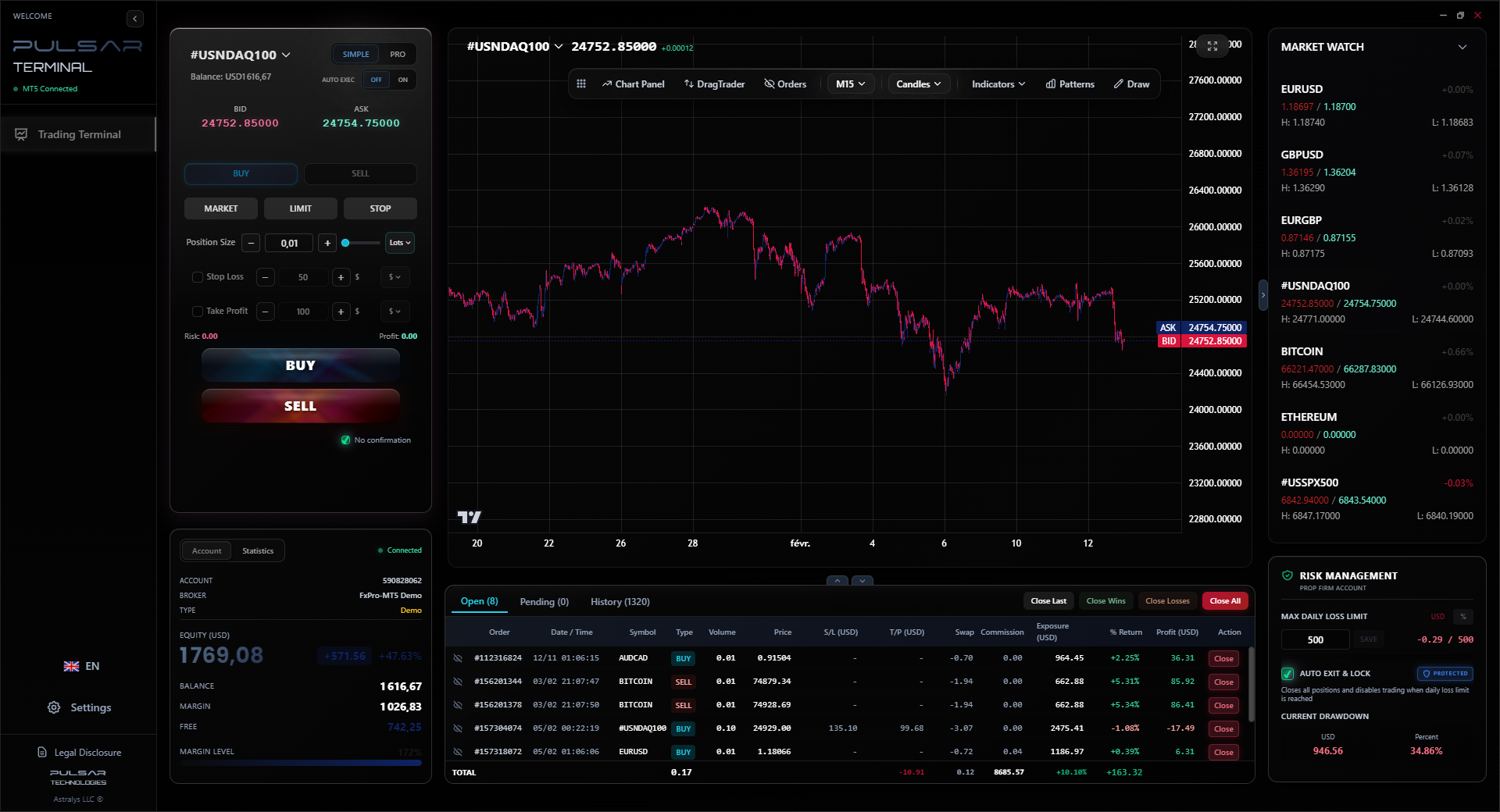
Managing complex trades on volatile pairs like USD/ZAR is simpler with tools that automate partial closures and trailing stops directly on your MT5 chart.
Pulsar Terminal
The all-in-one MT5 companion: drag-and-drop orders, multi-TP/SL, trailing stop, grid trading, Volume Profile, and prop firm protection. Used by 1,000+ traders daily.
“The regulatory environment forces discipline. You can't just wire more money from an offshore account when you're wrong.”
I've seen these blow up accounts and cause legal trouble.
Mistake 1: Using Unregulated "International" Accounts. The siren song of higher use, bigger bonuses. It ends with withdrawal problems. Always check the FSP number.
Mistake 2: Ignoring the Annual Allowance Aggregate. You transfer R800k in March. In November, you try to move R300k for a 'great opportunity.' The bank might allow it, but you've exceeded your R1m discretionary allowance. SARB will catch this in reporting, and you'll face penalties and forced repatriation.
Mistake 3: Trading African Exotics Like Majors. Applying the same technical indicators without adjusting for volatility. The RSI indicator can sit at 90 for days in a trending exotic pair. The MACD indicator might give constant false signals due to gap openings. You need to adapt your analysis.
Mistake 4: Not Having a Paper Trail for Every Transfer. Keep every SWIFT instruction, bank confirmation, and broker receipt. If SARS or SARB ever asks, you need to show the clear, legal path of your funds.
Mistake 5: Assuming Inter-Africa Transfers Are Easy. Sending money to a family member in Ghana is one thing (remittance). Sending money to a perceived 'investment' in Ghana is another. The latter will be scrutinized heavily. The legal way is through an authorised dealer, declaring the correct purpose.
💡 Winston's Tip
Regulations change. Set a calendar reminder for mid-2026 to check the SARB website for the final circular on new allowances. Your edge can be informational.
“Don't fight the cage. Learn its exact dimensions, and then practice your craft within them.”
Inter-Africa forex trading isn't a special, free-wheeling sector. It's forex trading conducted by a South African resident, subject to all of South Africa's strict exchange controls. Your edge won't come from dodging regulations; it will come from understanding them better than the next trader and operating flawlessly within the lines.
Your playbook is now clear:
- Use only FSCA-licensed brokers for your main trading activities.
- Understand and track your personal allowances like a hawk.
- Focus on CFD-based exposure to African currency pairs (USD/ZAR, USD/NGN) rather than trying to move physical currency between countries.
- Adjust your technical and risk management for high volatility and wide spreads.
- Plan for the 2026 allowance increases, but don't pre-spend the money.
The system is designed to be a friction. Your job is to reduce that friction to the legal minimum so you can focus on what matters: finding and executing good trades. Don't fight the cage. Learn its exact dimensions, and then practice your craft within them. That's how you survive and compound capital over the long term here.
FAQ
Q1Can I legally use my South African bank account to fund a forex broker in another African country?
It's very difficult and high-risk. You would need to use your Single Discretionary Allowance and the transfer would likely be blocked or heavily scrutinized by your bank, as it would be classified as a capital export for investment purposes. The legal and practical way is to use an FSCA-licensed broker that holds client funds in South Africa.
Q2What is the difference between the Single Discretionary Allowance and the Foreign Investment Allowance?
The Single Discretionary Allowance (currently R1m, proposed R2m) requires no tax clearance and can be used for travel, gifts, and foreign investment. The Foreign Investment Allowance (R10m) is for larger investments but REQUIRES a Tax Compliance Status PIN from SARS, proving you are up to date with your taxes.
Q3I found a broker offering great conditions on USD/NGN. How do I check if they are legal for me?
Go to the FSCA's website and use their 'Verify a License' search tool. You need the broker's FSP number. If they don't have an FSCA license, or if they try to onboard you to their global entity (e.g., based in Cyprus or Seychelles), it is not the legal channel for you as a South African resident.
Q4What happens if I accidentally exceed my annual discretionary allowance?
It's a violation of exchange control regulations. The SARB can impose penalties, force you to repatriate the excess funds, and it could affect your ability to get future approvals. Banks report all transactions, so it will be detected.
Q5Are the proposed 2026 allowance increases already in effect?
No. As of now (early 2026), they are draft proposals published by the SARB for public comment. They will only become law once the final circulars are issued after the comment period. Trade with the current limits until official confirmation.
Q6Can I trade cryptocurrencies as a way to move value across African borders?
This is a grey area with increasing regulation. The FSCA now licenses Crypto Asset Service Providers (CASPs). However, using crypto to circumvent exchange controls is illegal. Any conversion of ZAR to crypto for the purpose of moving value offshore is still subject to the same capital export rules. The regulatory net is closing here.
Q7What is an ADLA and when would I use one instead of a bank?
An Authorised Dealer with Limited Authority (ADLA), like a Bureau de Change, is licensed for specific foreign exchange transactions, often at better rates for physical cash or remittances. You'd use one for changing physical currency or sending a remittance to family abroad, not for funding an online trading account.
Prof. Winston's Lesson
Key Takeaways:
- ✓Always verify your broker's FSCA FSP number before depositing.
- ✓Track your discretionary allowance like a hawk - it's a hard annual limit.
- ✓Trade African exotics with 2-3x the stop-loss buffer you'd use for majors.
- ✓The proposed 2026 allowance increase to R2m is a game-changer for serious capital.
How useful was this article?
Click a star to rate
Weekly Trading Insights
Free weekly analysis & strategies. No spam.
About the Author
David van der Merwe
Emerging Markets Trader
Johannesburg-based trader with 11 years in emerging market currencies. Specializes in ZAR pairs, FSCA-regulated trading, and South African market analysis.
Comments
Risk Disclaimer
Trading financial instruments carries significant risk and may not be suitable for all investors. Past performance does not guarantee future results. This content is for educational purposes only and should not be considered investment advice. Always conduct your own research before trading.
You Might Also Like

Cara Trading Forex Sukses: 7 Prinsip dari Trader Profesional
Cara trading forex sukses dengan 7 prinsip trader pro: manajemen modal, disiplin, journal trading, backtest. Data nyata, bukan janji profit palsu.
Jam Trading Forex Terbaik untuk Trader Indonesia: Panduan Lengkap dengan Tabel Waktu
Panduan jam trading forex untuk trader Indonesia. Tabel 4 sesi dunia, jam emas 20:00-00:00, sesi mana yang harus dihindari. Data akurat + tips dari trader berpengalaman.
Top 5 Sàn Forex Uy Tín Nhất 2026: Review Jujur dari Trader Indonesia
Top 5 sàn forex uy tín 2026 untuk trader Indonesia. Review jujur: spread, deposit, withdraw, dukungan lokal. Exness, XM, IC Markets & lebih.
Get Pulsar Terminal
All these calculators are built into Pulsar Terminal with real-time data from your MT5 account. One-click position sizing, automatic risk management, and instant calculations.
Get Pulsar Terminal