


Most South African traders are looking at international forex brokers completely wrong.

David van der Merwe
Emerging Markets Trader ·  South Africa
☕ 12 min read
What you'll learn:
- 1FSCA Rules vs. International Regulation: Where You're Actually Protected
- 2The SARB Funding Maze: How to Actually Get Your Money Out There
- 3Real Costs: Spreads, Commissions, and the Hidden Fees That Eat Profits
- 4Choosing the Right Broker for YOUR Strategy
- 5Platforms, Tools, and the South African Connection
- 6Tax Implications: Keeping What You Earn
- 7Common Pitfalls I've Seen (And Fallen Into)
Most South African traders are looking at international forex brokers completely wrong. We obsess over spreads and use, but the real game is about jurisdiction, funding corridors, and which regulator actually has your back when things go south. I learned this the hard way, losing access to a five-figure account because I ignored the fine print on SARB rules. This isn't just another broker list. This is a breakdown of how to actually get your money in, trade smart within our unique limits, and get it back out again - profitably.
Let's clear this up first: trading with an international broker is completely legal for South Africans. The FSCA doesn't stop you. But here's the critical part almost no one talks about: the FSCA has zero jurisdiction over a broker regulated in Cyprus, the UK, or Australia. If that broker decides to freeze your withdrawals or manipulate your trades, your complaint to the FSCA ends up in a filing cabinet. They can't help you.
That's why your first filter shouldn't be the welcome bonus. It should be the regulator. I made this mistake early on. I signed up with a well-marketed broker licensed in a questionable offshore jurisdiction because they offered 500:1 use. When I had a legitimate dispute over slippage on a major news event, my emails went ignored. I had no recourse. That $2,300 lesson was cheaper than some learn.
You want a broker regulated by what we call a "top-tier" authority. Think the UK's FCA, the Australian Securities and Investments Commission (ASIC), or the Financial Markets Authority (FMA) in New Zealand. These regulators enforce strict rules: client money segregation (your funds are kept separate from the broker's operating money), negative balance protection, and clear dispute resolution processes. A broker like Pepperstone, regulated by ASIC and the FCA, operates under these stringent rules for its relevant clients.
Now, what about the FSCA's 30:1 use cap? That applies to brokers holding an FSCA license. If you open an account with an international broker under its overseas license, their use rules apply. You might see 500:1 offered. This feels like a loophole, but it's a double-edged sword. Higher use means higher risk of a margin call, and you're choosing to step outside the local consumer protection framework. It's a trade-off you need to consciously make.

Warning: Just because a broker's website has a .co.za domain or offers ZAR accounts doesn't mean it's FSCA-regulated. Always check the regulatory number on the FSCA's official website. I've seen brokers display expired licenses or licenses for entirely different financial services.

💡 Winston's Tip
Your broker is a utility, not a strategy. Spend 95% of your time refining your edge, 5% on broker selection. Once you find a safe, reliable pipe, stick with it.
“The FSCA has zero jurisdiction over a broker regulated in Cyprus, the UK, or Australia.”
This is the most frustrating, yet most important, part for South Africans. You cannot simply use your SA credit or debit card to fund an international trading account. SARB rules prohibit using local cards for speculative forex deposits abroad. I learned this when my FNB card was repeatedly declined trying to fund an IC Markets account back in 2020.
You have to use the formal channel: an Authorised Dealer (which is just your bank). You instruct them to convert your Rands into USD, EUR, or GBP and send it via an Electronic Funds Transfer (EFT) to the broker's client money account. It's slower, and your bank will charge a forex conversion fee and an international transfer fee.
Your Annual Allowances: The R1m and R10m Limits
You have two allowances:
- Single Discretionary Allowance (SDA): R1 million per calendar year. No tax clearance needed. Use this first for smaller amounts.
- Foreign Investment Allowance (FIA): R10 million per calendar year. This requires a Tax Compliance Status (TCS) pin from SARS. You must be tax-compliant.
These are for getting money out. To bring profits back, you'll go through the same Authorised Dealer process in reverse. Keep careful records of every transfer - the SWIFT confirmations from your bank and the deposit confirmations from your broker. SARS will want to see this if you're bringing back significant profits.

Pro Tip: When you initiate the transfer with your bank, tell them it's for "investment purposes." Calling it "trading" can sometimes trigger unnecessary additional questions from a cautious bank clerk. Have the broker's bank details (company name, account number, SWIFT) ready. It's a paperwork game.
A practical note: Some international brokers have local partners or payment processors that simplify this. They might offer Instant EFT deposits that feel like a local transaction, but behind the scenes, it's structured correctly for SARB. Always ask the broker's support about the recommended deposit method for South Africans.
“You cannot simply use your SA credit or debit card to fund an international trading account.”
Forget the advertised "from 0.0 pips" headline. You need to know the average spread during your trading session (London/New York overlap) and the commission structure. Let's talk real numbers from my journal.
I trade EUR/USD mostly. On a raw spread account with IC Markets, I typically see a spread of 0.1-0.3 pips, plus a commission of $7 round turn per lot. So my cost to enter and exit a 1-lot trade is roughly 0.2 pips + $7. Using a pip definition calculator, that $7 is about 0.7 pips on EUR/USD. Total effective cost: ~0.9 pips.
Compare that to a standard "commission-free" account at another broker where the EUR/USD spread averages 1.6 pips. The raw account is cheaper for my volume. But for a micro-lot trader, the fixed $7 commission hurts more, so the wider spread account might be better.
Where it gets expensive for us: Trading the ZAR. If you want to trade USD/ZAR or EUR/ZAR, prepare for wide spreads. It's just less liquid. I've seen spreads of 50-100 pips on USD/ZAR during illiquid times. On a broker like Pepperstone, the minimum is around 5 pips, which is still high compared to majors.
| Cost Type | Raw/ECN Account Example | Standard Account Example | Note for ZA Traders |
|---|---|---|---|
| EUR/USD Spread | 0.1 - 0.3 pips | 1.2 - 1.8 pips | Raw is cheaper for >0.5 lot trades. |
| Commission | $3.5 per side per lot | $0 | Factor commission into your position size calculator. |
| USD/ZAR Spread | 5 - 10 pips (min) | 15 - 25 pips | Very wide. Not ideal for scalping strategy. |
| Swap/Overnight Fee | Broker markup + interbank rate | Broker markup + interbank rate | Check broker's swap table. Long ZAR pairs often have negative swap. |
The Hidden Fee: Currency Conversion. If your broker account is in USD but your bank account is in ZAR, you pay your bank's conversion rate twice (deposit and withdrawal). This can easily add 1-2% in hidden costs. Some brokers, like XM or Exness, offer ZAR-denominated accounts to avoid this. It's a huge benefit.
“You cannot simply use your SA credit or debit card to fund an international trading account.”
Your trading style dictates your broker choice more than anything. I used to try to scalp on a broker with high latency and requotes. It was like running in sand.
For Scalpers & High-Frequency Traders: You need an ECN/RAW account with ultra-low latency execution and tight spreads. Look for brokers with servers in London (LD4) or New York. Commission-based pricing is your friend. IC Markets and Pepperstone are staples in this space for a reason. Your scalping strategy lives or dies by the speed of the execution and the consistency of the spread. Avoid any broker known for "slippage" during news.
For Swing Traders & Position Traders: You're holding trades for days or weeks. Spread matters less, but swap fees matter more. You need to scrutinize the broker's overnight financing rates (swap). If you're going long on a high-interest rate currency pair, a positive swap can add to your profits over time. Also, reliability and safety become paramount - you're leaving money with them for longer. A top-tier regulator is non-negotiable. A platform with good swing trading tools for longer-term analysis is key.
For Beginners: Your priority isn't the cheapest spread. It's education, customer support that answers quickly, and a user-friendly platform. A low minimum deposit lets you practice with real money without risk. Brokers like XM with their $5 minimum are attractive here. Also, look for brokers that offer demo accounts that don't expire after 30 days. You need time to blow up a few virtual accounts first.

Example: In 2023, I was swing trading XAU/USD (gold). I chose a broker not for its spread (gold spreads are generally wide), but because it had the most competitive swap rate for long gold positions. Over a 3-week hold, the positive swap paid me an extra $42 on a 1-lot position. That covered the wider spread cost.
💡 Winston's Tip
Test withdrawals before large deposits. A broker that makes it easy to take your money out is often more trustworthy than one that makes it easy to put money in.
“Forget the advertised 'from 0.0 pips' headline. You need to know the *average* spread during your trading session.”
MetaTrader 4 and 5 are the universal language here. Almost every international broker supports them. But MT4/MT5 is just the engine. The real edge comes from the tools you bolt onto it.
Most South African traders I know use MT5 for its slightly more advanced order types and built-in economic calendar. The key is finding a broker whose MT5 server connection is stable from our location. There's nothing worse than a disconnection during a volatile move. I've had this happen with a European broker during a South African news event; my hedge didn't go through, and I took an unnecessary loss.
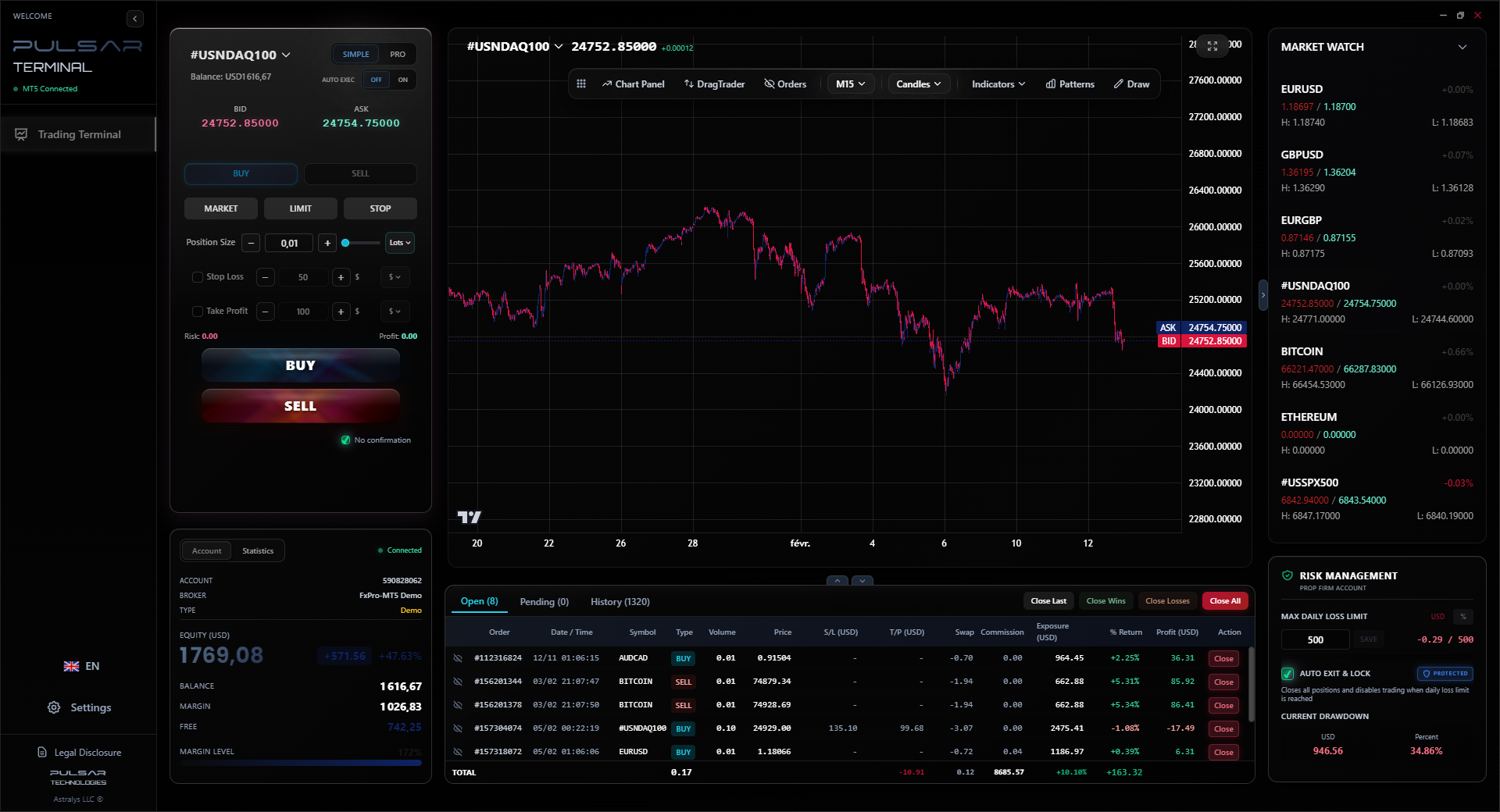
This is where third-party tools become essential. I use a market analysis platform that plugs directly into MT5. It gives me advanced charting, volume profile, and automated trade management that MT5 lacks. For example, setting a trailing stop that automatically moves to breakeven after a certain profit is a basic risk management tactic, but doing it manually on MT5 is clunky.
Speaking of automation, if you're using any Expert Advisors (EAs) or custom scripts, test them thoroughly on the broker's demo server first. Some brokers have restrictions on certain types of EAs (like ultra-high-frequency scalping EAs). Always check their policy.
Local connectivity is also a thing. Does the broker have a local phone number or support team that operates during SA hours? When you have a funding issue at 4 PM on a Friday, speaking to someone who understands what an "Authorised Dealer" is can save your weekend.
Managing complex trades and risk on MT5 is easier with tools that automate trailing stops, breakeven moves, and multi-target orders, letting you focus on analysis instead of manual adjustments.
Pulsar Terminal
The all-in-one MT5 companion: drag-and-drop orders, multi-TP/SL, trailing stop, grid trading, Volume Profile, and prop firm protection. Used by 1,000+ traders daily.
“Forget the advertised 'from 0.0 pips' headline. You need to know the *average* spread during your trading session.”
SARS views forex trading profits as income from a business or as capital gains, depending on your trading frequency and intent. For most active traders, it's considered ordinary revenue and is taxed at your marginal income tax rate (up to 45%).
You can deduct certain expenses: platform fees, data subscription costs, internet costs used for trading, and even a portion of your home office if you trade professionally. But you must keep every single receipt and statement.
Here's my biggest piece of advice: Get an accountant who understands trading, specifically, from day one. Don't wait until you have a six-figure year to figure it out. I didn't, and my first profitable year was a nightmare of spreadsheets and SARS queries. A good accountant will tell you to:
- Open a separate business bank account for all trading-related inflows and outflows.
- Keep a detailed trading journal (not just MT4 statements) noting the rationale for each trade.
- Record every single deposit to and withdrawal from your broker, with the ZAR value at the time of the transaction (use the SARB's daily exchange rate).
Bringing profits back into South Africa triggers the tax event. If you leave profits offshore, you still need to declare the foreign income and any interest earned on it in your tax return. SARS has information-sharing agreements with many countries now. Hiding it is not an option.
Remember, the R1m/R10m allowances are for moving capital. They don't make the profits tax-free. The profit you make on that capital is fully taxable.
“SARS views forex trading profits as income from a business. Get an accountant who understands trading, specifically, from day one.”
Let me save you some pain and money.
Pitfall 1: Chasing Bonuses. I once chose a broker offering a 100% deposit bonus. The catch? You had to trade a volume 50 times your deposit + bonus before you could withdraw any of your own money. It was a trap designed to make you overtrade until you blew the account. I did.
Pitfall 2: Ignoring the Withdrawal Process. Before you deposit a cent, test the withdrawal process. Open a demo? No. Open a live account with the minimum deposit, then immediately try to withdraw it. See how long it takes, what paperwork they require, and if there are any hidden fees. A legitimate broker won't mind this. A shady one will make it impossible.
Pitfall 3: Over-leveraging on an International Account. Just because you can get 500:1 use doesn't mean you should. Without the FSCA's 30:1 cap, you are your own risk manager. I've seen too many traders wipe out accounts in minutes because they used 100:1 use on a 1-lot trade with a $1,000 account. Use a position size calculator religiously. Risk 1-2% per trade, max.
Pitfall 4: Not Understanding the Counterparty. When you trade CFDs with a broker, you are trading against them as the counterparty. This is why regulation matters so much. A poorly regulated broker has a conflict of interest if they are taking the other side of your trade. They may manipulate spreads or execution. Always prefer an ECN/DMA model where your trade is routed to the interbank market, even if it costs a little more in commissions.
Finally, the emotional pitfall: switching brokers constantly looking for a "perfect" one. It doesn't exist. Find one that is safe, reasonably priced for your style, and reliable. Then focus on your trading. The broker is just the pipe. Your strategy is what flows through it.
💡 Winston's Tip
use is a magnifying glass. It makes both gains and losses bigger. The FSCA's 30:1 cap isn't a limitation for most; it's a forced dose of sanity. Apply it to yourself, even if your broker offers more.
FAQ
Q1Can I legally use international forex brokers as a South African?
Yes, absolutely. It is legal for South African residents to open accounts and trade with brokers regulated overseas. The key point is that you must fund the account through the correct SARB channels (via an Authorised Dealer/bank), not with a South African credit or debit card.
Q2What is the safest type of international broker for a South African?
The safest choice is a broker regulated by a top-tier authority like the UK's FCA, the Australian ASIC, or the New Zealand FMA. These regulators enforce strict client fund segregation and fair practice rules. While the FSCA is good for local brokers, it cannot assist you if you have a dispute with a foreign-regulated entity.
Q3How much money can I send to an international broker?
You can send up to R1 million per calendar year under the Single Discretionary Allowance (no tax clearance needed). For larger amounts, you can use the Foreign Investment Allowance of R10 million per year, but this requires a Tax Compliance Status pin from SARS.
Q4Are profits from international forex trading taxable in South Africa?
Yes. Profits are generally considered ordinary income and taxed at your marginal income tax rate (up to 45%). You must declare this income to SARS, regardless of whether you bring the profits back to South Africa or leave them offshore. Keep detailed records of all trades and transfers.
Q5What's better for a beginner: a local FSCA broker or an international one?
For a complete beginner, a local FSCA-regulated broker can be simpler due to easier ZAR deposits, local support, and the built-in 30:1 use safety cap. However, many international brokers cater well to beginners with excellent educational materials and micro accounts. Focus on education and customer support rather than just the regulator's location.
Q6Why are spreads on USD/ZAR so wide with international brokers?
The South African Rand (ZAR) is an emerging market currency with lower liquidity compared to majors like the USD or EUR. This lower liquidity naturally results in wider bid-ask spreads. International brokers may also add a markup due to the higher hedging costs and complexity involved in offering the pair.
Q7Can I use my preferred trading platform (like MT5) with international brokers?
In almost all cases, yes. MetaTrader 4 and 5 are the industry standard and are supported by the vast majority of reputable international brokers. Some brokers also offer their own proprietary platforms or access to other third-party platforms like cTrader.
Prof. Winston's Lesson
Key Takeaways:
- ✓Regulator trumps use. Safety first.
- ✓Test withdrawals with a small deposit first.
- ✓Factor in ALL costs: spread, commission, bank fees.
- ✓SARB rules are non-negotiable. Use an Authorised Dealer.
- ✓Taxes apply on profits, not just on repatriated funds.
How useful was this article?
Click a star to rate
Weekly Trading Insights
Free weekly analysis & strategies. No spam.
About the Author
David van der Merwe
Emerging Markets Trader
Johannesburg-based trader with 11 years in emerging market currencies. Specializes in ZAR pairs, FSCA-regulated trading, and South African market analysis.
Comments
Risk Disclaimer
Trading financial instruments carries significant risk and may not be suitable for all investors. Past performance does not guarantee future results. This content is for educational purposes only and should not be considered investment advice. Always conduct your own research before trading.
You Might Also Like

Cara Trading Forex Sukses: 7 Prinsip dari Trader Profesional
Cara trading forex sukses dengan 7 prinsip trader pro: manajemen modal, disiplin, journal trading, backtest. Data nyata, bukan janji profit palsu.
Jam Trading Forex Terbaik untuk Trader Indonesia: Panduan Lengkap dengan Tabel Waktu
Panduan jam trading forex untuk trader Indonesia. Tabel 4 sesi dunia, jam emas 20:00-00:00, sesi mana yang harus dihindari. Data akurat + tips dari trader berpengalaman.
Top 5 Sàn Forex Uy Tín Nhất 2026: Review Jujur dari Trader Indonesia
Top 5 sàn forex uy tín 2026 untuk trader Indonesia. Review jujur: spread, deposit, withdraw, dukungan lokal. Exness, XM, IC Markets & lebih.
Get Pulsar Terminal
All these calculators are built into Pulsar Terminal with real-time data from your MT5 account. One-click position sizing, automatic risk management, and instant calculations.
Get Pulsar Terminal