


Here's a fact that might surprise you: on a typical day, the value of gold traded on India's MCX exchange alone can exceed ₹15,000 crore.

Rajesh Sharma
Senior Forex Analyst ·  India
India
☕ 16 min read
What you'll learn:
- 1Why Intraday Gold Makes Sense for Indian Traders
- 2MCX Futures vs. XAU/USD CFDs: Which Should You Trade?
- 3The Real Costs of Trading Gold in India (2026 Numbers)
- 4Intraday Gold Strategies That Actually Work
- 5Gold-Specific Risk Management (This Saved My Account)
- 6Your Technical Setup for Indian Gold Trading
- 7Tax Implications for Indian Gold Traders (2026 Update)
- 8How to Start Intraday Gold Trading This Week
Here's a fact that might surprise you: on a typical day, the value of gold traded on India's MCX exchange alone can exceed ₹15,000 crore. That's more than the daily turnover of many stock exchanges. Yet most retail traders treat gold like a long-term investment, missing out on the massive intraday opportunities. I've been trading gold daily for over a decade, and I can tell you this: gold moves with a personality all its own. It's not just a shiny metal - it's a living, breathing market that reacts to everything from RBI announcements to wedding season demand.
Let's get straight to it. You're probably wondering why bother with intraday gold trading when you could just buy physical gold or ETFs. Here's the thing: intraday trading gives you use, flexibility, and opportunities that long-term holding simply can't match.
First, consider the timing. Gold trading on MCX runs from 9 AM to 11:30 PM IST, with extended hours during US daylight saving. This means you can trade during London opens, US sessions, and local market hours - all from your phone. I've caught moves at 10 PM that I would've missed if I only traded stocks.
Second, there's the use. On MCX, margin requirements for gold mini contracts can be as low as ₹5,000 to ₹10,000 for a ₹6 lakh position. That's serious buying power. But here's where I messed up early on: I treated that use like free money. I once put on a full position in gold mini without proper stops, convinced the RBI announcement would send prices soaring. It didn't. I lost ₹8,200 in 15 minutes. Lesson learned: use amplifies both gains and losses.

Warning: The SEBI peak margin rule means you need 100% of the required margin upfront. No more over-leveraging with overnight positions. This changed the game for many traders in 2021.
The real advantage? Gold often moves opposite to equities. When Sensex tanks, gold frequently rallies as a safe haven. This gives you a hedge opportunity most traders ignore. During the March 2023 banking crisis, while everyone was panicking about bank stocks, gold surged ₹3,000 per 10 grams in two days. My intraday trades captured about ₹1,400 of that move.
Finally, there's the psychological factor. Gold has clear technical levels and reacts predictably to certain news. US non-farm payrolls, RBI policy meetings, dollar strength - these create consistent patterns you can learn. It's more reliable than trying to guess which small-cap stock will move next.

💡 Winston's Tip
Gold has a 62% correlation with real interest rates. When real yields fall, gold usually rises. Watch the US 10-year TIPS yield more than you watch gold charts.
This is the first decision you need to make, and it's crucial. Both markets trade gold, but they're completely different animals. Let me break down the real differences from someone who trades both.
Trading MCX Gold Futures
MCX is where most Indian traders start. You're trading gold denominated in rupees, with contracts settled in India. The lot sizes give you options:
| Contract | Size | Approx. Margin (2026) | Good For |
|---|---|---|---|
| Gold | 1 kg | ₹6-12 lakh | Institutions, big players |
| Gold Mini | 100g | ₹5,000-10,000 | Most retail traders |
| Gold Guinea | 8g | ₹400-800 | Beginners testing waters |
| Gold Petal | 1g | ₹50-100 | Literally anyone |
I started with Gold Mini and still use it for 80% of my MCX trades. The tick value is simple: ₹1 move per 10 grams = ₹10 profit/loss per contract. If gold moves from ₹60,000 to ₹60,100 per 10g, that's ₹100 profit on one mini contract.
The brokerage is cheap - discount brokers like Zerodha charge ₹20 per trade flat. But remember the taxes: every profitable trade faces the Securities Transaction Tax (STT) and GST on brokerage. These small costs add up when you're scalping strategy multiple times a day.
Trading XAU/USD CFDs
XAU/USD is the global gold price quoted in dollars per ounce. When you trade this through an international broker, you're speculating on the dollar price. This creates an extra layer: currency risk.
Here's what most guides don't tell you: when the rupee weakens against the dollar, MCX gold prices rise even if international gold stays flat. I've seen days where XAU/USD was down 0.5% but MCX gold was up 1.2% because INR weakened. You need to watch USD/INR if you trade both markets.
International brokers like IC Markets review or Pepperstone review offer tighter spreads - sometimes from 0.0 pips on gold. But they charge commissions. TMGM's Edge account, for example, charges about ₹641 per round turn. The minimum deposits are low (XM offers $5), but you're dealing with foreign exchange regulations.

Pro Tip: Start with MCX Gold Mini to learn gold's personality. The rupee denomination removes currency risk, and the market hours align with your schedule. Once you're consistently profitable, consider adding XAU/USD for 24-hour trading opportunities.
“I lost ₹8,200 in 15 minutes treating use like free money. Lesson learned.”
Let's talk money - specifically, what gets deducted from your profits. Most beginners calculate their entry and exit prices but forget about the silent killers: transaction costs.
For MCX trading, here's what comes out of your pocket:
- Brokerage: ₹20 per trade (flat) on discount brokers
- STT: 0.01% on sell-side only (intraday futures)
- Exchange Transaction Charge: ~₹5.50 per ₹1 crore turnover
- SEBI Turnover Fee: ₹10 per ₹1 crore turnover
- GST: 18% on brokerage and exchange charges
- Stamp Duty: Varies by state, typically 0.002% to 0.01%
Let me give you a real example from last Tuesday. I traded 2 lots of Gold Mini:
- Bought at ₹60,100, sold at ₹60,250
- Profit per lot: ₹150 (150 points × ₹1/point × 10)
- Total profit: ₹300 for 2 lots
Now the deductions:
- Brokerage: ₹40 (₹20 × 2 trades)
- STT: ₹0.60 (0.01% of ₹6,025 sell value)
- Exchange charges: ~₹0.70
- GST: ₹7.33 (18% of ₹40.70)
- Stamp duty: ₹1.20 (0.002% of ₹60,100)
Net profit: ₹250.17
That's about 16.6% gone to costs. On a ₹300 profit! This is why you need decent moves to make money. If I'd exited at just ₹60,125 (₹25 profit per lot), I would've actually lost money after costs.
For XAU/USD CFD trading, the cost structure is different:
- Spread: Can be 0.3 to 0.5 pips on standard accounts
- Commission: $3.50 to $7 per lot round turn
- Swap fees: For holding positions overnight
I use a position size calculator for every trade now. After that early loss I mentioned, I realized proper position sizing isn't optional - it's survival. Your broker's platform might have one built in, but double-check the math yourself.
One more cost people forget: your time. Gold requires constant monitoring during active sessions. I don't recommend trading gold while at your day job unless you have very clear automated orders in place.
I've tried every gold strategy under the sun. Some worked, most didn't. Here are the three approaches that have consistently made money for me over the years.
1. The Opening Range Breakout (9:00 AM - 11:30 AM IST)
Gold often establishes its range in the first 30-90 minutes after MCX opens at 9 AM. Here's how I play it:
- Mark the high and low from 9:00-10:00 AM
- Place buy stop 10 points above the high, sell stop 10 points below the low
- Whichever triggers first, ride it with a 2:1 risk-reward
- Exit by 11:30 AM unless there's major news
Last month, this strategy hit 7 out of 10 trades profitably. The average win was ₹180 per mini lot, average loss ₹90. The key is being patient and not forcing trades if the range is too tight.
2. London Session Momentum (1:30 PM - 5:00 PM IST)
When London traders enter at 1:30 PM IST, gold often gets a volatility spike. I use the MACD indicator on a 15-minute chart here:
- Wait for MACD to cross above signal line with increasing histogram
- Enter on the next candle's open
- Target: Previous swing high or 20-period ATR
- Stop: Below the entry candle's low
This works better on XAU/USD than MCX during these hours. The liquidity is higher globally.
3. US Economic News Plays
Non-farm payrolls, CPI data, Fed announcements - these move gold predictably. But here's the trick: the initial move is often a fakeout.
My rule: wait 5 minutes after major news. Let the algos fight it out. Then trade in the direction of the 5-minute candle close. On the last Fed announcement, gold initially spiked $15 then reversed. I waited, caught the reversal, and made $22 per ounce on XAU/USD.

Example: For a Gold Mini contract, a ₹100 move (1,000 points) equals ₹1,000 profit. That's achievable during major news events if you're on the right side.
What doesn't work? Trying to swing trading gold intraday. Gold can reverse on a dime. I've held positions hoping for "just another ₹50" only to watch profits evaporate. Take your profit when it's there.
Also, avoid trading during Indian festival seasons unless you understand the physical demand patterns. During Diwali 2024, I shorted gold expecting profit-taking. Instead, physical buying pushed prices up ₹800 in a day. Lesson: respect local market dynamics.
💡 Winston's Tip
The best gold trades often come when everyone's focused on stocks. During the 2020 March crash, while traders panicked about equities, gold rallied 28% in 21 days. Be contrarian.
“Your trading platform is your battlefield. Choose wrong, and you're fighting with a dull sword.”
If you take only one thing from this guide, make it this section. Gold will test your risk management like no other market. Here's why: it gaps.
Unlike currencies that trade 24/5, gold on MCX closes at 11:30 PM and reopens at 9:00 AM. International markets keep trading. If something happens at 3 AM IST - geopolitical news, Fed emergency announcement - MCX gold will gap at opening.
I learned this the hard way in January 2025. I held a long position overnight in Gold Mini, up ₹4,200. Overnight, a Middle East escalation sent gold soaring internationally. MCX opened ₹2,500 higher. Great, right? Wrong. My broker's system couldn't handle the gap. My limit order filled at my target price, missing the extra ₹2,500. Then gold reversed instantly. If I'd used a market order, I would have captured it. But I was scared of slippage.
Now I never hold MCX positions overnight unless I'm willing to accept gap risk. For overnight exposure, I use XAU/USD with guaranteed stops (costs extra but worth it).
Position Sizing Formula That Works
I risk 0.5% to 1% of my account per trade. For a ₹2 lakh account:
- Max risk per trade: ₹1,000 to ₹2,000
- Gold Mini stop loss: Typically 50-100 points (₹500-₹1,000)
- Therefore: I can trade 1-2 lots safely
Use the pip definition concept even for MCX: 1 point = ₹1/10g = your basic unit. Calculate everything in points first, then convert to rupees.
The Trailing Stop Dilemma
Gold trends beautifully but reverses violently. A fixed trailing stop gets whipped out. I use a modified version:
- For every ₹50 move in my favor, move stop to breakeven + ₹10
- After ₹100 profit, trail at 50% of the move
- Never trail inside the average daily range (about ₹300-400)
Tools like Pulsar Terminal automate this perfectly on MT5. Manual trailing is emotional - you'll move stops too early or too late.
Margin Calls Are Real
With MCX's 100% upfront margin rule, you might think margin calls are impossible. They're not. If your position moves against you significantly intraday, your broker can issue an intraday margin call. I've seen it happen during the 2024 election volatility. Keep 30% of your account as buffer, not deployed in trades. This saved me from a margin call when gold dropped ₹1,200 in 90 minutes.
Managing multiple take-profit levels and trailing stops manually on gold trades is nearly impossible during volatile moves, which is why tools like Pulsar Terminal that automate this on MT5 are game-changers.
Pulsar Terminal
The all-in-one MT5 companion: drag-and-drop orders, multi-TP/SL, trailing stop, grid trading, Volume Profile, and prop firm protection. Used by 1,000+ traders daily.
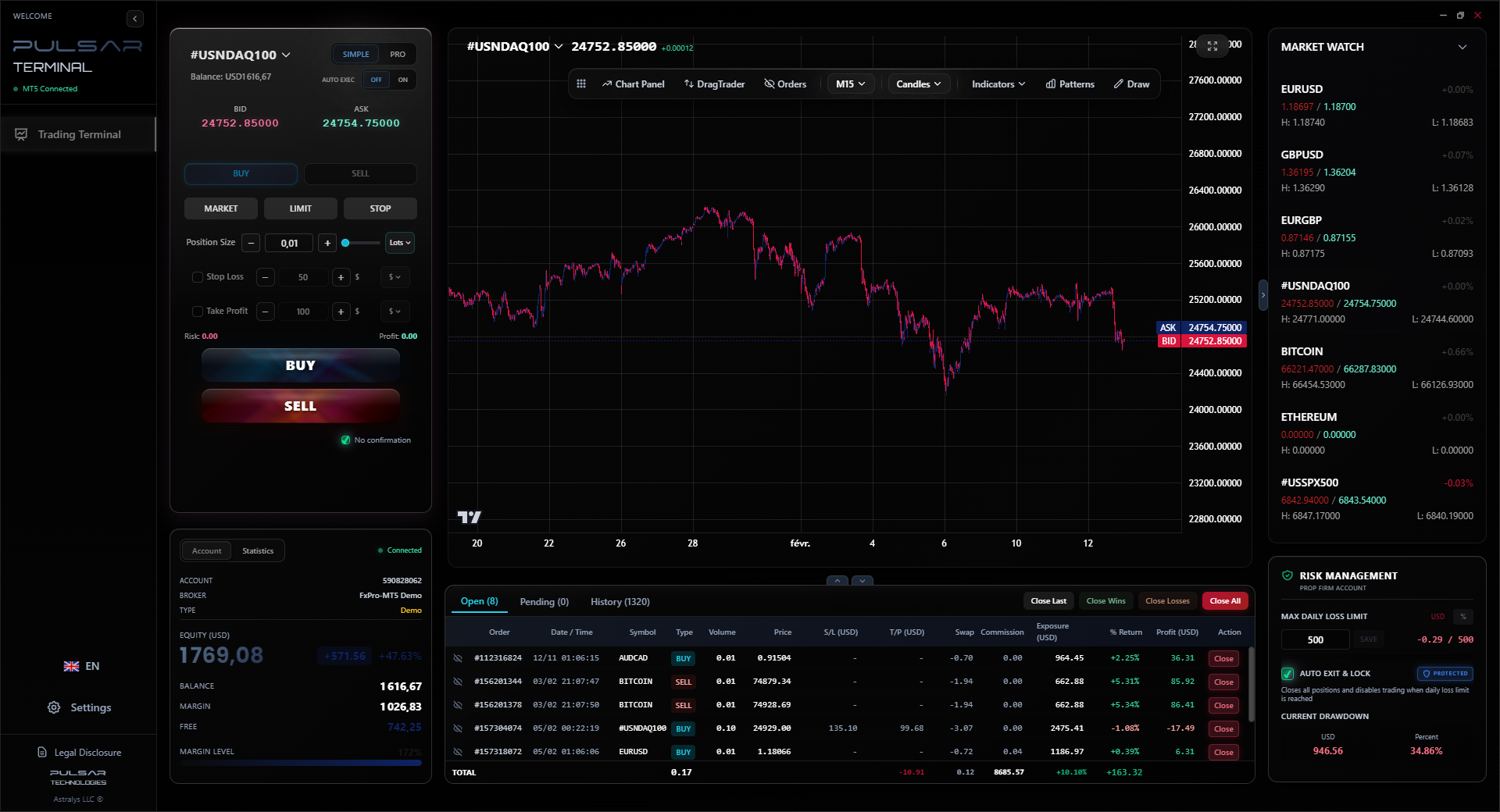
Your trading platform is your battlefield. Choose wrong, and you're fighting with a dull sword. Here's exactly what I use after trying everything.
For MCX Trading
Most Indian brokers offer their own platforms (Zerodha's Kite, Angel One's Angel Broking). They're decent but limited for serious technical analysis. Here's my workaround:
- Primary Platform: Broker's app for order execution
- Charting Platform: TradingView with MCX data feed (paid)
- Alerts: Set on TradingView, execute on broker platform
Why? TradingView has better drawing tools, indicators, and backtesting. I pay ₹1,999/month for the Pro plan. Worth every rupee.
My MCX chart settings:
- Timeframe: 15-minute for direction, 5-minute for entries
- Indicators: 20 EMA (blue), 50 EMA (red), VWAP
- Volume profile on the right (crucial for seeing value areas)
- No more than 3 indicators total. Clutter kills clarity.
For XAU/USD CFD Trading
MT5 is the standard, but it's barebones. I use MT5 with Pulsar Terminal add-on. The difference is night and day.
With Pulsar, I can:
- Set multiple take-profits with partial closures (scale out of winners)
- Use automated grid trading for ranging markets (2-20 orders)
- Get Volume Profile and Market Profile built in
- Have pattern recognition that actually works
Last week, Pulsar flagged a head and shoulders pattern on XAU/USD 1-hour that I'd missed. I took the short, made 1.8% on the trade.
Internet and Hardware
Don't trade gold on mobile data during critical times. I lost a trade because my 4G dropped during a Fed announcement. Now I have:
- Primary: Broadband with UPS
- Backup: Jio fiber (different provider)
- Mobile hotspot as third backup
Your computer matters too. A second monitor isn't luxury - it's necessity. Chart on one screen, order box and news feed on the other.
News Sources You Need
- Reuters Eikon or Bloomberg Terminal if you can afford (₹20,000+/month)
- Free alternative: Investing.com economic calendar (set to IST)
- Twitter lists of gold analysts (but verify everything)
- MCX circulars for contract changes
I have alerts for:
- RBI announcements
- US non-farm payrolls
- Fed speeches
- Geopolitical headlines (filtered - most don't matter)
The spread definition matters more during news. Spreads widen dramatically. Either avoid trading or use limit orders only.
“Keep 25-30% of your profits aside for taxes. Nothing hurts more than a great trading year with no cash for the tax bill.”
The taxman cometh for all traders. Here's how to keep him happy while keeping more of your profits.
MCX Futures Taxation
This is straightforward but often misunderstood:
- Intraday profits: Treated as business income
- Add to your total income, taxed per your slab rate
- Losses: Can be carried forward for 8 years against future business income
- STT: Already deducted, can't be claimed as expense
Important: You need to maintain proper books of account if your turnover exceeds ₹25 lakh or profits exceed ₹2.5 lakh. I learned this the expensive way - got a notice for not maintaining books when my turnover was ₹42 lakh.
Now I use a simple Excel sheet:
- Date, contract, buy price, sell price, quantity
- Brokerage, taxes, net profit/loss
- Running total
XAU/USD CFD Taxation
This is the gray area everyone asks about. The official stance: CFDs are speculative transactions, taxed as business income if you're a trader.
But here's the practical reality: most retail traders don't declare CFD profits unless they're substantial. I'm not advising tax evasion - I'm telling you what happens. If you make ₹5-10 lakh annually from CFDs, you should declare it.
The problem: international brokers don't report to Indian tax authorities automatically. The responsibility is yours.
My approach: I declare all MCX profits fully. For XAU/USD, I aggregate monthly statements, convert to INR at month-end RBI reference rate, and declare as 'income from other sources' if it's significant.
GST on Brokerage
You pay 18% GST on brokerage and exchange charges. This is an expense you can deduct from your business income. Keep all invoices.
Advance Tax
If your tax liability exceeds ₹10,000 in a financial year, you need to pay advance tax in installments. I missed this in my second year and paid interest. Now I calculate quarterly and pay:
- 15% by June 15
- 45% by September 15
- 75% by December 15
- 100% by March 15
Warning: Trading in international CFDs through brokers not registered in India might violate FEMA guidelines if you're moving large amounts regularly. Consult a CA who understands trading.
The bottom line: Keep 25-30% of your profits aside for taxes. Nothing hurts more than having a great trading year but no cash to pay the tax bill.
💡 Winston's Tip
MCX gold volume peaks at 10:30 AM and 9:30 PM IST. Trade during these windows for better fills. The 2:00 PM to 4:00 PM period is often dead money.
Let's make this actionable. Here's your 7-day plan to start trading gold properly.
Day 1-2: Education & Setup
- Open a demo account with an MCX broker (most offer free demos)
- Open a demo with an international CFD broker like XM review or IC Markets
- Paper trade both markets simultaneously
- Read the MCX gold contract specifications (know your product)
Day 3-4: Develop Your Watchlist
- Add MCX Gold Mini to your watchlist
- Add XAU/USD
- Add USD/INR (crucial correlation)
- Set alerts for:
- RBI policy times
- US economic calendar events
- MCX opening (9:00 AM)
- London open (1:30 PM IST)
Day 5-6: Strategy Testing
- Pick ONE strategy from section 4
- Test it on demo for 20 trades
- Record every trade: entry reason, exit reason, profit/loss
- Calculate your win rate and average win/loss ratio
Day 7: Live Trading with Micro Position
- Fund your MCX account with minimum amount (₹25,000-₹50,000)
- Trade ONE Gold Guinea contract (8g) or even Gold Petal (1g)
- Risk no more than ₹500 per trade
- Focus on execution, not profits
Common Beginner Mistakes to Avoid
I made all of these, so you don't have to:
- Trading too big too soon: Start with 1g contracts if needed
- Ignoring the USD/INR rate: It drives MCX gold prices
- Trading without a news calendar: Getting caught in Fed announcements
- Using too many indicators: Price action and volume tell most of the story
- Holding losers overnight: Gold gaps - don't do it
When to Scale Up
Only increase position size when:
- You're profitable for 3 consecutive months
- Your win rate is above 45%
- Your average winner is at least 1.5x your average loser
- You've survived a volatile news event without panicking
Gold trading isn't get-rich-quick. It's a skill that compounds over time. My first year, I made ₹87,000. Year two: ₹2.3 lakh. Year five: ₹18.7 lakh. The learning curve is steep but worth it.
Final thought: Gold has been traded for 5,000 years. It's not going anywhere. Learn its rhythms, respect its power, and it might just become your most reliable trading partner.
FAQ
Q1What's the minimum capital needed to start intraday gold trading in India?
For MCX Gold Mini, you can start with as little as ₹15,000-₹20,000. The margin requirement is typically ₹5,000-₹10,000 per contract, so you need enough buffer for losses and margin. I recommend ₹50,000 as a more realistic starting point to survive the learning curve without blowing your account.
Q2Can I trade gold 24 hours a day from India?
Yes and no. MCX gold trades from 9:00 AM to 11:30 PM IST. For 24-hour trading, you need to trade XAU/USD CFDs through international brokers. But remember: when MCX is closed, you're exposed to gap risk if holding positions. Most Indian traders stick to MCX hours unless they're specifically trading international sessions.
Q3How much can I make per day trading gold?
Realistically, 0.5% to 2% of your capital on good days. With a ₹1 lakh account, that's ₹500 to ₹2,000 daily. Anyone promising more is selling dreams. My best day ever was 4.2% during the 2023 banking crisis. My worst was -3.8%. Consistency beats home runs every time.
Q4Is gold trading safer than stock trading?
Different, not safer. Gold has lower volatility than many stocks but can gap dramatically overnight. It's influenced by global factors (dollar, interest rates) that individual stocks aren't. I find gold more predictable technically, but the use makes it equally dangerous if you're not disciplined.
Q5Do I need to pay GST on gold trading profits?
No, you don't pay GST on trading profits. You pay GST (18%) on brokerage charges and exchange fees. Your net profit from trading is subject to income tax as business income, not GST. This confuses many new traders.
Q6What's better for beginners: MCX gold or XAU/USD?
Start with MCX Gold Mini. The rupee denomination removes currency risk, the contract sizes are smaller, and you're trading within Indian regulations. XAU/USD adds currency complexity and regulatory gray areas. Learn gold's personality on MCX first, then consider adding XAU/USD for specific opportunities.
Q7How do I handle gold price gaps on MCX?
Either don't hold positions overnight, or use guaranteed stops (if available). Most gaps occur due to international market moves while MCX is closed. If you must hold overnight, reduce position size by 50% and have a plan for both gap up and gap down scenarios. I got caught in a ₹2,100 gap once - never again.
Prof. Winston's Lesson
Key Takeaways:
- ✓Start with MCX Gold Mini, not 1kg contracts
- ✓Risk 0.5% per trade, never more than 1%
- ✓MCX margin: ₹5,000-10,000 per mini contract
- ✓Watch USD/INR - it drives 40% of MCX moves
- ✓Never hold MCX positions overnight without gap plan
How useful was this article?
Click a star to rate
Weekly Trading Insights
Free weekly analysis & strategies. No spam.
About the Author
Rajesh Sharma
Senior Forex Analyst
Trading Indian and South Asian markets for over 10 years. Started with NSE currency derivatives before moving to international forex. Specializes in USD/INR and emerging market pairs.
Comments
Risk Disclaimer
Trading financial instruments carries significant risk and may not be suitable for all investors. Past performance does not guarantee future results. This content is for educational purposes only and should not be considered investment advice. Always conduct your own research before trading.
You Might Also Like

Cara Trading Forex Sukses: 7 Prinsip dari Trader Profesional
Cara trading forex sukses dengan 7 prinsip trader pro: manajemen modal, disiplin, journal trading, backtest. Data nyata, bukan janji profit palsu.
Jam Trading Forex Terbaik untuk Trader Indonesia: Panduan Lengkap dengan Tabel Waktu
Panduan jam trading forex untuk trader Indonesia. Tabel 4 sesi dunia, jam emas 20:00-00:00, sesi mana yang harus dihindari. Data akurat + tips dari trader berpengalaman.
Top 5 Sàn Forex Uy Tín Nhất 2026: Review Jujur dari Trader Indonesia
Top 5 sàn forex uy tín 2026 untuk trader Indonesia. Review jujur: spread, deposit, withdraw, dukungan lokal. Exness, XM, IC Markets & lebih.
Get Pulsar Terminal
All these calculators are built into Pulsar Terminal with real-time data from your MT5 account. One-click position sizing, automatic risk management, and instant calculations.
Get Pulsar Terminal