


Between 51% and 89% of retail traders lose money trading forex.

David van der Merwe
Emerging Markets Trader ·  South Africa
☕ 10 min read
What you'll learn:
Between 51% and 89% of retail traders lose money trading forex. That's the statistic every broker has to show you. In South Africa, with our unique rules and the volatile Rand, that number feels personal. I know because I was part of it. I blew up my first R40,000 account trying to trade USD/ZAR like it was EUR/USD. The question isn't just 'is forex hard?' It's 'why is it so brutally difficult here, and what does it actually take to have a shot?' Let's talk about the real grind, not the get-rich-quick fantasy.
Trading from South Africa isn't the same as trading from London or New York. We operate under a specific set of rules that fundamentally change the game, especially when it comes to risk.
The Financial Sector Conduct Authority (FSCA) is our main watchdog. Since 2021, they've capped use for retail traders at 30:1. You'll see international brokers advertising 1:500 or even 1:1000 to South African clients, but if they're not FSCA-licensed, you're stepping outside our consumer protection net. It's a trade-off: higher potential use versus sleeping at night knowing your broker is locally accountable. I learned this the hard way early on with an offshore broker that had slick marketing but terrible execution during local market opens.
Then there's our currency, the ZAR. Pairs like USD/ZAR and EUR/ZAR are your gateway to trading our economic story. But they're not like the majors. The spreads are wider - think 5 pips on USD/ZAR versus 0.1 on EUR/USD. That means your trade starts 5 pips in the red. You need much bigger moves just to break even. The liquidity isn't as deep either, so during volatile news events (like SARB interest rate announcements), the spreads can blow out to 20 pips or more. Trying to use a standard scalping strategy on these pairs is a fast track to having your account eroded by costs.

Warning: Trading exotics like ZAR pairs with the same lot size you'd use on EUR/USD is a classic beginner mistake. The volatility will eat you alive. Always use a position size calculator and account for the wider spread in your risk.
You don't just lose money on bad trades. You lose it quietly, drip by drip, on costs you might not even see. This is where forex gets hard on a practical, mathematical level.
The Spread: Your First Enemy
The spread is the difference between the buy and sell price. On a major pair with a good FSCA-regulated broker like IC Markets or Tickmill, you might get 0.1 pips on EUR/USD. On USD/ZAR, expect a minimum of 5 pips. That's R50 gone on a standard lot before your trade even moves. If your profit target is only 15 pips, you've already given away a third of it.
Commissions and Swaps
ECN accounts often have razor-thin spreads but charge a commission. It might be $3 per lot, per side. Overnight financing fees (swaps) are another killer if you hold positions for more than a day. I once held a short EUR/ZAR trade over a weekend, convinced I was right. The swap charges over those three days were more than the eventual profit I made. I'd won the battle but lost the war on costs.
The Minimum Deposit Illusion
Brokers like XM offer accounts from $5. It's accessible, sure. But with a R100 account and a 5-pip spread on USD/ZAR, a single trade at a sensible risk percentage might only target 10 pips. After the spread, your potential gain is tiny. You're forced to either risk too much per trade or make pennies. This pushes new traders to use excessive use to make the gains 'worth it,' which is exactly how accounts get blown up. That R1 million annual discretionary allowance for offshore transfers feels a long way away when you're starting.

💡 Winston's Tip
Your first R10,000 in the market is tuition, not capital. Expect to pay it to learn. The goal is to learn as much as possible before it's gone.
“The market doesn't beat you. You beat you.”
This is, hands down, the hardest part. The charts don't care about your rent, your ego, or your fear. I can give you a perfect strategy, and your own brain will find a way to ruin it.
I remember a specific trade on GBP/USD. My RSI indicator was showing overbought, price was at a key resistance level. The setup was textbook. I shorted. It went against me by 8 pips. Instead of sticking to my 15-pip stop loss, I moved it. 'It's just testing,' I thought. Then it went another 10 pips against me. I closed in a panic, taking a R2,000 loss. The very next candle, the pair reversed and plummeted 50 pips. I was right, but I wasn't strong enough to handle being temporarily wrong.
That's the grind. It's sitting through drawdowns on good trades. It's not chasing the USD/ZAR because it's moving fast and you're bored. It's logging out after a loss instead of 'revenge trading.' South Africa's load-shedding adds another layer of stress - will your internet hold during a critical exit? You need a plan for that too.
Discipline means treating trading like a boring business. You execute your plan, you keep a journal, you review your mistakes without self-flagellation. The market is a mirror, and it shows you every flaw in your character. Greed, impatience, arrogance. Fixing that is a lifetime's work.
So, is forex hard because you need a PhD in economics? No. It's hard because you need to become proficient in a few critical, interconnected skills, and most people only learn one or two.
Market Analysis: More Than Lines on a Chart
You need a basic understanding of both technical and fundamental analysis. Technicals help you with the 'when' and 'where' - like using support/resistance or a MACD indicator for momentum. Fundamentals give you the 'why' - like how a SARB rate hike typically strengthens the ZAR, or how US Non-Farm Payrolls shakes the entire market. The hard part is synthesizing them. A perfect head-and-shoulders pattern means nothing if the Fed is about to make a shocking announcement.
Risk Management: Your Survival Kit
This is non-negotiable. It means:
- Never risking more than 1-2% of your account on a single trade.
- Always knowing where your stop loss is before you enter.
- Understanding that a margin call is a failure of risk management, not bad luck.

Pro Tip: Your first trading plan shouldn't be about which candlestick patterns to trade. It should be a one-page document titled 'My Risk Management Rules.' Everything else comes second.
The Boring Stuff: Taxes and Records
In South Africa, your forex profits are taxable. SARS considers it income. You need to keep careful records of every trade - entry, exit, profit/loss in Rands. I use a simple spreadsheet. The administrative discipline feeds back into your trading discipline. If you can't be bothered to record your trades, you shouldn't be placing them.
💡 Winston's Tip
The most important indicator on your screen is your position size. A good trade with bad size is a bad trade.
“Your first trading plan shouldn't be about candlestick patterns. It should be titled 'My Risk Management Rules.'”
Let me be specific about where I went wrong, so you might avoid it.
Lesson 1: Ignoring the Spread on Home Turf. In 2020, I deposited R20,000. I scalped USD/ZAR, in and out for 5-10 pip gains. I was 'winning' on 6 out of 10 trades. After a month, my account was at R18,500. How? The 5-pip spread. I was paying R50 to enter and exit, trying to make R100. I needed an 80% win rate just to break even. The math was silently killing me.
Lesson 2: Overleveraging on a 'Sure Thing.' When Russia first invaded Ukraine, gold (XAU/USD) spiked. I was sure it would keep going. I used maximum use on my account (100:1 at the time) and bought at $1,920. It reversed. A 1% move against me wiped out my entire position. I lost R8,000 in minutes. I didn't respect the market's power. A proper study of XAU/USD volatility would have shown me how common those sharp reversals are.
Lesson 3: Not Having a Stop-Loss Philosophy. I used to place mental stop losses. 'I'll get out if it breaks this level.' It always breaks the level just enough to trigger your panic, then reverses. Now, my stop loss is entered into the platform the moment my trade is executed. It's an automated contract with myself. This single change saved my career. Tools that help automate this, like setting a stop and a take-profit at the same time, remove the emotional hesitation. It's one less decision to get wrong.
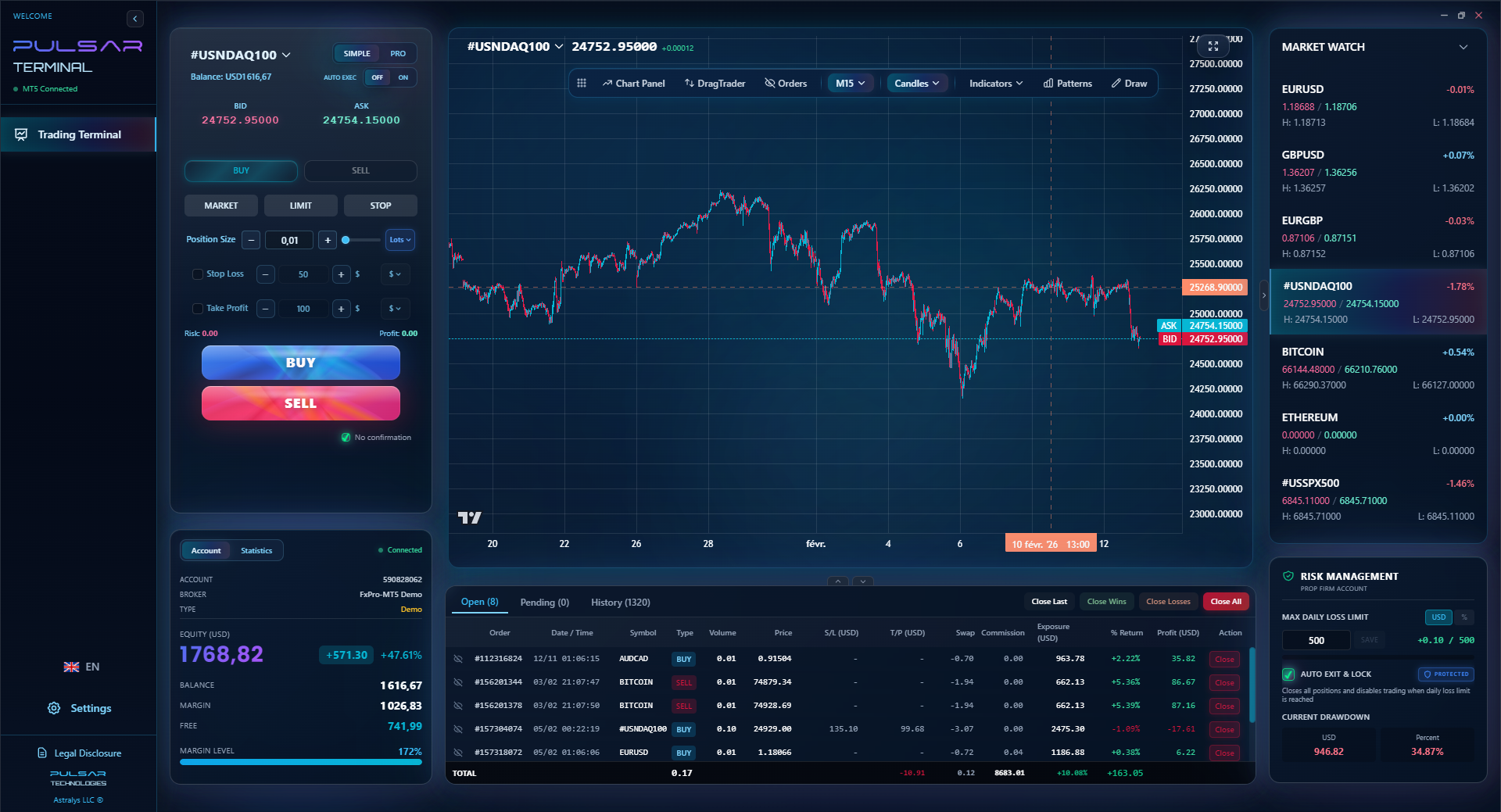
Sticking to a stop-loss philosophy is critical, and tools like Pulsar Terminal let you set and automate stop-loss, take-profit, and even trailing stop orders directly on your MT5 charts, removing emotional execution errors.
Pulsar Terminal
The all-in-one MT5 companion: drag-and-drop orders, multi-TP/SL, trailing stop, grid trading, Volume Profile, and prop firm protection. Used by 1,000+ traders daily.
If you're still reading, you're serious. So here's a realistic, unsexy path.
- Start with a Demo Account: But not for a week. For at least three months. Treat the virtual R100,000 as real money. Follow your risk rules. Experience a losing streak virtually first.
- Choose an FSCA-Regulated Broker: Go with a known entity like Pepperstone or Exness (if they hold a local license). Verify their FSP number on the FSCA website. The peace of mind is worth it.
- Fund with Money You Can Afford to Lose: Start small. R5,000. Your goal for the first year is not to make a million. It's to not lose that R5,000. It's to break even. That's a huge success.
- Specialize: Don't trade 28 pairs. Pick one major (like EUR/USD) and one cross that involves ZAR. Learn their personality, their average daily range, when they're most active.
- Adopt a Simple Strategy: Master one. It could be swing trading off key weekly levels. Complexity is the enemy of execution.
- Journal Relentlessly: Write down every trade. The setup, the emotion, the outcome. Review it weekly. Your journal is your best teacher.
Is forex hard? It's one of the hardest things you'll ever do properly. But the difficulty isn't a mystery. It's in the spread, the use, the psychology, and the daily discipline of managing yourself. The market doesn't beat you. You beat you. The good news? That means you can also fix you.
💡 Winston's Tip
If you feel a strong urge to enter a trade, that's often your signal to wait. The best entries feel boring, almost hesitant.
“Complexity is the enemy of execution. Master one simple strategy before you even look at another.”
Let's map the minefield.
| Pitfall | Why It Happens | The Fix |
|---|---|---|
| Chasing Losses | Emotional response to failure. | Stop trading for the day after two consecutive losses. The rule is non-negotiable. |
| Trading Too Big | Greed, or trying to recover losses fast. | Use a calculator. 1% of your account is your max risk per trade. No arguments. |
| Ignoring Fundamentals | Thinking lines on a chart are enough. | Have an economic calendar open. Know the big weekly events for your chosen pairs. |
| Over-trading | Boredom, or the need to 'be in the action.' | Define your setup clearly. If it's not there, don't trade. Sometimes the best trade is no trade. |
| Falling for 'Guru' Signals | The desire for a shortcut. | No one sells a real money-printing machine. If their strategy was so good, they'd be using it, not selling it. |
The biggest pitfall? Underestimating the time it takes. This isn't a side hustle you master in a month. It's a skilled profession. Give yourself two years of dedicated learning and practice before you judge your potential. That timeframe alone filters out 80% of people, which is why most fail.
FAQ
Q1Is forex trading actually illegal or a scam in South Africa?
No, it's completely legal and regulated by the FSCA. The scam element comes from unlicensed signal sellers, 'gurus' promising guaranteed returns, and unregulated offshore brokers who might manipulate prices. Always verify your broker's FSP license on the FSCA's official website.
Q2What's the minimum amount I need to start trading forex in South Africa?
Technically, you can start with as little as R100 (about $5) with some brokers. But realistically, to trade properly with sensible risk management on ZAR pairs with their wider spreads, a minimum of R5,000-R10,000 is more practical. It allows you to withstand normal losses without being forced to over-use.
Q3How are my forex trading profits taxed by SARS?
SARS views trading profits as income, not capital gains for active traders. You must declare your net profit (total profits minus total losses and allowable costs) in your annual tax return. It's added to your other income and taxed at your marginal rate. Keep detailed records of every single trade.
Q4Why is the spread on USD/ZAR so much higher than on EUR/USD?
Liquidity. EUR/USD is the most traded pair in the world, with billions moving every minute. USD/ZAR has far less trading volume. Lower liquidity means brokers take on more risk to hold the position, and they charge for that via a wider spread. It's a fundamental cost of trading emerging market currencies.
Q5Can I use my normal bank to fund my trading account?
Yes, but it can be expensive. Local FSCA brokers offer ZAR accounts you can EFT into. For international brokers, you'll use your annual discretionary allowance (up to R1 million) to send funds offshore via your bank as an international transfer, which incurs fees. Some brokers also accept credit/debit cards and e-wallets like PayPal.
Q6Is it better to trade with a South African broker or an international one?
There's a trade-off. A local FSCA broker (like Khwezi Trade) offers local support, ZAR accounts, and direct protection under South African law. A top-tier international broker with an FSCA license (like IG or Tickmill) often provides better technology, tighter spreads on major pairs, and access to more global markets. Avoid international brokers with no local regulation.
Q7How long does it take to become consistently profitable?
Assume 2-3 years of serious, dedicated study and practice. The first year is about not blowing up your account. The second is about breaking even. Consistency might come in the third. Anyone promising you profits in weeks or months is lying. This timeline is why most quit.
Prof. Winston's Lesson
Key Takeaways:
- ✓Respect the ZAR spread: 5 pips minimum means you need bigger moves.
- ✓Risk max 1% per trade. No exceptions, ever.
- ✓FSCA regulation is your safety net. Verify the license.
- ✓Profits are taxable income. Keep a detailed trade journal.
- ✓Give yourself 2-3 years to learn. This is a marathon.
How useful was this article?
Click a star to rate
Weekly Trading Insights
Free weekly analysis & strategies. No spam.
About the Author
David van der Merwe
Emerging Markets Trader
Johannesburg-based trader with 11 years in emerging market currencies. Specializes in ZAR pairs, FSCA-regulated trading, and South African market analysis.
Comments
Risk Disclaimer
Trading financial instruments carries significant risk and may not be suitable for all investors. Past performance does not guarantee future results. This content is for educational purposes only and should not be considered investment advice. Always conduct your own research before trading.
You Might Also Like

Cara Trading Forex Sukses: 7 Prinsip dari Trader Profesional
Cara trading forex sukses dengan 7 prinsip trader pro: manajemen modal, disiplin, journal trading, backtest. Data nyata, bukan janji profit palsu.
Jam Trading Forex Terbaik untuk Trader Indonesia: Panduan Lengkap dengan Tabel Waktu
Panduan jam trading forex untuk trader Indonesia. Tabel 4 sesi dunia, jam emas 20:00-00:00, sesi mana yang harus dihindari. Data akurat + tips dari trader berpengalaman.
Top 5 Sàn Forex Uy Tín Nhất 2026: Review Jujur dari Trader Indonesia
Top 5 sàn forex uy tín 2026 untuk trader Indonesia. Review jujur: spread, deposit, withdraw, dukungan lokal. Exness, XM, IC Markets & lebih.
Get Pulsar Terminal
All these calculators are built into Pulsar Terminal with real-time data from your MT5 account. One-click position sizing, automatic risk management, and instant calculations.
Get Pulsar Terminal