


You're a Muslim trader in the US, and you've seen the potential in the forex markets.

James Mitchell
Senior Trading Analyst
☕ 10 min read
What you'll learn:
- 1The Three Deal-Breakers: Riba, Gharar, and Maysir
- 2Islamic (Swap-Free) Accounts: How They (Actually) Work
- 3Practical Steps for Halal Trading in the US
- 4Common Haram Practices to Avoid (They'll Also Blow Your Account)
- 5Instrument Selection and the Line Between Trade & Speculation
- 6Consulting Scholars and Personal Responsibility
- 7Conclusion: The Ethical Edge
You're a Muslim trader in the US, and you've seen the potential in the forex markets. But a nagging question holds you back: is forex trading halal in Islam? The short answer is, it depends entirely on how you do it. Most conventional trading is built on financial mechanisms that directly contradict Islamic law. I've watched traders with great technical skill blow up their accounts not from bad analysis, but from ignoring the ethical and structural risks that make a trade haram. Let's break down the three deal-breakers and what you can actually do about them.
Forget about pips and spreads for a second. If you want to understand if forex trading is halal in Islam, you need to start with three Arabic terms. These aren't just guidelines; they're the foundation. Ignoring them doesn't just make your trading questionable, it makes it structurally unsound from a risk perspective.
Riba (Interest/Usury) This is the big one. Riba is any guaranteed, predetermined increase on a loan or debt. In forex, this manifests as the swap fee or rollover interest. When you hold a position overnight, you're either paid or charged interest based on the differential between the two countries' central bank rates. Earning or paying this interest is strictly prohibited. It's not a minor fee; it's the core mechanism that makes conventional margin trading work.
Gharar (Excessive Uncertainty/Deception) This refers to excessive risk, ambiguity, or deception in a contract. Trading on news you know is false? That's Gharar. Using a broker with hidden fees or a slippage policy that's designed to screw you? That's Gharar. Even trading an instrument where the underlying value is completely opaque (some complex CFDs qualify) can fall into this category. Your trades must be transparent and based on a clear exchange of assets.
Maysir (Gambling/Speculation) This is where many traders, Muslim or not, get wiped out. Maysir is earning money by mere chance, not by effort, skill, or assuming legitimate commercial risk. Placing a trade based on a 'gut feeling' with no analysis? That's gambling. Using extreme use like 1:1000 to make a quick buck on a tiny price move? That's gambling. The line between skilled speculation and Maysir is drawn by your process, your risk management, and your intent.

Warning: Don't fool yourself. If you're trading with a standard account and just 'accepting' the swap charges, you are engaging in Riba. The religious prohibition is clear, and from a trading standpoint, you're letting a cost you don't fully control eat into your profits.

💡 Winston's Tip
The swap fee isn't just a cost; it's a signal. If your strategy relies on earning it, you're building on interest. If you're constantly paying it, you're funding your broker's bottom line with a prohibited transaction. Eliminate it from your equation entirely.
So, how do you trade without swap fees? Brokers offer Islamic or swap-free accounts. They're not a magic halal button, but a specific structural workaround. Instead of charging you an interest-based swap, the broker typically charges a fixed administrative fee or a wider spread on overnight positions. This transforms the prohibited interest charge into a permissible service fee.
But you have to read the fine print. I made this mistake early on. I opened a 'swap-free' account with a broker, thinking I was covered. What I didn't realize was that they reserved the right to convert my account back to a standard type if I held certain positions for more than 30 days. I got hit with a hefty back-charged swap on a long-term EUR/USD swing trade that wiped out my gains. It was a costly lesson in not verifying the terms.
Here’s what you must check before opening one:
| Feature | What to Look For | Red Flag |
|---|---|---|
| Overnight Fees | A fixed, disclosed daily fee (e.g., $5 per lot). | Any mention of 'interest', 'swap', or 'rollover' in the fee description. |
| use | Reasonable levels (e.g., 1:30, 1:50). | Extremely high use (1:500+), which encourages Maysir. |
| Holding Period | No arbitrary limit on how long you can hold a trade. | Limits (e.g., 30 days) after which swaps apply. |
| Broker Regulation | Trustworthy jurisdiction (ASIC, FCA, etc.). | Offshore, unregulated brokers offering 'guaranteed' halal accounts. |
Not all brokers offer genuine Islamic accounts. Some of the more reputable ones that do include IC Markets and Pepperstone, but you must apply for the swap-free status specifically and confirm all conditions. This is a non-negotiable first step for any Muslim trader.
“Most conventional trading is built on financial mechanisms that directly contradict Islamic law.”
Getting a swap-free account is just step one. Making your entire practice halal requires intentionality in your strategy and execution. Here’s a framework I’ve developed over the years.
Adopt a Spot Trading Mindset
Islamically, the most straightforward forex transaction is a spot exchange: you buy one currency with another, and the settlement is immediate (or within T+2). While the modern forex market is built on speculation, you can align with this by avoiding strategies that rely on earning swap. Focus on capturing price movement within a defined timeframe. This naturally leads you towards day trading or scalping strategies where you open and close positions within the same session, avoiding overnight fees altogether.
Eliminate Gharar with Transparency
Your trades must be based on real analysis, not rumors or deception. This means:
- Using reliable data sources.
- Having a clear, written trading plan for every entry.
- Understanding every fee your broker charges (commission, spread, overnight admin fee).
- Never trading on insider information or manipulated news.
This isn't just ethics; it's good trading. The biggest losses I've ever taken came from trades where I was fuzzy on the reason for entry. Clarity is a religious and financial imperative.
Use use as a Tool, Not a Lottery Ticket
High use is the engine of Maysir in forex. Using 1:500 use means a 0.2% move against you wipes out your margin. That's not investing or skilled trading; that's betting. Restrict your use to levels that allow for normal market volatility without constant margin calls. In the US, retail use is capped at 1:50 for major pairs - this is a regulatory constraint that actually helps you avoid a haram practice.

Pro Tip: Calculate your position size based on your account risk (e.g., 1% per trade), not on how much your use allows you to trade. A position size calculator is essential. If your calculated lot size feels too small for your taste, that's your greed talking, not your trading plan.
Let's get blunt. Some common 'strategies' in the trading world are fundamentally at odds with Islamic finance. Avoiding them protects your faith and your capital.
News Scalping / 'Sniping' Trying to capitalize on the instant volatility of a high-impact news release like NFP is often pure Gharar and Maysir. The spreads widen massively, liquidity vanishes, and you're gambling on which way the price will jerk. I lost $800 in 90 seconds trying to do this on a GBP news event years ago. The order filled at a terrible price and reversed immediately. The uncertainty was excessive, and the outcome was based on chance, not skill.
Martingale / Grid Strategies These involve doubling down on losing trades to average your entry price. They are mathematically designed to eventually fail unless you have infinite capital. This creates excessive, undefined risk (Gharar) and turns trading into a probability gamble (Maysir). Most brokers offering these as 'EA-friendly' are counting on you blowing up.
Trading Binary Options or Digital Options These are almost universally agreed to be haram. You're not trading a currency pair; you're betting on whether the price will be above or below a certain point at a specific time. It's a fixed-odds bet, the very definition of Maysir. Stick to spot forex or CFDs (if your scholar permits them) where you actually own the contractual right to the asset's price movement.
Carry Trade Strategies This strategy is built on Riba. It involves buying a high-yield currency and selling a low-yield one to profit from the positive swap. The entire profit premise is the interest differential. If you're asking is forex trading halal in Islam, and your strategy is a carry trade, the answer is a definitive no.
💡 Winston's Tip
High use is the fastest solvent for a trading account and for ethical compliance. The US 1:50 cap isn't a restriction; it's a blessing in disguise. It forces you to build real skill, not just bet big.
“The line between skilled speculation and Maysir is drawn by your process, your risk management, and your intent.”
Not all forex pairs are created equal from a Sharia perspective. Major pairs like EUR/USD have immense liquidity and transparent pricing, minimizing Gharar. Exotic pairs (e.g., USD/TRY, USD/ZAR) can have wild spreads and be subject to sudden capital controls, introducing excessive uncertainty.
What about gold (XAU/USD)? Trading spot gold is generally considered more straightforward and permissible by many scholars, as you're dealing in a tangible asset. However, you must still use a swap-free account, as CFD gold trading also involves overnight fees. Our XAU/USD guide covers the specifics of trading it.
The core question is intent. Are you providing a service (like currency exchange for a business) or assuming legitimate commercial risk based on research? Or are you just hoping for a lucky break? I keep a trading journal that includes my rationale for each trade. If I can't write down a clear, analysis-based reason that isn't 'it feels like it will go up,' I don't take the trade. This practice alone filtered out dozens of losing, haram-gambling trades for me.

Example: A Halal Trade Setup
- Account: Verified Islamic swap-free account with XM or similar.
- Pair: EUR/USD (high liquidity, low spread).
- Analysis: Price bouncing off a key weekly support level, confirmed by a bullish divergence on the RSI indicator.
- Execution: Enter during London session. Set stop-loss at 1% of account capital using a position size calculator. Set take-profit at a 1.5:1 risk-reward ratio.
- Management: Plan to close before NY close to avoid any overnight fee. This is a clear, skill-based assumption of risk with no Riba, minimal Gharar, and zero Maysir.
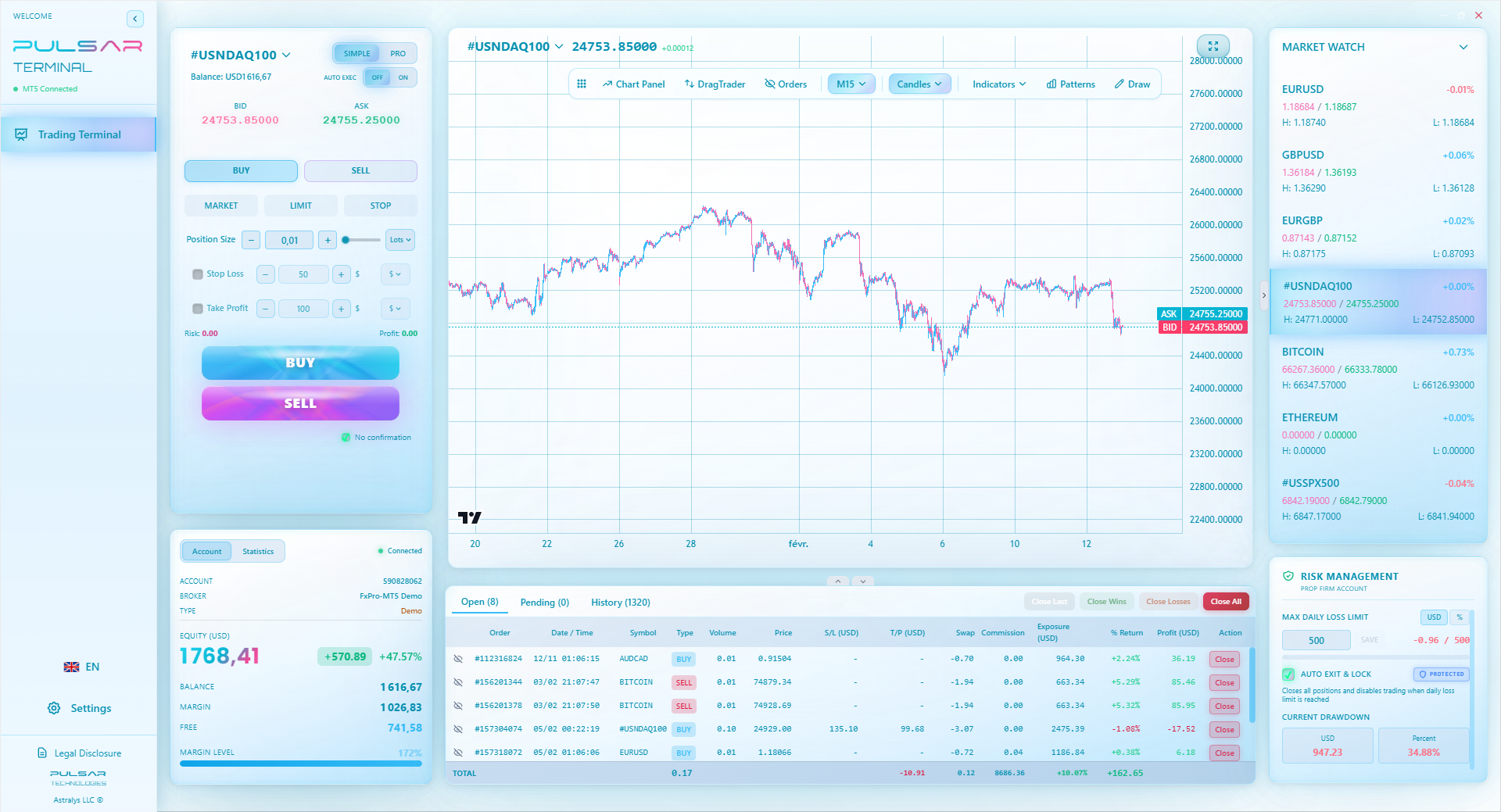
Executing a disciplined, same-day exit plan to avoid overnight fees is critical for halal trading, and Pulsar Terminal's drag-and-drop order and bracket system makes managing those precise exits effortless on MT5.
Pulsar Terminal
The all-in-one MT5 companion: drag-and-drop orders, multi-TP/SL, trailing stop, grid trading, Volume Profile, and prop firm protection. Used by 1,000+ traders daily.
I'm a trader, not a scholar. The final word on the permissibility of any financial activity in your life must come from a qualified Islamic scholar who understands modern finance. My role here is to show you the practical landscape so you can ask informed questions.
When you consult a scholar, don't just ask, "Is forex trading halal?" That's too vague. Present your specific case:
- "I plan to use a swap-free account from a regulated broker that charges a fixed admin fee instead of interest."
- "I will use maximum 1:30 use and risk only 1% of my capital per trade."
- "My strategy is based on technical analysis of price charts for major currency pairs, closing all positions daily."
This shows you've done your homework. , the responsibility (fard al-ayn) is on you. You cannot outsource your ethical judgment to a broker's marketing material that says 'Halal Account.' You have to verify the structure. The peace of mind from knowing your income is clean is worth far more than any potential profit from a shady, interest-based trade.
“What seems like a limitation becomes your framework for sustainable success.”
So, is forex trading halal in Islam? It can be, but it's a path you have to consciously build, not a default setting you find. It requires choosing the right broker account, adopting disciplined strategies that avoid gambling, and maintaining transparent intent.
Here's the unexpected benefit: the constraints of halal trading force you into being a better, more disciplined trader. You can't rely on swap income, so you get better at timing entries. You avoid crazy use, so you survive longer. You shun excessive uncertainty, so you stick to liquid, analyzable pairs. What seems like a limitation becomes your framework for sustainable success.
Start with the foundation: get a genuine Islamic account. Then build your strategy within the bounds of Riba, Gharar, and Maysir. It's harder than just clicking buy and sell. But in trading and in faith, the right way is rarely the easy way. Your capital and your conscience will thank you for it.
FAQ
Q1Can I trade forex without an Islamic account if I close all positions before the daily rollover?
Technically, yes. If you open and close a position within the same trading day (before 5 PM EST, the typical rollover time), you will not incur any swap interest, thus avoiding Riba. This is the basis of day trading. However, you must be absolutely certain of your broker's specific rollover time and ensure no positions are held past that point, even by accident. A genuine Islamic account provides a safety net against this risk.
Q2Are all swap-free accounts automatically halal?
No. 'Swap-free' is a broker label. You must investigate how the broker replaces the swap income. If they charge a fixed, transparent administrative fee, it's generally considered permissible. If they hide the cost by artificially widening spreads on overnight positions in a deceptive way, that introduces Gharar. Always read the full terms and conditions and, if possible, get a written explanation of their fee structure.
Q3Is using use (margin) in forex trading haram?
Not inherently. Using use as a tool to help a legitimate trade (like a margin loan in business) is permissible by many scholars, provided there is no interest (Riba). The problem is the level of use. Extremely high use (e.g., 1:500) transforms trading into a high-risk gamble (Maysir). Using moderate, responsible use (like the 1:50 cap in the US) within a well-risk-managed plan is the key distinction.
Q4Can I trade cryptocurrencies under Islamic finance principles?
This is a complex and debated area. The core issues are Gharar (extreme volatility and uncertain underlying value) and Maysir (speculative gambling). Many scholars are hesitant due to the lack of intrinsic value and the market's speculative nature. If you consider trading crypto, you must apply the same rigorous principles: avoid interest, use a spot exchange (not leveraged futures with funding fees), and have a clear, analytical strategy - not mere speculation. Consult a knowledgeable scholar for a definitive ruling.
Q5What is the ruling on trading profits from a mixed account (some halal, some haram trades)?
This is a serious matter. Scholars generally advise that profits generated from haram activities (like trades with swap interest) are impure (haram) and should be purified by giving them away in charity. You cannot benefit from them. This is why segregation is crucial. Do not mix strategies. Use a dedicated Islamic account for all your trading to ensure the complete purity of your capital and profits.
Q6Is technical analysis (using indicators) permissible in Islam?
Yes, using technical analysis like trend lines, support/resistance, and indicators such as the MACD or RSI is generally considered a form of market research and analysis. It helps reduce Gharar (uncertainty) by providing a reasoned basis for a trade. The impermissibility would come from using such analysis for gambling (Maysir), not from the tools themselves.
Prof. Winston's Lesson
Key Takeaways:
- ✓Swap fees = Riba. Use a verified Islamic account.
- ✓use over 1:100 is gambling, not trading.
- ✓Trade liquid majors to minimize Gharar.
- ✓Close trades same-day to avoid fee complexity.
- ✓Intent matters: journal your trade rationale.
How useful was this article?
Click a star to rate
Weekly Trading Insights
Free weekly analysis & strategies. No spam.
About the Author
James Mitchell
Senior Trading Analyst
Based in New York with over 9 years of trading experience. Focuses on major USD pairs, prop firm challenges, and the US regulatory landscape.
Comments
Risk Disclaimer
Trading financial instruments carries significant risk and may not be suitable for all investors. Past performance does not guarantee future results. This content is for educational purposes only and should not be considered investment advice. Always conduct your own research before trading.
You Might Also Like

Cara Trading Forex Sukses: 7 Prinsip dari Trader Profesional
Cara trading forex sukses dengan 7 prinsip trader pro: manajemen modal, disiplin, journal trading, backtest. Data nyata, bukan janji profit palsu.
Jam Trading Forex Terbaik untuk Trader Indonesia: Panduan Lengkap dengan Tabel Waktu
Panduan jam trading forex untuk trader Indonesia. Tabel 4 sesi dunia, jam emas 20:00-00:00, sesi mana yang harus dihindari. Data akurat + tips dari trader berpengalaman.
Top 5 Sàn Forex Uy Tín Nhất 2026: Review Jujur dari Trader Indonesia
Top 5 sàn forex uy tín 2026 untuk trader Indonesia. Review jujur: spread, deposit, withdraw, dukungan lokal. Exness, XM, IC Markets & lebih.
Get Pulsar Terminal
All these calculators are built into Pulsar Terminal with real-time data from your MT5 account. One-click position sizing, automatic risk management, and instant calculations.
Get Pulsar Terminal