


Let's cut through the noise.

James Mitchell
Senior Trading Analyst ·  Canada
☕ 11 min read
What you'll learn:

Let's cut through the noise. The biggest myth I hear from new Canadian traders is that our market is 'free' or 'unregulated.' They see ads for offshore brokers offering 1:1000 use and think that's the norm. It's not. In Canada, forex trading is legal, but it's wrapped in one of the most protective regulatory blankets in the world. That's a good thing for your capital, but it changes the game completely. I'll show you exactly how it works, where the traps are, and how to trade legally without getting your account frozen.
Forget what you know about the SEC or the FCA. Canada does things its own way, through a two-tiered system that can confuse even seasoned pros.
The big dog is the Canadian Investment Regulatory Organization (CIRO). This is the national self-regulatory organization that came to life in 2023 from the merger of IIROC and the MFDA. If a broker wants to offer leveraged forex or CFDs to you, a Canadian resident, they must be a CIRO member. No exceptions. This isn't a suggestion; it's the law.
Then you have the Canadian Securities Administrators (CSA), which is a council of all the provincial and territorial regulators. A broker needs to be registered in each province where it operates. So, a broker approved in Ontario might need extra paperwork for Alberta. This system is why you see fewer international brokers here - the compliance headache is real.
The protections are serious. Your funds must be segregated from the broker's operating capital. If the broker goes belly-up, your money isn't part of their bankruptcy estate. Even better, CIRO members are part of the Canadian Investor Protection Fund (CIPF), which covers eligible investor assets up to $1 million if a member firm fails. That's a safety net you won't get with an unregulated offshore outfit.

Warning: The CSA and CIRO regularly publish warnings about unregistered forex services. If you send money to a broker not on their list, you have virtually zero recourse if things go south. Consider that money gone.

This is where Canadian regulation hits you in the face. If you're dreaming of 1:500 use to turn $100 into $50,000, wake up. CIRO has strict caps to protect retail traders from themselves.
For major currency pairs like EUR/USD or USD/CAD, the maximum use is 1:50. For minor or exotic pairs, it drops to 1:20. Let's put that in perspective. On a $10,000 account, 1:50 use gives you $500,000 in buying power. That's still significant, but it's a far cry from the insanity offered elsewhere.
Why This Actually Helps You
I fought these limits when they first came in. I was wrong. Blowing up my first serious account in 2015 was a direct result of using insane use (1:200) on a volatile GBP/JPY trade. A 50-pip move against me wiped out 40% of my capital. At 1:50, that same move would have been an 8% loss - painful, but survivable. The use cap forces better position size calculator discipline. It makes you think in terms of risk per trade, not just potential reward.

Example: Trading USD/CAD with 1:50 use.
- Account Balance: $5,000
- Max Position Value: $5,000 * 50 = $250,000
- That's 2.5 standard lots. A 10-pip move is worth $250. That's 5% of your account on a single 10-pip move. See how quickly it adds up?
The bottom line? You need more capital to play the same size, or you need to accept smaller position sizes. It changes your entire approach to scalping strategy and swing trading.

💡 Winston's Tip
The CIRO use cap is your friend, not your enemy. It forces you to build an edge based on analysis and timing, not just brute financial force. The traders who succeed here are the ones who master patience.
“The use cap forces better position size discipline. It makes you think in terms of risk per trade, not just potential reward.”
Trading isn't free. In Canada, the cost structure is generally transparent but varies wildly between brokers. You're mainly paying through spreads and sometimes commissions.
Spreads on major pairs are competitive. You can find EUR/USD spreads as low as 0.0 pips on raw ECN accounts, but you'll pay a commission - usually around $5 to $7 per 100k lot (round turn). On standard accounts, expect spreads from 0.8 to 1.5 pips with no commission. For the home-team pair, USD/CAD, expect spreads between 0.3 and 3 pips normally, but I've seen them blow out to 9 pips during a Bank of Canada announcement. That's a killer if you're not watching.
Minimum deposits range from $0 (like at CMC Markets) to $500. Most sit around $100-$250. Don't get hung up on this. The minimum deposit is the least important number. Focus on the ongoing costs: the spread and commission.
Here’s a quick comparison of what you might actually pay on a 1-lot (100k) trade:
| Broker Type | EUR/USD Spread | Commission per Lot | Total Cost on 1 Lot Trade |
|---|---|---|---|
| Standard Account | 1.2 pips | $0 | $12 (1.2 * $10 per pip) |
| Raw/ECN Account | 0.1 pips | $7 | $8 ($1 from spread + $7 commission) |
Notice the ECN account is cheaper for larger sizes. For micro lots, the standard account might win. You have to do the math for your typical trade size.
And then there's the hidden cost: losing. The stats don't lie. Across all jurisdictions, a majority of retail accounts lose money. In Canada, with our tighter use, the percentage might be slightly better, but the principle remains. You are statistically likely to fund your broker's yacht, not buy your own. That's the real cost of admission.

Your broker choice in Canada is simpler but more critical. You must pick a CIRO-regulated entity. Here’s the reality of the major players.
Interactive Brokers (IBKR) is the institutional heavyweight. Their platform is a beast - incredibly powerful but not forex-focused. They offer tons of pairs but no CFDs for Canadians. Commissions are low, but it's better for multi-asset traders.
FOREX.com is a pure forex/CFD shop. They're regulated via Gain Capital Canada. Good platform selection (MT4, MT5, their own), solid execution, and they understand forex traders. Their research is decent. I've had an account with them for years for specific strategies.
OANDA is a Canadian classic, formerly under IIROC, now under CIRO. Their spreads on the standard account can be wider, but they're reliable and have a great API for algo traders. I used their data feed for backtesting for a long time.
AvaTrade operates here through Friedberg Direct. They offer a fixed spread model, which can be great for news traders who don't want spread widening, but you pay for that stability in slightly higher average costs.
My personal take? For pure forex, I split my capital between FOREX.com for active trading and Interactive Brokers for long-term macro plays. You need to verify their registration yourself. Go to the CIRO website and use their ‘Check an Advisor or Firm’ search tool. If they're not there, run.
💡 Winston's Tip
Pick your broker based on the cost structure that fits your most common trade size. Don't just look at the minimum deposit. A $7 commission on a 1-lot trade is fine. On a 0.01 micro lot, it's a massacre.
“The CRA has all your T5s from your broker. They know. Be proactive with your taxes from day one.”
Let's talk about the government's cut. The Canada Revenue Agency (CRA) treats forex trading profits in one of two ways: as capital gains or as business income. This distinction is everything.
If you're a casual trader (a few trades a month, not your primary income), profits are likely capital gains. Only 50% of the net gain is taxable at your marginal rate. This is the good scenario.
If trading is your business - you trade frequently, have a system, derive significant income from it - the CRA may deem it business income. Then 100% of your profits are fully taxable. You can deduct related expenses (platform fees, data subscriptions, a portion of home office), but it's a tougher tax hit.
I learned this the hard way. In 2018, I had a killer year trading XAU/USD volatility. I reported it as capital gains. The CRA reassessed me, arguing the frequency and organization of my trades made it a business. I spent months and thousands on an accountant to fight it. We settled. It was a nightmare.
You must report if your net gains or losses exceed $200 for the year. Keep careful records: trade confirmations, statements, journal entries. Use a proper trading journal. When you win, set aside a portion for taxes immediately. I put 25-30% of any withdrawal into a separate savings account. It hurts, but not as much as a surprise tax bill.

Pro Tip: Talk to an accountant who specializes in trading income before you have a big year. Set up your record-keeping from day one. The few hundred dollars in fees will save you thousands in stress and potential penalties.
Funding is where you feel the 'Canadian' part. Forget exotic e-wallets from other countries. Here, it's all about trust and the big banks.
Interac e-Transfer is the king. It's fast, secure, and almost universally accepted by domestic brokers. Funds usually show up within a few hours. Bank wire is the old-school fallback - slower (1-3 business days) and often has fees ($15-30) from your bank.
Some brokers support pre-authorized debit (PAD), which pulls funds directly from your bank account. It's efficient for regular deposits.
What you won't see as much? Cryptocurrency deposits. CIRO-regulated brokers are traditional. Also, credit card deposits for speculative trading products are often blocked by the card issuers themselves due to the risk.
Withdrawals are usually via the same method. E-Transfer withdrawals are fast. Bank wires take time. A key point: you can only withdraw to an account in your name. No sending profits to your cousin's account. They have anti-money laundering rules tighter than a drum.
I fund my accounts via e-Transfer. It's simple. When I withdraw, I plan for a 1-2 business day delay. It's not instant like some offshore brokers promise, but I sleep better knowing the broker is legit.
💡 Winston's Tip
Open a separate high-interest savings account and label it 'CRA'. Every time you make a profitable withdrawal from your trading account, immediately transfer 25-30% into it. Future you will send a thank-you card.
“Your edge in Canada won't be use. It will be precision and discipline.”
Trading the CAD pairs is a must for any Canadian trader. You have a natural feel for the news flow. Bank of Canada announcements, oil price swings (CAD is a petro-currency), and domestic employment data become your core catalysts.
USD/CAD is the most liquid. I've scalped it for years. The average daily range is about 70-100 pips. It loves to trend during North American sessions. Key levels from the 1.3600 to 1.3800 range have been battlegrounds for years.
Platform Reality
You'll be using MetaTrader. MT4 or MT5 are the standards offered by almost every CIRO broker like XM or Pepperstone. Some have their own web platforms, but the charting and automation king is still MT.
This is where tools become essential. The native MT stop-loss management is clunky. If you're running a strategy with multiple targets or a trailing stop, clicking manually is a recipe for disaster.
Pro Tip: Your edge in Canada won't be use. It will be precision and discipline. Use the tools available to enforce your rules. A good MACD indicator setup on the 4-hour chart, combined with strict risk management on the 15-minute, can work within our use constraints. Patience is your new best friend.
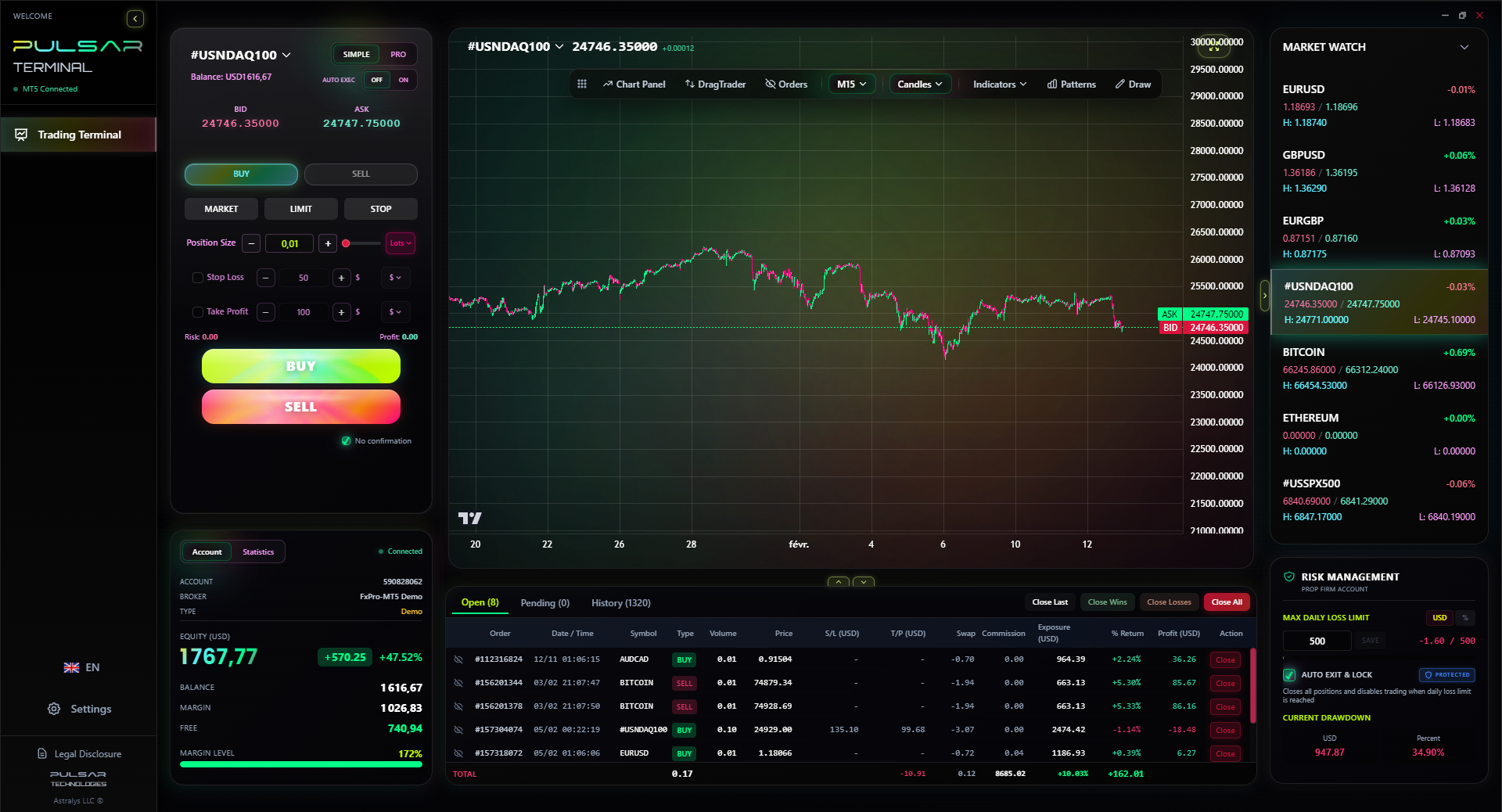
Managing multiple trades and complex exits within MT5 is cumbersome, but tools like Pulsar Terminal automate trailing stops, breakeven moves, and multi-target partial closures directly on your chart.
Pulsar Terminal
The all-in-one MT5 companion: drag-and-drop orders, multi-TP/SL, trailing stop, grid trading, Volume Profile, and prop firm protection. Used by 1,000+ traders daily.
I've made most of these mistakes so you don't have to.
Pitfall 1: Chasing Offshore Brokers. The siren song of higher use and crazy bonuses. I opened an account with one in 2019. The withdrawal process was a months-long nightmare of ‘verification’ requests. I got my money back, but it was a full-time job. Stick to the CIRO list.
Pitfall 2: Ignoring the Margin Call Warning. At 1:50 use, you might think you're safe. You're not. A fast-moving market can still wipe you out. I got cocky with a GBP/CAD short in 2022. The BoE intervened, and the pair ripped 300 pips in a day. My stop wasn't wide enough, I got gapped, and received the dreaded margin call. Always use a stop-loss, and make it a real one, not just a mental note.
Pitfall 3: Not Understanding the Spread. Trading right before major CAD news? The spread on USD/CAD will widen from 2 pips to 10+ in a blink. If you're entering a 0.5-lot trade, that's an instant $50 loss before the market even moves. Either trade around news or use limit orders, not market orders.
Pitfall 4: Tax Procrastination. Not setting aside money or keeping messy records. The CRA has all your T5s from your broker. They know. Be proactive.
The Canadian regulatory environment is designed to protect you from the worst of yourself and from outright fraud. Use that protection. Trade slower, trade smaller, and focus on consistency over home runs. That's how you survive and thrive up here.
FAQ
Q1Is forex trading legal in Canada for beginners?
Yes, it's completely legal for beginners. However, the regulatory environment (CIRO) is strict, with use capped at 1:50 for majors. This actually benefits beginners by preventing them from taking on catastrophic risk with small accounts, but it also means you need to be more patient and disciplined with your capital growth.
Q2Can I use MetaTrader 4/5 with Canadian brokers?
Absolutely. MT4 and MT5 are the industry standard platforms offered by nearly every CIRO-regulated broker in Canada, such as FOREX.com, OANDA, and others. They provide the charts, indicators, and automated trading capabilities you need.
Q3What is the maximum use allowed in Canada?
For retail traders, CIRO rules cap use at 1:50 for major currency pairs (like EUR/USD, USD/CAD) and 1:20 for minor or exotic pairs. This is a hard rule for all regulated brokers serving Canadian residents.
Q4Do I have to pay taxes on my forex trading profits?
Yes. You must report all trading profits to the CRA. They can be taxed as either capital gains (only 50% of the gain is taxable) or as business income (100% is taxable), depending on the frequency, volume, and business-like nature of your trading. Keep detailed records.
Q5How do I know if my broker is legally allowed to operate in Canada?
Use the CIRO's online 'Check an Advisor or Firm' search tool. Any legitimate broker offering services to Canadians will be listed there with their registration details. If they're not, they are operating illegally and you should avoid them.
Q6Are my funds safe with a CIRO-regulated broker?
They are significantly safer than with an unregulated broker. CIRO members must segregate client funds and are part of the Canadian Investor Protection Fund (CIPF), which protects eligible client assets up to $1 million per account in the event of the firm's insolvency.
Q7What's the best way to fund my trading account in Canada?
Interac e-Transfer is the most common, fastest, and easiest method for funding and withdrawals with domestic Canadian brokers. Bank wire is also accepted but is slower and may incur fees from your bank.
Prof. Winston's Lesson
Key Takeaways:
- ✓Maximum use is 1:50 for majors, 1:20 for minors.
- ✓Verify your broker on the CIRO website - no exceptions.
- ✓Set aside 25-30% of profits immediately for taxes.
- ✓Fund via Interac e-Transfer for speed and security.
- ✓Trade CAD pairs (USD/CAD) for a natural news advantage.
How useful was this article?
Click a star to rate
Weekly Trading Insights
Free weekly analysis & strategies. No spam.
About the Author
James Mitchell
Senior Trading Analyst
Based in New York with over 9 years of trading experience. Focuses on major USD pairs, prop firm challenges, and the US regulatory landscape.
Comments
Risk Disclaimer
Trading financial instruments carries significant risk and may not be suitable for all investors. Past performance does not guarantee future results. This content is for educational purposes only and should not be considered investment advice. Always conduct your own research before trading.
You Might Also Like

Cara Trading Forex Sukses: 7 Prinsip dari Trader Profesional
Cara trading forex sukses dengan 7 prinsip trader pro: manajemen modal, disiplin, journal trading, backtest. Data nyata, bukan janji profit palsu.
Jam Trading Forex Terbaik untuk Trader Indonesia: Panduan Lengkap dengan Tabel Waktu
Panduan jam trading forex untuk trader Indonesia. Tabel 4 sesi dunia, jam emas 20:00-00:00, sesi mana yang harus dihindari. Data akurat + tips dari trader berpengalaman.
Top 5 Sàn Forex Uy Tín Nhất 2026: Review Jujur dari Trader Indonesia
Top 5 sàn forex uy tín 2026 untuk trader Indonesia. Review jujur: spread, deposit, withdraw, dukungan lokal. Exness, XM, IC Markets & lebih.
Get Pulsar Terminal
All these calculators are built into Pulsar Terminal with real-time data from your MT5 account. One-click position sizing, automatic risk management, and instant calculations.
Get Pulsar Terminal