


I remember my first big trade with a local broker back in 2016.

David van der Merwe
Emerging Markets Trader ·  South Africa
☕ 11 min read
What you'll learn:
I remember my first big trade with a local broker back in 2016. I put R15,000 on a USD/ZAR short, convinced the rand would weaken. The trade went my way initially, but then the broker's platform froze during a major news event. By the time it came back, my stop-loss had been skipped, and I was staring at a R4,500 loss. That's when I learned the hard way that 'legal' doesn't automatically mean 'safe' or 'fair.' The question 'is forex trading legal in South Africa' is just the starting point. The real question is how to trade within that legal framework without getting burned.
Let's get the big one out of the way first. Yes, forex trading is completely legal for individuals in South Africa. But it's not the wild west. We have a solid, if sometimes slow-moving, regulatory system designed to protect you. The two main players are the Financial Sector Conduct Authority (FSCA) and the South African Reserve Bank (SARB).
The FSCA is your frontline guardian. They're the ones who license and supervise all financial service providers (FSPs). If a broker wants to offer forex and CFDs to South Africans, they need an FSP number from the FSCA. You can and should check this number on the FSCA's public register. It's not just a formality. An FSCA license means the broker has to follow strict rules, like keeping your money in a segregated account (so they can't use your deposit to pay their office rent) and maintaining certain capital levels.
Then there's SARB. Their role is more about the flow of money in and out of the country. You have an annual Single Discretionary Allowance of R1 million. This is the amount you can legally move offshore per calendar year without needing special tax clearance. If you're funding an international broker account from your South African bank, you're using part of this allowance. It's crucial to keep records for SARS. I learned this after a profitable year where I had to carefully trace every international deposit and withdrawal for my tax consultant. It was a headache I could have avoided with better record-keeping from day one.

Warning: Just because a big international broker accepts South African clients doesn't mean they are FSCA-licensed. Many operate under their home country's regulation (like CySEC or ASIC). This is legal for you to use, but if you have a dispute, you'll be dealing with a foreign regulator, not the FSCA. The protection isn't the same.
Knowing the rules isn't about limiting yourself. It's about knowing the playing field. Here are the non-negotiables that shape how we trade in South Africa.
The 30:1 use Cap
This is the big one that changed the game. Since 2021, the FSCA has capped use for retail traders at 30:1 on major forex pairs. For minor pairs and gold, it's often 20:1 or even 10:1. I have mixed feelings about this. On one hand, it saved me from myself in my early days when I was tempted to use 500:1. On the other hand, for experienced traders with solid risk management, it can feel restrictive. The intention is clear: to prevent you from blowing up your account in two seconds. You need to adjust your position size calculator inputs to reflect this lower use. It forces you to trade with more capital if you want larger position sizes, which isn't a bad thing.
Tax Obligations with SARS
Your forex profits are not a secret lottery win. SARS views them as income, and they are taxable. You need to declare your net profit (total profits minus total losses and allowable expenses) on your annual tax return. Allowable expenses can include data fees, trading platform subscriptions, and even a portion of your home office costs if you trade professionally. I made the mistake one year of only declaring my net profit from my main broker. SARS flagged it because the deposits from my bank account didn't match the declared income. They wanted to see the consolidated picture from all trading accounts. Now I use a simple spreadsheet tracking all accounts, and it makes tax season far less stressful.
The Segregated Accounts Rule
This is your financial life jacket. FSCA-licensed brokers must hold your money in a bank account separate from the company's own funds. This means if the broker goes bankrupt (it happens), your money should be safe and returned to you. This is not always guaranteed with unregulated offshore brokers. Your funds could be treated as part of the broker's assets.
Here’s a quick comparison of how key rules apply:
| Rule / Feature | FSCA-Regulated Broker | Unregulated Offshore Broker |
|---|---|---|
| use Limit | Max 30:1 (Retail) | Often 500:1 or 1000:1 |
| Client Fund Safety | Segregated Accounts Required | No Legal Requirement |
| Dispute Resolution | FSCA Ombud (Local) | Foreign Jurisdiction (Costly/Difficult) |
| Tax Reporting | Issues Local Tax Certificates (ITA88) | May not issue SA-friendly docs |
| Deposit/Ease | Easy EFT/ZAR Deposits | Often International Wire, Forex Costs |

💡 Winston's Tip
The FSCA's use cap isn't a cage, it's a training wheel that stops you from crashing before you learn to ride. The best traders I know made their first million in volatility, not use.
“The 30:1 use cap changes your strategic options. High-risk, high-use scalping becomes much harder. You need to adapt.”
This is your most important decision after deciding to trade. Do you go with a locally regulated broker or an international one? I've used both, and there are clear trade-offs.
Local FSCA Brokers (e.g., Khwezi Trade, Markets SA): The main advantage is protection and simplicity. Deposits are via instant EFT in ZAR, with no currency conversion fuss. You get local customer support that understands our market hours and public holidays. They provide tax certificates in the correct format for SARS. The downsides? Spreads and fees can be slightly higher than the sharpest international brokers. The product offering (number of pairs, other instruments) might be smaller. I started with a local broker, and the peace of mind was worth the extra pip or two on the spread definition.
Top-Tier International Brokers (e.g., IC Markets, Pepperstone): These are giants like IC Markets and Pepperstone. They often offer razor-thin spreads (sometimes raw spreads from 0.0 pips), superior trading platforms like MT4/MT5, and a massive range of instruments. However, they usually operate under their home license (like ASIC in Australia). They accept South African clients, but you're not their regulatory priority. Funding your account uses your R1 million allowance, involves international wire fees, and you'll trade in USD or EUR. Withdrawals take days, not hours.

Pro Tip: Don't get blinded by low minimum deposits. A $10 minimum deposit is a marketing gimmick. With 30:1 use, $10 is practically useless for anything beyond micro-lot practice. Plan to start with at least R5,000 to R10,000 to have meaningful, manageable positions.
My personal approach now is a hybrid. I keep my main, larger-capital account with a reputable international broker for execution and costs. I also have a smaller account with a local FSCA broker. This lets me test strategies in the local environment and gives me a backup. Check out our detailed reviews of Exness and XM to see how international brokers stack up for SA traders.
Trading isn't free. If you don't understand the costs, they'll eat your profits before you even see them. Here’s the real breakdown for a South African trader.
The Spread: This is the difference between the buy and sell price. It's your primary cost. On EUR/USD, a good local broker might offer 1.2 pips, while a raw account on IC Markets could be 0.1 pips plus a commission. That 1.1 pip difference matters. On a standard lot (100,000 units), 1 pip is about $10. So, that's an $11 difference just to enter the trade.
Commissions: Some accounts have zero commission but wider spreads. Others have tight raw spreads but charge a commission per lot. For example, a common model is $7 per round turn (to open and close) per standard lot. Calculate the total cost: Spread (in value) + Commission.
The Hidden Killer: Currency Conversion. This is the one that stung me early on. Let's say your trading account is in USD, but your bank account is in ZAR. You deposit R20,000. Your bank converts it to USD at their rate, which often includes a 2-3% margin. That's R400-R600 gone before you place a single trade. When you withdraw profits, it happens again. Always check your bank's conversion rate against the mid-market rate on Google. Consider using specialist forex services for larger transfers.
Inactivity Fees: Many brokers charge these if you don't trade for 2-3 months. It can be $10-$50 per month. If you're taking a break, close the account or be aware of the fee.
A Real Example from My Journal: I bought 0.5 lots of EUR/USD at 1.0850 on a 'raw' account.
- Spread: 0.1 pips. Cost = 0.1 * $10 * 0.5 lots = $0.50
- Commission: $7 per lot RT. Cost = $7 * 0.5 = $3.50
- Total Entry Cost: $4.00 If I'd used a spread-only account at 1.5 pips, the cost would have been 1.5 * $10 * 0.5 = $7.50. The 'raw' account saved me $3.50. Small on one trade, but massive over a year.
💡 Winston's Tip
Your trading journal should have three columns: P&L in USD, P&L in ZAR, and notes on SARB allowance used. The taxman cares about the second one, and your lifestyle depends on the third.
“Moving money offshore without tracking it is asking for trouble with SARS. Open a separate spreadsheet today.”
The 30:1 use cap changes your strategic options. High-risk, high-use scalping strategy that relies on 100:1 use to make tiny moves profitable becomes much harder. You need to adapt.
Swing Trading is Your Friend: This aligns perfectly with our regulatory environment. Swing trading holds trades for days or weeks, aiming for larger moves of 100-300 pips. You don't need massive use for this. With 30:1, a 2% position on a R50,000 account gives you plenty of exposure to capture a meaningful swing without excessive risk. I've had more consistent results focusing on swing trades on pairs like EUR/USD and XAU/USD using daily and 4-hour charts.
Using Indicators Within Limits: Indicators like the RSI indicator and MACD indicator work well for identifying swing entry points. The key is to widen your stop-loss to account for lower use. If you used to risk 10 pips with high use, you might now need to risk 20-30 pips for the same position size. This requires more patience and better trade selection.
Risk Management is Non-Negotiable: This is the most critical skill. With lower use, the temptation is to put too much of your account into one trade to 'make up' for it. Don't. Use a position size calculator religiously. Never risk more than 1-2% of your capital on a single trade. The use rule is there to protect you from a margin call, but you can still blow up an account with poor risk management at 30:1.

Example: You have a R20,000 account and want to buy GBP/USD. Your stop-loss is 25 pips away. With a 1% risk rule, you can afford to lose R200 on this trade.
- Pip Value for a Standard Lot on GBP/USD ≈ $10.
- At 30:1 use, your maximum buying power is R600,000 (30 * R20,000), but we're governed by risk, not buying power.
- R200 risk / (25 pips * ~R18 per pip*) = ~0.44 mini lots. *(Using a rough ZAR/USD rate of 18) This gives you a sensible position size that fits both the use cap and proper risk management.
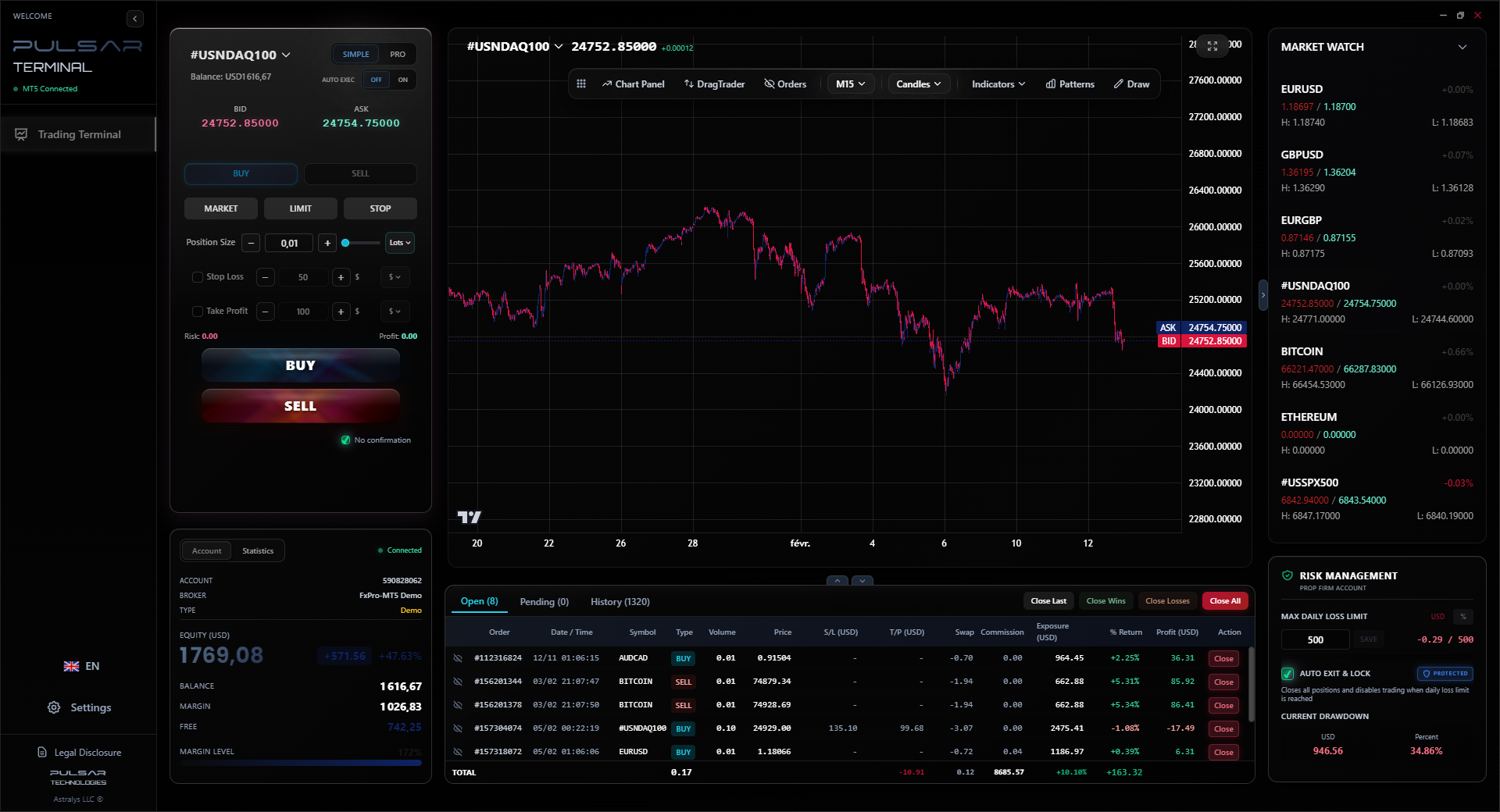
Managing multiple trades and precise risk levels within the 30:1 leverage limit is easier with tools that automate partial closures and breakeven moves, like those in Pulsar Terminal for MT5.
Pulsar Terminal
The all-in-one MT5 companion: drag-and-drop orders, multi-TP/SL, trailing stop, grid trading, Volume Profile, and prop firm protection. Used by 1,000+ traders daily.
I've stepped in most of these potholes so you don't have to.
Pitfall 1: Chasing 'Unregulated' High use. You'll see ads for brokers offering 1000:1 use. It's tempting, especially when you're under-capitalized. I tried it once with a small 'test' amount of $500. I turned it into $3000 in a week using crazy use. I felt like a genius. Then I lost it all in the next two days. The psychological damage of that rollercoaster took months to recover from. The FSCA's 30:1 limit, while frustrating sometimes, creates a safer playground.
Pitfall 2: Ignoring SARB Allowances and Tax. Moving money offshore without tracking it is asking for trouble with SARS. Open a separate spreadsheet today. Log every international deposit (date, ZAR amount, USD equivalent), every withdrawal, and your monthly profit/loss statement from your broker. Your future self will thank you.
Pitfall 3: Using a Broker Without Checking the FSP Number. It takes two minutes on the FSCA website. If they're not there, ask yourself why. Are they new? Or are they avoiding regulation? When in doubt, stick with a known entity from our broker reviews.
Pitfall 4: Underestimating the Impact of ZAR Volatility. You might be brilliant at trading EUR/USD, but if the rand strengthens dramatically against the dollar, your USD-denominated profits are worth less in ZAR when you withdraw. It's an extra layer of risk to be aware of, especially for long-term holdings.
The bottom line? Forex trading is legally accessible in South Africa within a framework that's actually designed to help you survive long enough to learn. Work with the rules, not against them. Choose your broker wisely, manage your risk like your financial life depends on it (because it does), and always keep SARS in your calculations. It's a marathon here, not a sprint.
FAQ
Q1Can I legally use international brokers like IC Markets or Pepperstone?
Yes, it is legal for you as a South African resident to open an account with international brokers. They operate under a 'passport' system accepting clients globally. However, they are not FSCA-regulated, meaning you forfeit local regulatory protection. Your funds are protected under their home jurisdiction (e.g., ASIC in Australia), which is still strong but harder to access from SA.
Q2What is the maximum use I can get in South Africa?
For retail traders, the FSCA has set a maximum use limit of 30:1 for major currency pairs since 2021. This is a hard cap for all FSCA-licensed brokers. Some brokers may offer lower use. For exotic pairs or commodities, the limit is often 20:1 or 10:1. Professional client classification can allow for higher use, but the criteria are strict.
Q3How do I pay tax on my forex trading profits?
You must declare your net trading profit (total profits minus total losses and allowable trading expenses) as 'Other Income' on your annual SARS tax return (ITR12). Keep detailed records of all statements, deposits, and withdrawals. Allowable expenses can include platform fees, internet/data costs, and a portion of home office expenses if you trade professionally. Consulting a tax professional familiar with trading is highly recommended.
Q4Is there a limit to how much money I can send to an overseas broker?
Yes. You can use your annual Single Discretionary Allowance (SDA) of R1 million per calendar year to fund international brokerage accounts without tax clearance. Amounts over R1 million require a Tax Compliance Status (TCS) pin from SARS and fall under your Foreign Capital Allowance. Always declare these transfers to your bank as 'investment' or 'trading capital'.
Q5What happens if my FSCA-regulated broker goes bankrupt?
This is a key benefit of using a locally regulated broker. FSCA rules require client funds to be held in segregated trust accounts at reputable banks. In theory, these funds are separate from the broker's assets and should be returned to clients in the event of insolvency. There is also a potential recourse through the FAIS Ombud for disputes. This protection is not guaranteed with unregulated brokers.
Q6What's the minimum amount I need to start trading forex in SA?
Technically, some brokers allow you to start with as little as $5 (approx. R90). Practically, this is pointless due to the 30:1 use cap. To trade meaningfully and apply proper risk management, a realistic minimum starting capital is between R5,000 and R10,000. This allows for sensible position sizes without risking your entire account on one or two trades.
Prof. Winston's Lesson
Key Takeaways:
- ✓FSCA regulation provides essential protection; always verify the FSP number.
- ✓The 30:1 use cap mandates larger capital for serious size.
- ✓Tax on profits is unavoidable; track ZAR value from day one.
- ✓International brokers are legal but come with FX and legal complexity.
How useful was this article?
Click a star to rate
Weekly Trading Insights
Free weekly analysis & strategies. No spam.
About the Author
David van der Merwe
Emerging Markets Trader
Johannesburg-based trader with 11 years in emerging market currencies. Specializes in ZAR pairs, FSCA-regulated trading, and South African market analysis.
Comments
Risk Disclaimer
Trading financial instruments carries significant risk and may not be suitable for all investors. Past performance does not guarantee future results. This content is for educational purposes only and should not be considered investment advice. Always conduct your own research before trading.
You Might Also Like

Cara Trading Forex Sukses: 7 Prinsip dari Trader Profesional
Cara trading forex sukses dengan 7 prinsip trader pro: manajemen modal, disiplin, journal trading, backtest. Data nyata, bukan janji profit palsu.
Jam Trading Forex Terbaik untuk Trader Indonesia: Panduan Lengkap dengan Tabel Waktu
Panduan jam trading forex untuk trader Indonesia. Tabel 4 sesi dunia, jam emas 20:00-00:00, sesi mana yang harus dihindari. Data akurat + tips dari trader berpengalaman.
Top 5 Sàn Forex Uy Tín Nhất 2026: Review Jujur dari Trader Indonesia
Top 5 sàn forex uy tín 2026 untuk trader Indonesia. Review jujur: spread, deposit, withdraw, dukungan lokal. Exness, XM, IC Markets & lebih.
Get Pulsar Terminal
All these calculators are built into Pulsar Terminal with real-time data from your MT5 account. One-click position sizing, automatic risk management, and instant calculations.
Get Pulsar Terminal