


Here's a fact that might surprise you: London handles nearly 38% of the entire world's daily forex turnover.

Sarah Collins
Trading Strategist ·  United Kingdom
☕ 9 min read
What you'll learn:
Here's a fact that might surprise you: London handles nearly 38% of the entire world's daily forex turnover. That's over $3 trillion changing hands here every single day. So, is forex trading legal in the UK? Absolutely. But the real question isn't about legality - it's about how you navigate one of the most regulated, protected, and frankly, restrictive retail trading environments on the planet. I've traded here for over a decade, and the rules have reshaped my entire approach.
Forex trading is 100% legal in the United Kingdom. The Financial Conduct Authority (FCA) oversees everything, and they don't mess around. This isn't some grey-area side hustle; it's a fully recognized financial activity with a clear rulebook.
But here's the kicker: that rulebook exists for a reason. The FCA estimates that 80% of retail CFD traders lose money. Their regulations are a direct response to that statistic, designed to stop you from blowing up your account in five minutes. When I first started, I saw these rules as handcuffs. Now, after watching the 30:1 use cap save me from a margin call on a wild GBP/USD swing in 2022, I see them as a seatbelt. Annoying sometimes, but probably for the best.
The legal framework means you get serious protections - segregated client funds, negative balance protection, and the £85,000 FSCS safety net if a broker goes under. Trading here is safe from a regulatory standpoint. The danger, as always, comes from the charts and your own decisions.
If you want to trade forex in the UK, you play by the FCA's rules. Full stop. These aren't suggestions.
The use Cap: Your New Reality
This is the big one. For retail clients, use is capped. You can't get the 500:1 some international brokers offer. Here’s what you’re working with:
- Major Pairs (EUR/USD, GBP/USD): 30:1
- Minor Pairs & Gold (XAU/USD): 20:1
- Non-Major Indices & Commodities: 10:1
- Individual Shares: 5:1
- Cryptocurrency CFDs: Banned for retail. You can't trade them with a UK-regulated broker.
I had to completely rethink my position size calculator inputs when these caps came in. A £10,000 account used to control £500,000 on EUR/USD. Now it controls £300,000. It forces more conservative trades, which hurts potential returns but absolutely saves accounts. It killed the high-risk, high-reward scalping strategy I used to run.
The Non-Negotiables: Protection
- Negative Balance Protection: You can't lose more than you deposit. In 2015, during the Swiss Franc shock, I knew traders who ended up owing their broker five-figure sums. That can't happen here.
- Client Money Rules: Your cash is held in segregated accounts. If the broker collapses, it can't be used to pay their debts.
- 50% Margin Close-Out Rule: If your losses eat up 50% of the margin required for your open positions, your broker will start closing them to prevent a margin call. It's brutal but effective.

Warning: These protections ONLY apply if you trade with an FCA-authorised broker. If you sign up with an offshore entity to chase higher use, you forfeit all of this. I've seen it go wrong.

💡 Winston's Tip
The FCA's 30:1 use cap isn't a limit on your potential, it's a governor on your greed. Treat it as a built-in risk manager. A strategy that only works with 500:1 use isn't a strategy; it's a time bomb.
“The UK framework protects you from brokers, but not from yourself.”
Forget just the spread. The cost structure here is layered. Let me break down what comes out of your pocket, using real numbers from my trading journal.
Spreads & Commissions: You typically choose your poison.
- Standard Account: Wider spreads, no commission. On a slow day, EUR/USD might be 1.2 pips. That's £12 cost per standard lot before the market even moves.
- Professional/Raw Account: Tighter spreads plus commission. My go-to is a Raw account where EUR/USD is often 0.1 pips. But I pay £4.50 round-turn commission per lot. On 10 lots, that's £45 in commissions.
Here’s a quick comparison from my experience last quarter:
| Trade (10 lots EUR/USD) | Spread Cost | Commission | Total Cost |
|---|---|---|---|
| Standard Account (1.2 pip spread) | £120 | £0 | £120 |
| Raw Account (0.1 pip spread) | £10 | £45 | £55 |
For active trading, the Raw/ECN model is almost always cheaper. But you need volume.
The Hidden Fees:
- Inactivity Fees: Leave your account dormant for a year? Some brokers, like OANDA, will charge you £10 a month. It's a nudge to either trade or withdraw.
- Currency Conversion: Fund in GBP but trade USD pairs? Most brokers add a small fee, often around 0.5%, when they convert your money. I fund a USD account directly via transfer to avoid this.

Pro Tip: Always check the 'Fees & Charges' PDF on your broker's site. The devil is in the details, like overnight financing (swap rates), which can be a major cost for swing trading positions.
💡 Winston's Tip
Always run the numbers. A 'commission-free' account with a 1.5 pip spread costs you more on a standard lot than a 'raw' account with a 0.1 pip spread and a £4.50 commission. Know your break-even point.
This is the UK trader's unique advantage, and it's crucial you understand it. How you trade determines how you're taxed.
Spread Betting: This is where you bet on price movements in pounds per point. Profits from spread betting are tax-free for UK residents. No Capital Gains Tax (CGT), no income tax. I keep a separate account just for longer-term directional bets I place as spread bets. The psychology is different - it feels like a 'bet,' not an 'investment' - but the tax benefit is real.
CFD Trading: When you trade a CFD (Contract for Difference), you're entering a financial derivative contract. Profits here are subject to Capital Gains Tax. You have an annual tax-free allowance (currently £1,000), then you pay 10% if you're a basic rate taxpayer or 20% if you're a higher rate taxpayer.
Here’s my blunt take: For most retail traders starting out, the tax question is a distraction. You need to be consistently profitable first. Worrying about tax on profits you haven't made yet is like picking the paint colour for a Ferrari you can't afford. Focus on the trading. But once you have a solid, profitable track record, structuring your activity to use spread betting for eligible trades is a no-brainer. Just know that use caps and other FCA rules apply equally to both.
💡 Winston's Tip
Your first £10,000 in profits will likely come from your trading skill. Your first £100,000 might come from your tax planning. Understand the spread betting advantage early, but master the craft first.
“Worrying about tax on profits you haven't made yet is like picking the paint colour for a Ferrari you can't afford.”
With so many FCA-regulated options, the choice is overwhelming. It's not about who has the flashiest ads. It's about fit.
Platform is King: You'll live on this software. MT4 is still the old reliable, but MT5 is becoming the standard. Brokers like IC Markets and Pepperstone offer both, plus cTrader and TradingView integration. Test their demo platforms. Can you place orders quickly? Does the charting make sense? I switched to a broker offering MT5 exclusively because the depth of market feature changed my EUR/USD guide entry tactics.
Cost Structure Alignment: Match the account type to your style. Are you a high-volume scalper? A raw spread account is essential. A casual swing trader? A standard account with no commission might be simpler. Don't just look at the advertised EUR/USD spread; check the GBP/USD and XAU/USD spreads too, especially if you trade those.
The Small Print:
- Minimum Deposit: Many, like XM or Fusion Markets, have none or a tiny £5-£10 minimum. Others like IG or City Index ask for £100. Start small.
- Withdrawal Speed & Fees: How fast do you get your money? Are there fees? A broker that makes it hard to withdraw is a red flag.
My mistake early on was chasing the lowest spread without considering execution quality. I'd get a 0.1 pip spread but suffer with constant requotes during news events. Speed and reliability often matter more than a fractional pip.
The UK framework protects you from brokers, but not from yourself. Here are the traps.
Pitfall 1: Chasing Offshore use. The temptation is real. You see an ad for 500:1 use. You think, "My strategy would work so much better!" I opened an offshore account in 2018. I turned £2,000 into £8,000 in three weeks trading minor pairs with huge use. I felt like a genius. Then one bad trade, with no negative balance protection, wiped out the £8,000 and left me with a £500 debt to the broker. I learned the hard way that the FCA caps are there because of people like me.
Pitfall 2: Ignoring the 50% Close-Out Rule. You think, "I've got plenty of margin." But in a fast market, your stops can slip. If your equity dips below 50% of your required margin, the broker's system will automatically close your largest losing position. It can create a cascade. I've had this happen - it feels like the platform is trading against you. You must manage your risk so you're never near this level. Use a stop-loss, always.
Pitfall 3: Not Using the Protections. You have access to the Financial Ombudsman Service (FOS) and the FSCS. If you have a legitimate dispute with your broker, you have recourse. I once had a disputed withdrawal delay that was resolved in days after mentioning the FOS. Know your rights.

Example: A £10,000 account with 30:1 use on EUR/USD controls £300,000. The required margin is £10,000. If your floating losses hit -£5,000, your equity is now £5,000 - exactly 50% of margin. The auto-closeout process begins. This is why risk management is non-negotiable.
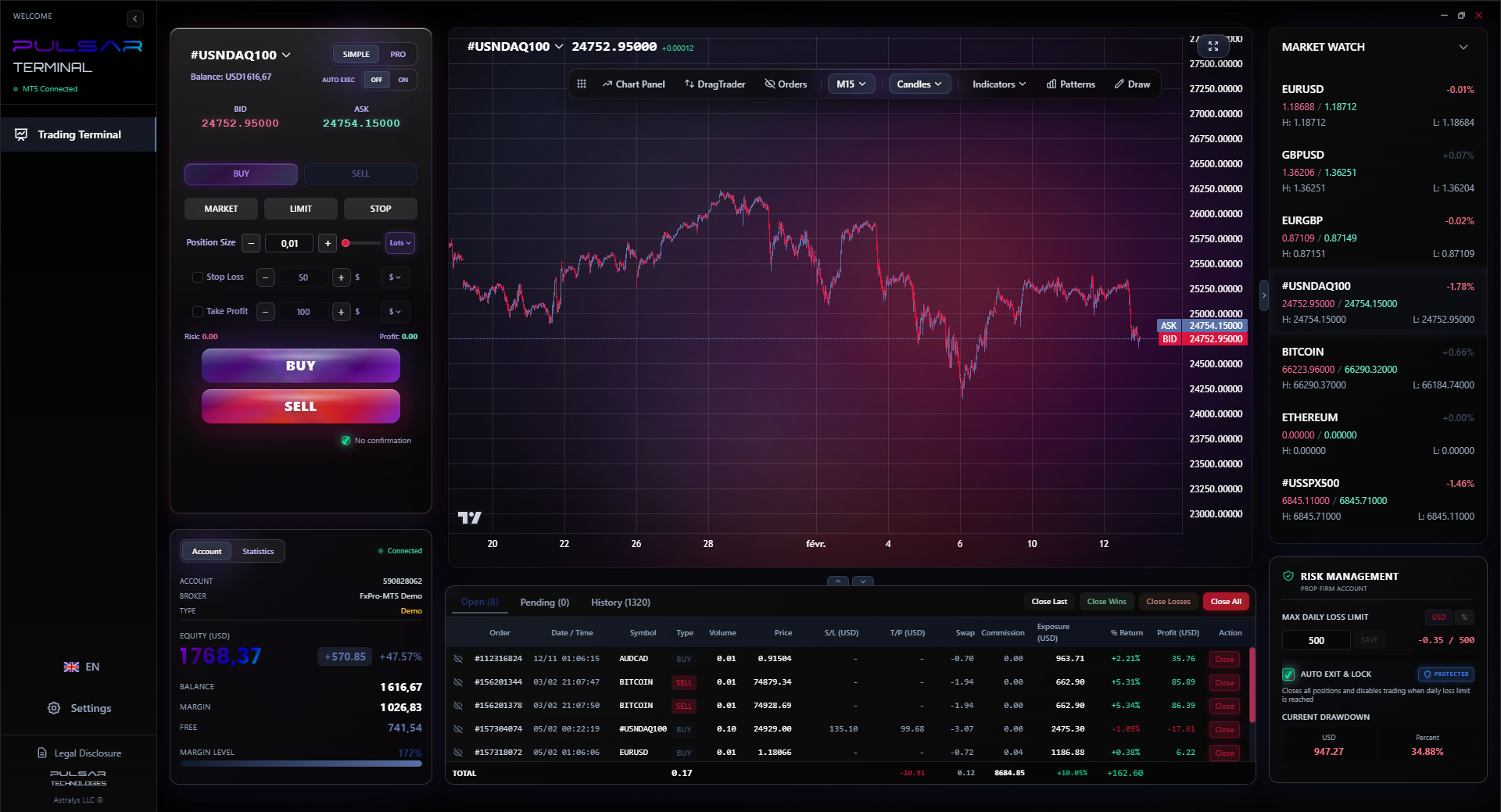
Managing multiple trades and risk under strict FCA rules requires precision; Pulsar Terminal's drag-and-drop orders and multi-TP/SL tools on MT5 help you execute your plan without hesitation.
Pulsar Terminal
The all-in-one MT5 companion: drag-and-drop orders, multi-TP/SL, trailing stop, grid trading, Volume Profile, and prop firm protection. Used by 1,000+ traders daily.
“A strategy that only works with 500:1 use isn't a strategy; it's a time bomb.”
Cut through the noise. Here's your action list.
- Educate Yourself First: Don't deposit a penny. Understand what a pip is, what spread means, and how use works. The FCA requires brokers to display the percentage of losing retail accounts (usually 70-80%). Believe it.
- Pick 2-3 FCA Brokers & Demo Trade: Open demo accounts with, say, Pepperstone and XM. Test their platforms for a month. Execute your paper strategy. Get a feel for the execution.
- Start Absurdly Small: When you go live, deposit the absolute minimum. For me, that was £100 with XM. Trade micro lots (0.01). Your goal for the first six months is not to make money. It's to not lose money while learning the real emotional pressure.
- Document Everything: Keep a trading journal. Note every trade, the rationale, the emotional state. Review it weekly. My biggest improvements came from reviewing losing trades and spotting my own repetitive mistakes.
- Formalise Your Strategy: Before risking more capital, you need a written plan. What pairs do you trade? What's your entry signal? Where is your stop-loss and take-profit? What's your maximum risk per trade (I recommend 1% of account equity)? Without this, you're gambling.
The UK market is sophisticated and demanding. It rewards patience, discipline, and respect for the rules. It punishes arrogance and impulsiveness faster than any regulator ever could.
FAQ
Q1Is forex trading legal in the UK for beginners?
Yes, completely legal. The FCA framework actually offers beginners more protection than in most countries, with use caps and negative balance protection preventing catastrophic losses. However, the high percentage of losing traders shows it's extremely difficult to succeed, regardless of legality.
Q2Can I use MetaTrader 5 with UK brokers?
Absolutely. MT5 is widely offered by major FCA-regulated brokers like IC Markets, Pepperstone, and Admirals. It's become the platform of choice for many serious traders due to its advanced features and superior back-testing capabilities compared to MT4.
Q3What's the difference between spread betting and forex trading?
Forex trading is the asset class (currencies). You can access it via two main products in the UK: Spread Bets and CFDs. A Spread Bet is a tax-free bet on the price movement. A CFD is a derivative contract that replicates the price movement and is subject to Capital Gains Tax. Both are legal and offered by the same brokers.
Q4Do I need to pay tax on my forex profits?
It depends on the product. Profits from spread betting are tax-free. Profits from trading forex CFDs are subject to Capital Gains Tax after using your annual tax-free allowance (£1,000). You must declare CFD profits to HMRC via a Self-Assessment tax return.
Q5What is the safest UK forex broker?
"Safest" refers to financial security and regulatory adherence. All FCA-authorised brokers must meet strict capital requirements and segregate client funds. Established names like IG, CMC Markets, and Saxo Bank have long track records. Your funds are also protected up to £85,000 per firm by the FSCS if the broker fails.
Q6Why is use so low in the UK compared to other countries?
The FCA imposed retail use caps (like 30:1 on majors) after research showed that high use was a key factor in most retail trader losses. They deemed it a necessary consumer protection measure to reduce the risk of rapid, significant losses. It's a permanent rule, not a temporary one.
Q7Can I trade cryptocurrencies with a UK forex broker?
No, not as CFDs. The FCA has banned the sale of cryptocurrency CFDs and ETNs to retail consumers in the UK due to their extreme volatility and perceived harm. You cannot trade crypto derivatives with any FCA-regulated broker. You can only buy and hold the actual assets on crypto exchanges.
Prof. Winston's Lesson
Key Takeaways:
- ✓use is capped at 30:1 for majors. Work with it, not against it.
- ✓Spread betting profits are tax-free; CFD profits are not.
- ✓Client funds are segregated and protected up to £85,000.
- ✓Crypto CFD trading is banned for UK retail traders.
- ✓Over 75% of retail traders lose money. The rules exist because of this.
How useful was this article?
Click a star to rate
Weekly Trading Insights
Free weekly analysis & strategies. No spam.
About the Author
Sarah Collins
Trading Strategist
London-based trading strategist with 12 years in financial markets. Former analyst at a City of London brokerage. Covers GBP pairs, European markets, and FCA-regulated trading.
Comments
Risk Disclaimer
Trading financial instruments carries significant risk and may not be suitable for all investors. Past performance does not guarantee future results. This content is for educational purposes only and should not be considered investment advice. Always conduct your own research before trading.
You Might Also Like

Cara Trading Forex Sukses: 7 Prinsip dari Trader Profesional
Cara trading forex sukses dengan 7 prinsip trader pro: manajemen modal, disiplin, journal trading, backtest. Data nyata, bukan janji profit palsu.
Jam Trading Forex Terbaik untuk Trader Indonesia: Panduan Lengkap dengan Tabel Waktu
Panduan jam trading forex untuk trader Indonesia. Tabel 4 sesi dunia, jam emas 20:00-00:00, sesi mana yang harus dihindari. Data akurat + tips dari trader berpengalaman.
Top 5 Sàn Forex Uy Tín Nhất 2026: Review Jujur dari Trader Indonesia
Top 5 sàn forex uy tín 2026 untuk trader Indonesia. Review jujur: spread, deposit, withdraw, dukungan lokal. Exness, XM, IC Markets & lebih.
Get Pulsar Terminal
All these calculators are built into Pulsar Terminal with real-time data from your MT5 account. One-click position sizing, automatic risk management, and instant calculations.
Get Pulsar Terminal