


Is forex trading profitable? That's the question every new trader asks, and the one most get wrong.
James Mitchell
Senior Trading Analyst ·  Canada
☕ 10 min read
What you'll learn:
Is forex trading profitable? That's the question every new trader asks, and the one most get wrong. The short answer is yes, it can be. But the real answer, the one that matters, is far more complicated. It's not about some secret strategy. It's about understanding the brutal math, the Canadian regulatory cage you trade in, and the psychological grind that separates the 10% from the 90% who lose. I've been trading from Toronto for over a decade. I've had months where I cleared $15,000 CAD and weeks where I blew a $5,000 account. Let's talk about what profitability actually looks like here.
Forget the get-rich-quick stories. Profitability starts with accepting some ugly statistics. Most global brokers are required to disclose that a high percentage of retail traders lose money. Those figures typically sit between 74% and 89%. Think about that. In a room of 100 traders, maybe 15 walk out ahead over the long term.
Why? It's not a conspiracy. It's simple arithmetic working against you.
The Cost of Doing Business Every trade has a cost - the spread. If you're trading a standard account with OANDA, you might face a 1.7 pip spread on EUR/USD. That means the price has to move 1.7 pips in your favour just for you to break even. On a $10,000 CAD position (roughly 0.1 lots), that's about $1.70 gone before you even start. It seems small, but it adds up fast. I used to be a hyper-active scalping strategy guy, making 20-30 trades a day. I was profitable on 60% of them, but my average winner was only 3 pips. After accounting for the spread, my net gain was microscopic. The broker was making more from my volume than I was.

Example: Trade: Buy 0.1 lots EUR/USD at 1.0850 (Value: ~$10,850 CAD) Spread: 1.7 pips Your break-even price is 1.08517. The market needs to move almost 2 pips before you see a cent of profit.
The use Trap Here in Canada, CIRO caps use at 1:50 for majors and 1:20 for minors. This is a protective measure, but it's still a double-edged sword. On a $2,000 account, 1:50 use lets you control $100,000. A 1% move against you wipes out 50% of your capital. That's a margin call waiting to happen. Early on, I learned this the hard way trading USD/CAD. I was right on the long-term direction, but a 30-pip spike against my position on thin liquidity triggered a stop-out. I was using too much use for my account size. I wasn't wrong on the market; I was wrong on my position size calculator.

💡 Winston's Tip
Profitability is a rate, not an event. Focus on your risk-to-reward ratio. Aim for a system where your average win is at least 1.5 times your average loss. That way, you can be wrong more often than you're right and still break even.
Trading from Canada isn't the same as trading from an offshore jurisdiction. We have a specific, strict framework that directly impacts your potential profitability.
CIRO Regulations: Your Safety Net and Your Cage
All legitimate forex brokers serving Canadians must be members of the Canadian Investment Regulatory Organization (CIRO). This gives you crucial protections: client funds are segregated, and you're covered by the Canadian Investor Protection Fund (CIPF) for up to $1 million per account type if a broker goes under. This peace of mind is priceless.
The trade-off? The use limits I mentioned, and a ban on promotional incentives like deposit bonuses. You won't find those "50% bonus" offers here. Your profit has to come purely from trading.
The Hidden Fees That Eat Returns
Beyond the spread, you need to watch for:
- Inactivity Fees: Leave your account dormant for a year with FOREX.com? That's a $20 CAD monthly fee. AvaTrade will hit you with a $50 fee after just three months. This kills small or seasonal accounts.
- Currency Conversion: Your account is in CAD, but you're trading USD pairs. When you deposit, withdraw, or even when profits are converted, brokers like OANDA add a 0.5% markup. On a $10,000 deposit, that's $50 gone instantly.
- Overnight Financing (Swap): If you hold a position past 5 PM ET, you pay or receive interest. Most of the time, if you're long a currency with a lower interest rate than the one you're short, you pay. It's a small daily cost that can wreck a long-term swing trading position. I once held a GBP/JPY short for three months for a 400-pip gain. The negative swap fees ate nearly 15% of that profit.

Warning: Always check a broker's fee schedule. That "low spread" account might have a commission that makes it more expensive than the standard account for your typical trade size. Do the math for your own strategy.
“Forex trading can be profitable. But the profit isn't just the money in your account. It's the skill, discipline, and self-knowledge you earn along the way.”
Let's get personal. Theory is one thing, but the market teaches you with real money. Here are two trades that defined my understanding of profitability.
The Lesson in Patience (The Win) In early 2020, as the pandemic panic peaked, I was watching XAU/USD (gold). It had sold off sharply from highs. My analysis, using weekly support levels and a bullish divergence on the RSI indicator, suggested a major bounce. I entered a long at $1,471.50 per ounce. My stop was wide, at $1,430, risking about $4,150 CAD on my position. I didn't set a take-profit. Instead, I trailed my stop manually, moving it up under each new higher low on the 4-hour chart. I held that trade for 11 weeks. It was agonizing. I watched paper profits of $8,000 evaporate to $2,000 during pullbacks. But I stuck to my plan. I finally closed at $1,765, for a profit of just over $29,000 CAD. The lesson? The biggest profits come from sitting on your hands, not from frantic clicking. One good trade can cover a dozen small losses.
The Lesson in Hubris (The Loss) Conversely, in late 2021, I was on a hot streak with EUR/USD scalps. I got cocky. The ECB was due to speak, and I anticipated volatility. I placed a massive (for me) 2-lot short right before the announcement, no stop loss, thinking I'd catch a quick drop. The news was ambiguous, and the pair spiked up 18 pips in seconds. My loss was over $3,600 CAD in under a minute. I broke every rule: oversized position, no stop, trading news blindly. That loss wiped out two weeks of careful work. It was the most expensive reminder that profitability isn't about being right; it's about managing risk when you're wrong. I was one bad trade away from a margin call.
These extremes taught me that consistent profitability isn't about huge wins. It's about ensuring your average winning trade is significantly larger than your average losing trade, and that you never let a single loss threaten your account.
So, how do you tilt the odds? You build a system that respects the Canadian context and your own psychology.
1. Choose Your Broker Wisely. You need a CIRO-regulated broker. Compare their all-in costs for your style. A scalping strategy needs the tightest possible spread, so a raw/ECN account from a broker like Pepperstone (via their global entity) with a small commission might be best. A longer-term swing trader might prefer a standard account with no commission but a slightly wider spread. Don't just look at the EUR/USD spread; check the spread definition on CAD pairs like USD/CAD, which you'll likely trade often.
2. Master Risk Management First. This is non-negotiable. With Canadian use limits, you still need to be stricter.
- Risk Per Trade: Never risk more than 1-2% of your account on a single trade. On a $5,000 account, that's $50-$100.
- Use Stops Religiously: Every. Single. Trade. Your stop-loss distance determines your position size. A 20-pip stop on USD/CAD means you can trade a larger lot size than a 5-pip stop on GBP/JPY.
- The Power of Take-Profit Levels: Don't just exit randomly. Know your profit target based on support/resistance. Using a tool that lets you set multiple take-profit levels can help you secure partial profits and let the rest run.
3. Find an Edge You Can Execute. Your edge is simply a repeatable reason to enter a trade that gives you a statistical advantage. It could be price action at key levels, a specific MACD indicator crossover confirmation, or order flow analysis. My edge is a combination of daily chart trend direction and entering on pullbacks using the 1-hour chart. It's boring. It generates about 8-12 signals a month. But it works for me.

Pro Tip: Backtest and forward-test your strategy on a demo account for at least 100 trades. Keep a journal. If it's not profitable in simulation with perfect execution, it definitely won't be with real money and emotions involved.
💡 Winston's Tip
Your first profitable year target shouldn't be a percentage return. It should be: 'I followed my trading plan on 95% of my trades.' The money follows the discipline, not the other way around.
“You are trading in one of the world's most regulated retail environments. This levels the playing field but also means you need to be sharper.”
You can have the best strategy in the world, and still blow up your account. The market is a mirror, and it reflects your fear and greed right back at you.
The Two Killer Emotions:
- Fear: This makes you close winning trades too early ("I better take this $200 profit before it disappears!") and let losing trades run ("It'll come back, I just need to wait...").
- Greed: This makes you add to losing positions (averaging down), ignore stop losses, and risk way too much on a "sure thing."
I used to have a terrible habit. After a losing trade, I'd immediately jump back in, trying to "make my money back." This is called revenge trading, and it's a guaranteed path to a losing day. I had to make a physical rule: after two consecutive losses, I walk away from the screens for the rest of the day. It saved me thousands.
The Discipline of Routine: Profitability is a job. I treat it like one. I have pre-market checklists, defined trading hours, and a post-market review where I analyze every trade - win or lose. This structure removes emotion from the equation. You're just following the process.
The question "is forex trading profitable" is a question about yourself. Are you disciplined enough to follow a plan, humble enough to accept losses, and patient enough to wait for your edge? The market doesn't care about your goals. It just is. Your job is to align your actions with its reality.
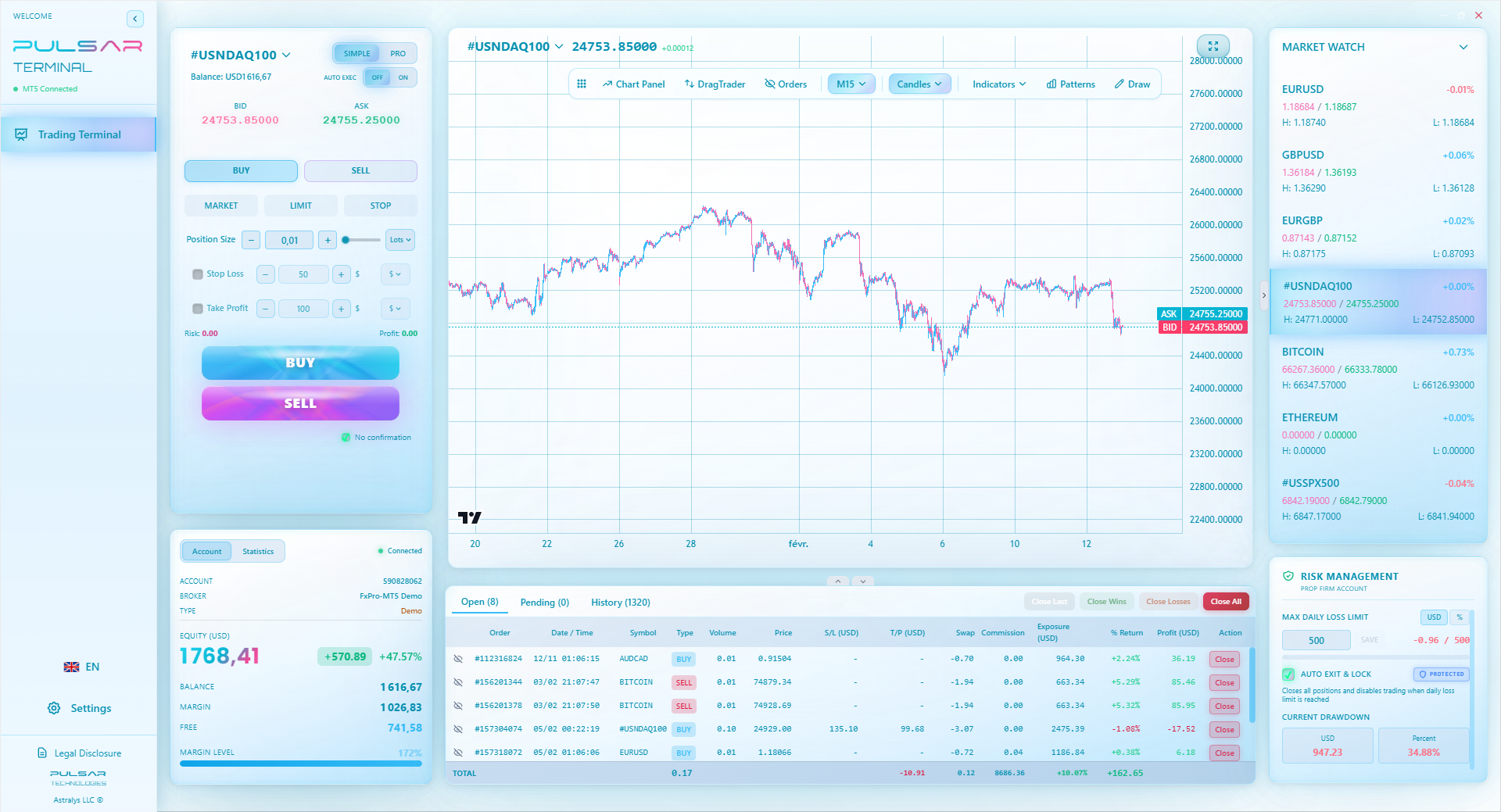
Managing the psychology of trade execution is easier when your tools let you plan entries, exits, and risk precisely before you ever click the buy button.
Pulsar Terminal
The all-in-one MT5 companion: drag-and-drop orders, multi-TP/SL, trailing stop, grid trading, Volume Profile, and prop firm protection. Used by 1,000+ traders daily.
Is forex trading profitable in Canada? Yes, it's possible. But it's a professional undertaking, not a hobby or a side hustle you can ignore.
The reality is this: You are trading in one of the world's most regulated retail environments. You have lower use, higher transparency, and strong investor protections. This levels the playing field in some ways but also means you need to be sharper. Your profits must overcome real, tangible costs and the psychological weight of knowing most fail.
It took me nearly three years and two blown accounts before I found consistent profitability. My first year in the green, I made about 14% return on my capital. That's less than a good year in the stock market for some. But I did it myself, with my own analysis and discipline. The next year was 22%. The satisfaction wasn't just in the money; it was in proving to myself I could master the process.
If you're starting, begin with a CIRO-regulated broker like Exness (global entity) or IC Markets that offers a strong demo environment. Learn what a pip definition really means in dollar terms. Paper trade until your strategy shows a clear, statistical edge over hundreds of trades. Then, fund a small live account with money you can afford to lose completely. Treat it as tuition.
Forex trading can be profitable. But the profit isn't just the money in your account. It's the skill, discipline, and self-knowledge you earn along the way. That's the trade that's truly worth making.
FAQ
Q1What percentage of forex traders are actually profitable in Canada?
There's no Canada-specific public data, but global broker disclosures consistently show that between 74% and 89% of retail CFD/Forex traders lose money. The environment in Canada, with its strict CIRO use caps, may slightly improve these odds by preventing extreme over-use, but the underlying principle remains: a significant majority do not achieve long-term profitability.
Q2How are forex trading profits taxed in Canada?
The Canada Revenue Agency (CRA) treats profits either as capital gains or business income. If you're an occasional trader, it's likely capital gains, where 50% of the profit is taxable. If you trade frequently, with significant capital, and it's your primary income source, the CRA may classify it as business income, making 100% of the profit taxable. Keep careful records and consult a Canadian tax professional.
Q3With CIRO's 1:50 use limit, can you still make good money?
Absolutely. In fact, 1:50 is more than enough to generate significant returns - and significant losses. The key is position sizing. With a $10,000 CAD account, 1:50 lets you control $500,000. A 1% move is $5,000. You don't need high use to make money; you need good risk management. Many professional traders use far less use than the maximum allowed.
Q4What is the biggest mistake new Canadian forex traders make?
Ignoring the total cost of trading. They see a "0.0 pip spread" ad and don't factor in commissions, currency conversion fees, and swap rates. They also underestimate the psychological impact of use. They use the full 1:50 on a small account, and a normal market fluctuation triggers a stop-loss, chipping away at their capital with fees and small losses until it's gone.
Q5Is it better to use a standard or a commission-based (ECN/Raw) account?
It depends entirely on your trading style. Scalpers and high-volume traders usually save money with a commission-based account (e.g., $3.50 per $50k round turn) because the raw spreads are often under 0.2 pips. Swing traders who make fewer, larger trades might find a standard account with a 1-pip spread and no commission is cheaper. You must calculate the cost per trade for your typical lot size.
Q6Can I use international brokers not regulated by CIRO?
Technically, you can access them, but it's not advisable. You forfeit all Canadian investor protections, including CIPF coverage and the guarantee of segregated funds. Also,, CIRO-regulated brokers are obligated to follow Canadian law. Trading with an offshore broker exposes you to higher potential use (like 1:500) and weaker recourse if something goes wrong. Stick with CIRO-regulated firms for safety.
Prof. Winston's Lesson
Key Takeaways:
- ✓74-89% of retail traders lose money long-term.
- ✓CIRO use caps (1:50) are a protective advantage.
- ✓Risk max 1-2% of capital per trade.
- ✓Your trading costs (spread, commission, swap) must be part of your strategy.
- ✓Psychology, not strategy, is the final hurdle to profitability.
How useful was this article?
Click a star to rate
Weekly Trading Insights
Free weekly analysis & strategies. No spam.
About the Author
James Mitchell
Senior Trading Analyst
Based in New York with over 9 years of trading experience. Focuses on major USD pairs, prop firm challenges, and the US regulatory landscape.
Comments
Risk Disclaimer
Trading financial instruments carries significant risk and may not be suitable for all investors. Past performance does not guarantee future results. This content is for educational purposes only and should not be considered investment advice. Always conduct your own research before trading.
You Might Also Like

Cara Trading Forex Sukses: 7 Prinsip dari Trader Profesional
Cara trading forex sukses dengan 7 prinsip trader pro: manajemen modal, disiplin, journal trading, backtest. Data nyata, bukan janji profit palsu.
Jam Trading Forex Terbaik untuk Trader Indonesia: Panduan Lengkap dengan Tabel Waktu
Panduan jam trading forex untuk trader Indonesia. Tabel 4 sesi dunia, jam emas 20:00-00:00, sesi mana yang harus dihindari. Data akurat + tips dari trader berpengalaman.
Top 5 Sàn Forex Uy Tín Nhất 2026: Review Jujur dari Trader Indonesia
Top 5 sàn forex uy tín 2026 untuk trader Indonesia. Review jujur: spread, deposit, withdraw, dukungan lokal. Exness, XM, IC Markets & lebih.
Get Pulsar Terminal
All these calculators are built into Pulsar Terminal with real-time data from your MT5 account. One-click position sizing, automatic risk management, and instant calculations.
Get Pulsar Terminal