


Let's cut through the hype.

David van der Merwe
Emerging Markets Trader ·  South Africa
☕ 12 min read
What you'll learn:
Let's cut through the hype. The promise of forex trading profitability in South Africa is a seductive lie for most. Social media gurus flaunt luxury cars, but they're selling a dream, not a reality. I've been trading for over a decade, and I've seen more accounts blown than I can count. This isn't to scare you off, but to ground you. Is it possible to be profitable? Absolutely. But the path is narrower, more regulated, and far more demanding than you've been told. I'll show you the real landscape, the exact numbers, and the mistakes that cost me real money so you can make an informed decision.
Trading in South Africa isn't the wild west. We have a strong regulator, the Financial Sector Conduct Authority (FSCA), and their rules directly shape your potential for profit. Ignoring this is your first step towards a margin call.
The FSCA caps use at 30:1 for retail traders. Coming from offshore brokers offering 500:1, this feels restrictive. I hated it at first. But in 2018, before the cap, I blew a R15,000 account in two days using 100:1 on GBP/USD. The use felt like a superpower until the market moved 1.5% against me. Poof. The 30:1 limit is annoying, but it's a forced discipline that probably saves more traders than it hinders.
Here's a critical rule many miss: you cannot directly speculate on the ZAR through an online broker. Want to short USD/ZAR on a hunch? You can't. You need a licensed bank or forex dealer for that. This pushes South African traders towards major pairs like EUR/USD or XAU/USD (gold), which isn't a bad thing - liquidity is better.
Always, always verify your broker's FSCA license on their public register. If you use an international broker like IC Markets or Pepperstone, understand the FSCA can't help you if things go wrong. Your protection is the broker's home regulator.

Warning: Trading with an unregulated offshore broker might offer higher use, but if they disappear with your deposit, you have exactly zero recourse. Your potential profit is 0% if your capital is gone.
Tax is the other half. SARS views your net trading gains as income. You need to keep careful records. I learned this the hard way after a good year in 2020; my accountant had to reconstruct six months of trades from broker statements. It was a nightmare. Now, I log every trade, win or loss, in a spreadsheet the moment I close it.

💡 Winston's Tip
The 30:1 use cap isn't a barrier, it's a governor on your engine. It prevents you from blowing your account in one spectacular, stupid trade. See it as a gift of forced patience.
“The dream of quitting your job in three months is a fast track to the 90% club.”
Let's talk about the uncomfortable statistics. Globally, between 70% and 90% of retail traders lose money. South Africa isn't an exception. The dream of quitting your job in three months is a fast track to the 90% club.
What Can You Realistically Earn?
These figures assume consistent discipline and a proven strategy. They are not guarantees.
- Beginner (First 1-2 years): You're not earning. You're paying for education. Small wins of R50-R300 on a good day are offset by losses. Your goal is survival, not profit.
- Intermediate (Years 2-4): With a R50,000 account, a solid 2% monthly return is excellent. That's R1,000. A great month might be 5% (R2,500). The online fantasy of R50k/month at this stage is dangerous nonsense.
- Experienced (5+ years): This is where compounding works. A R200,000 account generating a consistent 3-5% monthly is R6,000 to R10,000. On a stellar trade, you might bag R20,000. I know a few disciplined traders who consistently hit R50k-R100k monthly, but their accounts are well over R1 million, and they've been at it for a decade.
The Silent Profit Killers: Costs
Your broker isn't your partner. They are a business. Every cost comes straight from your potential profit.
| Cost Type | Typical Example | Impact on a R10,000 Trade (EUR/USD) |
|---|---|---|
| Spread | 0.7 pips on EUR/USD | You start -R7.40 in the hole (at ~R18.50/$). |
| Commission | $7 per lot (round turn) | -R129.50 per standard lot. |
| Swap/Overnight | Varies by pair & direction | Holding a EUR/USD short for a week could cost you R50. |
| Currency Conversion | 1% on ZAR deposits/withdrawals | Depositing R10,000 costs you R100 instantly. |
I used to chase the lowest spreads, but then I got killed on commissions. You need to look at the total cost per trade. A broker like Exness might have tight spreads, while IC Markets offers raw spreads with a clear commission. Do the math.

Example: If you take 20 trades a month with an average total cost of R50 per trade, you've paid R1,000 in fees. You need to make at least R1,001 just to break even. This is why overtrading is a silent killer.
The biggest cost, however, is your own psychology. Revenge trading after a loss cost me more in my first two years than all broker fees combined. A single emotional trade can wipe out a week of careful profits. Using a position size calculator religiously is the best defence against yourself.
“A single emotional trade can wipe out a week of careful profits.”
I want to show you what a real, costly mistake looks like. This isn't a theory. It happened in February 2022, trading from Johannesburg.
The Setup: The US Fed was talking tough on inflation. USD was strong. I saw USD/ZAR pushing higher (remember, I couldn't trade this directly, but I could trade USD strength via other pairs). I decided EUR/USD was the proxy. My analysis said: short.
The Execution: I entered at 1.1320. Account size: R80,000. I broke my own rule and risked 3% of my account (R2,400). My stop loss was at 1.1370 (50 pips). My target was 1.1220 (100 pips). Risk/Reward: 1:2. On paper, perfect.
The Mistake: An hour later, news broke of potential peace talks in Ukraine (a major risk-off event). EUR started to rally. My stop was at 1.1370. The price spiked to 1.1375, took me out, and immediately reversed back down to 1.1330. I was stopped out.
The Emotional Error: I was furious. A 'false breakout'! I re-entered the short at 1.1335, convinced I was right. I moved my stop loss further away to 1.1400, 'giving the trade room to breathe.' I broke my risk management rules.
The rally continued. It hit 1.1400. Loss number two. Total loss: over R5,000 on the combined trades. I had turned a planned R2,400 risk into a R5,000 disaster because of emotion.
The lesson was brutal. The market doesn't care about your analysis being 'right' in the long run. My first trade had good management. My revenge trade had none. This single afternoon set my monthly progress back to zero. It's why I now swear by tools that enforce discipline, like setting a hard stop loss the second I enter a trade and walking away.
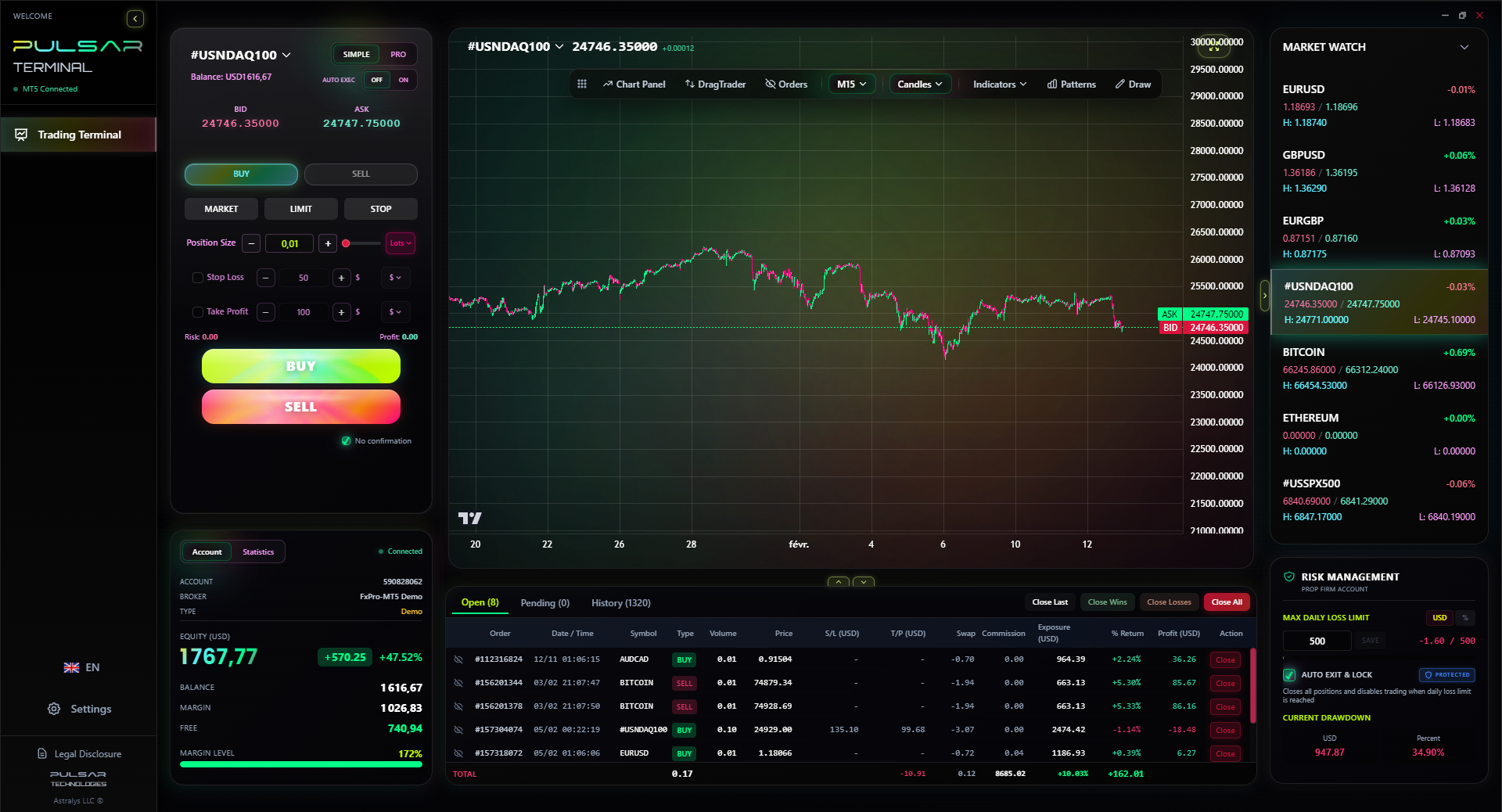
After a costly revenge trade like the one I described, you realize you need tools that enforce discipline; Pulsar Terminal lets you set multi-level take-profits and stop-losses the moment you enter, automating your plan so your emotions can't ruin it.
Pulsar Terminal
The all-in-one MT5 companion: drag-and-drop orders, multi-TP/SL, trailing stop, grid trading, Volume Profile, and prop firm protection. Used by 1,000+ traders daily.
“A single emotional trade can wipe out a week of careful profits.”
Given our constraints (30:1 use, no direct ZAR pairs), your strategy needs to be adapted. High-frequency scalping with massive use? Forget it. The math doesn't work with our caps and costs.
Focus on Swing Trading: This aligns perfectly with our environment. You hold trades for days or weeks, aiming for 100-300 pip moves. The lower use is sufficient, and swap costs become a calculated factor rather than a scalper's nightmare. A good swing trading plan focusing on daily charts saved my profitability when the use rules changed.
Trade the Right Sessions: The sweet spot for South Africans is the London overlap (10:00 AM - 1:00 PM SAST). Liquidity is high, spreads are tight. Trying to trade the dead Asian session from SA is a recipe for getting picked off by wider spreads.
Choose Your Pairs Wisely:
- EUR/USD: Your bread and butter. Tight spreads, high liquidity. It should be your primary pair to master. I have a whole EUR/USD guide on how I approach it.
- XAU/USD (Gold): Popular with SA traders, often acts as a proxy for ZAR sentiment and global risk. Understand it moves differently to currencies. Check my thoughts in this XAU/USD guide.
- AUD/USD & NZD/USD: Correlate with commodity prices, which matter for our economy. Good for diversification.
Indicators Are Guides, Not Oracles: I use the MACD indicator on the daily chart for trend direction and the RSI indicator on the 4-hour for potential entry zones. That's it. I used to have 8 indicators on my screen. It was noise. Now, I focus on price action and a couple of key levels.

Pro Tip: Build your strategy around the SA reality. Test it on a demo account during our best trading hours (London session). If it doesn't work with 30:1 use and includes all real costs (spreads, commissions), it's not a strategy, it's a hope.
💡 Winston's Tip
Your first profitable year is an anomaly. Your second is luck. Your third consecutive profitable year is the beginning of a career. Don't confuse a hot streak with skill.
“Your goal is not 'make R5000 today.' Your goal is 'execute my plan perfectly on 3 set-ups.'”
Your broker is your gateway. A bad choice will choke your profitability before you even start. Here’s my breakdown from a ZAR perspective.
FSCA-Regulated vs. International:
- FSCA-Regulated (e.g., some local offerings): Safety first. Your funds are protected under SA law. The downside? Often higher spreads and fewer instruments. Good for absolute beginners who prioritize security.
- Top-Tier International Brokers: These are my preference for serious trading. They offer better technology, tighter raw spreads, and access to MT4/MT5. The key is to pick ones that actively welcome SA clients and offer ZAR accounts or cheap ZAR deposits.
My Practical Experience: I've traded with several. Here’s the real deal:
- IC Markets: My main platform for raw spreads. Their Raw Spread account has commissions, but the spreads are often 0.0 on EUR/USD. Depositing in ZAR via PayFast is seamless. Their IC Markets review details the pros and cons.
- Pepperstone: Fantastic execution speed. Their Razor account is similar to IC Markets. I used them heavily for a scalping strategy when I was testing higher-frequency approaches (even with 30:1).
- Exness: They offer unique features like unlimited use on some demo accounts (great for testing crazy ideas) and have a strong local presence. Worth a look, as covered in this Exness review.
- XM: They are famous for their educational resources and low minimum deposit. If you're starting with a small amount like R500, they are a viable option to get a real feel. Read the XM review for more.
The Deposit/Withdrawal Test: Before you fund a large amount, do a small test deposit AND a test withdrawal. How long does it take to get your Rands back into your bank account? If it takes weeks or has hidden fees, walk away. I learned this after waiting 12 business days for a withdrawal from a now-defunct broker.
“Your goal is not 'make R5000 today.' Your goal is 'execute my plan perfectly on 3 set-ups.'”
You can have the best strategy and the perfect broker, but if your psychology is weak, you will lose. Full stop. In South Africa, with our unique market pressures, this is amplified.
Loadshedding is a Risk Factor: You must have a plan. A UPS for your router and monitor is a trading expense, not an optional extra. I once lost a profitable position because my internet died during a scheduled outage and my stop loss wasn't a guaranteed stop. Now, I always use a broker that offers guaranteed stops if I'm holding over a likely loadshedding window, or I simply close the trade before.
The Isolation Trap: Trading can be lonely. You're up at 10 AM watching charts while friends have normal jobs. You'll have losing weeks. Doubt creeps in. This is when you're vulnerable to buying a 'guaranteed' signal service or robot. Don't. Every Rand I've spent on those is a Rand I regret.
Process Over Outcome: Your goal is not 'make R5000 today.' Your goal is 'execute my plan perfectly on 3 set-ups.' If you do that and lose R1000, it was a good day. If you make R5000 by breaking all your rules, it was a terrible, dangerous day. This mindset shift took me years to internalise.
Keep a Physical Journal: Not just a spreadsheet. Write down how you felt before each trade. 'Felt impatient, forced a trade.' 'Felt greedy, didn't take profit at target.' This feedback loop is more valuable than any indicator. Reviewing my old journals, I see the same emotional errors causing losses again and again until I finally addressed them.
💡 Winston's Tip
The most important indicator on your screen is your account balance. If it's going down over 100 trades, your brilliant strategy is wrong. No amount of chart analysis changes that math.
“The market doesn't care about your analysis being 'right' in the long run.”
So, is forex trading profitable in South Africa? The market itself offers the same opportunity as anywhere else. The 'South African' part just defines the rules of the game: 30:1 use, FSCA oversight, ZAR-based costs, and our own set of real-world distractions.
The profitability equation comes down to you. Are you willing to treat this as a 3-5 year apprenticeship, not a get-rich-quick scheme? Can you embrace the 30:1 use as a protective cage rather than a limitation? Will you do the boring work of managing risk, tracking costs, and journaling your emotions?
If your answer is yes, then yes, it is possible to build a profitable venture. It will be a second job at first. The income will be irregular. You will have months where you make nothing or lose.
But if you persevere, develop a strong process, and manage your psychology, you can reach a point where the market pays you for your edge and your discipline. It won't be the Lamborghini lifestyle. It might be a consistent R10k-R30k a month that grows steadily over time. And in today's economy, that's a very real and powerful form of profitability.
Start small. Start slow. Use a demo account until your strategy is statistically proven. Then trade with money you can afford to lose. The market will always be there tomorrow. Your job is to make sure you are too.
FAQ
Q1What is the maximum use I can use in South Africa?
The FSCA limits use for retail forex traders to a maximum of 30:1. This applies to all FSCA-regulated brokers. Some international brokers may offer higher use to SA clients, but you forfeit FSCA protection by using them.
Q2Do I pay tax on my forex trading profits in South Africa?
Yes. SARS treats your net profits (total gains minus total losses and allowable expenses) as taxable income. You must declare it in your annual tax return. Keep detailed records of all your trades, deposits, and withdrawals.
Q3Can I trade the South African Rand (ZAR) online?
No, not for speculative purposes. South African regulations prohibit individuals from speculating directly on ZAR pairs (like USD/ZAR) through online CFD/fx brokers. You can only do physical foreign exchange through a licensed bank or dealer.
Q4How much money do I need to start forex trading in South Africa?
You can start with as little as R500 at some brokers. However, with 30:1 use, that gives you very little room for error. A more practical starting amount to properly test a strategy with sensible risk is between R5,000 and R10,000. Never trade with money you can't afford to lose.
Q5Which is better for South Africans, an FSCA or an international broker?
It's a trade-off. FSCA brokers offer direct legal protection and easier ZAR handling. Top-tier international brokers (like IC Markets or Pepperstone) often offer better trading conditions (tighter spreads, MT5). Many experienced SA traders use reputable international brokers for their main trading but understand they are not protected by the FSCA.
Q6What is the most common mistake new South African traders make?
Using too much use, even at 30:1. They see a R10,000 account and think they can control R300,000 worth of currency. A small move against them wipes out the account. The second biggest mistake is not accounting for all costs (spreads, commissions, conversion fees), which destroys their profit margin.
Q7How do I handle loadshedding while trading?
Plan for it. Use a UPS (Uninterruptible Power Supply) for your computer and fibre router. Consider a mobile data hotspot as a backup. For critical trades, use a broker that offers 'guaranteed stop loss' orders, which will execute even if you lose connection. Better yet, avoid holding positions over high-risk outage periods.
Prof. Winston's Lesson
Key Takeaways:
- ✓use is a risk multiplier, not a profit tool. 30:1 is enough.
- ✓Your worst trade will be an emotional one, not an analytical one.
- ✓Include ALL costs (spread, commission, conversion) in your strategy test.
- ✓Profitability is measured in years, not months.
How useful was this article?
Click a star to rate
Weekly Trading Insights
Free weekly analysis & strategies. No spam.
About the Author
David van der Merwe
Emerging Markets Trader
Johannesburg-based trader with 11 years in emerging market currencies. Specializes in ZAR pairs, FSCA-regulated trading, and South African market analysis.
Comments
Risk Disclaimer
Trading financial instruments carries significant risk and may not be suitable for all investors. Past performance does not guarantee future results. This content is for educational purposes only and should not be considered investment advice. Always conduct your own research before trading.
You Might Also Like

Cara Trading Forex Sukses: 7 Prinsip dari Trader Profesional
Cara trading forex sukses dengan 7 prinsip trader pro: manajemen modal, disiplin, journal trading, backtest. Data nyata, bukan janji profit palsu.
Jam Trading Forex Terbaik untuk Trader Indonesia: Panduan Lengkap dengan Tabel Waktu
Panduan jam trading forex untuk trader Indonesia. Tabel 4 sesi dunia, jam emas 20:00-00:00, sesi mana yang harus dihindari. Data akurat + tips dari trader berpengalaman.
Top 5 Sàn Forex Uy Tín Nhất 2026: Review Jujur dari Trader Indonesia
Top 5 sàn forex uy tín 2026 untuk trader Indonesia. Review jujur: spread, deposit, withdraw, dukungan lokal. Exness, XM, IC Markets & lebih.
Get Pulsar Terminal
All these calculators are built into Pulsar Terminal with real-time data from your MT5 account. One-click position sizing, automatic risk management, and instant calculations.
Get Pulsar Terminal