


Let's clear up the biggest misconception right now: no, forex trading is not some magical tax-free loophole in the UK.

Sarah Collins
Trading Strategist ·  United Kingdom
☕ 9 min read
What you'll learn:
- 1HMRC Classification: The Only Thing That Matters
- 2Speculative Spread Betting: The Closest to 'Tax-Free'
- 3CFDs and Spot Forex: The Capital Gains Tax Reality
- 4Trading as a Business: Income Tax and NICs
- 5FCA Rules: Your First Line of Protection (Before Tax)
- 6Real Costs: Broker Fees vs. Tax
- 7What You MUST Do: Record Keeping
- 8Final Verdict: Myth Busted
Let's clear up the biggest misconception right now: no, forex trading is not some magical tax-free loophole in the UK. I've seen too many traders blow up their accounts, then get a nasty surprise from HMRC on top of it. The idea that you can make consistent profits without the taxman noticing is a fantasy that ends in real financial pain. The truth is your tax liability hinges on one critical factor: how HMRC decides to classify your trading activity. I'll walk you through the exact rules, the recent brutal changes, and what you need to do to keep your profits from being eaten alive.
Forget everything you've heard from forums. The UK tax authority, HMRC, doesn't care what you call yourself. They use a set of principles called the 'badges of trade' to decide if you're a gambler, an investor, or a professional trader. This classification is everything. It dictates which taxes apply, what allowances you get, and how you report your earnings.
Most retail traders fall into one of three boxes, and getting this wrong is the first step toward a tax headache. I made this mistake early on. I was trading multiple times a day, treating it like a job, but I was still trying to claim the Capital Gains Tax allowance. When I finally spoke to an accountant, he laughed and said HMRC would have viewed me as a self-employed trader in a heartbeat. That meant Income Tax, not CGT. I had to go back and re-file two years of returns. It was a mess.

Warning: Don't assume you're a 'private investor' just because you have a day job. If your trading is frequent, organised, and aimed at profit, HMRC can easily argue it's a business. Your own label means nothing to them.
This is where the myth comes from. Profits from financial spread betting are generally exempt from UK Capital Gains Tax and Income Tax for most individuals. I repeat: for most individuals. This is because HMRC historically viewed it as gambling, not investing.
But there's a massive, glaring catch that nobody talks about. First, you can't offset your spread betting losses against other capital gains. If you lose £5,000 spread betting and make £5,000 selling shares, you still pay CGT on the full share profit. Second, if HMRC decides your spread betting is so frequent and sophisticated it constitutes a 'trade', they can reclassify it and tax you under Income Tax rules. This is rare, but it's a sword hanging over full-time spread bettors.
Also, remember that 'tax-free' doesn't mean 'cost-free'. You pay through the spread, which is how brokers offering 'tax-free' products make their money. The spreads on these accounts are often wider than on a direct CFD or spot forex account. You're just paying the broker instead of the taxman, and you have fewer consumer protections under the FCA's gambling rules versus its investment rules.
“Your tax liability hinges on one critical factor: how HMRC decides to classify your trading activity.”
For the vast majority of you trading CFDs or spot forex on platforms like MetaTrader, this is your reality. HMRC will likely treat you as a private investor. Your profits are subject to Capital Gains Tax (CGT).
The Shrinking Safety Net
Here's the kicker, and a recent change that's hammered part-time traders. The CGT Annual Exempt Amount - your tax-free profit allowance - has been slashed. It was £12,300 not long ago. For the 2023/24 tax year, it was £6,000. Now, for 2024/25 and beyond, it's just £3,000. Let that sink in. If your net trading gains (profits minus losses) exceed £3,000 in a tax year, you owe tax on the excess.
The Tax Rates
- Basic Rate Taxpayer: You'll pay 10% CGT on your gains above the £3,000 allowance.
- Higher or Additional Rate Taxpayer: You'll pay 20%.
So, if you're a higher-rate taxpayer and you net a £10,000 profit this year, your calculation is: £10,000 - £3,000 allowance = £7,000 taxable gain. Your CGT bill would be £7,000 * 20% = £1,400. That's a direct hit to your trading capital. You can use a position size calculator to model how this affects your net returns after tax.


💡 Winston's Tip
The £3,000 CGT allowance isn't a target. It's a tiny buffer. If your annual trading profit is consistently hovering around it, your strategy isn't scalable. Focus on improving your edge, not minimising tax.
This is the big leagues, and the taxman takes a much bigger bite. If your trading is systematic, frequent, and your main source of income, HMRC can classify it as a trade. You're now a self-employed forex trader.
Your profits are subject to Income Tax and potentially National Insurance Contributions (NICs). Forget the £3,000 CGT allowance. You get the Personal Allowance (£12,570 for 2024/25), then you pay:
- 20% on profits between £12,571 and £50,270
- 40% on profits between £50,271 and £125,140
- 45% on profits over £125,140
You also pay Class 2 and Class 4 NICs. The upside? You can deduct legitimate business expenses (software subscriptions, data feeds, part of your home office costs) and your trading losses can be offset against other income or carried forward.
I know a few full-time swing trading pros. One had a £80,000 profit year. After the Personal Allowance, he paid 20% on £37,700 and 40% on the remaining £29,730, plus NICs. His total tax bill was over £25,000. He didn't mind because it was proof of consistent profitability, but it's a stark contrast to the CGT world. You need to be seriously profitable to make this work after tax.
“The broker took 20% of my gross profit. The taxman took 2%. See where the real threat is?”
Before you even worry about tax, you need to survive trading. That's where the Financial Conduct Authority (FCA) comes in. Only trade with an FCA-regulated broker. This isn't optional. The protections are real:
- Client Money Segregation: Your cash is held separately from the broker's money. If they go bust, your funds are protected.
- Negative Balance Protection: You can't lose more than you deposit. This saved countless traders during the Swiss Franc crisis.
- use Caps: Retail use is capped at 1:30 for major pairs, 1:20 for minors. This is a good thing - it stops you from blowing up your account in seconds. Brokers like IC Markets and XM adhere to these limits for UK clients.
- Financial Services Compensation Scheme (FSCS): Up to £85,000 protection if the regulated firm fails.
The FCA's Consumer Duty, in force since July 2023, forces brokers to act in your best interest. It means clearer pricing, fewer hidden traps, and warnings about risk. A broker trying to sell you 1:500 use isn't acting under the FCA's watch. This regulatory safety net is why your first question should always be about FCA status, not tax status.
Let's talk numbers. Your profit is what's left after broker costs and tax. Ignoring either is suicidal.
Broker Costs (The Silent Killer):
- Spreads: On a standard account, the EUR/USD spread might be 1.0 pip. On a raw account like Pepperstone's Razor, it's 0.1 pips plus a £2.25 per lot commission. If you're a high-volume scalping trader, the raw account saves you money. If you trade once a week, the standard account might be cheaper.
- Overnight Financing (Swap): Holding positions past 5 pm UK time incurs a charge or credit. This can erode long-term swing trading profits.
The Combined Hit: Imagine you make 100 trades on EUR/USD, averaging 5 pips profit per trade on a standard lot (€100,000). That's 500 pips profit, or €5,000.
- Broker Cost: With a 1-pip spread, you paid 100 pips (1 pip per trade) in spread costs. That's €1,000 gone. Net profit before tax: €4,000.
- Tax: You're a higher-rate taxpayer. After your £3,000 (~€3,500) CGT allowance, you pay 20% on €500. Tax bill: €100.
Your real take-home profit is €3,900. The broker took 20% of your gross profit. The taxman took 2%. See where the real threat is? Focus on reducing your trading costs first. Worry about tax when you're consistently profitable enough for it to matter.
“The goal isn't to avoid tax; that's illegal. The goal is to understand your liability so it doesn't destroy your profitability.”
This is non-negotiable. If you can't prove your trades, your calculations, and your losses, HMRC will assume everything is profit. You need a trading journal. Not a notepad, a proper digital record.
For every trade, log:
- Date/Time opened & closed
- Instrument (e.g., GBP/USD)
- Direction (Buy/Sell)
- Entry & Exit Price
- Position Size
- Profit/Loss in your account currency (GBP)
- Reason for trade (optional, but good for review)
At the end of the tax year (5th April), you need to calculate your total net profit or loss. That's all your winning trades minus all your losing trades. If it's over £3,000, you must declare it via a Self Assessment tax return. You can use your broker's statements, but a dedicated journal is cleaner. I use a simple spreadsheet. Some traders use specialised software. The method doesn't matter; the consistency does.
I learned this the hard way after a profitable month where I closed dozens of trades. Reconstructing it from MT4 statements was a nightmare. Now, I update my journal as I close each trade. It takes 30 seconds and saves days of stress later.
💡 Winston's Tip
Your trading journal is your first line of defence in a tax investigation. A well-kept log proving your systematic approach can be the difference between being classified as an investor or a trader, which has huge tax implications.
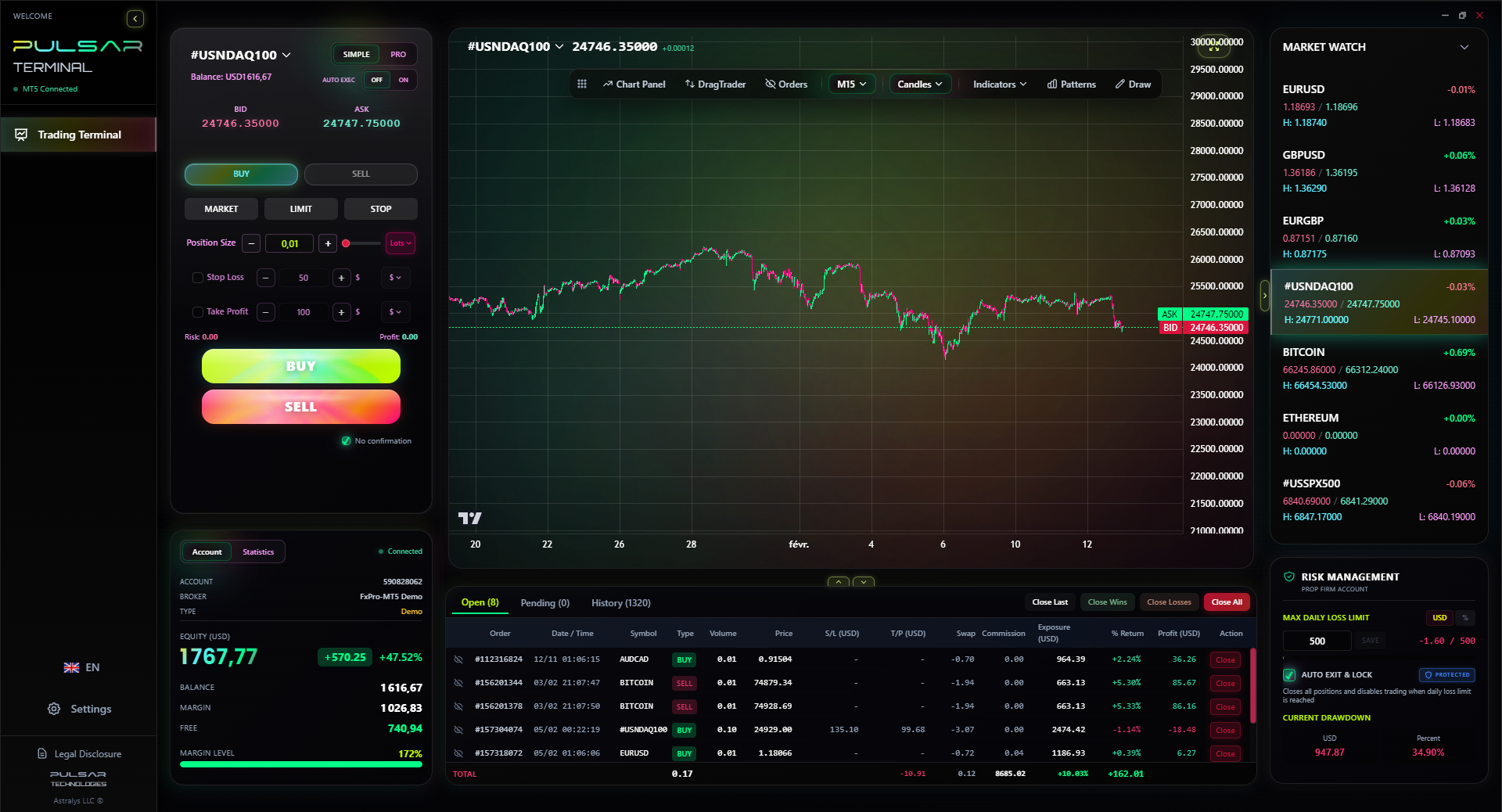
Accurate tax reporting starts with accurate trade tracking, and Pulsar Terminal's advanced journaling and reporting tools on MT5 give you a clear, auditable record of every entry, exit, and profit.
Pulsar Terminal
The all-in-one MT5 companion: drag-and-drop orders, multi-TP/SL, trailing stop, grid trading, Volume Profile, and prop firm protection. Used by 1,000+ traders daily.
So, is forex trading tax free in the UK? Absolutely not. For CFD/spot traders, you have a tiny £3,000 CGT allowance. For spread bettors, you have a precarious 'gambling' exemption that offers no loss relief. For professionals, you're facing Income Tax rates up to 45%.
The goal isn't to avoid tax; that's illegal. The goal is to understand your liability so it doesn't destroy your profitability. Your priority list should be:
- Survive: Trade with an FCA broker. Use sensible position sizing. Avoid the margin call.
- Get Profitable: Focus on your edge. Reduce your broker costs (spreads, commissions). Your trading strategy, using tools like the RSI or MACD, must first overcome these fees.
- Then Worry About Tax: Keep impeccable records. Know your classification. Set aside a percentage of your profits for your potential tax bill. Speak to a qualified accountant who understands financial trading.
Forex trading is hard enough. Don't make it harder with tax surprises. The taxman always gets his share. Your job is to make sure there's still a worthwhile share left for you.
FAQ
Q1Do I have to pay tax on forex trading if I lose money?
No, you don't pay tax on losses. In fact, if you're trading CFDs/spot and are subject to Capital Gains Tax, you can use your net losses to offset other capital gains in the same tax year, or carry them forward to offset future gains. This is a key reason why keeping accurate records is crucial. Spread betting losses, however, cannot be offset against other gains.
Q2What is the tax-free allowance for forex trading profits?
It depends on your classification. If you're a private investor (CFDs/spot), you have the Capital Gains Tax Annual Exempt Amount, which is £3,000 for the 2024/25 tax year. If you're spread betting as a hobby, your profits are generally tax-free, but you get no allowance for losses. If HMRC deems you a self-employed trader, you get the standard Personal Allowance (£12,570) before Income Tax kicks in.
Q3How does HMRC know about my forex trading profits?
Brokers regulated in the UK, like Exness for their UK entity, may be required to report certain information to HMRC under international agreements like the Common Reporting Standard (CRS). However, the primary responsibility for declaring your income and gains lies with you via Self Assessment. HMRC can and does cross-reference data, and failing to declare taxable profits can result in penalties, interest, and back taxes.
Q4Is it better to spread bet or trade CFDs for tax reasons?
There's no simple answer. Spread betting offers potential tax exemption but usually has wider spreads and no loss relief. CFD trading has tighter spreads on raw accounts but is subject to CGT. For a small, part-time trader making occasional trades, spread betting might be simpler. For a more active, systematic trader aiming for consistent profits, the ability to offset losses in a CFD account often makes it the better financial choice, even after tax. You must run the numbers for your own trading style.
Q5Do I need to do a Self Assessment tax return for forex?
Yes, if your net taxable profits from CFD/spot forex trading exceed the £3,000 CGT allowance, or if you are trading as a business. You must register for Self Assessment and submit a return by 31st January following the end of the tax year. Even if you are below the threshold, it can be wise to submit a return if you have losses you wish to carry forward.
Q6Can I claim trading platform costs as an expense?
Only if HMRC classifies your trading as a business (self-employed). In that case, you can deduct legitimate expenses incurred wholly and exclusively for your trading. This can include platform/data fees, trading journal software, a proportion of home office costs, and education directly related to your trading. As a private investor, you cannot deduct these expenses against your capital gains.
Prof. Winston's Lesson
Key Takeaways:
- ✓Forex trading is NOT tax-free for UK CFD/spot traders.
- ✓The CGT tax-free allowance is now only £3,000 per year.
- ✓HMRC classification (investor vs. trader) dictates your tax rate.
- ✓Broker fees (spreads) often consume more profit than tax.
- ✓Impeccable trade records are non-negotiable for tax compliance.
How useful was this article?
Click a star to rate
Weekly Trading Insights
Free weekly analysis & strategies. No spam.
About the Author
Sarah Collins
Trading Strategist
London-based trading strategist with 12 years in financial markets. Former analyst at a City of London brokerage. Covers GBP pairs, European markets, and FCA-regulated trading.
Comments
Risk Disclaimer
Trading financial instruments carries significant risk and may not be suitable for all investors. Past performance does not guarantee future results. This content is for educational purposes only and should not be considered investment advice. Always conduct your own research before trading.
You Might Also Like

Cara Trading Forex Sukses: 7 Prinsip dari Trader Profesional
Cara trading forex sukses dengan 7 prinsip trader pro: manajemen modal, disiplin, journal trading, backtest. Data nyata, bukan janji profit palsu.
Jam Trading Forex Terbaik untuk Trader Indonesia: Panduan Lengkap dengan Tabel Waktu
Panduan jam trading forex untuk trader Indonesia. Tabel 4 sesi dunia, jam emas 20:00-00:00, sesi mana yang harus dihindari. Data akurat + tips dari trader berpengalaman.
Top 5 Sàn Forex Uy Tín Nhất 2026: Review Jujur dari Trader Indonesia
Top 5 sàn forex uy tín 2026 untuk trader Indonesia. Review jujur: spread, deposit, withdraw, dukungan lokal. Exness, XM, IC Markets & lebih.
Get Pulsar Terminal
All these calculators are built into Pulsar Terminal with real-time data from your MT5 account. One-click position sizing, automatic risk management, and instant calculations.
Get Pulsar Terminal