


You've seen the ads.

James Mitchell
Senior Trading Analyst
☕ 9 min read
What you'll learn:

You've seen the ads. Trade with a firm's capital, keep most of the profits, and skip the years of building your own account. It sounds like the golden ticket, right? Especially with names like Topstep popping up everywhere. But is Topstep a prop firm in the traditional sense, or is it something else entirely? I've been through their process, funded a few accounts, and blown up one or two along the way. Let's cut through the marketing and look at what you're really signing up for.
Let's get this out of the way first. Topstep calls itself a "funded trader program." In the purest, old-school definition of a proprietary trading firm, that's not quite accurate. A traditional prop firm hires you, gives you a desk, and you trade the firm's capital as an employee or partner. Your risk is your job. Topstep's model is different. It's a gateway, or more accurately, a performance filter.
You pay a fee (they call it a Trading Combine) to prove you can trade profitably under specific rules. If you pass, you get access to a simulated account that behaves like a live one. Profits from that simulation are then paid out to you as real money. They're not giving you direct access to a live brokerage account with their millions in it. You're trading in a simulated environment, and they're paying you based on your simulated performance. This is the core of the "is Topstep a prop firm" debate.

Warning: Don't confuse "simulated" with "easy." The platform mimics live market conditions, spreads, and slippage. The psychological pressure is very real, because real payouts are on the line.
Why this model? It massively reduces risk for them. They don't have to worry about a rogue trader blowing up a physical desk. They only pay out after you've consistently made simulated profits. From their perspective, it's a brilliant business model. From yours, it's a skills test you pay to take. I remember my first Combine in 2021. I was so focused on the profit target I ignored the daily loss limit. A single bad ES futures trade hit my max loss and reset me to zero. That $165 monthly fee felt like a very expensive lesson.
The Trading Combine (The Paid Test)
This is the audition. You choose an account size (e.g., $50K, $100K, $150K). Each has a profit target, a daily loss limit, and a maximum trailing drawdown. Your job is to hit the profit target without breaching the loss limits. It's not just about being right; it's about risk management. You'll pay a monthly subscription fee for the platform access during this phase. Fail, and you can reset (for a fee) or walk away.
The Funded Account (The Performance-Based Payout)
Pass the Combine, and you graduate to a "Funded Account." The rules are similar but often slightly more relaxed. You trade in the simulation, and if you end the week in profit, you can request a withdrawal. Topstep takes a cut (typically 10-20%), and you get the rest. This is where the "prop firm" analogy feels closest. You're trading "their" capital in the sense that they are liable for the simulated profits they pay you.

Example: Let's say you're in a $100K account. You have a $3,000 profit target in the Combine. Your daily loss limit is $1,500, and your max drawdown is $2,500. You make $500 on Monday, lose $800 on Tuesday (still above your daily limit), and then grind out $3,200 by Friday. You pass. In the funded stage, you make $1,500 in a week. You request a payout. If your split is 80/20, you get $1,200, Topstep keeps $300.
The costs add up. A $150K Combine might run you $165 per month. A reset fee is often $105. If it takes you 3 months and one reset to pass, you've invested about $600 before seeing a single real dollar. This is why treating it like a business expense, not a lottery ticket, is critical. Compare this structure to brokers like IC Markets review or Pepperstone review, where you simply deposit your own capital and trade.

💡 Winston's Tip
Never view a program fee as a ticket to profits. View it as tuition. If you learn something that improves your trading forever, even if you fail, it might be worth it.
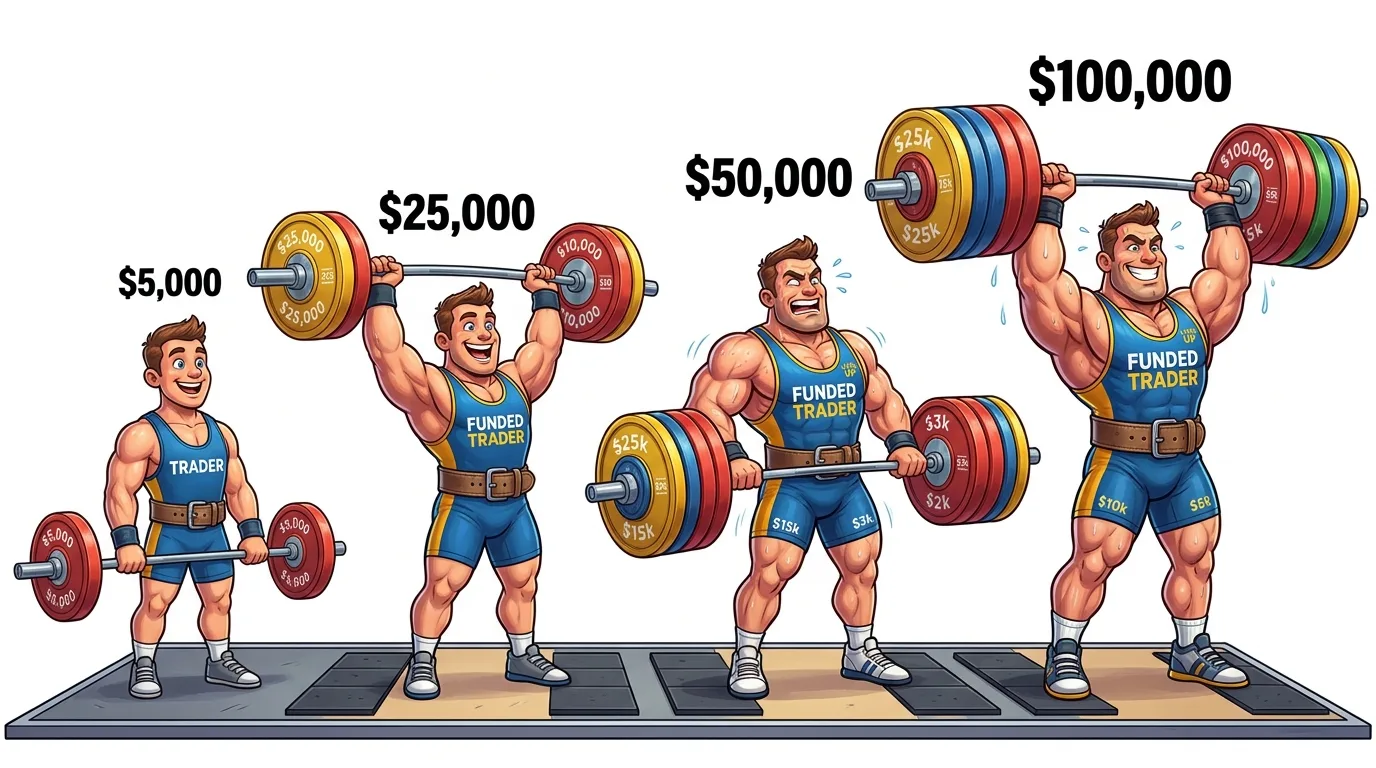
“Topstep isn't a prop firm; it's a performance-based filter with a payout model.”
The Pros (It's Not All Bad):
- Capital Access: The biggest draw. You can "control" a $100K account for a fraction of the actual capital. This allows for sensible position size calculator use that would be impossible with a $2,000 personal account.
- Forced Discipline: The rules are a brutal but effective teacher. They will hammer risk management into you. You learn to avoid the one-trade blow-up.
- No Personal Capital Risk: You can't lose more than your subscription fees. Your personal savings are never on the line in the market.
The Cons (The Fine Print):
- The Simulated Reality: This is the biggest mental hurdle. You know it's not "real" money in the market, which can lead to careless trading or, conversely, weird psychological blocks.
- Rule Rigidity: The daily loss limit is a double-edged sword. It protects you, but it can also stop you out on a volatile but correct trade. This favors certain styles, like scalping strategy, over longer-term swing trading.
- The Cost Trap: For struggling traders, this can become an expensive subscription service with no payout. I've seen guys cycle through $1,000 in fees without ever getting funded.
- Profit Caps & Scaling: Payouts are consistent, but building real wealth is slow. Scaling to larger accounts often means going through the Combine process again.
My own reality check came after my first successful payout. I got cocky. In the funded account, I broke my own rules, overtraded, and violated the drawdown rule on a stubborn EUR/USD guide position. Account gone. The lesson? The rules are there for a reason, even after you pass.

| Feature | Topstep (Funded Program) | Traditional Prop Firm |
|---|---|---|
| Capital Access | Simulated account, real payouts | Direct live market access |
| Upfront Cost | Monthly subscription & reset fees | Often a deposit or none; you're an employee |
| Personal Risk | Limited to fees paid | Could owe losses; job is at risk |
| Profit Split | Typically 80-90% to you | Often 50/50 to 80/20 to you |
| Primary Goal | Identify profitable traders via a filter | Generate profits from hired traders |
| Style Flexibility | Must follow their strict risk rules | Often more flexibility, especially for proven traders |
| Geographic Limit | Accessible almost globally | Often requires physical presence in a financial hub |
The table shows the core difference. Topstep is a gatekeeper. A traditional prop firm is an employer or partner. One is a standardized test; the other is a job with a seat at the table. If you're in a city like Chicago or New York, a traditional prop path might be viable. For everyone else, programs like Topstep are the only game in town for this kind of model.
💡 Winston's Tip
The daily loss limit is your best friend. It's the rule that will save you from yourself on your worst day. Don't fight it; design your entire risk plan around it.
“The daily loss limit is a brutal teacher, but it will hammer risk management into you.”
Topstep isn't for beginners. Throwing a novice into a Combine is like giving a learner driver a Formula 1 test. They'll crash, and it'll be expensive.
It's ideal for the intermediate trader with a proven edge but no capital. You have a back-tested strategy, you've traded a personal account with discipline, but scaling from $5K to $50K would take years of profits. Topstep compresses that timeline.
It's also useful for the experienced but undisciplined trader. The rigid rules act as handcuffs to stop you from your worst habits. If you're prone to revenge trading or ignoring stop-losses, the daily loss limit will shut you down fast. It's painful but educational.
Finally, it can be a psychological bridge. Trading a $50K simulated account with real payout pressure prepares you for eventually handling a real $50K of your own money. The stakes feel high, but the downside is capped.

Pro Tip: Before you even look at a Topstep Combine, paper trade your strategy with their specific rules for a full month. Use their daily loss and drawdown limits on your simulator. If you can't be profitable with those constraints in a stress-free environment, you won't be in the paid one.

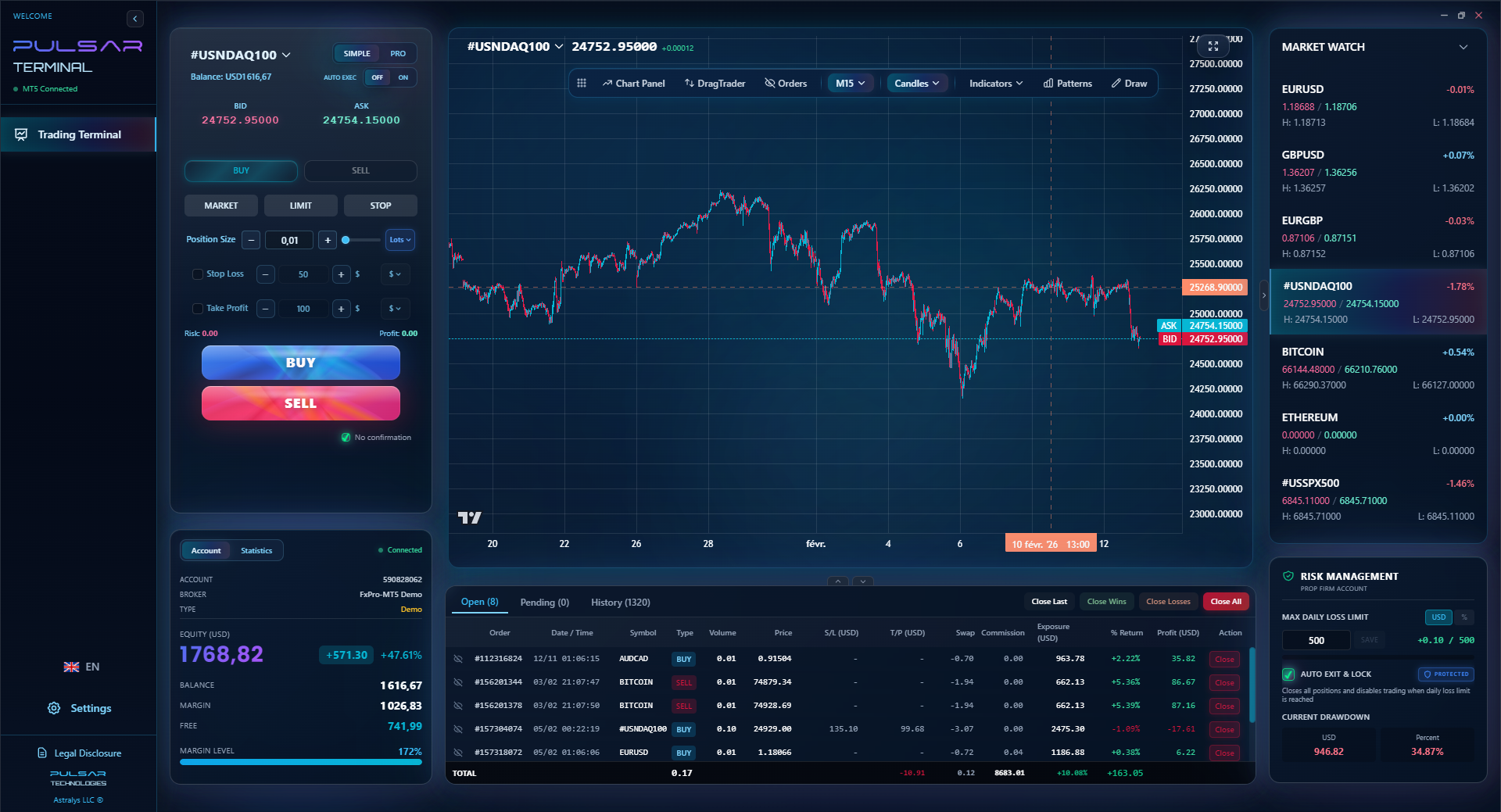
Managing the strict daily loss and drawdown rules of a prop firm challenge is easier with a tool that lets you set and visualize all your risk parameters on a single chart.
Pulsar Terminal
The all-in-one MT5 companion: drag-and-drop orders, multi-TP/SL, trailing stop, grid trading, Volume Profile, and prop firm protection. Used by 1,000+ traders daily.
Watch out for these:
- The "Easy Money" Marketing: Any program promising quick, effortless funding is selling a dream. This is hard work.
- Hidden Fees: Understand all costs: subscription, reset, inactivity fees in the funded account.
- Unrealistic Payout Stories: Focus on the structure, not the outlier who made $50k in a month.
What are the alternatives?
- Other Funded Programs: Firms like FTMO, The5%ers, and Earn2Trade have similar models with different rule sets (e.g., one-phase challenges, no daily loss limit). Shop around.
- Build Your Own Account: This is the slow, honest path. Use a low-cost broker like Exness review or XM review, master your position size calculator, and compound gains. It's less sexy, but 100% of the profits are yours.
- Trading Your Own Strategy: Focus on mastering a few instruments. A deep understanding of something like XAU/USD guide with a clear edge is better than randomly trading a dozen markets to pass a challenge.
I spent two years and significant money in various funded programs before I had the discipline to grow my own account steadily. In hindsight, I could have saved time and money by focusing on my own capital earlier. But the forced education did fix some fatal flaws.
💡 Winston's Tip
If you can't explain your edge in two sentences and back it up with 100 trades of personal data, you're not ready for a funded challenge. Go back to the simulator.

“For the right trader, it's a powerful tool. For the wrong one, it's an expensive subscription to a dream.”
So, is Topstep a prop firm? Not in the traditional sense. It's a funded trader program - a performance-based filter with a payout model.
Is it a legitimate way to make money from trading? Absolutely, but with major caveats. It's legitimate if you are already a consistently profitable, disciplined trader who simply lacks scale. It is not a magic wand that will make you a profitable trader.
Think of it as a business loan application. You wouldn't ask a bank for a loan to start a business you have no experience in. You'd get a business plan, some proof of concept, and then apply for capital to scale. Topstep is the same. The Combine is your business plan test. Your trading history is your proof of concept.
For the right trader, it's a powerful tool. For the wrong one, it's an expensive subscription to a dream. Be brutally honest with which one you are before you click "buy." Your answer to "is Topstep a prop firm" matters less than your answer to "am I ready for what they actually offer?"

FAQ
Q1Do you actually get real money from Topstep?
Yes, but indirectly. You trade in a simulated environment. When you make simulated profits in your funded account and request a withdrawal, Topstep pays you real money from their corporate funds, taking their share. You never have direct access to a live market account.
Q2What's the biggest mistake traders make in the Trading Combine?
Focusing only on the profit target and ignoring the daily loss limit. One bad day where you hit that max daily loss will fail you instantly, no matter how much profit you had before. It forces you to prioritize survival over aggression.
Q3Can you trade any market with Topstep?
Primarily, it's futures (like the E-mini S&P 500) and forex. Their core platform is built for futures trading. Their offerings are more limited than a full brokerage like IC Markets or Pepperstone.
Q4How long does it take to get a payout?
After passing the Combine, you enter the funded account. Payouts are typically requested weekly. Once requested, it can take several business days to process and hit your bank account. Your first payout might be 3-4 weeks after starting the funded phase.
Q5Is Topstep better than other funded programs like FTMO?
"Better" depends on your trading style. Topstep has a daily loss limit, which some traders hate and others need. FTMO uses a max drawdown only, no daily limit. Topstep is futures-focused; FTMO is strong on forex and indices. You need to pick the rules that best fit your strategy.
Q6What happens if I lose money in the funded account?
You have a maximum drawdown limit (e.g., $2,500 on a $50K account). If your losses reach that drawdown, your funded account is closed. You do not owe them money, but you lose the account and would need to purchase a new Trading Combine to try again.
Prof. Winston's Lesson
Key Takeaways:
- ✓Funded programs are for traders with an edge, not those seeking one.
- ✓Your max risk per trade should be a fraction of your daily loss limit.
- ✓The subscription cost is a business expense, not a gambling stake.
- ✓Passing a challenge is just the entrance exam; the real test is consistent funded performance.
How useful was this article?
Click a star to rate
Weekly Trading Insights
Free weekly analysis & strategies. No spam.
About the Author
James Mitchell
Senior Trading Analyst
Based in New York with over 9 years of trading experience. Focuses on major USD pairs, prop firm challenges, and the US regulatory landscape.
Comments
Risk Disclaimer
Trading financial instruments carries significant risk and may not be suitable for all investors. Past performance does not guarantee future results. This content is for educational purposes only and should not be considered investment advice. Always conduct your own research before trading.
You Might Also Like

Cara Trading Forex Sukses: 7 Prinsip dari Trader Profesional
Cara trading forex sukses dengan 7 prinsip trader pro: manajemen modal, disiplin, journal trading, backtest. Data nyata, bukan janji profit palsu.
Jam Trading Forex Terbaik untuk Trader Indonesia: Panduan Lengkap dengan Tabel Waktu
Panduan jam trading forex untuk trader Indonesia. Tabel 4 sesi dunia, jam emas 20:00-00:00, sesi mana yang harus dihindari. Data akurat + tips dari trader berpengalaman.
Top 5 Sàn Forex Uy Tín Nhất 2026: Review Jujur dari Trader Indonesia
Top 5 sàn forex uy tín 2026 untuk trader Indonesia. Review jujur: spread, deposit, withdraw, dukungan lokal. Exness, XM, IC Markets & lebih.
Get Pulsar Terminal
All these calculators are built into Pulsar Terminal with real-time data from your MT5 account. One-click position sizing, automatic risk management, and instant calculations.
Get Pulsar Terminal