


I remember staring at my screen in 2018, watching USD/ZAR spike from 13.80 to 14.20 in a single London session.

David van der Merwe
Emerging Markets Trader ·  South Africa
☕ 11 min read
What you'll learn:
- 1Is Forex Trading Legal in South Africa?
- 2Your First Steps (Before You Deposit a Cent)
- 3Choosing a South African Forex Broker
- 4Funding Your Account: Local Payments & Costs
- 5Developing a South African Trader's Mindset
- 6Pitfalls Every New South African Trader Faces
- 7Executing Your First Live Trade
- 8The Path Forward
I remember staring at my screen in 2018, watching USD/ZAR spike from 13.80 to 14.20 in a single London session. My hands were sweating. I had a small long position, and for a moment, I was up R800. Then it reversed. I held, hoping it would come back. It didn't. I watched my profit vanish and turn into a R1200 loss before I finally clicked 'close.' That was my expensive welcome to forex. Here's what I wish someone had told me before I decided to join forex in South Africa.
Yes, absolutely. But you have to play by the house rules, and the house is the Financial Sector Conduct Authority (FSCA). This isn't a grey area. Trading through an FSCA-regulated broker is completely legal. Trading through some offshore bucket shop you found on Instagram? That's where you get into trouble.
The FSCA is serious about protecting people. In 2024, they fined a signals provider over R1 million and banned him for 10 years for operating without a license. They want the industry clean. For you, this means one non-negotiable first step: always verify your broker's FSP number on the FSCA's public register. If they're not there, walk away.
There's a big catch for us South Africans, though. You are not allowed to speculate directly against the Rand. Sounds weird, right? It means you can't just open a trade betting the Rand will crash. You also can't buy foreign currency directly from a forex broker for investment. That needs to go through a bank or a licensed currency dealer. When you join forex, you're trading contracts for difference (CFDs) on currency pairs, not the physical currency itself. It's a crucial distinction.

Warning: If a "broker" or "mentor" approaches you promising insane returns and isn't on the FSCA register, they are not legal. Full stop. The FSCA actively debars and fines these operators.
The biggest mistake I see? People funding an account before they even know what a pip definition is. Let's break down the real prep work.
Get Your Finances in Order
Forex is not a side hustle to fix debt. I learned this the hard way. If you're using rent money or an emergency fund, the psychological pressure will destroy you. Start with capital you can afford to lose completely. For most beginners, that's between R1,000 and R5,000. This isn't seed money for a business. Consider it tuition fees for a very practical education.
Choose Your Learning Path
You have two options: structured education or self-directed learning. I did the latter, and it took me twice as long and cost me in bad trades. Nowadays, I'd recommend a hybrid. Use free resources from reputable brokers (IG and Pepperstone have decent ones) to understand basics like charts, orders, and risk. Then, open a demo account. Not for a day. Not for a week. I'm talking 2-3 months of consistent, daily demo trading. Treat the virtual R100,000 like it's real. Your goal isn't to double it. Your goal is to not blow it up for three months straight.
Understand the Tax Man
SARS sees your trading profits as income. You must declare your net profit (profits minus losses and costs) in your annual tax return. Keep a detailed log of every trade from day one. Trust me, trying to reconstruct a year of trades for SARS is a special kind of hell. When you join forex, you're also joining the self-assessment taxpayer club.

💡 Winston's Tip
Your first R10,000 in profits is the hardest. It's not the market's fault; it's the price of tuition. Pay it patiently.
“A realistic, excellent return for a skilled retail trader is 10-20% per year on your risk capital.”
This is where most people get overwhelmed. Let's cut through the marketing with some hard numbers from 2025.
Regulation is Non-Negotiable: Your broker must be FSCA-regulated. Some international brokers like IC Markets and Pepperstone have local entities for this. Others, like XM and Exness, are fully licensed here.
Look at the Real Costs:
| Broker Example | Min. Deposit (ZAR approx.) | Typical EUR/USD Spread | Key Feature for ZA Traders |
|---|---|---|---|
| XM | ~R90 ($5) | 0.6 pips | Very low barrier to entry, good education. |
| Exness | ~R180 ($10) | 0.0 pips (on Pro account) | Tight spreads, popular locally. |
| Tickmill | ~R1,800 ($100) | 0.11 pips (with commission) | Excellent raw spreads for active traders. |
| IG | R1,000 | Variable | Huge, established brand with strong local presence. |
Spreads are just one cost. Check for commissions (often $3-$7 per lot), and understand swap fees if you hold trades overnight. For us, a ZAR-denominated account is a massive advantage. It means your deposits, withdrawals, and profits are in Rands, so you avoid your bank's nasty forex conversion fees on every transaction.
The use Limit: For retail traders, the FSCA caps use at 30:1. That means with R1,000, you can control a position worth up to R30,000. Some brokers offer higher use through their international entities, but you'd be trading outside the FSCA's protection. For a beginner, 30:1 is more than enough to get you into serious trouble if you're not careful with your position size calculator.

Pro Tip: Don't get hypnotized by "0.0 pip spreads!" For a beginner trading small sizes, the difference between 0.0 and 0.6 pips is a few Rands. Far more important is execution speed, platform stability, and customer support that answers the phone in SA business hours.
This is the practical part nobody talks about. Getting money in and out.
Most brokers offer free deposits. You can usually use a debit/credit card (Visa/Mastercard) or a bank wire transfer. E-wallets like PayPal are less common but available with some. The instant method is usually cards.
Here's the hidden cost: your bank's fees. If you deposit in ZAR to a local broker entity, it's usually a local transfer, cheap or free. If you deposit in USD or EUR, your bank will convert your Rands at their marked-up rate and charge a fee.
Let me give you a real example from 2024. I deposited $100 (about R1,850) with a major SA bank to an international broker. The bank charged:
- A forex conversion fee: R99.50
- They used an exchange rate about 20 cents worse than the interbank rate (a hidden cost of ~R37)
- Total cost to send $100: nearly R140. That's a 7.5% haircut before I even placed a trade.
The solution? Use a broker with a ZAR account. Fund it via a normal EFT. It's cheaper and faster. Withdrawals work the same way. Some brokers process them same-day back to your SA bank account.

Example: Funding R2,000.
- With ZAR Account: EFT, fee R0 (often), lands as R2,000 in trading account.
- With USD Account: Bank converts R2,000 to USD at poor rate, charges R100+ fee. You might only get $105 (≈R1,940) in your account. You're down R60 before you start.
💡 Winston's Tip
A ZAR account saves you 2-3% on every deposit and withdrawal. That's an edge your broker doesn't advertise. Take it.
“The goal of your first 10 live trades is not to make money. It's to execute your plan perfectly.”
Trading psychology is universal, but being in SA adds unique flavors. Our market can feel isolated, and the "get rich quick" noise on social media is deafening.
First, kill the lottery ticket mentality. I blew my first R5,000 account in three weeks trying to make 50% a month. It's impossible sustainably. A realistic, excellent return for a skilled retail trader is 10-20% per year on your risk capital. Aim for consistency, not headlines.
Use your time zone. We're in a sweet spot. The London session opens at 10:00 AM our time (9:00 AM in winter), and New York opens at 4:00 PM (3:00 PM). Our afternoons are the most liquid, volatile time of the trading day. Perfect for swing trading entries or monitoring scalping strategy positions.
Find your community, but be wary. There are good local trading forums and Telegram groups. But avoid the ones filled with "signal gurus" and screenshots of Lamborghinis. Look for groups that discuss market structure, risk management, and trading journals. The best traders I know in Johannesburg and Cape Town are quiet, disciplined, and focused on process, not profits.
Your biggest edge won't be a secret indicator. It will be your ability to manage risk and your emotions. The MACD indicator or RSI indicator works the same here as in London. Your discipline is what you must build from scratch.
Let me save you some money by listing my own expensive lessons.
1. Over-leveraging on ZAR Pairs: USD/ZAR and EUR/ZAR are tempting. You feel you understand the Rand. But these are exotic pairs. The spread definition is wide (5-14 pips vs. 0.1-0.6 on EUR/USD). That means the price has to move significantly just for you to break even. In 2019, I took a EUR/ZAR trade with a 12-pip spread. The market went sideways for days, and the overnight swap fees slowly ate my position alive. I lost money on a trade where the price never really moved against me.
2. Ignoring the Daily Loss Limit. Most brokers will automatically close your positions if your losses reach a certain percentage of your margin. This is a margin call. I once had 70% of my capital in one USD/CAD trade (a stupid, emotional revenge trade). A sudden spike triggered my margin call, and I lost R2,800 in seconds. It was a brutal lesson in position sizing.
3. Chasing "Prop Firm" Dreams. Passing a proprietary trading firm challenge is the new hot thing. It's tempting: they give you "virtual" capital, you pass a test, and you get to trade their money. But these challenges have insanely strict rules on drawdown. They are designed for the top 5% of disciplined traders. Trying to pass one in your first year is like trying to run Comrades with no training. Focus on being consistently profitable with your own small capital first.
4. Not Having a Written Plan. You need a rulebook for yourself. What pairs will you trade? What's your maximum risk per trade (1% of capital is a good start)? What conditions will you enter and exit? Write it down. Without it, you're just gambling.
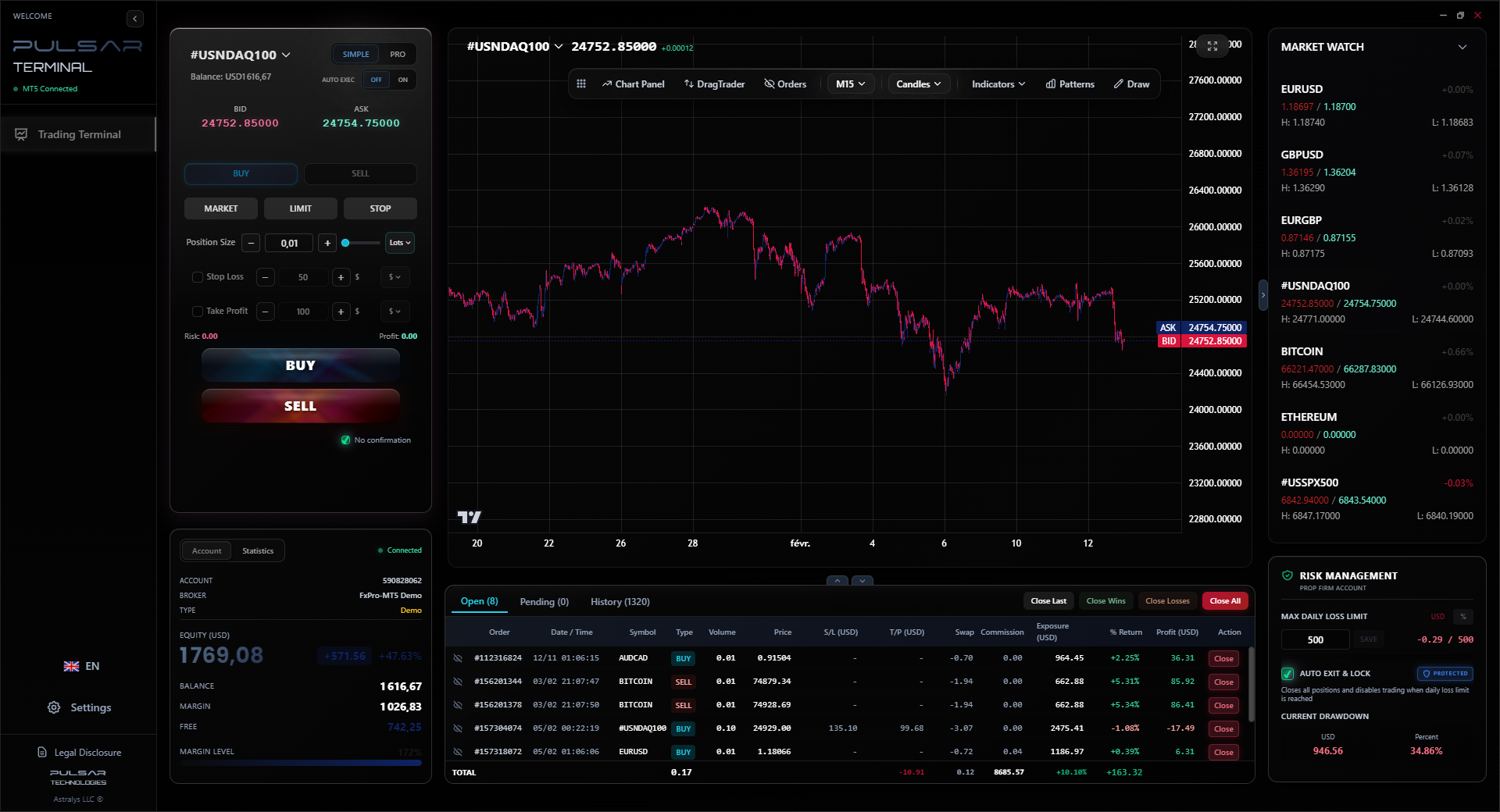
Managing multiple trades and strict risk rules, like those needed for prop firm challenges, is far easier with a tool that automates partial closures and breakeven moves directly on your MT5 chart.
Pulsar Terminal
The all-in-one MT5 companion: drag-and-drop orders, multi-TP/SL, trailing stop, grid trading, Volume Profile, and prop firm protection. Used by 1,000+ traders daily.
“Joining forex is just the start of a long journey. After 6 months, if you're breaking even, you're ahead of 80%.”
Your demo account is consistent. You've saved R2,000. You've chosen a regulated broker with a ZAR account. Now what?
1. Start Stupidly Small. Deposit your R2,000. Then, on your first live day, risk no more than R20 (1%). That might mean a micro lot (1,000 units) or even less. The goal of your first 10 trades is not to make money. The goal is to execute your plan perfectly and manage the live-market adrenaline.
2. Pick a Major Pair. Stick to EUR/USD, GBP/USD, or USD/JPY. They have the tightest spreads and highest liquidity. Forget about the XAU/USD guide (gold) or exotic pairs for now. Keep it simple.
3. Have a Clear Reason. Don't just trade because you're bored. Are you buying EUR/USD because it bounced off a key support level on the 4-hour chart? Because the daily trend is up? Write down your reason in your journal before you click buy.
4. Set Your Stop-Loss and Take-Profit IMMEDIATELY. This is non-negotiable. Before your trade is live, decide where you're wrong (stop-loss) and where you'll take profit. Enter these orders with your initial trade. I can't tell you how many times I've thought "I'll just move my stop later" only to watch a losing trade sink 100 pips while I froze.
Here was my first successful live trade in 2019, after many failures:
- Pair: EUR/USD
- Account Balance: R2,500
- Trade: Buy at 1.1180
- Reason: Bounced off rising trendline on 1H chart, bullish MACD indicator crossover.
- Stop-Loss: 1.1150 (30 pips risk)
- Take-Profit: 1.1230 (50 pips reward)
- Position Size: 0.03 lots (risking ~R75, which was 3% – a bit high, I know)
- Result: Hit take-profit 8 hours later. Profit: R125. It wasn't life-changing. But it proved the process worked. The profit was secondary.
💡 Winston's Tip
If you can't explain your trade in one simple sentence before entering, you don't have a trade. You have a hope.
Joining forex is just the start of a long journey. After 6 months, if you're breaking even or slightly up, you're ahead of 80% of people who start.
Your next focus should be on refining your edge. Maybe that's specializing in EUR/USD guide during the London open. Maybe it's mastering price action. Keep a detailed journal. Note not just your trades, but your emotional state. Were you impatient? Were you scared of missing out?
Consider your tools. MT4 and MT5 are the industry standards here. As you progress, look at tools that help you manage trades more efficiently, like platforms that allow for advanced order types and better trade management directly on your charts.
Finally, remember why you started. For most of us, it's about financial self-reliance and the intellectual challenge. It's a marathon of continuous learning. The market will humble you constantly. But if you treat it with respect, manage your risk ruthlessly, and focus on the process, it can be one of the most rewarding skills you'll ever develop. Good luck, and trade safe.
FAQ
Q1What is the minimum amount I need to join forex trading in South Africa?
Technically, you can start with as little as R90 (with brokers like XM). However, I strongly recommend starting with at least R1,000 - R2,000. This allows for proper position sizing and risk management without your account being wiped out by a single, small loss. Treat this as learning capital, not investment capital.
Q2Can I trade with high use like 1:500 in South Africa?
Not if you trade with an FSCA-regulated broker as a retail client. The FSCA caps use at 30:1 to protect traders. Some brokers may offer higher use through their international entities, but you would then be trading outside of South African regulatory protection, which I don't recommend for beginners.
Q3Do I pay tax on my forex trading profits?
Yes. The South African Revenue Service (SARS) considers your net trading profits (profits minus losses and expenses) as taxable income. You must declare this in your annual tax return. Keep careful records of all your trades from day one.
Q4Is it better to have a ZAR account or a USD account?
For South African residents, a ZAR account is almost always better. It eliminates costly bank conversion fees when you deposit and withdraw. Your profit and loss are also calculated in Rands, making it simpler for tax and personal accounting.
Q5What are the most common ways to lose money when starting out?
The top three are: 1) Using too much use and being wiped out by a small move, 2) Not using a stop-loss order, and 3) Risking too much capital on a single trade (e.g., more than 2-5% of your account). Emotional trading and chasing losses are the behaviors that lead to these mistakes.
Q6How long should I practice on a demo account before going live?
Aim for a minimum of 2-3 months of consistent, daily demo trading. The goal isn't just to make a profit on demo, but to prove you can follow your trading plan consistently through both winning and losing periods without blowing up the virtual account.
Q7Are there specific times of day that are best for trading from South Africa?
Yes. Our time zone is excellent. The most liquid and volatile periods are during the overlap of the London and New York sessions, which is from about 4:00 PM to 6:00 PM SAST. The London session open (10:00 AM SAST) also often provides good trading opportunities.
Prof. Winston's Lesson
Key Takeaways:
- ✓Verify FSCA license before any deposit.
- ✓Start with a ZAR account to avoid bank fees.
- ✓Risk a maximum of 1-2% per trade.
- ✓Demo trade for 3 months minimum.
- ✓Write down every trade reason and result.
How useful was this article?
Click a star to rate
Weekly Trading Insights
Free weekly analysis & strategies. No spam.
About the Author
David van der Merwe
Emerging Markets Trader
Johannesburg-based trader with 11 years in emerging market currencies. Specializes in ZAR pairs, FSCA-regulated trading, and South African market analysis.
Comments
Risk Disclaimer
Trading financial instruments carries significant risk and may not be suitable for all investors. Past performance does not guarantee future results. This content is for educational purposes only and should not be considered investment advice. Always conduct your own research before trading.
You Might Also Like

Cara Trading Forex Sukses: 7 Prinsip dari Trader Profesional
Cara trading forex sukses dengan 7 prinsip trader pro: manajemen modal, disiplin, journal trading, backtest. Data nyata, bukan janji profit palsu.
Jam Trading Forex Terbaik untuk Trader Indonesia: Panduan Lengkap dengan Tabel Waktu
Panduan jam trading forex untuk trader Indonesia. Tabel 4 sesi dunia, jam emas 20:00-00:00, sesi mana yang harus dihindari. Data akurat + tips dari trader berpengalaman.
Top 5 Sàn Forex Uy Tín Nhất 2026: Review Jujur dari Trader Indonesia
Top 5 sàn forex uy tín 2026 untuk trader Indonesia. Review jujur: spread, deposit, withdraw, dukungan lokal. Exness, XM, IC Markets & lebih.
Get Pulsar Terminal
All these calculators are built into Pulsar Terminal with real-time data from your MT5 account. One-click position sizing, automatic risk management, and instant calculations.
Get Pulsar Terminal