


I remember my first 'big' trade back in 2015.

Olumide Adeyemi
West African Trading Pioneer ·  Nigeria
☕ 10 min read
What you'll learn:
- 1Why Most 'Step-by-Step PDFs' Fail Nigerian Traders
- 2Step 1: Get Your Legal and Tax Basics Straight (Nigeria-Specific)
- 3Step 2: Choosing Your Broker (The Real Numbers)
- 4Step 3: Learn the Core Concepts (No Fluff)
- 5Step 4: Building Your First Simple Strategy
- 6Step 5: Risk Management (Your Non-Negotiable Survival Kit)
- 7Step 6: The Demo-to-Live Transition (The Real Test)
I remember my first 'big' trade back in 2015. I'd paid NGN 150,000 for a fancy PDF course promising 'guaranteed profits.' Following its signals, I went all in on GBP/USD with $500. The trade went 40 pips against me in an hour. I didn't understand what a margin call was until I got one, wiping out my account. That expensive PDF taught me nothing about risk. Here's what you actually need to learn forex trading step by step, tailored for our unique Nigerian reality.
Let's be honest. The internet is flooded with ads selling 'secret' forex PDFs for NGN 50,000 or more. They promise a magic system, but they're almost always generic, outdated, and completely ignore our local context.
They don't mention the 10% capital gains tax on your profits here in Nigeria. They won't tell you that the Central Bank of Nigeria (CBN) prohibits using official FX windows to fund your trading account, so you need alternative payment methods. They certainly won't explain which internationally regulated brokers actually accept Nigerian clients reliably.
These PDFs are a business model, not an education. Real learning isn't about passively reading a document. It's about understanding market mechanics, practicing with a demo account, and developing your own judgment. The Nigerian forex market turnover jumped 56.4% to $8.6 billion in 2025. That growth is driven by real people figuring things out, not by buying overpriced manuals.

Warning: Any course or PDF that guarantees profits or hides its 'strategy' behind a huge paywall is a red flag. The real value is in foundational knowledge, which is widely available for free or at a much lower cost.

💡 Winston's Tip
The spread isn't just a cost, it's a filter. If your strategy can't overcome the average spread on your chosen pair, it's not a strategy, it's a donation.
Before you even look at a chart, understand the rules of the game here. This is the most skipped, most critical step.
Forex trading is legal for individuals in Nigeria using personal funds. However, our local regulatory scene for retail forex is still developing. You won't find a 'SEC Nigeria-regulated forex broker.' Instead, we rely on brokers regulated by international bodies like the UK's FCA, Cyprus's CySEC, or the FSCA in South Africa. These brokers, like Exness or IC Markets, must keep client funds separate, which is crucial for your safety.
The 10% Tax Rule
This is non-negotiable. The Federal Inland Revenue Service (FIRS) expects a 10% capital gains tax on your gross forex trading profits. If you make NGN 1,000,000 in profit this year, you owe NGN 100,000 in tax. Plan for this from day one. It affects your real net profit and your position sizing.
Funding Your Account
Since you can't use the CBN's official window, you'll use payment processors. Brokers offer options like bank wire, credit/debit cards, and e-wallets (Skrill, Neteller, Sticpay). Deposits in Naira are usually converted to USD by the broker or processor. Always check for conversion fees and processing times.

Pro Tip: Keep a simple trading journal from your very first demo trade. Note entry, exit, profit/loss, and the reasoning. This habit is worth more than any PDF. It builds discipline and creates a record for your eventual tax calculations.
“Real learning isn't about passively reading a document. It's about understanding market mechanics and developing your own judgment.”
Your broker is your gateway to the market. Don't just pick the one with the flashiest ads on Instagram. Compare based on cold, hard numbers that affect your bottom line.
For a Nigerian starting out, key factors are: low minimum deposit (so you can start small), reliable Naira deposit/withdrawal methods, and solid international regulation. Spreads are your main cost, so compare them directly.
Here’s a quick comparison of popular brokers among Nigerian traders:
| Broker | Typical Min. Deposit | EUR/USD Spread (Standard) | Key Regulation for NG Clients |
|---|---|---|---|
| Exness | $10 (Standard) | ~1 pip | Seychelles FSA |
| OctaFX | $25 / ~NGN 30k | From 0.7 pips | FSCA, CySEC |
| HF Markets | $5 (Cent Acc) | From 1.4 pips | Offshore (SVG) |
| XM | $5 | From 1.7 pips | CySEC, ASIC, FSC |
| IC Markets | $200 | From 0.6 pips (Raw) | CySEC, ASIC |
Notice the spreads? That's the difference between paying $10 or $17 in costs on a standard lot trade. Over hundreds of trades, that adds up massively. I started on a broker with 3-pip spreads on EUR/USD and didn't realize I was fighting an uphill battle until I switched.
Also, test their customer support. Send a question about depositing in Naira. See how fast and clearly they respond. Your money is with them, so this matters. You can read our detailed reviews for brokers like Exness, IC Markets, and XM to get the full picture.

Example: On a $10,000 trade (a mini lot), a 1-pip spread equals a $1 cost to enter. A 3-pip spread is a $3 cost. If you take 20 trades a week, that's $40 vs. $120 in weekly costs - just to break even!
Now for the actual trading knowledge. Forget complex jargon. You need to internalize these five concepts until they're second nature.
1. Pips & Lots: A pip is the smallest price move. For most pairs, it's 0.0001. A standard lot is 100,000 units of currency. But you'll start with micro lots (1,000 units) or mini lots (10,000 units). If EUR/USD moves from 1.1000 to 1.1001, that's 1 pip. With a micro lot, that's a $0.10 move. With a standard lot, it's $10. Get comfortable with this math using a position size calculator.
2. use & Margin: This is a double-edged sword. use of 1:100 means you control $10,000 with just $100 of your own money (your margin). It amplifies both gains and losses. In Nigeria, brokers often offer high use (1:500, even 1:1000). My advice? Start with 1:10 or 1:20 on a demo, then a live account. High use is the fastest route to a margin call.
3. Bid/Ask & Spread: The bid is the price you sell at. The ask is the price you buy at. The difference is the spread, your instant cost. A '1-pip spread' means the price must move 1 pip in your favor just for you to be at breakeven.
4. Orders: You need to know more than just 'buy' and 'sell.' A stop-loss (SL) order closes your trade at a predetermined loss level to protect you. A take-profit (TP) locks in profit. A market order executes immediately at the current price. A pending order (like a buy limit) executes only if the price reaches a specified level.
5. Analysis Types: Fundamental analysis looks at economic news (like US Non-Farm Payrolls or CBN interest rate decisions). Technical analysis studies price charts and patterns. Most retail traders use a blend. Start with technicals; they're more objective for a beginner.
💡 Winston's Tip
Your first 100 live trades should be boring. If they're exciting, you're risking too much. Excitement is the tax on ignorance.
“Your stop-loss is not a failure. It's an insurance policy. It's the cost of doing business.”
You don't need 10 indicators flashing on your screen. Complexity is the enemy of execution. Here’s a brutally simple framework I wish I’d started with.
The Trend-Pullback Framework:
- Identify the Trend: Use the daily (D1) chart. Is the price mostly making higher highs and higher lows (uptrend)? Or lower highs and lower lows (downtrend)? If you can't tell, it's ranging - stay out.
- Wait for a Pullback: In an uptrend, wait for the price to dip or 'pull back' towards a key area. This could be a moving average (like the 50-period EMA) or a previous support level.
- Look for a Confirmation Signal: On the 1-hour (H1) or 4-hour (H4) chart, wait for a sign the pullback is ending and the trend is resuming. This could be a bullish candlestick pattern (like a hammer or engulfing bar) or a basic indicator like the RSI indicator moving out of oversold territory (>30).
- Enter with a Plan: Place your buy order. Immediately set a stop-loss below the recent swing low of the pullback. Set a take-profit target at least 1.5 to 2 times the distance of your stop-loss. This gives you a positive risk-reward ratio.
I made my first consistent profits using a version of this on Gold (XAU/USD). I'd wait for a clear daily trend, then use the 4-hour chart to find pullbacks to the 21 EMA. Entry with a bullish pin bar, stop loss 5-10 dollars below. It wasn't fancy, but it was repeatable. For more active styles, you can explore a scalping strategy, but master the basics of swing trading first.
Warning: Do NOT add more indicators to 'confirm' your trade. If your simple setup isn't clear, that's the market telling you the trade isn't there. Patience is a strategy.
This is where I blew up my first account, and where most traders fail. Profit targets are a dream; risk management is the plan that lets you survive to trade tomorrow.
The 1% Rule: Never risk more than 1% of your trading account capital on a single trade. If you have a $1,000 account, your maximum risk per trade is $10. This means if your stop-loss is 20 pips away, you can only trade a position size where 20 pips = $10 loss. This automatically determines your lot size.
Risk-Reward Ratio: Always aim for a potential reward that is at least 1.5 times your risk. If your stop-loss is 20 pips away (risking $10), your take-profit should be at least 30 pips away (aiming for $15). This means you can be wrong half the time and still break even.
Psychology of the Stop-Loss: Your stop-loss is not a failure. It's an insurance policy. It's the cost of doing business. Moving your stop-loss further away because you're scared of being wrong is a guaranteed way to turn a small loss into a catastrophic one. I learned this the hard way on a USD/JPY trade where I turned a $50 loss into a $400 loss in 30 minutes.
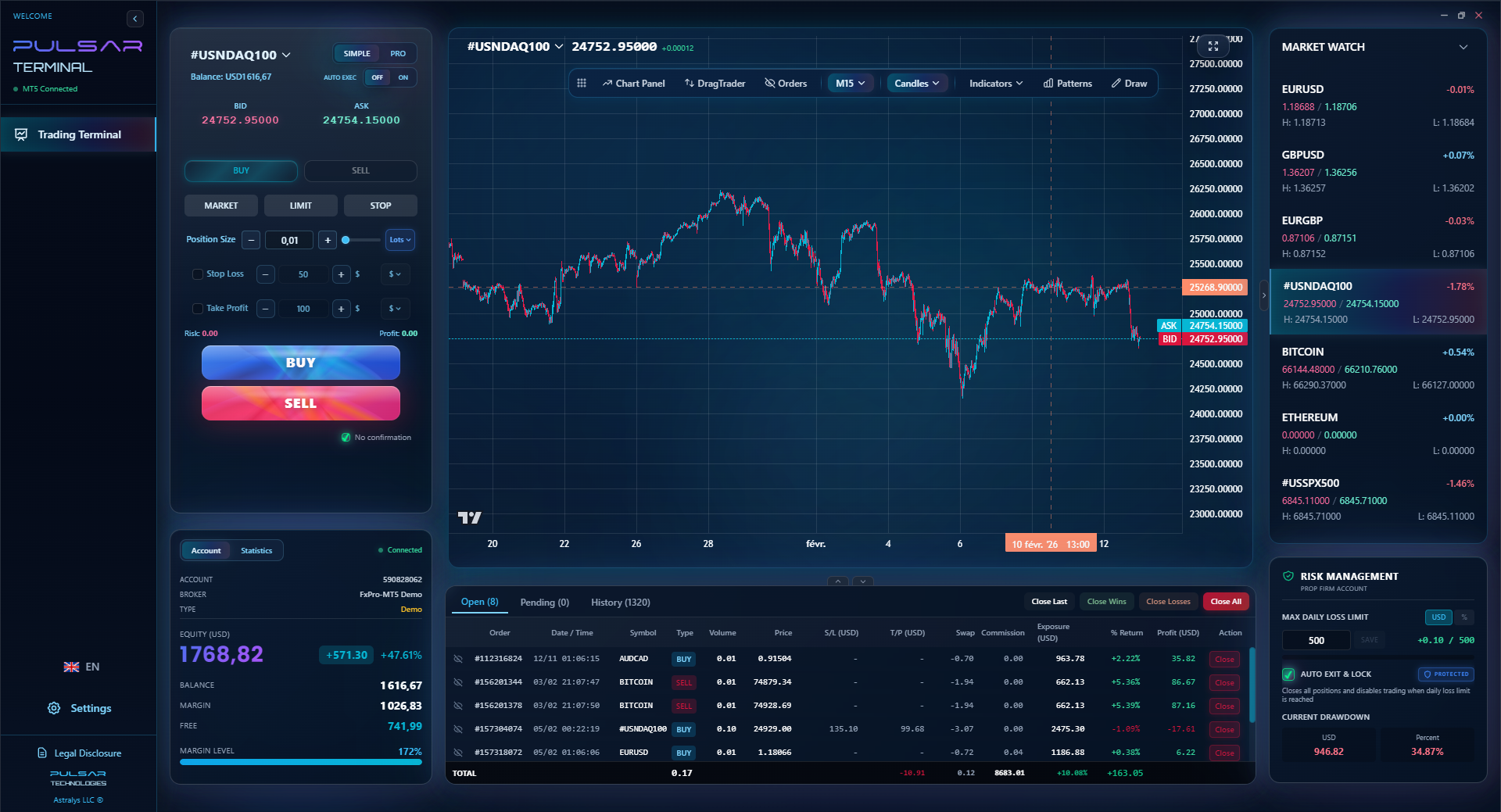
Tools like Pulsar Terminal can help automate this discipline by letting you set multi-level take-profits and trailing stops directly on your MT5 platform, removing emotional decisions in the heat of the moment.
💡 Winston's Tip
The Naira's volatility isn't just a news item; it's a trading lesson on your doorstep. Watch how it reacts to CBN announcements. That's fundamental analysis in real-time.
When moving from demo to live, the emotional pressure can break your rules; Pulsar Terminal helps lock in your risk management plan with automated trailing stops and breakeven functions directly on MT5.
Pulsar Terminal
The all-in-one MT5 companion: drag-and-drop orders, multi-TP/SL, trailing stop, grid trading, Volume Profile, and prop firm protection. Used by 1,000+ traders daily.
“The first 100 live trades should be boring. If they're exciting, you're risking too much.”
Trading a demo account with $100,000 feels like a video game. Trading your own $100 live is a completely different psychological beast.
Your Demo Mission: Don't just try to make money. Your goal is to execute your plan flawlessly for 100 trades. Log every one. Focus on your win rate and risk-reward consistency. Are you following your rules? Once you can do this consistently over 2-3 months, you're ready to consider live trading.
Going Live: Start Microscopic. Fund your live account with money you can afford to lose completely - this is critical. Start trading with the smallest possible position size (micro lots). Your goal for the first month is not profit. Your goal is to make it through the month without breaking your risk management rules. The emotional pressure is real, and you need to acclimatize to it slowly.
I moved to live with $500. My rule was to only trade 0.01 lots (micro lots) for the first 50 trades, risking about $5 per trade. The first 10 trades were nerve-wracking, even for such small amounts. But by trade 30, the process started to feel normal. That gradual exposure saved me from myself.
This structured, patient approach is the true way to learn forex trading step by step. It builds real skill, not just theoretical knowledge from a PDF.
FAQ
Q1Is forex trading legal and taxable in Nigeria?
Yes, it's legal for individuals using personal funds. And yes, you must pay a 10% capital gains tax on your gross profits to the FIRS. Any course or person telling you otherwise is misleading you.
Q2What's a realistic amount to start forex trading in Nigeria?
You can start with as little as $10-$50 with some brokers. However, a more realistic amount that allows for proper risk management is $200-$500. This lets you trade micro lots and risk 1% ($2-$5) per trade without being wiped out by a few losses. Never trade with money you need for rent or bills.
Q3Why shouldn't I just buy a proven trading strategy PDF?
Because no PDF can give you the market experience or emotional discipline required. Markets change, and a static document can't adapt. The real 'secret' is risk management and psychology, which you only learn by doing. Most of those PDFs are recycled basic information sold at a huge markup.
Q4Which trading platform is best for beginners in Nigeria?
MetaTrader 4 (MT4) or MetaTrader 5 (MT5) are the industry standards. They're free, offered by almost every broker, and have a huge community. This means you can find countless free tutorials on YouTube specific to MT4/MT5. Start there before considering any other platform.
Q5How do I handle the 10% tax? Do brokers deduct it?
No, international brokers do not deduct Nigerian taxes. It is your personal responsibility to calculate your annual profit and file/pay the 10% capital gains tax with the FIRS. Keep detailed records of all your trades and withdrawals.
Q6Can I pass a prop firm challenge from Nigeria?
Yes, many Nigerians do. The key is treating the challenge like a real trading job with extreme discipline. Use the strict risk management rules we discussed (1% rule, positive risk-reward). Prop firms are testing your ability to not lose money, not just to make it. Tools that help automate daily loss limits are useful here.
Q7What's the biggest mistake Nigerian beginners make?
Two tied for first: 1) Using excessive use (like 1:500) because it's available, which destroys accounts on small moves, and 2) jumping into live trading without a documented, proven plan from months of demo practice. They confuse luck with skill.
Prof. Winston's Lesson
Key Takeaways:
- ✓Always calculate your 10% tax liability before you count profits.
- ✓Risk a maximum of 1% of your account on any single trade.
- ✓A strategy must overcome the spread to be profitable.
- ✓Demo trade for 2-3 months minimum before going live.
How useful was this article?
Click a star to rate
Weekly Trading Insights
Free weekly analysis & strategies. No spam.
About the Author
Olumide Adeyemi
West African Trading Pioneer
One of Nigeria's most active forex trading educators. 8 years of experience trading from Lagos. Specializes in low-capital strategies and prop firm challenges for African traders.
Comments
Risk Disclaimer
Trading financial instruments carries significant risk and may not be suitable for all investors. Past performance does not guarantee future results. This content is for educational purposes only and should not be considered investment advice. Always conduct your own research before trading.
You Might Also Like

Cara Trading Forex Sukses: 7 Prinsip dari Trader Profesional
Cara trading forex sukses dengan 7 prinsip trader pro: manajemen modal, disiplin, journal trading, backtest. Data nyata, bukan janji profit palsu.
Jam Trading Forex Terbaik untuk Trader Indonesia: Panduan Lengkap dengan Tabel Waktu
Panduan jam trading forex untuk trader Indonesia. Tabel 4 sesi dunia, jam emas 20:00-00:00, sesi mana yang harus dihindari. Data akurat + tips dari trader berpengalaman.
Top 5 Sàn Forex Uy Tín Nhất 2026: Review Jujur dari Trader Indonesia
Top 5 sàn forex uy tín 2026 untuk trader Indonesia. Review jujur: spread, deposit, withdraw, dukungan lokal. Exness, XM, IC Markets & lebih.
Get Pulsar Terminal
All these calculators are built into Pulsar Terminal with real-time data from your MT5 account. One-click position sizing, automatic risk management, and instant calculations.
Get Pulsar Terminal