


My screen was a sea of red.

Rajesh Sharma
Senior Forex Analyst ·  India
India
☕ 11 min read
What you'll learn:
- 1What Are You Actually Trading? XAU/USD Demystified
- 2Finding Your Gateway: Brokers for Live Gold Trading in India
- 3What Makes Gold Tick? The Real Drivers
- 4Putting It Into Practice: Strategies for Live Gold Trades
- 5The Golden Rule: Managing Risk on Every Trade
- 6The Mind Game: Trading Gold Without Going Crazy
- 7Your First Live Gold Trade: A Step-by-Step Checklist

My screen was a sea of red. It was March 2020, and XAU/USD had just plummeted from $1700 to $1450 in a matter of days. Panic was everywhere. I remember sitting there, my finger hovering over the sell button on my small long position, convinced the world was ending. But then I looked at the charts, really looked. The RSI indicator on the daily was screaming oversold at levels I hadn't seen in years. I held my nerve, added a tiny bit more to my position at $1462, and waited. That trade taught me more about the psychology of a live gold trade than any book ever could. Gold isn't just a metal, it's a pulse check on global fear and greed. Let's talk about how you can trade that pulse from right here in India.
When you place a live gold trade, you're almost certainly trading the symbol XAU/USD. Forget physical bars for a moment. XAU is the code for one troy ounce of gold. USD is the US dollar. So, XAU/USD = the price of one ounce of gold in US dollars. If the price is 2345.60, it means you need $2345.60 to buy one ounce.
Here's the crucial bit for us in India: You are trading the international spot price. This is different from the gold you buy at a local jeweller, which has making charges, GST, and is priced in rupees based on the MCX. Your trade's profit or loss is in dollars, converted to your account currency (usually USD, EUR, or INR) by your broker.

Warning: Don't confuse MCX Gold with Spot Gold (XAU/USD). MCX Gold is a futures contract traded on the Indian exchange, with specific lot sizes and expiry dates. XAU/USD is a 24/5 spot market with no expiry. The prices move together, but they are different instruments with different rules and brokers.
Why trade XAU/USD? The liquidity is massive. It's one of the most traded markets in the world, which generally means tighter spreads. You can get in and out of positions quickly, which is perfect for the fast moves gold is known for. For a deeper look at the instrument's behavior, check out our dedicated XAU/USD guide.

💡 Winston's Tip
Gold's trend on the weekly chart is your best friend. Most of your trades should be in its direction. Fighting the primary trend is like swimming against a tsunami.
This is where most Indian traders get stuck. The regulatory environment is, to put it mildly, complex. The RBI has strict rules on remitting money abroad for margin trading. Because of this, you cannot legally fund an international broker directly from your Indian bank account for speculative trading.
So, how do people trade? There are two practical paths, each with trade-offs.
The International Broker Route
Many serious traders use large, reputable international brokers like IC Markets, Pepperstone, or Exness. These brokers offer raw spreads on gold, often below 20 cents, and reliable platforms. The funding hurdle is solved by using international payment methods like Skrill, Neteller, or Cryptocurrency, which these brokers accept. You convert your INR to the funding wallet's currency, then transfer to the broker.

Pro Tip: Always, always start with a small test deposit and withdrawal. Confirm the entire process - funding, trading, and getting your profit back into your Indian bank account - works smoothly before committing larger capital.
The Domestic Broker Route
You can trade Gold contracts on the MCX through a registered Indian broker. This is fully legal and straightforward. However, you're trading a futures contract, not the 24/5 spot market. This means you deal with expiry dates, larger contract sizes (1 kg for Gold Mini!), and trading hours that match the Indian session. The liquidity is lower than the global spot market, which can mean wider spreads during off-hours.
The choice boils down to your style. If you want to scalp or trade on global news at 2 AM, an international broker with XAU/USD is the only way. If you prefer swing trading based on daily charts and want absolute regulatory comfort, MCX through a domestic broker is your path. Do your own thorough research on any broker you consider.
“Gold isn't just a metal, it's a pulse check on global fear and greed.”
Trading gold blindly is a sure way to lose money. You need to know what news to watch. It's not just about inflation.
The US Dollar (DXY): This is the big one. Gold is priced in USD. A stronger dollar makes gold more expensive for holders of other currencies, which can dampen demand and push the price down. It's an inverse relationship about 80% of the time. Watch the US Dollar Index.
Real Yields: This is the professional's metric. Look at the US 10-Year Treasury Inflation-Protected Securities (TIPS) yield. When real yields (interest rate minus inflation) go up, gold, which pays no interest, becomes less attractive. When real yields fall or go negative, gold shines. In 2022, despite high inflation, gold struggled because the Fed was hiking rates aggressively, pushing real yields up.
Geopolitical Fear & Market Stress: War, banking crises, stock market crashes. Gold is the classic safe haven. The rally during the early days of the Ukraine war is a textbook example. But be careful: these moves can be sharp and reverse quickly once headlines calm.
Central Bank Buying: In recent years, central banks (especially from emerging markets) have been net buyers of gold. This provides a steady floor of demand. Reports from the World Gold Council can give you clues.
I learned about real yields the hard way. In early 2022, I was long gold because inflation was at 8%. I couldn't understand why price was stuck. I ignored the soaring 10-year yield. That trade was a breakeven mess when it should have been a winner. Now, I have a TIPS yield chart open next to my gold chart, always.

Theory is useless without execution. Here are two frameworks I use consistently.
Strategy 1: The News Scalp (High Risk, High Focus)
Gold loves major US economic data: CPI, Non-Farm Payrolls, FOMC decisions. The strategy is to trade the initial spike.
- Setup: Have a live chart open 5 minutes before the news release. I use a 1-minute or 5-minute chart.
- Order Placement: Place a buy stop order 30-40 points above the current price and a sell stop order 30-40 points below. This captures a breakout in either direction.
- Execution & Exit: The moment one order triggers, IMMEDIATELY cancel the other order. Your target is a quick 15-25 point move. Use a tight stop-loss (10-15 points). Don't get greedy. The goal is to catch the initial volatility surge.

Example: Gold is trading at $2330.50 before CPI. You place a Buy Stop at $2334.00 and a Sell Stop at $2327.00. CPI comes out hot, price rockets. Your Buy Stop triggers at $2334. Your immediate target is $2336.50 (25 points). You're in and out in 90 seconds.
The key here is discipline and a reliable broker with fast execution. Slippage can kill this strategy. I've had my best and worst moments with this. One NFP, I made $420 on a 0.5 lot trade in under a minute. Another time, a platform freeze turned a potential win into a $180 loss. It's not for the faint of heart.
Strategy 2: The Daily Chart Swing (More Sustainable)
This is my bread and butter. I use it for swing trading positions I hold for days or weeks.
- Trend Identification: Use the 50 and 200 Daily Moving Averages. Is price above both? That's your bullish bias. Below both? Bearish.
- Entry Signal: Wait for a pullback to a key support (in an uptrend) or resistance (in a downtrend). Use the MACD indicator on the 4-hour chart to spot a momentum reversal (e.g., MACD histogram turning up while above the zero line in an uptrend).
- Risk Management: This is everything. Your stop-loss goes below the recent swing low (for a long trade). Your position size must be calculated so that if you hit that stop, you lose only 1-2% of your account. Never wing this. Use a position size calculator.
A recent trade: In late March, gold was in a clear daily uptrend. It pulled back to $2,150, which was previous resistance-turned-support. The 4-hour MACD showed bullish divergence. I went long at $2,152. Stop at $2,130 (risk of $22 per lot). Target was the previous high near $2,200. The trade worked, netting about $48 per lot. The risk was defined before I ever entered.
💡 Winston's Tip
The most important number on your screen isn't your potential profit. It's your pre-calculated risk. If that number makes you uncomfortable, your position size is too big. Cut it in half.

“Constantly monitoring a live gold trade will tempt you to micromanage it, moving stops, taking early profits, and ruining your plan's edge.”
You can have the best strategy in the world and still blow up your account with poor risk management. Gold is volatile. A $30 move in a day is normal. A $100 move happens more often than you think.
The 1% Rule: Never risk more than 1% of your trading capital on a single trade. For a $5,000 account, that's $50. If your stop-loss distance is 50 points ($5 per 0.1 lot on XAU/USD), you can only trade a position size of 0.1 lots. ($5 risk per point x 50 points = $250? Wait, let's correct that).
Let's get the math right, because this is where people fail. On XAU/USD, a 1-point move on a 1.00 standard lot is $10. So, on a 0.1 lot, a 1-point move is $1.
If your stop-loss is 50 points away, and you're trading 0.1 lots, your risk is: 50 points * $1 per point = $50. Perfect for your $5,000 account (1%).
If you want to place a tighter stop of 20 points, you could trade a larger size: $50 risk / 20 points = $2.50 per point. Since $1 per point = 0.1 lots, $2.50 per point = 0.25 lots. Always work backwards from your risk.
Dealing with Gaps: Gold trades 24/5, but it closes on the weekend. Major news (like war breaking out on a Saturday) can cause the price to open sharply higher or lower on Sunday. Your stop-loss won't protect you. It will be executed at the first available price, which could be much worse. The only defense is to either close positions before the weekend or size them so that a catastrophic gap won't wipe you out.
I learned about gaps in 2016 with the Brexit vote. I was short over the weekend. It opened $60 higher. My account took a hit I wasn't prepared for. Now, I either go flat or reduce my size significantly before major event risks. Understanding your broker's policy on margin call levels is also critical here.

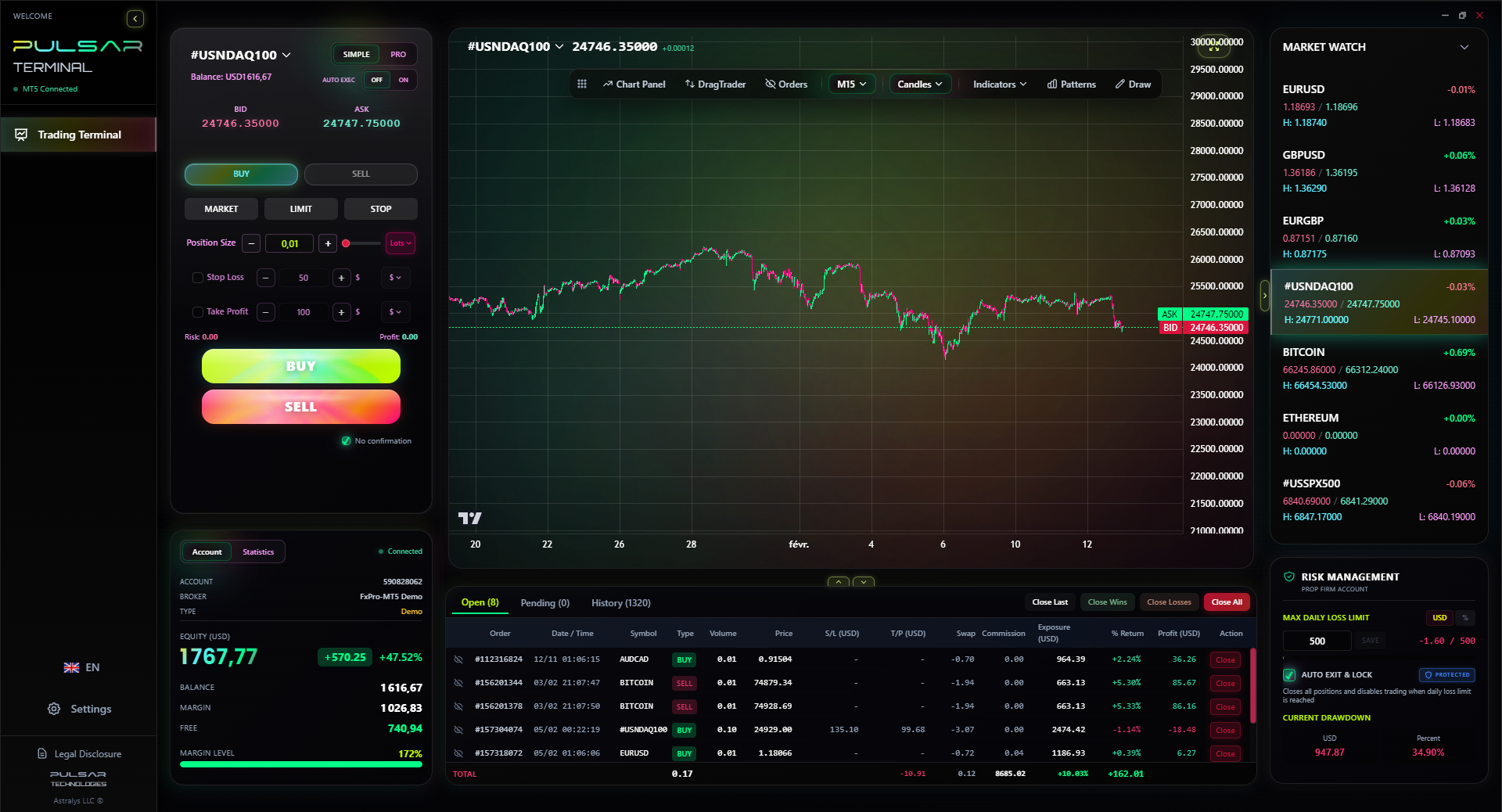
Managing multiple targets and moving stops to breakeven on volatile gold trades is stressful, but tools like Pulsar Terminal automate these actions directly on your MT5 chart.
Pulsar Terminal
The all-in-one MT5 companion: drag-and-drop orders, multi-TP/SL, trailing stop, grid trading, Volume Profile, and prop firm protection. Used by 1,000+ traders daily.
Gold trading is an emotional rollercoaster. It's tied to fear, greed, and global uncertainty. If you're not careful, you'll start mirroring that chaos in your trading.
Detach from the Narrative: The financial news will have a story for every move. "Gold up on inflation fears!" "Gold down on strong dollar!" It's noise. Your charts and your plan are the only truth. I used to watch business news all day. It made me jumpy and reactive. I turned it off, and my performance improved within a month.
Embrace the Wait: The best gold trades are often the boring ones. You enter based on your plan, set your stop and target, and then you wait. You don't need to watch every tick. Constantly monitoring a live gold trade will tempt you to micromanage it, moving stops, taking early profits, and ruining your plan's edge.
Journal Everything: This is non-negotiable. For every trade, note: Entry price, stop-loss, target, position size, the chart setup, and most importantly, your emotional state. Were you nervous? Overconfident? Chasing? Reviewing my journal showed me that 80% of my losses came from trades I entered out of boredom or frustration, not from my core strategies. That was a painful but vital lesson.
Gold can make you feel like a genius one week and a fool the next. The traders who last are the ones who manage their emotions as strictly as they manage their money.
💡 Winston's Tip
Your first profit target should always be to move your stop-loss to breakeven. Protecting your capital is rule number one. Profits come after survival is guaranteed.

“The goal of your first 10-20 live trades is not to make money, but to execute your plan perfectly under real psychological pressure.”
Before you click 'buy' or 'sell', run through this list.
- Education & Demo: Spend at least 2-3 months on a demo account. Trade through different market conditions - quiet ranges, high-volatility news. Don't rush this.
- Broker Selection & Funding: Choose your path (international or domestic). Open an account, do a test deposit and withdrawal. Get completely comfortable with the platform.
- Define Your Strategy: Pick ONE strategy from the section above. Master it on demo. Know your entry, exit, and risk rules by heart.
- Start Absurdly Small: When you go live, start with a position size that is 1/4 or 1/2 of what your risk calculation allows. The goal of your first 10-20 live trades is not to make money, but to execute your plan perfectly under real psychological pressure.
- Analyze and Adapt: Religiously journal every trade. Once a week, review what's working and what's not. Tweak your strategy slowly. Don't overhaul it after two losses.
Remember, trading is a marathon, not a sprint. Your first goal is survival. Your second goal is consistent execution. Profitability is the natural result of those two things. Avoid the temptation to chase the spectacular win. Focus on the boring, repeatable process. That's what builds a real trading career.

FAQ
Q1Is trading XAU/USD legal for Indian residents?
Trading forex and commodities like XAU/USD with international brokers operates in a regulatory grey area. The RBI prohibits remitting funds abroad specifically for margin trading. However, many traders use alternative payment methods. Trading gold futures on the MCX through a SEBI-registered domestic broker is fully legal and regulated.
Q2What is a good lot size to start trading gold?
Start as small as possible. Most international brokers offer micro lots (0.01). With gold's volatility, a 0.01 lot move of 10 points is roughly $1. This allows you to practice real trading with minimal risk. Never start with standard lots (1.00) as a beginner; the risk is far too high.
Q3What time is best to trade gold from India?
The most volatile and liquid overlaps are during the London (1:30 PM to 10:30 PM IST) and New York (6:30 PM to 3:30 AM IST) sessions. Major US economic data is released around 6:00 PM to 8:00 PM IST, causing big moves. The Asian session (early morning IST) is often quieter and more range-bound.
Q4What's the difference between the spread and commission on gold?
The spread is the difference between the buy and sell price quoted by the broker. A low spread (e.g., 20 cents) is good. Some brokers charge a commission per lot on top of a raw spread. You must calculate the total cost (spread + commission) to compare brokers fairly. A 10-cent spread with a $5 commission can be more expensive than a 35-cent spread with no commission.
Q5Can I trade gold with just 10,000 INR?
Technically, yes, with a broker offering micro lots. However, it's extremely challenging. After currency conversion, 10,000 INR is about $120. Proper risk management (1% rule) would mean risking only $1.20 per trade, leaving almost no room for market movement. It's strongly advised to have more capital or to use a demo account until you can fund with a more viable amount, ideally equivalent to at least $1,000.
Q6Why did my gold trade hit stop-loss so quickly?
Gold has high intraday volatility and can whip around support/resistance levels. Your stop-loss might have been placed too tight, within the market's normal 'noise' range. Re-evaluate your stop placement on higher time frames (like the 4-hour chart) to place it beyond recent swing points, giving the trade more room to breathe.
Prof. Winston's Lesson
Key Takeaways:
- ✓Trade XAU/USD, not physical gold or MCX for 24/5 access.
- ✓Risk a maximum of 1% of capital per trade, no exceptions.
- ✓Watch US Real Yields (TIPS), not just inflation headlines.
- ✓Use daily chart trend to filter all your trade ideas.
- ✓Start with 0.01 micro lots to learn real-market psychology.
How useful was this article?
Click a star to rate
Weekly Trading Insights
Free weekly analysis & strategies. No spam.
About the Author
Rajesh Sharma
Senior Forex Analyst
Trading Indian and South Asian markets for over 10 years. Started with NSE currency derivatives before moving to international forex. Specializes in USD/INR and emerging market pairs.
Comments
Risk Disclaimer
Trading financial instruments carries significant risk and may not be suitable for all investors. Past performance does not guarantee future results. This content is for educational purposes only and should not be considered investment advice. Always conduct your own research before trading.
You Might Also Like

Cara Trading Forex Sukses: 7 Prinsip dari Trader Profesional
Cara trading forex sukses dengan 7 prinsip trader pro: manajemen modal, disiplin, journal trading, backtest. Data nyata, bukan janji profit palsu.
Jam Trading Forex Terbaik untuk Trader Indonesia: Panduan Lengkap dengan Tabel Waktu
Panduan jam trading forex untuk trader Indonesia. Tabel 4 sesi dunia, jam emas 20:00-00:00, sesi mana yang harus dihindari. Data akurat + tips dari trader berpengalaman.
Top 5 Sàn Forex Uy Tín Nhất 2026: Review Jujur dari Trader Indonesia
Top 5 sàn forex uy tín 2026 untuk trader Indonesia. Review jujur: spread, deposit, withdraw, dukungan lokal. Exness, XM, IC Markets & lebih.
Get Pulsar Terminal
All these calculators are built into Pulsar Terminal with real-time data from your MT5 account. One-click position sizing, automatic risk management, and instant calculations.
Get Pulsar Terminal