


You're sitting in Johannesburg or Cape Town, coffee in hand, watching the charts at 10 AM.

David van der Merwe
Emerging Markets Trader ·  South Africa
☕ 13 min read
What you'll learn:
- 1Why the London Session is Your Prime Time
- 2The London Session Forex Pairs You Should Actually Care About
- 3A Simple Strategy for London Session Volatility
- 4Brokers, Costs, and the 30:1 Reality
- 5Risk Management When the Volume is On
- 6Forget Fancy Indicators, Use These
- 7Mistakes I've Made (So You Don't Have To)
- 8Putting It All Together: A Sample London Session
You're sitting in Johannesburg or Cape Town, coffee in hand, watching the charts at 10 AM. The London session is open, and you know the big money is moving. But which pairs should you actually be watching? Throwing a dart at the currency list is a sure way to get stopped out before lunch. The London session isn't just about any pair, it's about specific pairs that come alive with liquidity and volatility during those hours. For us in South Africa, with our perfect timezone overlap, this is our prime hunting ground. Let's cut through the noise and talk about the London session forex pairs that matter, how to approach them with our 30:1 use limit, and how to avoid the traps that wipe out most local accounts.
Forget trying to trade the Tokyo session at 3 AM. Your natural advantage as a South African trader is your timezone. London opens at 10:00 AM SAST (8:00 AM GMT) and runs until 6:00 PM SAST. This isn't just convenient, it's critical. You're awake and trading during the single most liquid window in the entire global forex market.
About $2.7 trillion changes hands during this session. That volume does two things for you: it crushes spreads and creates clean, decisive price movements. The tiny, erratic jumps you see in the Asian session get replaced with proper trends and breakouts. This is when major European economic data drops, Bank of England announcements happen, and big institutional orders get filled.
For us, the overlap with the New York session opening (from 3:00 PM SAST) is the real sweet spot. From 3 PM to 6 PM SAST, you have both London and New York desks active. This is often the most volatile period of the entire 24-hour cycle. It's where I've caught some of my biggest swing trading moves, simply because the momentum generated in London gets amplified when the Americans join the party.

Example: On a typical day, the EUR/USD might have a 1.5 pip spread with your broker at 2 AM SAST. At 10:05 AM SAST, just after the London open, that same spread can tighten to 0.2 pips. That's a direct Rands-and-cents saving on every trade you enter.

💡 Winston's Tip
The first 90 minutes of London are for watching, not trading. Let the market show its hand. The best trades often appear after the initial chaos settles.
Not all pairs are created equal when Big Ben chimes. You want to focus on pairs where the volume is concentrated. Trading an exotic during London is like fishing in a puddle when the ocean is right next to you.
The Majors: Your Bread and Butter
These are the workhorses. The EUR/USD is the king, making up nearly 20% of all global forex volume. During London hours, its spread is often at its absolute tightest, sometimes hitting 0.1 pips on raw accounts. It reacts sharply to Eurozone data and sets the tone for the dollar. The GBP/USD is the wild cousin. It moves fast and can be brutal, but the opportunities are huge, especially around UK inflation or jobs reports. The USD/JPY is your carry-trade and risk-sentiment barometer. It's a bit more orderly than cable but still packs a punch.
The Crosses: Where the Real Edge Can Be
This is where many traders miss out. The EUR/GBP and GBP/JPY are London specials. The EUR/GBP is a pure play on relative European/UK economic strength. It often trends beautifully during the session with less noise than the majors. The GBP/JPY, however, is not for the faint of heart. It's highly volatile, a favorite of prop desks, and can make or break your day in minutes. I treat it with immense respect and a tight leash.
Here’s a quick comparison of what to expect:
| Pair | Typical London Session Behaviour | Why It's Good for London | Risk Note |
|---|---|---|---|
| EUR/USD | Strong, liquid trends. Reacts to EU & US data. | Highest liquidity, tightest spreads. | Can be range-bound if no catalyst. |
| GBP/USD | Explosive, news-driven moves. High volatility. | Great for breakout strategies. | Whipsaws around news are common. |
| USD/JPY | Clean, technical moves driven by yields/sentiment. | Good for trend-following. | Can gap on BOJ intervention talk. |
| EUR/GBP | Steady, trending behaviour. Lower average speed. | Excellent for swing positions. | Lower daily range than majors. |
| GBP/JPY | Extremely volatile, large daily ranges. | Huge profit potential for the agile. | Can cause a margin call fast. |
What About the ZAR?
You might be wondering about USD/ZAR or EUR/ZAR. Honestly, I treat these as a separate category. They can be active during London, but their liquidity is a fraction of the majors. Spreads are wider (often 50-100 pips on USD/ZAR), and moves can be driven by local SA politics or commodity prices that have nothing to do with London flow. I don't recommend them as your primary London session forex pairs unless you have a specific, informed view on South Africa.
“Trading USD/ZAR during London against massive offshore funds is a tough game. The spreads eat you alive.”
Complex strategies fail when volatility is high. You need clarity. Here’s a basic framework I’ve used for years, focusing on the first two hours after the open (10:00 AM - 12:00 PM SAST).
1. The Opening Range Break: I mark the high and low of the first 30-60 minutes after the London open on my chart. This range often acts as a consolidation area before the real direction is chosen. A sustained break (closing a 5-minute candle outside) of this range, especially on increasing volume, can signal the initial directional bias for the session. I’ll look for a retest of the broken level as a potential entry. I got caught on the wrong side of this in early 2023 with GBP/USD. The range was 50 pips, it broke down, I shorted, but it immediately reversed and took out the high. Lesson? Wait for the retest and hold. Don't chase the initial break.
2. The News Catalyst Play: Economic calendars are your friend. At 11:00 AM SAST, you often get major EU or UK data. I don't trade the news spike itself - that’s a coin flip. I wait for the aftermath. The market often overreacts initially. I watch for a rejection at a key technical level (a previous daily high/low, a round number) following the spike, and then trade in the direction against the initial overreaction, back towards the pre-news range. This requires patience and letting the manic price action settle.
3. The Overlap Surge: When New York comes online at 3:00 PM SAST, I’m not looking for new setups. I’m managing existing positions. The influx of volume can accelerate your winning trades, allowing you to move your stop to breakeven or take partial profits. It can also violently reverse trends that were purely London-driven. This isn't a time to be complacent.

Warning: A common mistake is overtrading because 'things are moving.' The London session provides the opportunity, not the obligation, to trade. Sometimes the cleanest move is to wait for the New York overlap for confirmation. If you’re confused in the first hour, it’s okay to sit on your hands and watch.
💡 Winston's Tip
If you're looking at GBP/JPY, halve your normal position size. The volatility isn't a suggestion, it's a law of physics. Respect it or it will break you.
Let's talk about the practicalities of trading these pairs from South Africa. The FSCA's 30:1 use cap for retail clients changed the game. It’s a good thing. Anyone telling you that you need 500:1 to win is selling you a dream that usually ends in a margin call. At 30:1, a 3.3% move against you wipes your margin. That forces proper position size calculator use and risk management.
You have two main choices: a local FSCA-licensed broker or a reputable international one that accepts SA clients. Local brokers like Khwezi Trade (min deposit R500) or iFX Brokers offer ZAR accounts, which saves on bank conversion fees. International brokers like Exness (FSCA regulated), IC Markets, or XM often have tighter spreads on the major London session forex pairs.
Here’s a real example from my trading: On a standard account with a typical broker, the spread on EUR/USD during London might be 0.9 pips. On a raw account with a broker like Pepperstone or IC Markets, you might pay a $7 commission per lot but get a spread of 0.1 pips. Which is cheaper? For a 1-lot trade: The standard account cost is 0.9 pips = $9. The raw account cost is 0.1 pips ($1) + $7 commission = $8. Slightly cheaper, and the tighter spread gives you a better entry. For scalping strategy, the raw account is almost always better.
Funding is easy these days. Most brokers offer instant EFT via providers like Ozow or PayFast. Withdrawals back to your SA bank account usually take 1-3 business days. Just make sure you understand the tax implications - trading profits are considered income and are taxable.
“High liquidity can give you a false sense of security. The price can move 50 pips against you in the time it takes to blink.”
This is the most important section. High liquidity can give you a false sense of security. "The spread is tight, I can get in and out easily!" Yes, but the price can also move 50 pips against you in the time it takes to blink.
Your first rule must be position sizing. With 30:1 use, if you risk more than 1% of your account on a single London session trade, you're gambling. I use a hard rule: 0.5% risk per trade during the volatile first hour, moving to 1% only if a clear trend establishes. This isn't conservative, it's sane.
Stop losses are non-negotiable, but they need room. Placing a 5-pip stop on GBP/JPY during London is just donating money to the market. Look at the Average True Range (ATR) indicator. If the GBP/JPY’s ATR for the 1-hour chart is 80 pips, your stop needs to be at least 40-50 pips away from entry, or you'll be stopped out by normal market noise. This means trading smaller position sizes to keep your rand risk constant.
I learned this the hard way trading EUR/USD. I placed a logical stop 20 pips away based on a support level. A sudden, thin-volume spike (a 'stop hunt') took me out, and the price immediately rocketed back up to my original target. My analysis was right, my risk management was childish. Now, I place my stops beyond obvious congestion areas, even if it means risking slightly more in Rands. I adjust my position size down to compensate.

Pro Tip: During the London-New York overlap (3-6 PM SAST), volatility often peaks. Consider taking partial profits (e.g., close 50% of your position) if you're in a winning trade before this period. It locks in gains and lets you trail the rest with a much wider, safer stop.
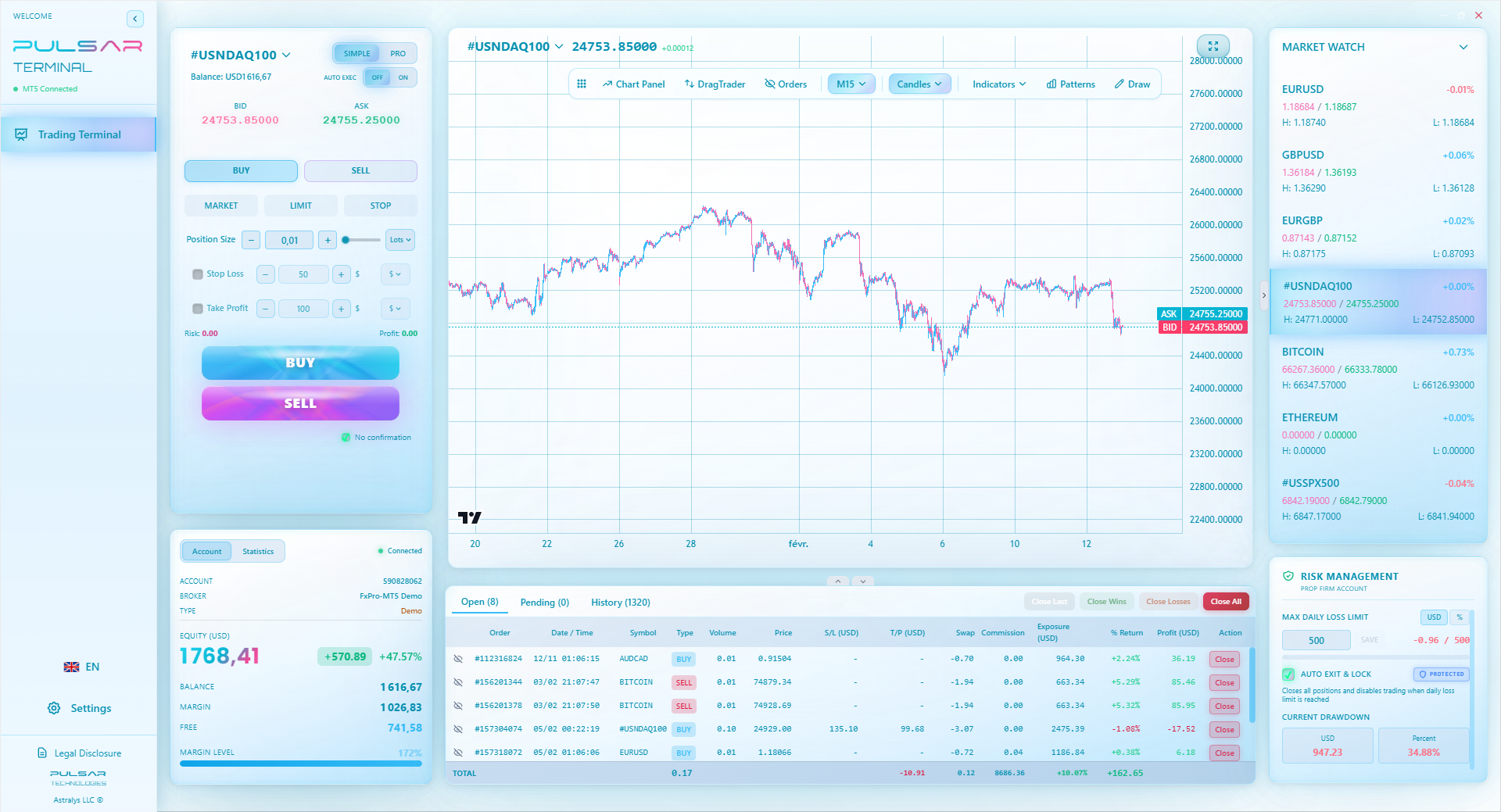
Managing multiple trades and adjusting stops quickly during the volatile London session is critical, and tools like Pulsar Terminal automate this directly on your MT5 platform.
Pulsar Terminal
The all-in-one MT5 companion: drag-and-drop orders, multi-TP/SL, trailing stop, grid trading, Volume Profile, and prop firm protection. Used by 1,000+ traders daily.
Your chart doesn't need to look like a Christmas tree. For London session trading, I use three things:
- Volume Indicator: This is crucial. You want to see if a price move is supported by high volume (likely real) or low volume (likely a fakeout). A breakout from the London opening range on surging volume is a high-probability signal.
- The 1-Hour and 15-Minute Charts: The daily gives you direction, but these two timeframes are your tactical maps for London. I use the 1-hour to define the session's trend and the 15-minute for precise entries.
- Simple Moving Averages: A 20-period and 50-period EMA on the 1-hour chart. During London, I watch for the price to pull back to these EMAs in a strong trend. They often act as dynamic support/resistance. A clean bounce off the 20-EMA with volume can be a great continuation entry.
I avoid lagging indicators like the standard MACD indicator or RSI indicator for entry signals during fast markets. By the time they give a signal, the move is often half over. They are better for confirming the strength of a move already in progress. For instance, if price is making a new high but the RSI is making a lower high (divergence) during the London session, it’s a strong warning that the uptrend is tired, even if the price hasn't turned yet.
💡 Winston's Tip
Your stop loss isn't a suggestion. It's a pre-paid insurance policy. Moving it wider 'just this once' is the first step to turning a small loss into a catastrophic one.
“The discipline is to wait for *your* setup on *your* chosen pair, even if it means watching other pairs make moves without you.”
Let's get blunt. We have unique advantages and we still mess up. Here are the classic South African trader errors during London:
Chasing ZAR Pairs: We have a natural curiosity about our own currency. But trading USD/ZAR during London against massive offshore funds with better information is a tough game. The spreads eat you alive. I lost R4,200 in two days trying to scalping strategy USD/ZAR before admitting it was a terrible idea. Stick to the major London session forex pairs where you have a fair fight.
Ignoring SAST Time: Confusing GMT with SAST and missing the open. London opens at 10:00 AM SAST. Not 9, not 11. Set an alarm.
Overleveraging Because of 30:1: "It's only 30:1, I need to trade bigger to make money!" Wrong. This thinking blows up accounts. Use the use to take sensible positions with tight stops, not to bet the farm.
Trading Through Major News Blind: You wouldn't drive with a blindfold. Don't trade GBP/USD at 11:00 AM SAST when UK CPI data is due without knowing the number and the expectation. The resulting spike will ignore all your technical levels. Either have a specific news strategy or be flat.
Forgetting About Load Shedding: It's our reality. Have a plan. A UPS for your router and laptop, or ensure your broker has a reliable mobile app so you can manage positions from your phone if the power goes. I once had to close a trade on my phone during stage 6 load shedding. It was stressful, but having the app ready saved me from a bigger loss.
Let's walk through a hypothetical Wednesday, looking at EUR/USD.
9:55 AM SAST: I'm at my desk. Calendar shows EU Industrial Production at 11:00 AM SAST. No major US data until the afternoon. The daily chart is in a mild uptrend.
10:00 AM - 10:30 AM SAST: London opens. I draw a rectangle from the high (1.0850) to low (1.0830) of the first 30 minutes. Price is chopping within this 20-pip range. Volume is decent. I wait.
10:45 AM SAST: A cluster of 5-minute candles breaks above 1.0850. Volume on the breakout bar is the highest of the morning. This is my signal. I don't chase. I wait for a pullback.
10:55 AM SAST: Price pulls back to 1.0848 (near the breakout level) and holds. My entry is 1.0850. The daily ATR is 70 pips, so I place my stop loss at 1.0810 (40 pips away, below the morning range). My profit target is the previous day's high at 1.0890 (a 40 pip reward). My risk is 0.75% of my account. I enter.
11:00 AM SAST: EU data is released, slightly better than expected. A quick spike up to 1.0865, then a retracement. My stop is safe at 1.0810. I'm not worried.
12:30 PM SAST: A steady uptrend resumes. I move my stop to breakeven at 1.0850. The trade now has no risk.
3:00 PM SAST: New York opens. Volume surges, pushing price to 1.0885. I decide to take partial profits (50% of position) here, locking in 35 pips. I move my stop on the remaining half to 1.0860, locking in 10 pips.
4:30 PM SAST: Price hits my original target of 1.0890, closing the second half. Total for the day: (35 pips / 2) + (40 pips / 2) = 37.5 pips net. A clean, disciplined play on a classic London session breakout in a major pair.
The key wasn't a fancy indicator. It was understanding the session rhythm, using volume, placing a logical stop, and managing the trade through the volatility. That's how you trade London session forex pairs from South Africa.
FAQ
Q1What time does the London session open and close in South Africa?
The London session opens at 10:00 AM SAST (8:00 AM GMT) and closes at 6:00 PM SAST (4:00 PM GMT). The most active and volatile period is typically the first two hours (10 AM - 12 PM SAST) and the overlap with the New York session (3 PM - 6 PM SAST).
Q2Is 30:1 use from the FSCA enough to trade the London session?
Absolutely, and it's safer. High use (like 500:1) is often marketed as necessary, but it simply increases risk. At 30:1, a standard 1% risk on a trade requires more careful position sizing, which is a good discipline. The high liquidity of the London session means you don't need extreme use to get good fills on your trades.
Q3Which London session forex pair is best for beginners in South Africa?
Start with the EUR/USD. It has the tightest spreads, the highest liquidity, and tends to have cleaner, less erratic trends than pairs like GBP/JPY. It's the most forgiving major pair to learn on while you get a feel for the session's rhythm.
Q4Can I trade the South African Rand (ZAR) during the London session?
You can, but I don't recommend it as a primary focus. Pairs like USD/ZAR have much wider spreads (often 50-100 pips) and can be driven by local SA factors unrelated to London flow. The liquidity is also lower, making you more vulnerable to sharp moves. It's better to focus on the major pairs where the conditions are optimal.
Q5Do I need a special account type to get low spreads on London pairs?
Often, yes. A standard account might offer 'commission-free' trading but have wider spreads (e.g., 0.9 pips on EUR/USD). A 'Raw' or 'ECN' account typically charges a small commission per lot (e.g., $7) but offers spreads as low as 0.0-0.1 pips. For active trading, especially scalping strategy, the raw account is usually cheaper overall.
Q6How do I handle load shedding during a critical London session trade?
Have a contingency plan. This is non-negotiable. A small UPS for your fibre router and laptop can buy you 30-60 minutes to manage or close positions. Ensure your broker has a fully functional mobile app installed on your phone, and that you know how to use it quickly. Practice closing a trade on your phone before you need to do it for real.
Q7What's the biggest psychological trap during the London session?
FOMO (Fear Of Missing Out). You see EUR/USD, GBP/USD, and GBP/JPY all moving at once and feel you need to be in every move. This leads to overtrading, chasing entries, and taking low-probability setups. The discipline is to wait for your setup on your chosen pair, even if it means watching other pairs make moves without you.
Prof. Winston's Lesson
Key Takeaways:
- ✓London opens at 10:00 AM SAST. Mark it in your calendar.
- ✓Focus on EUR/USD, GBP/USD, USD/JPY. Avoid ZAR exotics for core strategies.
- ✓Use the 30:1 use cap as a tool for discipline, not a limitation.
- ✓Place stops based on ATR, not arbitrary pip amounts.
- ✓Always have a load shedding contingency plan.
How useful was this article?
Click a star to rate
Weekly Trading Insights
Free weekly analysis & strategies. No spam.
About the Author
David van der Merwe
Emerging Markets Trader
Johannesburg-based trader with 11 years in emerging market currencies. Specializes in ZAR pairs, FSCA-regulated trading, and South African market analysis.
Comments
Risk Disclaimer
Trading financial instruments carries significant risk and may not be suitable for all investors. Past performance does not guarantee future results. This content is for educational purposes only and should not be considered investment advice. Always conduct your own research before trading.
You Might Also Like

Cara Trading Forex Sukses: 7 Prinsip dari Trader Profesional
Cara trading forex sukses dengan 7 prinsip trader pro: manajemen modal, disiplin, journal trading, backtest. Data nyata, bukan janji profit palsu.
Jam Trading Forex Terbaik untuk Trader Indonesia: Panduan Lengkap dengan Tabel Waktu
Panduan jam trading forex untuk trader Indonesia. Tabel 4 sesi dunia, jam emas 20:00-00:00, sesi mana yang harus dihindari. Data akurat + tips dari trader berpengalaman.
Top 5 Sàn Forex Uy Tín Nhất 2026: Review Jujur dari Trader Indonesia
Top 5 sàn forex uy tín 2026 untuk trader Indonesia. Review jujur: spread, deposit, withdraw, dukungan lokal. Exness, XM, IC Markets & lebih.
Get Pulsar Terminal
All these calculators are built into Pulsar Terminal with real-time data from your MT5 account. One-click position sizing, automatic risk management, and instant calculations.
Get Pulsar Terminal