


Here's a brutal truth most trading 'gurus' won't tell you: over 90% of new traders who blow up their accounts do it because of poor position sizing, not bad market calls.

Olumide Adeyemi
West African Trading Pioneer ·  Nigeria
☕ 11 min read
What you'll learn:
- 1What Exactly Is a 'Lot' in Forex?
- 2Calculating Pip Value & Your Real Risk (Naira Edition)
- 3How to Choose the Right Lot Size in Nigeria
- 4How Lot Size Affects Your Trading Costs (Spreads & Commissions)
- 5Lot Size Mistakes I See Nigerian Traders Make (And How to Avoid Them)
- 6Practical Examples: From Theory to Your MT4 Screen
- 7Essential Tools to Manage Your Lot Size Like a Pro
Here's a brutal truth most trading 'gurus' won't tell you: over 90% of new traders who blow up their accounts do it because of poor position sizing, not bad market calls. You can be right on the direction of EUR/USD and still end up in a margin call. In Nigeria, where accessing forex itself can be a challenge, protecting your trading capital isn't just smart, it's essential. This guide breaks down lot size forex from a Naija perspective, so you can stop guessing and start calculating your risk like a pro.
Think of a lot as the standardised package size for a currency trade. It's like buying a carton of eggs instead of individual eggs. The broker's platform needs to know how much you're buying or selling, and the lot is the unit they use.
The three main types you'll encounter are:
- Standard Lot: 100,000 units of the base currency. This is the big league. If you trade 1 standard lot of EUR/USD, you're controlling €100,000.
- Mini Lot: 10,000 units. One-tenth the size of a standard lot.
- Micro Lot: 1,000 units. One-tenth of a mini lot and a perfect starting point for most retail traders.
Many brokers now also offer nano lots (100 units) or even allow you to trade in units, which is fantastic for precise risk management. The key thing to remember is that your lot size directly determines how much each pip movement is worth in your account currency. A bigger lot means bigger pip value, which means bigger swings in your profit and loss. I learned this the hard way early on. I once got overconfident on a USD/JPY setup and used a mini lot on a $500 account. A 30-pip move against me wiped out nearly 6% of my capital in minutes. It was a stupid, expensive lesson that a position size calculator would have prevented.

Warning: Don't let high use fool you into using large lot sizes. A broker like Exness might offer 1:Unlimited use, but that's a risk tool, not an invitation to max out your margin on every trade.
This is where the rubber meets the road. You need to know what each pip is worth in Naira to understand your true risk. The formula changes slightly depending on your account currency and the pair you're trading.
For USD/NGN or Pairs Where USD is the Quote Currency
If your account is in Naira and you're trading USD/NGN, the calculation is straightforward.
- Pip Value = (0.01 / NGN Exchange Rate) * Lot Size in Units Let's say USD/NGN is at 1500 and you trade a micro lot (1,000 units).
- Pip Value = (0.01 / 1500) * 1000 = (0.00000667) * 1000 = ₦6.67 per pip.
For Major Pairs Like EUR/USD
This is more common. If your Naira account trades EUR/USD, you first find the pip value in USD, then convert.
- Pip Value (USD) = (0.0001 / USD Quote Price) * Lot Size in Units For a micro lot (0.01 lots) on EUR/USD at 1.0850:
- Pip Value (USD) = (0.0001 / 1) * 1000 = $0.10 per pip. (Since USD is the quote currency, the divisor is 1). Now convert to Naira: If USD/NGN is 1500, then $0.10 * 1500 = ₦150 per pip.

Example: Let's put it all together. You have a ₦100,000 account with a broker like XM. Your rule is to risk only 1% per trade (₦1,000). You want to buy EUR/USD at 1.0850, with a stop loss at 1.0820 (30 pips risk).
- Pip Value in Naira for a micro lot = ₦150 (from above).
- Total risk for 1 micro lot = 30 pips * ₦150 = ₦4,500. That's way over your ₦1,000 limit!
- Correct Lot Size = (Account Risk in Naira) / (Pips Risk * Pip Value per Micro Lot). = ₦1,000 / (30 * ₦150) = ₦1,000 / ₦4,500 = 0.22 micro lots. You'd enter a position size of 0.22 micro lots, or 220 units. This precision is crucial.

💡 Winston's Tip
Your first 100 trades are for data collection, not profit. Use micro lots to gather intel on your own psychology and strategy hit rate without financial panic.
“Your lot size should be based on your account size and risk rules, not your recent P&L.”
Forget the one-size-fits-all approach. Your lot size should be a personal decision based on three pillars: your account size, your risk tolerance, and the specific trade setup.
1. Start Micro, Always. No matter how confident you feel, begin with micro lots (0.01). It lets you test your strategy in the real market without emotional pressure. I don't care if you funded your IC Markets account with ₦500,000. Use micro lots for your first 20-30 trades.
2. The 1% Rule is Your Best Friend. Never risk more than 1% of your account balance on a single trade. For a ₦50,000 account, that's ₦500. This rule alone will keep you in the game long enough to learn. If you're swing trading with wider stops, you'll need a smaller lot size to keep the risk at 1%. If you're scalping with tight 5-pip stops, you can use a slightly larger lot size while still risking the same amount.
3. Factor in Volatility. Some pairs are wilder than others. GBP/JPY can easily move 100 pips a day, while EUR/CHF might be sleepy. Your stop loss distance (in pips) for GBP/JPY will likely be larger, meaning your lot size needs to be smaller to keep the total risk amount constant. A tool that shows average true range (ATR) is super helpful here.
4. Be Honest About Your use. High use is a double-edged sword. Brokers like Exness offer insane use, but that doesn't mean you should use it all. use amplifies your lot size's effect. If you have 1:1000 use on a ₦100,000 account, you could technically control $100,000. That's a surefire path to a margin call. Use use to access smaller position sizes comfortably, not to maximize them.
Your lot size doesn't just affect profit and loss, it directly determines your transaction costs. You pay costs on the full volume of your trade.
Spreads: The spread is the difference between the buy and sell price. It's usually quoted in pips. If the EUR/USD spread is 1.0 pip, you start the trade 1 pip in the red.
- Cost = Spread in pips * Pip Value * Lot Size
- On a standard lot (1.0) with a pip value of $10, a 1-pip spread costs you $10 the moment you enter.
- On a micro lot (0.01) with a pip value of $0.10, the same spread costs you $0.10.
This is why brokers advertising "raw spreads from 0.0 pips" like Pepperstone or FP Markets are attractive for larger lot sizes. That tiny spread saving compounds.
Commissions: ECN/RAW account models charge a commission per lot traded. For example, a broker might charge $3.50 per side per standard lot.
- Trade 1 standard lot: Pay $7 round turn ($3.50 in + $3.50 out).
- Trade 0.1 lots (a mini lot): Pay $0.70 round turn.
- Trade 0.01 lots (a micro lot): Pay $0.07 round turn.

Pro Tip: If you're trading micro lots most of the time, a commission-free account with a slightly higher spread might be more cost-effective. But if you scale up to mini or standard lots, switch to a raw spread account. Do the math for your typical lot size.
💡 Winston's Tip
If you feel a rush of excitement when you increase your lot size, that's your greed talking. The correct lot size should feel boring, almost clinical.
“High use is a double-edged sword. Use it to access smaller position sizes comfortably, not to maximize them.”
I've made these, my friends have made these. Let's save you the trouble.
Mistake 1: Scaling Up Too Fast After a Win. You make ₦15,000 on a trade with a micro lot. The adrenaline hits. "Imagine if I used a mini lot!" Next trade, you triple your lot size out of greed. The market reverses, and you give back all your profits plus more. Your lot size should be based on your account size and risk rules, not your recent P&L.
Mistake 2: Ignoring Naira Volatility. When you trade EUR/USD, you're also exposed to USD/NGN movement through conversion. If the Naira weakens sharply, your profits in USD might be worth less in Naira when you withdraw. Some brokers like HFM offer Naira-denominated accounts to remove this conversion risk. Consider it.
Mistake 3: Using the Same Lot Size for Every Trade. This is lazy trading. A volatile GBP/NZD trade requires a different stop distance (and thus lot size) than a stable EUR/USD trade. Your risk in Naira should be consistent, not your lot size. I once put a 50-pip stop on AUD/CAD and used my usual 0.1 lot size, forgetting the pair was in a news frenzy. It hit my stop in 10 minutes for a loss twice my normal amount. I broke my own rule.
Mistake 4: Letting Emotions Dictate Size. "This is a sure thing" or "I need to recover my loss" are phrases that lead to disastrous lot size decisions. Use a calculator, set it before the trade, and don't touch it. Automation helps. Setting a stop-loss and take-profit order when you enter the trade locks in your risk-reward ratio, no matter what your gut says later.
Let's walk through two real scenarios for a Nigerian trader with a ₦200,000 account.
Example 1: Conservative Swing Trade on XAU/USD (Gold)
- Account: ₦200,000. Risk per trade: 1% = ₦2,000.
- Trade: Buy XAU/USD at $2350. Stop Loss: $2330 (20 points risk).
- Pip/Point Value: For gold (XAU/USD), a 1-point move on a standard lot is $10. On a micro lot (0.01), it's $0.10.
- Let's assume USD/NGN = 1500. So, $0.10 = ₦150 per point.
- Total Risk for 1 micro lot = 20 points * ₦150 = ₦3,000. This exceeds our ₦2,000 risk limit.
- Correct Lot Size = ₦2,000 / (20 * ₦150) = ₦2,000 / ₦3,000 = 0.67 micro lots.
- Action: You enter a buy order for 0.67 lots (or 670 units) on your platform. Your max loss is now capped at ₦2,000. For more on this, see our XAU/USD guide.
Example 2: Scalping EUR/USD During London Open
- Account: ₦200,000. Risk per trade: 0.5% (scalping requires tighter risk) = ₦1,000.
- Trade: Sell EUR/USD at 1.0875. Stop Loss: 1.0880 (5 pips risk).
- Pip Value for micro lot (from earlier): ₦150.
- Total Risk for 1 micro lot = 5 pips * ₦150 = ₦750. This is under our limit.
- We can actually use a slightly larger size: ₦1,000 / (5 * ₦150) = ₦1,000 / ₦750 = 1.33 micro lots.
- Action: You sell 1.33 micro lots (1330 units). Your risk is precisely ₦1,000. The tight stop allows for a larger position size while keeping monetary risk low.
Using a platform like MT5 with a good position size calculator or a trading journal makes this process automatic. You input your account balance, risk percentage, and stop loss distance, and it tells you the exact lot size to enter.
💡 Winston's Tip
Write your lot size calculation on a sticky note next to your screen: 'Risk % * Balance = Naira Risk. Naira Risk / (Pips to Stop * Pip Value) = Lot Size.' Do it for every single trade.
“Forget the one-size-fits-all approach. Your lot size is a personal decision.”
You don't have to do this math in your head. Use these tools.
1. Trading Platform Calculators: Both MT4 and MT5 have a built-in calculator in the order window. When you set your stop loss, it shows the margin and approximate loss. It's basic but works.
2. Online Position Size Calculators: These are a lifesaver. You input account balance, risk %, entry, stop loss, and account currency. It spits out the correct lot size. Bookmark one.
3. Trading Journals: A good journal (like TraderSync or even a detailed spreadsheet) forces you to record your planned lot size vs. your actual lot size. Reviewing this weekly shows if you're letting emotions creep in.
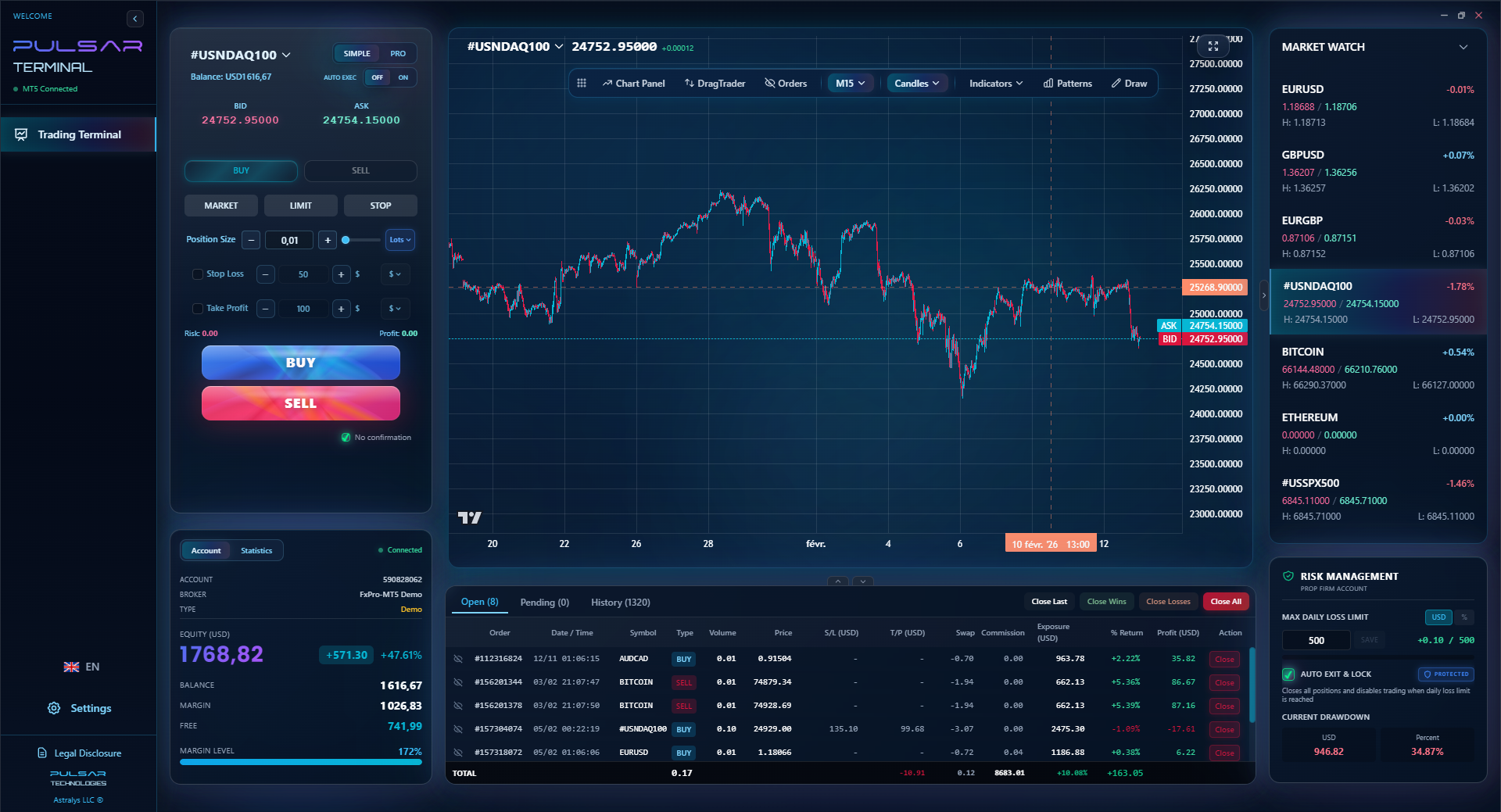
4. Advanced Trading Tools: This is where the game changes. Manual calculation is fine, but automation is better. Imagine a tool that lets you set a fixed monetary risk (e.g., ₦2,000) and then automatically calculates and sets the correct lot size for every trade based on your stop-loss distance. Or one that can trail your stop loss to breakeven once a trade is in profit by a certain amount, protecting you from winners turning into losers. This kind of precise trade management, which handles partial closures and multiple take-profit levels, is what separates consistent traders from hopeful gamblers. Managing lot size and exits manually under pressure is hard; having a system do it by your rules is a massive edge.
5. Indicator-Based Help: Some custom indicators can display the current ATR (Average True Range) on your chart, which helps you gauge a sensible stop-loss distance for your chosen pair, directly influencing your lot size calculation. Combining the RSI indicator or MACD indicator with proper position sizing is a solid strategy foundation.
Manually calculating lot size for every trade is tedious and error-prone; Pulsar Terminal automates this and your entire trade management process directly on your MT5 platform.
Pulsar Terminal
The all-in-one MT5 companion: drag-and-drop orders, multi-TP/SL, trailing stop, grid trading, Volume Profile, and prop firm protection. Used by 1,000+ traders daily.
FAQ
Q1What is the best lot size for a beginner in Nigeria?
Start with micro lots (0.01). No exceptions. With a typical starter account of ₦50,000-₦100,000, a micro lot keeps your risk per trade low (often under ₦1,000) while you learn the ropes. It's about education, not big profits, in the beginning.
Q2How does use affect my lot size choice?
use allows you to control a larger position with less capital. It doesn't change the value of a pip. The danger is that high use can make a small lot size feel insignificant, tempting you to trade larger lots than your account can safely handle. Always calculate your lot size based on your risk percentage first, then check if your use allows it.
Q3Should I use a standard, mini, or micro lot?
It depends entirely on your account size. As a rule of thumb: Under $1,000 (₦~1.5M), use micro lots. Between $1,000 and $10,000, mini lots are appropriate. Consider standard lots only with accounts significantly above $10,000, and even then, only when the trade risk justifies it.
Q4How do I calculate lot size if my account is in Naira?
- Decide your risk in Naira (e.g., 1% of balance). 2) Determine your stop-loss distance in pips for the trade. 3) Calculate the pip value in Naira for a single micro lot of that pair (requires knowing the USD/NGN rate). 4) Use the formula: Lot Size (in micro lots) = (Risk in Naira) / (Stop Loss in Pips * Pip Value in Naira per Micro Lot).
Q5Is trading a 1.00 lot size a good idea?
For the vast majority of Nigerian retail traders, no. A 1.00 (standard) lot controls 100,000 currency units. On EUR/USD, one pip move equals $10 (about ₦15,000 at NGN1500/$). A small 20-pip move would be ₦300,000. Unless your account is in the tens of millions of Naira, this size is far too risky.
Q6Can I change my lot size after entering a trade?
You cannot directly modify an open position's lot size. However, you can partially close the trade (sell off some of the units) to effectively reduce your position size, or you can add to the trade (if it's a multi-position strategy) to increase it. It's usually better to decide your size before entering.
Q7Do all brokers offer micro lots?
Most reputable international brokers catering to retail traders do. Brokers like XM, Exness, and IC Markets all allow trading from 0.01 lots. Always check the "minimum trade size" in the broker's specifications before funding an account.
Prof. Winston's Lesson
Key Takeaways:
- ✓Start with 0.01 lots, no matter your account size.
- ✓Never risk more than 1% of your capital on a trade.
- ✓Calculate pip value in Naira, not just USD.
- ✓A larger lot size amplifies both costs and emotions.
How useful was this article?
Click a star to rate
Weekly Trading Insights
Free weekly analysis & strategies. No spam.
About the Author
Olumide Adeyemi
West African Trading Pioneer
One of Nigeria's most active forex trading educators. 8 years of experience trading from Lagos. Specializes in low-capital strategies and prop firm challenges for African traders.
Comments
Risk Disclaimer
Trading financial instruments carries significant risk and may not be suitable for all investors. Past performance does not guarantee future results. This content is for educational purposes only and should not be considered investment advice. Always conduct your own research before trading.
You Might Also Like

Cara Trading Forex Sukses: 7 Prinsip dari Trader Profesional
Cara trading forex sukses dengan 7 prinsip trader pro: manajemen modal, disiplin, journal trading, backtest. Data nyata, bukan janji profit palsu.
Jam Trading Forex Terbaik untuk Trader Indonesia: Panduan Lengkap dengan Tabel Waktu
Panduan jam trading forex untuk trader Indonesia. Tabel 4 sesi dunia, jam emas 20:00-00:00, sesi mana yang harus dihindari. Data akurat + tips dari trader berpengalaman.
Top 5 Sàn Forex Uy Tín Nhất 2026: Review Jujur dari Trader Indonesia
Top 5 sàn forex uy tín 2026 untuk trader Indonesia. Review jujur: spread, deposit, withdraw, dukungan lokal. Exness, XM, IC Markets & lebih.
Get Pulsar Terminal
All these calculators are built into Pulsar Terminal with real-time data from your MT5 account. One-click position sizing, automatic risk management, and instant calculations.
Get Pulsar Terminal