


How many times have you watched your margin level drop like a stone, your stomach tightening with every pip against you? If you're trading from South Africa, you're not just battling the markets.

David van der Merwe
Emerging Markets Trader ·  South Africa
☕ 11 min read
What you'll learn:
- 1What Exactly Is Margin Level? (It's Not What You Think)
- 2The Two Numbers That Matter: Margin Call & Stop Out
- 3Calculating It All in Rands: A Local Walkthrough
- 4How I Keep My Margin Level Healthy (Practical Strategies)
- 5Mistakes I've Seen (And Made) Right Here in SA
- 6Picking a Broker: What to Look For in the Margin Fine Print
- 7When Things Go Wrong: Damage Control
How many times have you watched your margin level drop like a stone, your stomach tightening with every pip against you? If you're trading from South Africa, you're not just battling the markets. You're navigating FSCA use caps, ZAR account quirks, and the ever-present threat of a margin call that can wipe out your capital. I've been there. I've had accounts suspended. I've made the classic mistakes. Let's talk about what margin level really means for us, how to manage it, and how to keep trading another day.
Most new traders think margin is just the deposit needed to open a trade. That's only half the story. Margin level is the real-time health bar of your entire trading account. It's the percentage that tells you how much breathing room you have left before your broker starts closing your positions.
Here's the formula your platform uses every second: Margin Level = (Equity / Used Margin) x 100%
Let's break that down with Rands, because thinking in dollars just adds another layer of confusion.
- Equity: This is your current account value. It's your balance plus your floating profit or loss. If you deposited R10,000 and are currently sitting on a R500 unrealized loss, your equity is R9,500.
- Used Margin: This is the total collateral currently locked up to keep all your open positions running. It's not a fee; it's just held aside.
So, if your equity is R9,500 and your used margin is R2,000, your margin level is (9,500 / 2,000) x 100 = 475%. That's a healthy cushion.
The scary part? This number updates with every tick. A losing trade shrinks your equity while your used margin stays the same, causing the level to plummet. This is where the real danger lies, especially when you're scalping strategy with multiple positions open.

Warning: Don't confuse margin with use. use (like the FSCA's 1:30 retail cap) determines how much margin you need. Margin level tells you how close you are to a disaster using that use.
I learned this the hard way in 2018. I had a great swing trade idea on USD/ZAR. I used too much use, the Rand strengthened unexpectedly, and my margin level fell from 300% to 100% in under an hour. I was so focused on the chart I missed the account warning. By the time I looked, it was too late. The stop-outs had begun.

💡 Winston's Tip
Margin level is a measure of your risk, not your opportunity. A high level isn't an invitation to trade bigger; it's proof you're trading within your means.
“Margin level is the real-time health bar of your entire trading account.”
Every broker sets specific thresholds. These aren't suggestions; they're automatic triggers. You need to know yours like you know your own phone number.
The Margin Call (Warning Level)
This is your broker's first and only warning. Typically, it's set at 100%. When your margin level hits this point, your equity equals your used margin. You have zero buffer left. Most platforms will flash a warning, but they won't close your trades yet. You can still act - deposit more funds or close losing positions.
In practice, a 100% margin call is a five-alarm fire. If your trade doesn't reverse immediately, you're seconds away from the next stage.
The Stop Out Level (The Guillotine)
This is where positions get automatically liquidated, starting with the biggest loser. In South Africa, for FSCA-regulated brokers, this is often 50% or 20%. Let's use 50% as the common example.
When your margin level hits 50%, your equity is now only half of your used margin. The system starts closing trades to free up margin until your level climbs back above 50%.
Here’s a brutal example from my own logbook:
- Account Balance: R20,000
- Open Trades (Used Margin): R5,000
- Unrealized Loss: R12,500 (A bad GBP/USD move during London open)
- Equity: R20,000 - R12,500 = R7,500
- Margin Level: (7,500 / 5,000) x 100 = 150%
The loss continues. Equity drops to R2,600.
- New Margin Level: (2,600 / 5,000) x 100 = 52%
The platform is now on the brink. One more push and it hits 50%. The algorithm then sells my losing GBP/USD position at the worst possible price, locking in the loss. My equity is now decimated. This is why understanding your position size calculator is non-negotiable.

Example: If your broker's stop out is 20%, you have a smaller buffer. With R10,000 equity and R5,000 used margin, a loss of R9,000 would trigger it: Equity becomes R1,000. Margin Level = (1,000 / 5,000) x 100 = 20%. Boom. Trades closed.
“The 1:30 use cap is annoying, but it's a guardrail. I've blown more accounts with 1:500 use than I care to admit.”
Let's make this practical for a ZAR-based account. The FSCA's 1:30 use cap for retail traders on majors changes the math significantly compared to the old 1:500 days.
Scenario: You want to buy 1 standard lot (100,000 units) of EUR/USD. Your account is denominated in ZAR (R).
- Convert the Position Size to ZAR: First, find the ZAR value of the trade. If EUR/USD is at 20.50 (meaning 1 Euro = 20.50 Rand), then 100,000 Euros is worth R2,050,000.
- Apply the use: At 1:30 use, you only need to put up 1/30th of the total value as margin.
- Required Margin: R2,050,000 / 30 = R68,333.33.
That R68k is your used margin for that single trade. It's a big number. It shows why the FSCA caps exist - to prevent you from controlling R2 million with only R10,000 in your account.
Now, what about a ZAR pair, like USD/ZAR? use is often lower, say 1:20. If you buy 1 lot of USD/ZAR (100,000 USD) at 18.00, the ZAR value is R1,800,000. Your required margin is R1,800,000 / 20 = R90,000.
See the difference? Trading the local pairs you know best often requires more margin due to higher volatility and lower use. This is a key local nuance. A broker like Pepperstone review or IC Markets review will clearly show these margin requirements per instrument in their specs.
My advice? Before you even think about a trade, use your platform's order ticket. It will show you the estimated margin requirement. If that number is more than 2-3% of your total account equity, you're likely over-leveraging. This simple check saved me countless times after my early disasters.
“The 1:30 use cap is annoying, but it's a guardrail. I've blown more accounts with 1:500 use than I care to admit.”
Managing margin level isn't about complex formulas. It's about discipline. Here’s what works for me.
1. The 5% Rule (My Golden Rule) I never let my total used margin exceed 5% of my account equity. Ever. If my account is R100,000, my total margin across all trades should stay under R5,000. This automatically keeps my margin level above 2000% in normal conditions, giving me a massive buffer against volatility. This rule forces you to use sensible position size calculator outputs.
2. Monitor Aggregate Exposure, Not Single Trades You might have three trades open, each with a small 1% risk. But if they're all correlated (e.g., EUR/USD, GBP/USD, AUD/USD), they'll likely all move against you together in a dollar-strength event. Your used margin is fixed, but your equity can drop across all three trades simultaneously, crushing your margin level. Diversify your currency exposure.
3. Use a Margin Level Alert Set a platform alert for when your margin level drops to 150%. This is your "time to check the charts" signal, not your panic signal. It gives you time to assess and make a calm decision.
4. Understand the Impact of Other Instruments Trading gold (XAU/USD guide) or indices? Their margin requirements can be much higher than forex. Adding a single gold lot to your forex positions can double your used margin overnight. Always check the margin for each instrument type in your broker's contract specifications.

Pro Tip: When trying a new swing trading strategy, do it on a demo account first. Watch how holding trades overnight and through weekends affects your margin level, especially with swap charges adding up. It's a different ball game compared to day trading.
💡 Winston's Tip
If you find yourself constantly watching your margin level instead of your charts, your position size is wrong. Reduce it by half.
“Aim to keep your margin level above 500%. Never let it approach 100%.”
We have unique pitfalls. Here are the big ones.
Mistake 1: Ignoring ZAR Volatility on Your Deposit. You fund a USD account with Rands. If the Rand weakens (USD/ZAR goes up), your account balance in USD goes down before you even place a trade. This immediately lowers your equity and your margin level. Solution? Where possible, use a ZAR-denominated account with an FSCA broker to eliminate this hidden risk.
Mistake 2: Chasing High use Offshore. I get it. The 1:30 FSCA cap feels limiting. The temptation to sign up with an offshore broker offering 1:500 is huge. I did it. The problem? You lose FSCA protection. Your funds aren't necessarily segregated in SA. And most importantly, that high use makes it astronomically easier to blow your account. The 1:30 cap is annoying, but it's a guardrail. I've blown more accounts with 1:500 use than I care to admit.
Mistake 3: Not Factoring in Wider Spreads on ZAR Pairs. You place a trade on EUR/ZAR. The spread might be 14 pips. That's an immediate R140 loss on a mini lot. That loss comes straight off your equity the second you open the trade, reducing your margin level immediately. With majors like EUR/USD guide, the spread might be 0.6 pips. The difference in starting margin level is significant.
Mistake 4: Forgetting About Weekend Gaps. You hold a risky position over the weekend with a 200% margin level. On Sunday night, the market gaps against you by 50 pips. Your equity plummets, and your margin level could be below 100% before you can even log in. The broker's stop-out executes at the gapped price. Always reduce use or close high-risk positions before major news or weekends.
“Aim to keep your margin level above 500%. Never let it approach 100%.”
Not all FSCA-regulated brokers are equal when it comes to margin. Here’s your checklist.
- Clear, Published Stop-Out Level: It should be on their website, typically under "Trading Conditions" or "Account Specifications." Is it 50%? 20%? 10%? A higher stop-out (like 50%) is more conservative and gives you slightly more warning. A lower one (like 20%) lets you ride out more volatility but risks a bigger loss if hit.
- Margin Requirements Per Instrument: Can you easily find a table showing the margin % or use for forex majors, minors, ZAR pairs, gold, and indices? Brokers like XM review and Exness review have these details upfront.
- Hedging Margin Policy: If you open a buy and sell on the same pair (hedging), how does it affect your used margin? Some brokers net them off (reducing margin), others charge full margin for both. This drastically changes your margin level calculation.
- Margin Calls: Do they provide a clear warning (email, SMS, pop-up) at 100%? Or do they just stop out without notice? The former is more professional.
- ZAR Account Availability: As discussed, this removes currency risk on your deposit. It's a must-have feature for peace of mind.
A quick comparison based on typical offerings:
| Broker Feature | Why It Matters for Margin Level |
|---|---|
| ZAR Denominated Account | Eliminates deposit/withdrawal FX risk affecting your equity. |
| Low Minimum Deposit | Lets you start small and practice margin management without huge risk. |
| Tight Spreads on Majors | Smaller immediate loss on trade open, preserving equity & margin level. |
| Clear Stop-Out Policy | No surprises. You know exactly when the auto-liquidation will occur. |
Remember, the broker's platform is your cockpit. You need to know every gauge. If their margin terms are hidden, that's a red flag.
“Managing margin level isn't about complex formulas. It's about discipline.”
Your margin level is at 110% and falling. What now? Panic is the worst strategy. Here's a structured approach.
Step 1: Diagnose the Problem. Are one or two trades causing all the pain? Or is your entire portfolio moving against you? Look at the floating P/L for each position. Identify the biggest loser(s).
Step 2: Can You Hedge? If the problem is one catastrophic trade, consider opening an immediate opposite position on the same instrument and lot size. This locks in the loss but neutralizes further market movement. It stops the bleeding on your margin level instantly. You can then close both trades calmly when the market settles. This is a surgical move, not a cure-all.
Step 3: The Brutal Cut. If hedging isn't possible or the problem is widespread, you must close positions. Start with the biggest loser. Yes, it hurts. But letting the broker's stop-out do it will often get you a worse price. Manually closing reclaims that position's margin immediately, boosting your margin level.
Step 4: The Last Resort: Deposit. If you have immediate funds and believe in your trades, a deposit increases your equity. This is the fastest way to boost your margin level. But it's dangerous. You're throwing good money after bad if your analysis is wrong. I've only done this once successfully, and it was a white-knuckle ride.
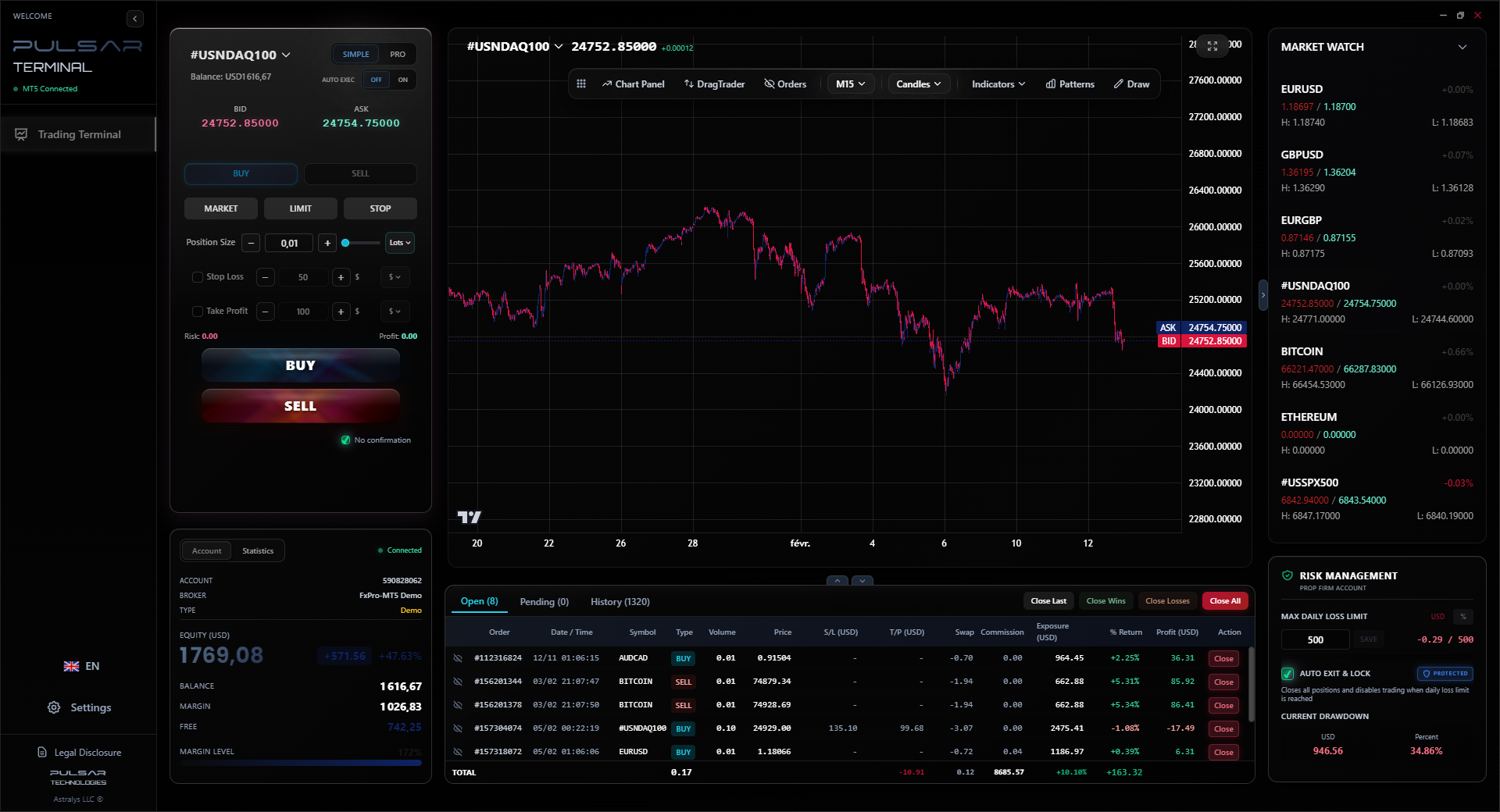
The best damage control is prevention. Using tools that help you visualize risk can be a game-saver. For instance, managing multiple trades with individual stop-losses is critical, and having a tool that can set a trailing stop or move stops to breakeven automatically can protect your equity without you needing to watch the screen every second.
When you're in a margin crisis, manually closing multiple trades under pressure is a recipe for mistakes. A tool that lets you manage all positions and set automated safety nets from one screen is invaluable for preserving your equity and sanity.
Pulsar Terminal
The all-in-one MT5 companion: drag-and-drop orders, multi-TP/SL, trailing stop, grid trading, Volume Profile, and prop firm protection. Used by 1,000+ traders daily.
FAQ
Q1What is a good margin level to maintain in forex trading?
Aim to keep it above 500% during normal trading. This gives you a huge buffer. I use a personal red line at 200%. If it drops below that, I'm not opening any new trades and I'm reviewing all my open ones. Never let it approach 100%.
Q2How does the FSCA's 1:30 use affect my margin level?
It makes it harder to blow up quickly, but also means you need more capital to control the same position size. Your used margin will be higher for a given trade compared to 1:500 use. This actually makes your margin level less volatile in the face of losses, as the margin (the denominator in the formula) is a bigger number. It's a forced safety feature.
Q3Can I change my broker's margin call or stop out level?
No. These are set by the broker based on their risk models and regulatory guidelines. They are non-negotiable terms of service. You must trade within them.
Q4Why did my margin level drop when I didn't have any open trades?
This usually happens on a ZAR account when you have an open trade in a different currency, like USD. If the USD/ZAR rate moves, the ZAR value of your held margin changes, which affects the calculation. It can also happen due to fees, swap charges, or a miscalculation on a pending order that's still using a small amount of margin.
Q5Is a 50% or 20% stop out level better?
It depends on your style. A 50% stop out is more conservative. It cuts your losses sooner, preserving more remaining equity. A 20% stop out gives your trades more room to recover from a drawdown, but if they don't, you lose a much bigger chunk of your account. I prefer brokers with a 50% stop out - it forces stricter discipline on me.
Q6Do all instruments affect my margin level the same way?
Absolutely not. A standard lot of gold (XAU/USD) can require 5-10 times more margin than a standard lot of EUR/USD. Adding just one CFD for the JSE Top 40 can use significant margin. Always check the specific margin requirement for each instrument before opening a trade.
Prof. Winston's Lesson
Key Takeaways:
- ✓Margin Level = (Equity / Used Margin) x 100%. Know this formula.
- ✓Never let used margin exceed 5% of your account equity.
- ✓FSCA's 1:30 use is a risk-reducer, not a limit to circumvent.
- ✓Use a ZAR account to avoid deposit currency risk.
- ✓Set a platform alert for margin level at 150%, not 100%.
How useful was this article?
Click a star to rate
Weekly Trading Insights
Free weekly analysis & strategies. No spam.
About the Author
David van der Merwe
Emerging Markets Trader
Johannesburg-based trader with 11 years in emerging market currencies. Specializes in ZAR pairs, FSCA-regulated trading, and South African market analysis.
Comments
Risk Disclaimer
Trading financial instruments carries significant risk and may not be suitable for all investors. Past performance does not guarantee future results. This content is for educational purposes only and should not be considered investment advice. Always conduct your own research before trading.
You Might Also Like

Cara Trading Forex Sukses: 7 Prinsip dari Trader Profesional
Cara trading forex sukses dengan 7 prinsip trader pro: manajemen modal, disiplin, journal trading, backtest. Data nyata, bukan janji profit palsu.
Jam Trading Forex Terbaik untuk Trader Indonesia: Panduan Lengkap dengan Tabel Waktu
Panduan jam trading forex untuk trader Indonesia. Tabel 4 sesi dunia, jam emas 20:00-00:00, sesi mana yang harus dihindari. Data akurat + tips dari trader berpengalaman.
Top 5 Sàn Forex Uy Tín Nhất 2026: Review Jujur dari Trader Indonesia
Top 5 sàn forex uy tín 2026 untuk trader Indonesia. Review jujur: spread, deposit, withdraw, dukungan lokal. Exness, XM, IC Markets & lebih.
Get Pulsar Terminal
All these calculators are built into Pulsar Terminal with real-time data from your MT5 account. One-click position sizing, automatic risk management, and instant calculations.
Get Pulsar Terminal