


So you want to trade forex, and you keep hearing about 'margin' and 'use.' Maybe your buddy bragged about turning R5,000 into a R100,000 position.

David van der Merwe
Emerging Markets Trader ·  South Africa
☕ 11 min read
What you'll learn:
- 1What Margin Really Is (It's Not a Loan)
- 2The Three Key Margin Concepts You Must Track
- 3FSCA Rules & use Caps: The South African Reality
- 4A Real Margin Call Story with ZAR
- 5How to Manage Margin Risk Like a Pro
- 6Choosing a Broker: Margin Policies & Safety
- 7The Most Common Margin Mistakes (I've Made Them All)
So you want to trade forex, and you keep hearing about 'margin' and 'use.' Maybe your buddy bragged about turning R5,000 into a R100,000 position. Sounds great, right? Before you get too excited, let me tell you a quick story. I once put on a massive USD/ZAR trade during a volatile political announcement, thinking my margin was fine. I wasn't watching my margin level closely enough. The rand spiked, my equity dropped, and I got a margin call so fast it made my head spin. I lost 40% of that account in minutes. Understanding the margin meaning in forex isn't just theory, it's the difference between staying in the game and getting wiped out. Let's break it down properly, for our market.
Most beginners get this wrong. They think margin is a loan from the broker. It's not. Think of it like a security deposit or good faith money. When you rent a flat, you pay a deposit. That money is still yours, but the landlord holds it as collateral in case you trash the place. Margin works the same way.
When you open a leveraged trade, your broker sets aside a chunk of your existing capital. That chunk is your required margin. It's locked up, out of your available balance, to cover potential losses on that position. The broker does this because you're controlling a position size much larger than your actual cash. If the trade moves against you, they use that locked-up margin first before asking for more money. That's the core of the margin meaning in forex.

Warning: Don't confuse margin with the total value of your trade. If you use 1:30 use on a R150,000 trade, your required margin is only R5,000. The other R145,000 is 'borrowed' use, but your broker's risk is covered by your R5,000 deposit. If losses eat into that R5,000, alarms start going off.
The amount of margin you need is directly tied to your use. In South Africa, thanks to FSCA rules, retail traders are capped at 30:1 on major pairs. So for every R1 in margin, you control R30 in the market. That's powerful, but it cuts both ways.

💡 Winston's Tip
Margin is a privilege, not a right. Use it like a sharp knife - with respect and clear intention. The market doesn't care about your use dreams.
Your trading platform will show these three terms. Ignoring them is like driving with your eyes closed.
Required Margin
This is the exact amount of your money currently being used as collateral for your open positions. It's not a fee, it's just locked up. Open a second trade, and your required margin increases. Close a trade, and it's released back into your free balance.
Free Margin
This is your lifeline. It's the cash in your account that's not being used as margin. You use free margin to open new trades, and more importantly, it's the buffer that absorbs your floating losses. If your free margin hits zero, you can't open any new positions. If it goes negative? That's a margin call, and your broker will start closing trades to fix it.
Margin Level
This is the single most important number on your screen after your P&L. It's calculated as (Equity / Used Margin) x 100. It's a percentage that tells you the health of your account.
- Margin Level > 100%: You're okay. You have equity exceeding your used margin.
- Margin Level = 100%: Your equity equals your used margin. Your free margin is zero. Danger zone.
- Margin Level < 100%: Your equity is less than your used margin. This is a margin call. Most brokers will automatically close your largest losing position to get the level back above 100%.
I learned this the hard way trading GBP/ZAR. I had a R10,000 account with R3,000 in used margin. My equity dropped to R2,900 during a news event. My margin level hit (2900/3000)*100 = 96.7%. Bam. Platform closed my trade before I could even react. Always, always know your margin level. Using a position size calculator before every trade is non-negotiable for managing this.
“Understanding margin isn't just theory, it's the difference between staying in the game and getting wiped out.”
We can't talk about margin without talking about our local regulator, the Financial Sector Conduct Authority (FSCA). They stepped in a few years back to protect retail traders from themselves, and honestly, it was needed. I've seen too many people get shredded by 1:500 use.
For you and me as retail traders, the FSCA has strict caps:
| Instrument | Maximum use | What It Means for Margin |
|---|---|---|
| Major Forex Pairs (EUR/USD, GBP/USD) | 30:1 | You need ~3.33% of the trade value as margin. |
| Minor Pairs, Gold, Major Indices | 20:1 | You need 5% margin. |
| Other Commodities (like Oil) | 10:1 | You need 10% margin. |
| Individual Equities (CFDs) | 5:1 | You need a hefty 20% margin. |
This means on a standard lot of EUR/USD (€100,000), the maximum margin you can be asked for is about €3,333. At 1:30 use, that's your reality. Some offshore brokers like Exness or IC Markets might still offer South Africans higher use (like 1:500) if you sign up under their global entity, but you lose FSCA protection. That's a big risk. Your funds aren't segregated under South African law, and you have no local recourse if something goes wrong.

Pro Tip: Start with less than the maximum use. Just because you can use 1:30 doesn't mean you should. I rarely go above 1:10 on my core positions. It gives my trades room to breathe and dramatically reduces my chance of a margin call. Save the high use for tiny, calculated punts if you must.
Let's make this painfully concrete with our favourite volatile pair: USD/ZAR.
The Setup:
- Account Balance: R20,000
- Broker: FSCA-regulated, 1:30 use.
- I decide to buy 1 standard lot of USD/ZAR at R18.50. (1 lot = $100,000).
- In Rands, that's a trade value of R1,850,000.
The Margin Math: At 1:30 use, my Required Margin = Trade Value / use. R1,850,000 / 30 = R61,667 required margin.
Wait. That's a problem. My account only has R20,000. I can't even open this trade. The platform won't let me. This is the first safety check.
Revised Trade: I scale down to a mini lot (0.1 lots = $10,000). Trade Value: R185,000. Required Margin: R185,000 / 30 = R6,167. That works. My Free Margin is now R20,000 - R6,167 = R13,833.
The Disaster: USD/ZAR drops to R18.00. I'm long, so I'm losing. Loss = (R18.00 - R18.50) * 100,000 units? No. For a mini lot, it's 10,000 units. Loss = -R0.50 * 10,000 = -R5,000.
My Equity is now Balance + Floating P/L = R20,000 - R5,000 = R15,000. My Margin Level is (Equity / Used Margin) * 100 = (R15,000 / R6,167) * 100 = 243%. Still okay.
But what if it drops to R17.50? Loss = -R1.00 * 10,000 = -R10,000. Equity = R10,000. Margin Level = (R10,000 / R6,167) * 100 = 162%.
R17.00? Loss = -R1.50 * 10,000 = -R15,000. Equity = R5,000. Margin Level = (R5,000 / R6,167) * 100 = 81%.
MARGIN CALL. At 81%, well below 100%, the broker's system will automatically start closing my position to prevent my equity from falling below my used margin. I'm out. Game over. A 1500 pip move in USD/ZAR is not uncommon during a crisis. This is why position size is everything. I should have traded 0.01 lots with that account size.
💡 Winston's Tip
Your first calculation before any trade shouldn't be potential profit. It should be 'If I'm wrong, how much margin will this loss consume, and what will my margin level be?'
“Your margin level is the single most important number on your screen after your P&L.”
Managing margin isn't about avoiding it, it's about controlling it. Here’s what works for me.
1. The 1% Rule is Your Best Friend. Never risk more than 1% of your account equity on a single trade. This isn't about margin, it's about your stop-loss. But if you follow this, your margin usage will automatically stay in a sane zone. On a R20,000 account, 1% is R200. If your stop-loss on that USD/ZAR trade is 50 pips (R500 per mini lot), you can only afford to trade 0.4 mini lots. That instantly limits your margin.
2. Monitor Margin Level Religiously. I have my margin level displayed right next to my balance. If it ever dips below 200%, I review all my open trades. Below 150%, I start looking to reduce risk by closing my weakest position.
3. Use a Stop-Loss. Always. This is the number one reason for margin calls. No stop-loss. A trade goes against you, you 'hope' it comes back, and it just keeps going. A stop-loss defines your maximum loss and protects your margin. Setting a stop-loss and a take-profit for partial closes is a foundational skill, and tools that help you visualize and manage these levels are useful.
4. Understand Correlation. If you're long USD/ZAR, long EUR/ZAR, and long GBP/ZAR, you're not diversified. You're just triple-long on the rand weakening. If the rand strengthens, all three trades will lose money simultaneously, draining your equity and spiking your margin level incredibly fast. This has bitten me more than once.
5. Keep a Cash Buffer. Don't use 100% of your capital as margin. Aim to use 50% or less in normal markets. That free margin is your breathing room. It lets you withstand normal volatility without sweating. For a deeper look at a strategy that uses careful trade management, check out our guide on swing trading.
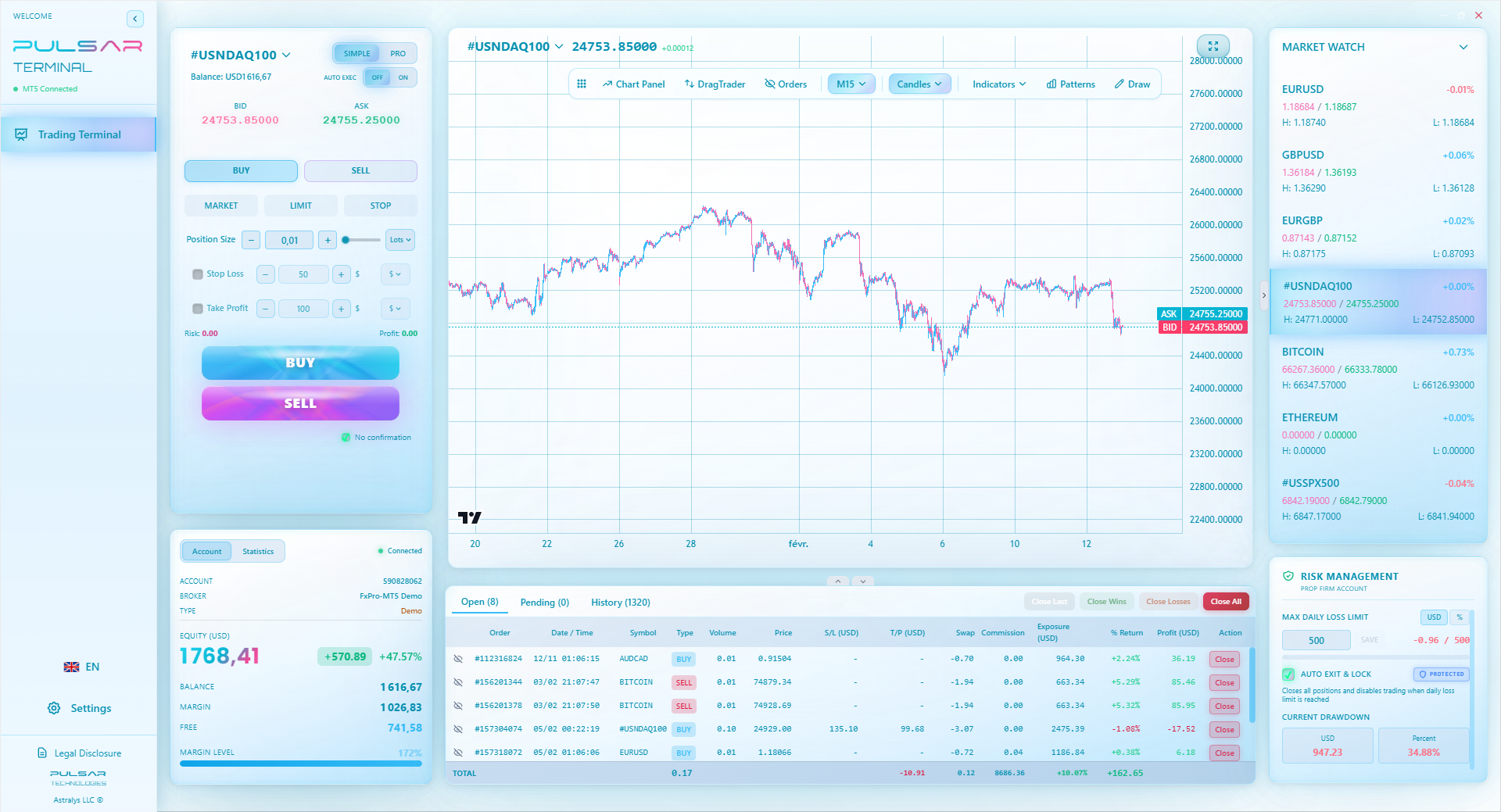
Managing multiple trades and their associated stop-losses is critical for margin control, and Pulsar Terminal lets you set and trail stops for all positions directly on your MT5 charts.
Pulsar Terminal
The all-in-one MT5 companion: drag-and-drop orders, multi-TP/SL, trailing stop, grid trading, Volume Profile, and prop firm protection. Used by 1,000+ traders daily.
Not all brokers are the same, especially here. When looking at a broker, their margin policy is a key factor.
FSCA-Regulated is Non-Negotiable for Beginners. This means client money segregation. Your Rands are held in a separate bank account from the broker's operating funds. If the broker goes under (it happens), your money should be safe. Brokers like IG, Plus500, and local favourite Khwezi Trade are FSCA-licensed. Khwezi, for example, offers MT5 and keeps funds segregated with major SA banks.
Watch the Margin Call & Stop-Out Levels. This is in the fine print. Most brokers have a margin call level (e.g., 100%) and a stop-out level (e.g., 50%). At 100%, you get a warning. At 50%, they forcibly close everything. Some are more aggressive than others. Know your broker's specific numbers.
Check Deposits in ZAR. Does the broker offer a local ZAR account for deposits? This saves you a fortune in bank conversion fees. Some international brokers like XM or FP Markets do. Also, check if they offer popular local methods like EFT or PayFast.
Execution Speed Matters. In a fast market, a slow execution can cause 'slippage.' You might get stopped out at a worse price than you set, losing more money and hitting your margin level faster. Look for brokers with a reputation for fast, reliable execution, especially if you're considering techniques like scalping.

Example: Broker A has a stop-out at 20%. Broker B has a stop-out at 50%. With Broker B, your positions will be closed much sooner to preserve more of your remaining equity. It's stricter but safer for your account's survival.
“Just because you can use 1:30 use doesn't mean you should. I rarely go above 1:10 on my core positions.”
Let me save you some money and heartache.
1. Over-leveraging a Small Account. This is the classic. You have R5,000 and want to make it big. You use maximum use on a few trades. A tiny move against you wipes out 30% of your account. The account is now psychologically crippled. Build slowly.
2. Adding to a Losing Position (Averaging Down). Your trade is losing, and your margin level is falling. You think, "It's a bargain now!" and add more, locking up even MORE margin on a losing idea. This accelerates the path to a margin call. I did this with gold (XAU/USD) in 2020. Doubled down as it fell, got margin called right before it reversed. Brutal.
3. Ignoring Overnight/Margin Changes. Some brokers increase margin requirements over weekends or during high-volatility events. If you're maxed out on a Friday, you could get a surprise margin call on Sunday night if the market gaps. Always have extra buffer before weekends.
4. Confusing Margin with Profit. Just because you have R10,000 in 'usable margin' doesn't mean you should use it all. That's not profit, it's risk capital. Your goal is to preserve it, not spend it on trades.
5. Not Understanding the Spread Impact. When you open a trade, you start at a slight loss due to the spread. On a highly leveraged trade, that initial loss can be a significant chunk of your margin. On exotic pairs with wide spreads, this can be a real margin killer from the second you click 'buy.'
💡 Winston's Tip
The most dangerous phrase in a leveraged trader's vocabulary is 'It'll come back.' It often doesn't. Your margin will be gone before you find out.
FAQ
Q1What is a margin call in simple terms?
It's your broker's emergency alarm. It means the money in your account (equity) is getting too close to the money you've put up as collateral (margin) for your trades. If you don't add more funds or close some losing positions, the broker will automatically close them for you to prevent your account from going negative.
Q2Is trading on margin illegal in South Africa?
No, it's completely legal and standard practice. However, it's strictly regulated by the FSCA. For retail traders, there are caps on how much use you can use (max 30:1 on major forex pairs) to prevent excessive risk-taking.
Q3Can I lose more money than I deposit with margin?
With a reputable FSCA-regulated broker, you should have 'negative balance protection.' This means your losses are limited to the funds in your account; you can't owe the broker money. However, if you trade with an unregulated offshore broker, you could potentially lose more than your deposit.
Q4What's a good margin level to maintain?
Aim to keep it above 200% in normal conditions. This gives you a huge buffer against market swings. If it falls below 150%, treat it as a serious warning sign to reduce your risk. Never let it approach 100%.
Q5How is margin different from use?
They're two sides of the same coin. use is the ratio (like 1:30) that determines how much you can control. Margin is the actual amount of cash (like R6,167) that gets locked up as collateral when you use that use to open a trade.
Q6Do all brokers have the same margin rules?
No. While the FSCA sets maximum use, individual brokers set their own margin call and stop-out levels (e.g., 100% vs. 50%). They can also increase margin requirements for specific instruments or during volatile periods. Always read your broker's specific terms.
Prof. Winston's Lesson
Key Takeaways:
- ✓Margin is collateral, not a loan or cost.
- ✓FSCA caps retail use at 30:1 for major pairs.
- ✓Always calculate margin impact before opening a trade.
- ✓Keep your margin level above 200% for safety.
- ✓Use a stop-loss on every single trade.
How useful was this article?
Click a star to rate
Weekly Trading Insights
Free weekly analysis & strategies. No spam.
About the Author
David van der Merwe
Emerging Markets Trader
Johannesburg-based trader with 11 years in emerging market currencies. Specializes in ZAR pairs, FSCA-regulated trading, and South African market analysis.
Comments
Risk Disclaimer
Trading financial instruments carries significant risk and may not be suitable for all investors. Past performance does not guarantee future results. This content is for educational purposes only and should not be considered investment advice. Always conduct your own research before trading.
You Might Also Like

Cara Trading Forex Sukses: 7 Prinsip dari Trader Profesional
Cara trading forex sukses dengan 7 prinsip trader pro: manajemen modal, disiplin, journal trading, backtest. Data nyata, bukan janji profit palsu.
Jam Trading Forex Terbaik untuk Trader Indonesia: Panduan Lengkap dengan Tabel Waktu
Panduan jam trading forex untuk trader Indonesia. Tabel 4 sesi dunia, jam emas 20:00-00:00, sesi mana yang harus dihindari. Data akurat + tips dari trader berpengalaman.
Top 5 Sàn Forex Uy Tín Nhất 2026: Review Jujur dari Trader Indonesia
Top 5 sàn forex uy tín 2026 untuk trader Indonesia. Review jujur: spread, deposit, withdraw, dukungan lokal. Exness, XM, IC Markets & lebih.
Get Pulsar Terminal
All these calculators are built into Pulsar Terminal with real-time data from your MT5 account. One-click position sizing, automatic risk management, and instant calculations.
Get Pulsar Terminal