


Most people telling you how to master forex trading in Nigeria are either selling you a course or have never traded with real money.

Olumide Adeyemi
West African Trading Pioneer ·  Nigeria
☕ 11 min read
What you'll learn:
- 1The Nigerian Forex Reality Check: It's Legal, But It's a Minefield
- 2Picking Your Broker: Look Beyond the 'Welcome to Nigeria' Banner
- 3Building Your Foundation: The Boring Stuff That Makes You Money
- 4Crafting a Profitable Strategy: Steal This, Don't Invent
- 5The Trader's Mindset: Your Biggest Enemy is in the Mirror
- 6Advanced Tools & Tactics for When You're Ready
- 7Your 90-Day Action Plan to Mastery
Most people telling you how to master forex trading in Nigeria are either selling you a course or have never traded with real money. The truth is, 90% of Nigerian traders blow their first account, not because the market is rigged, but because they're unprepared for the psychological warfare. I lost over ₦450,000 in my first year making every classic mistake. This guide isn't about getting rich quick. It's about building the discipline, knowledge, and cold-blooded strategy you need to survive and actually profit in the Nigerian forex scene.
Let's clear this up first: yes, retail forex trading is legal for you as an individual in Nigeria. The Central Bank of Nigeria (CBN) isn't kicking down doors to arrest retail traders. Their main fight is against people sourcing forex from official windows for speculation, which is a different game entirely. Your legal risk is minimal if you're trading with an international broker.
Your real risk is financial and regulatory. Since local oversight of online brokers is light, you're largely on your own. The SEC requires authorization, but many of the brokers you'll see advertised aren't locally registered. This means if Exness or IC Markets messes up, you can't run to the CBN. You're relying on that broker's home regulator, like CySEC or the FSCA. It's a crucial distinction.
And yes, you owe tax. The Federal Inland Revenue Service (FIRS) wants 10% of your capital gains. I know, I know - "who's gonna know?" Maybe no one. Until you try to buy a property or a car with a sudden influx of cash and someone starts asking questions. Keep a simple trading journal with profits and losses. It's not just for taxes; it's the first step to actually mastering your performance.

Warning: Don't confuse legal retail trading with currency speculation using bank-sourced forex. The latter can get you into serious trouble with the CBN. Your trading capital should come from your savings, not from trying to game the official exchange rate.
Broker marketing in Nigeria is aggressive, and they'll promise you the moon: 1:2000 use, zero spreads, deposits from ₦2,000. It's mostly nonsense designed to hook the inexperienced. Your broker is your business partner. Pick a bad one, and they'll make money even when you lose.
Regulation is Your First Filter
Ignore the fancy websites. Scroll to the footer. Who regulates them? Tier-1 authorities like the UK's FCA or Australia's ASIC are gold standards. Many popular brokers here are under CySEC (Cyprus) or the FSCA (South Africa), which are also solid. If you can't find clear regulation, run. A broker like Pepperstone or IC Markets, regulated by ASIC, has more to lose by screwing you over than some offshore shell company.
Decoding the Real Costs
They'll show you "spreads from 0.0 pips!" in huge font. Read the tiny print. That's usually on a "Raw" or "ECN" account that charges a commission. Do the math. A 0.1 pip spread with a $6 commission per lot round turn might be cheaper than a 1.6 pip spread with no commission on a standard account, but only if you're trading size.
For a beginner, a standard account with a slightly higher but fixed spread is often simpler. You know your cost upfront. Here’s a quick comparison based on typical offerings:
| Broker Type | Typical EUR/USD Spread | Commission | Best For... |
|---|---|---|---|
| Standard Account | 1.0 - 1.6 pips | None | Beginners, small accounts, clarity |
| Raw/ECN Account | 0.0 - 0.2 pips | $3 - $6 per lot | Scalpers, large volume traders |
The Platform is Your Weapon
MetaTrader 4 (MT4) is the king in Nigeria for a reason. It's stable, has every indicator you'll ever need, and there's a mountain of free educational content for it. MT5 is better for stocks and futures, but for pure forex, MT4 is often enough. Some brokers like XM offer great MT4 integration. Before you deposit, download the platform and play with the demo account. If it feels clunky or keeps disconnecting, that's a red flag.

Pro Tip: Always test withdrawal before making a large deposit. Put in ₦10,000, trade a little, then try to pull out ₦8,000. If it's a hassle or takes weeks, you've just saved your future capital. A smooth withdrawal process is the hallmark of a decent broker.
“Mastery isn't a destination. It's the daily grind of preparation, execution, and review.”
This is where dreams die. Everyone wants to talk about the secret RSI divergence that predicts tops. Nobody wants to talk about position sizing. But this is the core of how to master forex trading.
Risk Management is Not a Suggestion
I'll give you a number that changed my career: 1%. Never risk more than 1% of your trading capital on a single trade. On a ₦100,000 account, that's ₦1,000. If your stop loss is 50 pips away on EUR/USD, you can only afford a position size of roughly 0.02 lots. Use a position size calculator for this. Religiously. I didn't, and I wiped out 40% of my account in two bad trades during a volatile NFP announcement.
Understanding use: Your Double-Edged Sword
Brokers here offer insane use, up to 1:2000. Using that is like doing brain surgery with a chainsaw. With ₦20,000 and 1:500 use, you can control $10,000. A 1% move against you wipes out your entire capital. That's not trading, it's gambling. Start with 1:10 or 1:20 max. It forces you to be selective and use proper capital. use amplifies gains, but it annihilates accounts faster than anything else.
The Only Three Analyses You Need
- Price Action: Learn to read candlestick patterns and support/resistance. A pin bar at a key level is more valuable than 10 lagging indicators.
- Trend: Use a simple moving average like the 50 or 200 EMA. Are prices above it? General trend is up. Don't complicate it.
- Momentum: Pick ONE oscillator. The RSI indicator or MACD indicator. Learn to spot divergence. That's it.
Your strategy should fit your life. If you have a 9-5, don't try scalping strategy. You'll get fired. Look at swing trading where you check charts once a day. I made my first consistent profits swing trading GBP/JPY, holding trades for 2-5 days based on weekly chart levels.

💡 Winston's Tip
The market's job is to take your money. Your job is to not give it to them. Every rule you create - 1% risk, a specific entry trigger - is a wall around your capital. Build the walls high before you try to conquer the castle.
You don't need to invent a new wheel. Find a proven strategy and master its execution. Here's a simple, time-tested one I used to turn my first ₦50,000 into ₦180,000 over six months (with drawdowns, of course).
The "London Breakout" for Nigerian Time Zones
Our 1:00 PM to 6:00 PM WAT window is golden. It's when London is active and New York is coming online. Liquidity is high, moves are real.
Setup (Check at 12:45 PM WAT):
- Identify the high and low of the Asian session (12:00 AM - 12:00 PM WAT).
- Place a buy stop order 2-3 pips above the Asian high.
- Place a sell stop order 2-3 pips below the Asian low.
- Set stop loss for each order 15 pips beyond the opposite side of the range.
- Set take profit at 1.5x to 2x your risk (e.g., 22-30 pips).
The Logic: The Asian session is often quiet. A break of its range when London traders arrive signals momentum. One order will trigger, the other gets cancelled. It's a pure momentum play.
My Real Trade Example (EUR/USD):
- Asian Range High: 1.0950 | Low: 1.0925
- Buy Stop: 1.0953 | Sell Stop: 1.0922
- Buy order triggered at 1.0953. Stop Loss: 1.0905 (48 pips risk). Take Profit: 1.1005 (52 pips reward).
- Price rallied on a weak German data release. Hit TP in 2 hours. Profit: 52 pips.
On a 0.05 lot position (risking about 1% of a ₦250k account), that was about $26 profit. It's not glamorous, but it's repeatable. The key is discipline: you take the trade when the setup forms, not when you "feel" like it.

Example: If your Asian range is 25 pips wide, a 15-pip stop loss beyond the range means you're risking 40 pips total (25+15). Your take profit at 1.5x risk should be 60 pips. This keeps your risk/reward ratio positive.
“Your broker is your business partner. Pick a bad one, and they'll make money even when you lose.”
You can have the best strategy in the world and still fail. I've been there. The market is a psychological battleground.
Fear & Greed: You'll close winning trades too early out of fear (I've taken 10-pip profits on a 50-pip runner more times than I care to admit). You'll let losing trades run, hoping they'll turn around, leading to a margin call. The solution is mechanical rules. Set your stop loss and take profit, and walk away. Use a trailing stop if you must, but don't micromanage.
Revenge Trading: You lose ₦5,000. Your brain screams, "I need to get it back NOW!" You jump into a bigger, sloppier trade and lose ₦10,000. It's a death spiral. When you lose, shut down the platform. Go outside. The market will be there tomorrow.
Overconfidence: You have three winning trades in a row. You start thinking you're a genius. You increase your position size fourfold. The next trade, a normal 40-pip loss, now wipes out the profits from the last three wins. This is why the 1% rule is sacred. It protects you from yourself.
The single most important journal entry isn't your profit/loss. It's "How did I feel?" Were you scared, greedy, bored? Master your emotions, and you start to master forex trading.
💡 Winston's Tip
Your trading journal is your only true mentor. A losing trade with perfect execution is a better teacher than a winning trade you stumbled into. Review what you controlled (your actions), not what you couldn't (the market's final move).
Once you're consistently profitable for 6 months, you can start exploring tools that enhance efficiency, not replace discipline.
Automation & Advanced Order Types: This is where platforms shine. Instead of manually moving your stop loss to breakeven, you can set an automated trailing stop. Want to scale out of a position? Use multiple take-profit levels. For example, close half at 1:1 risk/reward, move stop to breakeven, and let the rest run.
Volume Analysis: Price tells you what is happening, volume can hint at why. A breakout on high volume is more convincing than one on thin volume. Some advanced platforms integrate Volume Profile tools to see where most trading activity occurred.
Correlation Trading: Nigeria's economy is tied to oil (USD/NGN, XAU/USD). Sometimes, instead of trading EUR/USD directly, I'll look at GBP/USD and EUR/GBP for confirmation. If EUR/USD is rising, but EUR/GBP is falling sharply, the EUR/USD move might be weak, driven solely by USD selling. It's an extra filter.
Prop Firm Challenges: These are popular now. They give you a simulated account, and if you pass their profit target and risk rules, you get a funded account. The catch? Their rules are brutal - strict daily loss limits, no-news trading periods. You need iron-clad discipline. The strategies that work in your personal account might need tweaking to pass their specific drawdown rules.
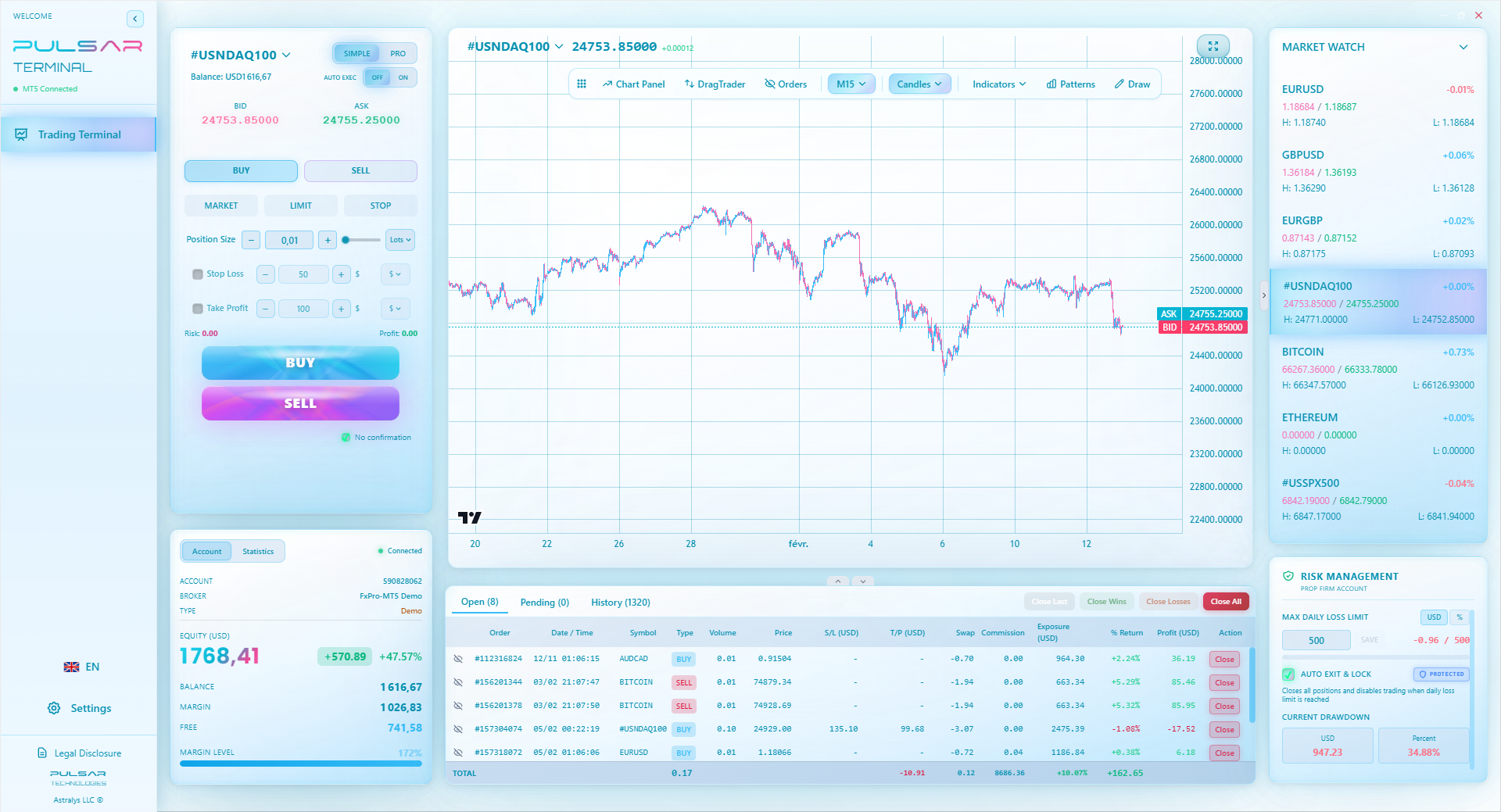
Managing complex strategies like scaling out of positions or adhering to strict prop firm rules is where a tool like Pulsar Terminal shines, automating these mechanics directly on your MT5 platform so you can focus on analysis.
Pulsar Terminal
The all-in-one MT5 companion: drag-and-drop orders, multi-TP/SL, trailing stop, grid trading, Volume Profile, and prop firm protection. Used by 1,000+ traders daily.
“The single most important journal entry isn't your profit/loss. It's 'How did I feel?'”
Stop reading and start doing. Here's your roadmap.
Weeks 1-4: Education & Demo
- Pick a regulated broker from our Exness review or IC Markets review. Open a demo account.
- Learn the platform. Place trades, set stops, calculate pip values.
- Paper trade the London Breakout strategy every day for a month. Keep a journal. Your goal is not profit, but consistency in following the rules.
Weeks 5-8: Live Trading (Micro Account)
- Fund a live account with the minimum amount you can afford to lose. ₦20,000 is plenty.
- Trade with 0.01 lots only. Your goal is to make 10 disciplined trades in a row, win or lose, following your plan.
- Focus on one pair. EUR/USD guide is perfect - it's liquid and has tight spreads.
Weeks 9-12: Review & Scale
- Analyze your journal. What was your win rate? Your average win vs. average loss?
- If you're profitable and disciplined, consider increasing your position size slightly, but never your risk percentage (keep it at 1%).
- Start studying one new concept in depth, like the XAU/USD guide for gold trading, to diversify.
Mastery isn't a destination. It's the daily grind of preparation, execution, and review. The market doesn't care about your hopes. It only responds to your skill.
FAQ
Q1What is the minimum amount I need to start forex trading in Nigeria?
Technically, you can start with as little as ₦2,000 or $1 with some brokers. But realistically, that's pointless. You can't practice proper risk management. Start with a demo account until you're consistent, then fund a live account with at least ₦50,000-₦100,000. This allows you to trade 0.01 lots and still practice meaningful position sizing without being wiped out by a single bad trade.
Q2Which forex broker is the best and safest for Nigerians?
There's no single "best." The safest are internationally regulated brokers with a strong track record of serving Nigerian clients. Look at brokers like Pepperstone (ASIC regulated), IC Markets (ASIC), or XM (CySEC, FSCA). Safety comes from their external regulation, not local ads. Always verify their license number on the regulator's website.
Q3How do I avoid forex trading scams in Nigeria?
Avoid any "mentor" or "signal seller" who guarantees profits or asks for direct access to your trading account. Never use a broker that isn't clearly regulated by a reputable foreign authority. If an offer sounds too good to be true (e.g., "double your money in a week"), it is. Your best defense is your own education and skepticism.
Q4What is the best time to trade forex in Nigeria?
The most active and predictable times are between 1:00 PM and 6:00 PM West Africa Time (WAT). This overlaps with the London session (open 10 AM WAT) and the early New York session (open 2 PM WAT). This overlap creates higher volume and stronger trends, which are easier to trade than the choppy Asian session.
Q5Do I need to pay tax on my forex trading profits in Nigeria?
Yes, legally. The FIRS considers trading profits as capital gains, taxable at 10%. While enforcement on individual retail traders is currently inconsistent, you are required to declare this income. Keeping detailed records isn't just for tax purposes; it's the most critical tool for improving your trading performance.
Q6Can I make a living from forex trading in Nigeria?
A very small percentage of traders do. It requires significant capital (think millions of Naira), years of disciplined practice, and a business-like approach. Do not quit your job to trade. Start as a side hustle. Aim for consistent monthly returns of 5-10% on your risk capital. If you can do that for two years without blowing up, then you can consider scaling it into a primary income.
Q7Is use of 1:500 good for a beginner?
Absolutely not. It's a trap. High use like 1:500 allows tiny market moves to wipe out your account. It encourages overtrading and massive risk. As a beginner, cap your use at 1:20 or 1:30. This forces you to be selective with your trades and learn proper capital allocation. use is a tool for experts, not a shortcut for beginners.
Prof. Winston's Lesson
Key Takeaways:
- ✓Never risk more than 1% of capital per trade
- ✓Verify broker regulation before depositing
- ✓Trade the London-NY overlap (1-6 PM WAT)
- ✓Journal every trade, especially emotions
- ✓Start with use no higher than 1:20
How useful was this article?
Click a star to rate
Weekly Trading Insights
Free weekly analysis & strategies. No spam.
About the Author
Olumide Adeyemi
West African Trading Pioneer
One of Nigeria's most active forex trading educators. 8 years of experience trading from Lagos. Specializes in low-capital strategies and prop firm challenges for African traders.
Comments
Risk Disclaimer
Trading financial instruments carries significant risk and may not be suitable for all investors. Past performance does not guarantee future results. This content is for educational purposes only and should not be considered investment advice. Always conduct your own research before trading.
You Might Also Like

Cara Trading Forex Sukses: 7 Prinsip dari Trader Profesional
Cara trading forex sukses dengan 7 prinsip trader pro: manajemen modal, disiplin, journal trading, backtest. Data nyata, bukan janji profit palsu.
Jam Trading Forex Terbaik untuk Trader Indonesia: Panduan Lengkap dengan Tabel Waktu
Panduan jam trading forex untuk trader Indonesia. Tabel 4 sesi dunia, jam emas 20:00-00:00, sesi mana yang harus dihindari. Data akurat + tips dari trader berpengalaman.
Top 5 Sàn Forex Uy Tín Nhất 2026: Review Jujur dari Trader Indonesia
Top 5 sàn forex uy tín 2026 untuk trader Indonesia. Review jujur: spread, deposit, withdraw, dukungan lokal. Exness, XM, IC Markets & lebih.
Get Pulsar Terminal
All these calculators are built into Pulsar Terminal with real-time data from your MT5 account. One-click position sizing, automatic risk management, and instant calculations.
Get Pulsar Terminal