


I remember when MBA Forex first popped up on my radar.

Olumide Adeyemi
West African Trading Pioneer ·  Nigeria
☕ 12 min read
What you'll learn:
I remember when MBA Forex first popped up on my radar. A friend was buzzing about their 'guaranteed' 20% monthly returns. 'It's different,' he insisted. I ran the numbers: turning ₦500,000 into over ₦3 million in a year with 'zero risk.' My gut screamed scam, but the FOMO was real. I nearly allocated 5% of my trading capital to test it. Thank God I didn't. That 'investment' would have vanished with the ₦213 billion lost by over 40,000 Nigerians. Let's talk about why the MBA Forex and Capital Investment Limited registration was a complete fraud, and how you can avoid the next one.
MBA Forex and Capital Investment Limited wasn't a brokerage. It was a classic Ponzi scheme dressed in forex clothing. They promised the moon: 15-20% monthly returns, zero risk, and 'professional' trading. They even had a fancy office and a charismatic CEO, Maxwell Odum.
The math never added up. Consistent 20% monthly returns would make them the best traders in human history. Warren Buffett averages about 20% per year. They were claiming that per month. It was pure fantasy designed to attract desperate capital.
Here's how it worked: New investor money was used to pay 'returns' to earlier investors. This created the illusion of a profitable business. As long as a constant stream of new money came in, the scheme could continue. The moment that inflow slowed or people tried to withdraw their principal, the whole house of cards collapsed.

Warning: Any investment promising guaranteed high returns with no risk is a scam. Full stop. Forex trading is inherently risky. Profitable traders have losing months, even losing quarters. Anyone claiming otherwise is lying.
The Central Bank of Nigeria (CBN) eventually froze their accounts, but not before an estimated ₦171 billion had allegedly been moved out. The Securities and Exchange Commission (SEC) had them listed as an illegal operator long before the collapse. The real tragedy? Many victims ignored these public warnings, seduced by the early 'payouts' they saw friends receiving.
I've seen this pattern before with MMM and other schemes. The initial 'test' withdrawal works perfectly to build trust. Then, when you commit serious capital, the exit door slams shut. The MBA Forex and Capital Investment Limited registration was never with the SEC. They had no license, no audited records, and no real trading happening. It was all smoke and mirrors.

💡 Winston's Tip
A guaranteed return is a guaranteed lie. The only certainty in markets is uncertainty. Price that in.
“MBA Forex wasn't a brokerage. It was a classic Ponzi scheme dressed in forex clothing.”
After MBA Forex, new schemes pop up every few months. They learn from past mistakes and get slicker. Here’s your checklist to avoid getting burned.
The Guarantee Red Flag: This is the biggest one. If they promise specific returns ("Make 50% in 3 months!") or use the word 'guaranteed,' run. I don't care if your uncle is the one promoting it. Real trading firms and prop firms give you capital to trade, they don't promise you returns on a deposit.
Pressure to Recruit: Ponzi schemes need new victims. If the business model seems more about bringing in new 'members' or 'partners' than about actual trading services, it's a pyramid. Legit brokers like Exness or IC Markets want you to trade, not recruit your family.
The 'SEC Registration' Check: This is crucial. Any legitimate capital market operator in Nigeria MUST be registered with the SEC. Don't just take their word for it.
- Go to the official SEC Nigeria website (sec.gov.ng).
- Look for their 'List of Registered Capital Market Operators' or a searchable database.
- Search for the company's exact name. If they're not there, they are illegal.
MBA Forex wasn't on that list. The next scam won't be either.
Too-Good-To-Be-True Marketing: Fancy cars, luxury hotel seminars, and celebrity endorsements are marketing tools paid for by investor funds. A real brokerage's reputation is built on execution speed, low spreads, and regulatory compliance, not Instagram floss.
Lack of Transparency: Can you see live trading statements? Do they have a clear explanation of their strategy? A real fund manager will have audited track records (which still carry risk). Scams operate in shadows with vague terms like 'proprietary AI algorithm' or 'secret forex loophole.'

Pro Tip: Before you invest a kobo, ask for their SEC registration number. Then verify it independently on the SEC website. If they hesitate or give excuses, you have your answer.
“Any investment promising guaranteed high returns with no risk is a scam. Full stop.”
Let's talk about what real regulation looks like. The landscape has gotten much stricter, especially after disasters like MBA Forex.
The Two Main Regulators
In Nigeria, you're dealing with two key bodies:
- Securities and Exchange Commission (SEC): They regulate all capital market activities. This includes anyone offering investment services, portfolio management, or operating a trading platform. The new Investments and Securities Act (ISA) 2025 makes it illegal to run an online forex platform without SEC registration.
- Central Bank of Nigeria (CBN): They govern foreign exchange transactions and monetary policy. A broker facilitating Naira deposits/withdrawals will need to work with CBN-licensed financial institutions.
What Registration Actually Costs (The Real Numbers)
For a company to be a legit Capital Market Operator (CMO), it's not cheap. The SEC recently jacked up capital requirements to strengthen the system. Here’s a snapshot of the new minimum capital, effective by June 2027:
| Type of Operator | New Minimum Capital | Old Minimum Capital |
|---|---|---|
| Broker (Execution Only) | ₦600 Million | ₦200 Million |
| Broker-Dealer | ₦2 Billion | ₦300 Million |
| Digital/Crypto Platform | ₦2 Billion | New Category |
| Fund Manager (Tier 1) | ₦5 Billion | ₦150 Million |
These aren't filing fees. This is paid-up capital that must be maintained. There are also registration fees ranging from ₦50,000 to ₦250,000. This high barrier exists to ensure only serious, solvent companies operate.
This is why most 'forex brokers' serving Nigerians are actually internationally regulated entities. They are regulated by bodies like the FSCA (South Africa), ASIC (Australia), or CySEC (Cyprus). They then partner with local payment processors to handle Naira. This is a perfectly legal and common setup. The key is that the international broker itself is heavily regulated elsewhere. You can check our reviews for brokers like XM or Pepperstone to see what strong international regulation looks like.
So, when you hear 'registration,' understand the scale. MBA Forex and Capital Investment Limited registration was a fantasy. They didn't have ₦2 billion in capital. They had your subscription fees.
“Any investment promising guaranteed high returns with no risk is a scam. Full stop.”
Okay, so MBA Forex was a scam. How do you actually trade forex safely from Nigeria? You have two main paths.
Path 1: Trade Directly with a Regulated International Broker This is what I do and what I recommend for most individual traders. You open an account with a broker regulated by a reputable foreign authority.
What to look for:
- Regulation: ASIC, FCA, FSCA, CySEC are top tiers. Check the broker's 'About Us' page for license numbers and verify them on the regulator's website.
- Naira-Friendly: They should offer local bank transfer deposits and withdrawals. Brokers like HFM offer Naira-denominated accounts, which simplifies things.
- Realistic Minimums: You can start small. Many brokers allow you to open a micro account with as little as $10 (about ₦15,000). But be honest, to trade properly and manage risk, I'd suggest a minimum of $500 (₦750,000). This lets you use sensible position sizing without getting wiped out by a few bad trades.
- Transparent Costs: Look for clear info on spreads and commissions. For example, a broker might offer EUR/USD spreads from 0.1 pips with a $3.50 commission per lot. That's transparent.
Path 2: Become a Funded Trader (Prop Trading) This has become hugely popular. You pass a trading challenge with a proprietary trading firm. If you pass, they give you a large funded account (e.g., $100,000). You keep a large share of the profits you make. The firm provides the capital, you provide the skill.
Key difference from MBA Forex: You are not giving them money. You pay a one-time evaluation fee (say, $200) for the chance to get funded. Your risk is capped at that fee. They make money from the fees and a split of your actual trading profits. There's no promise of returns to you. It's the opposite - you're proving you can generate returns.

Example: You pay a $200 challenge fee to a prop firm. You pass their rules (hit a profit target without breaching a daily loss limit). They give you a $100,000 account. You make 10% profit ($10,000). Your profit split is 80/20, so you get $8,000. Your ROI on the $200 fee is 4,000%. That's the real model, not 'give us money for monthly interest.'
Whichever path you choose, you are in control of your trades. You decide when to enter, set your stop-loss, and take profit. No one is promising you a magical return. The profit potential is real, but so is the risk of loss. That's authentic trading.
💡 Winston's Tip
Your first ₦100,000 profit is less important than your first ₦20,000 loss. How you handle the loss defines your future.
“Legitimacy is boring. It's about license numbers, terms & conditions, and tax obligations.”
Trading legally means dealing with the taxman. Let's not kid ourselves, this part isn't fun, but ignoring it is asking for trouble.
Capital Gains Tax (CGT): In Nigeria, your forex trading profits are generally considered capital gains. The current rate is 10%. This is payable to the Federal Inland Revenue Service (FIRS).
Here's a practical example from my own books. In the 2023 tax year, my net profit from forex trading (after all losses) was ₦8,500,000. My capital gains tax liability was 10% of that: ₦850,000. It's a significant chunk, but it's the cost of operating above board. You calculate this on your net profit for the year, not on every individual winning trade.
Record Keeping is Your Best Friend: The FIRS won't take your word for it. You need records.
- Trade Journals: Every trade - entry, exit, profit/loss in Naira equivalent. Use a spreadsheet or trading journal software.
- Bank Statements: All deposits to and withdrawals from your brokerage account.
- Broker Statements: Monthly or yearly statements from your broker showing all activity.
I learned this the hard way early on. I had a great year but my records were a mess - screenshots scattered across my phone. Reconciling it for my accountant took weeks of stress. Now, I update my master spreadsheet every Friday without fail.
What About Losses? This is important. If you make a net loss in a tax year, you generally cannot offset it against other income (like your salary). However, you can usually carry forward that loss to offset against future trading profits. Keep those loss records just as diligently.
Trading with a registered, international broker simplifies this. You get clean, professional statements. Trading with an illegal scheme like MBA Forex? You get nothing. No statements for taxes, and you've lost your capital anyway. Going legit actually makes your financial life simpler in the long run.
“Legitimacy is boring. It's about license numbers, terms & conditions, and tax obligations.”
The allure of scams like MBA Forex is the promise of easy money without effort. Real trading is the opposite. It's a skill built on education, discipline, and a solid strategy. Let's talk about what that actually involves.
Start with a Method, Not a Dream: You need a clear set of rules for entering and exiting trades. This could be based on price action, MACD and RSI divergences, or moving average crossovers. It doesn't have to be complex. My most consistent strategy for years was a simple 50/200 EMA crossover on the 4-hour chart, filtered with support and resistance. I'd use it for swing trading over several days.
Backtest and Forward Test: Don't risk real money on a hunch. Test your strategy on historical data (backtesting). Then, test it in real-time on a demo account (forward testing) for at least 2-3 months. Does it hold up? What's the win rate? What's the average win vs. average loss?
Risk Management is Your Survival Kit: This is non-negotiable. I never risk more than 1% of my account on a single trade. Ever. On a $5,000 account, that's $50. This means my stop-loss distance and position size are calculated before I ever click buy. Use a position size calculator every single time. This one habit protects you from the one terrible trade that can blow up your account.
Embrace the Psychology: This is the hardest part. You will have losing streaks. A scam 'guarantees' no losses, so you never learn to handle them. A real trader knows a 5-trade losing streak is statistically normal even with a 60% win-rate strategy. The discipline to stick to your plan during that streak is what separates pros from gamblers.
I once had a 7-loss streak on my gold (XAU/USD) strategy. It sucked. My brain was screaming to double down or abandon the plan. Because my risk was capped at 1% per trade, my total drawdown was a manageable 6.3%. I stuck to the rules. The next 8 trades were winners, and I finished the month positive. Scams can't teach you that resilience. Only real, logged, painful experience can.
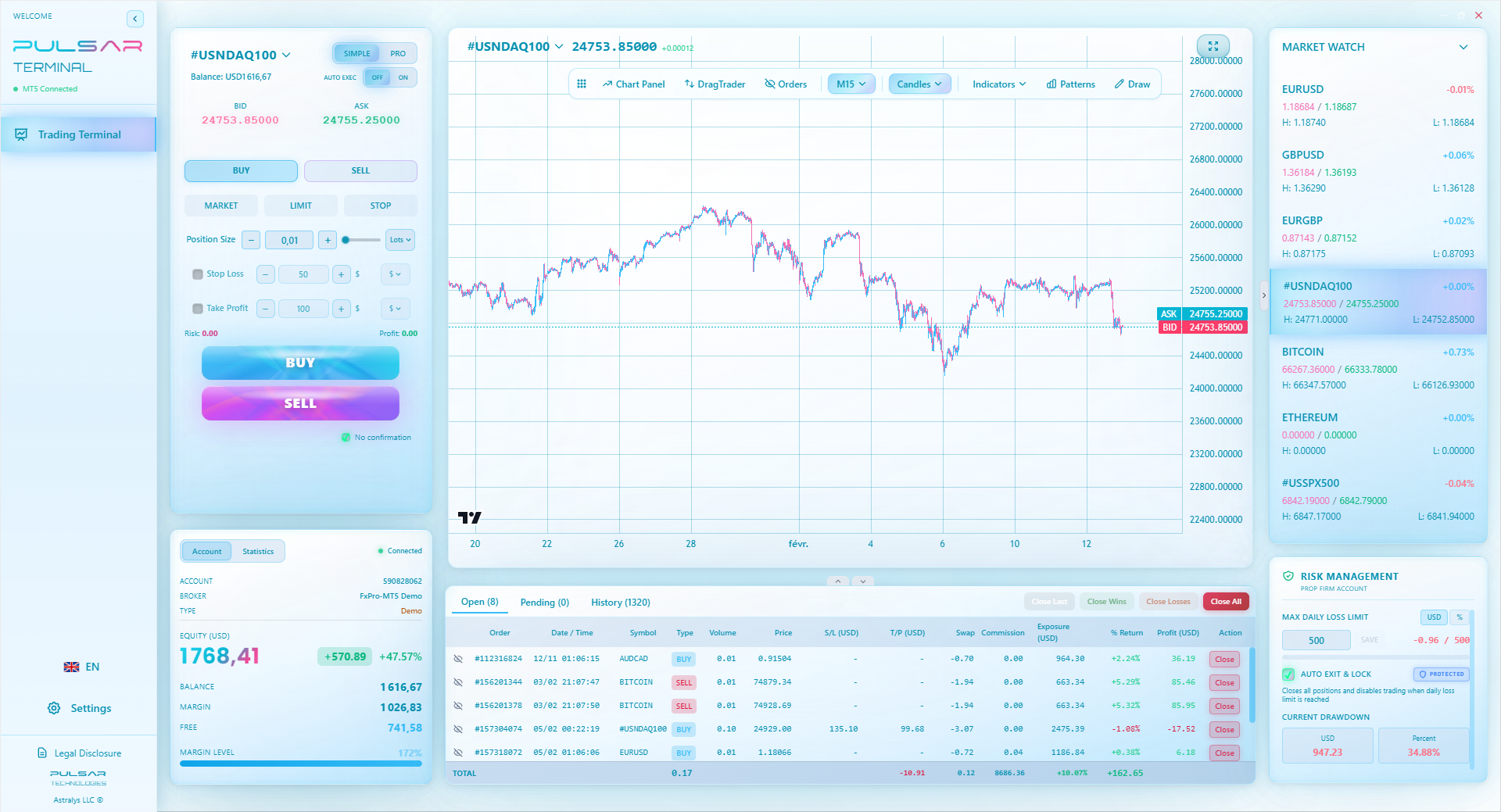
Sticking to a strategy during a losing streak requires iron discipline, and tools like Pulsar Terminal help by automating your trade management and risk rules directly on MT5.
Pulsar Terminal
The all-in-one MT5 companion: drag-and-drop orders, multi-TP/SL, trailing stop, grid trading, Volume Profile, and prop firm protection. Used by 1,000+ traders daily.
“Your trading plan should focus on survival. Profits come from consistency, not lottery tickets.”
The story of MBA Forex and Capital Investment Limited registration is a painful lesson for Nigeria's investing public. It won't be the last scam, but you can be smarter than the next one.
Remember, legitimacy is boring. It's about license numbers, terms & conditions pages, and tax obligations. It's about brokers competing on spreads and execution, not on referral bonuses for bringing in your village meeting. Profitability is hard. It comes from screen time, disciplined repetition, and continuous learning.
Your action plan is simple:
- Verify, then trust. Check SEC registration for local firms. Verify international regulation for offshore brokers.
- Reject guarantees. If it sounds too good to be true, it's a scam. Every single time.
- Start small and learn. Use a demo account. Then fund a live account with money you can afford to lose. Treat it as tuition for a valuable skill.
- Manage your risk first. Your trading plan should focus on survival. Profits come from consistency, not lottery tickets.
The forex market is a real opportunity. I've built a career and a life from it. But the path is paved with the wreckage of get-rich-quick schemes. Don't be another cautionary tale. Be the disciplined trader who builds genuine, sustainable wealth, one well-calculated trade at a time.
Pro Tip: Bookmark the SEC Nigeria's 'List of Registered Capital Market Operators' and their 'List of Unregistered/Illegal Operators.' Make checking these your first step when you hear about any new 'investment platform.' It takes two minutes and could save you millions.
FAQ
Q1Was MBA Forex and Capital Investment Limited ever registered with SEC Nigeria?
No, never. The Securities and Exchange Commission (SEC) publicly listed MBA Forex and Capital Investment Limited as an unregistered, illegal operator. They had no license to operate in the Nigerian capital market.
Q2What is the minimum capital for a legitimate forex broker in Nigeria?
For a company to be registered as a Broker-Dealer with the SEC Nigeria, the minimum paid-up capital is now ₦2 Billion (as per 2026 rules). This is why most traders use internationally regulated brokers (like FSCA or ASIC-regulated firms) that accept Nigerian clients, as they meet much higher capital requirements in their home jurisdictions.
Q3How much tax do I pay on forex trading profits in Nigeria?
Forex trading profits are typically subject to Capital Gains Tax (CGT) at a rate of 10%. You pay this to the Federal Inland Revenue Service (FIRS) on your net annual profit (total gains minus total losses).
Q4Can I start forex trading in Nigeria with a small amount like ₦50,000?
Technically, yes. Some international brokers allow minimum deposits as low as $10 (≈₦15,000). However, with ₦50,000 (≈$33), effective risk management is extremely challenging. A single standard lot move against you could wipe the account. It's better to save up to at least ₦500,000-₦750,000 to start with a sensible buffer, or practice extensively on a demo account first.
Q5What's the difference between a prop firm and a scam like MBA Forex?
A legitimate prop firm charges you a one-time evaluation fee to test your skills. If you pass, they give you their capital to trade and you share the profits. Your risk is limited to the fee. A scam like MBA Forex takes your deposit and promises guaranteed monthly returns, using new deposits to pay old investors. You have no control and the model inevitably collapses.
Q6Which is safer: a Nigerian-registered broker or an international one?
For retail forex trading, an international broker regulated by a top-tier authority (like ASIC, FCA, or FSCA) is generally the established route. They operate under stringent global standards, offer strong platforms like MT4/MT5, and have a long track record. The key is ensuring they are truly regulated and offer smooth Naira payment processing.
Prof. Winston's Lesson
Key Takeaways:
- ✓Verify SEC registration independently. Never trust a company's word.
- ✓Real brokers compete on spreads, not referral bonuses.
- ✓Risk a maximum of 1% per trade. Every time.
- ✓10% Capital Gains Tax applies to net annual profits.
- ✓Prop firms charge evaluation fees; scams ask for investment deposits.
How useful was this article?
Click a star to rate
Weekly Trading Insights
Free weekly analysis & strategies. No spam.
About the Author
Olumide Adeyemi
West African Trading Pioneer
One of Nigeria's most active forex trading educators. 8 years of experience trading from Lagos. Specializes in low-capital strategies and prop firm challenges for African traders.
Comments
Risk Disclaimer
Trading financial instruments carries significant risk and may not be suitable for all investors. Past performance does not guarantee future results. This content is for educational purposes only and should not be considered investment advice. Always conduct your own research before trading.
You Might Also Like

Cara Trading Forex Sukses: 7 Prinsip dari Trader Profesional
Cara trading forex sukses dengan 7 prinsip trader pro: manajemen modal, disiplin, journal trading, backtest. Data nyata, bukan janji profit palsu.
Jam Trading Forex Terbaik untuk Trader Indonesia: Panduan Lengkap dengan Tabel Waktu
Panduan jam trading forex untuk trader Indonesia. Tabel 4 sesi dunia, jam emas 20:00-00:00, sesi mana yang harus dihindari. Data akurat + tips dari trader berpengalaman.
Top 5 Sàn Forex Uy Tín Nhất 2026: Review Jujur dari Trader Indonesia
Top 5 sàn forex uy tín 2026 untuk trader Indonesia. Review jujur: spread, deposit, withdraw, dukungan lokal. Exness, XM, IC Markets & lebih.
Get Pulsar Terminal
All these calculators are built into Pulsar Terminal with real-time data from your MT5 account. One-click position sizing, automatic risk management, and instant calculations.
Get Pulsar Terminal