


If you're trading forex in Nigeria, you're operating in one of the most dangerous retail environments on the planet.

Olumide Adeyemi
West African Trading Pioneer ·  Nigeria
☕ 10 min read
What you'll learn:
- 1What Was the MBA Forex Event? (Spoiler: It Was a Scam)
- 2The Nigerian Forex Regulation Reality Check
- 3How to Spot a Scam Broker (The MBA Forex Playbook)
- 4Real Brokers for Nigerian Traders: The Data
- 5Trading Costs & The Naira Reality
- 6Safe Trading Practices in a High-Risk Environment
- 7Moving Forward: Trading After the MBA Forex Era
If you're trading forex in Nigeria, you're operating in one of the most dangerous retail environments on the planet. It's not just the market volatility that'll wipe you out. It's the predators. The 2019 MBA Forex event wasn't a seminar. It was a $462 million warning shot across the bow of every Nigerian trader. I've seen more accounts blown up by fake brokers and Ponzi schemes than by bad trades. This guide will show you exactly how to spot the scams, find a real broker, and actually keep your money while trading.
Let's clear this up right now. The 'MBA Forex event' refers to the investor summits and fancy dinners thrown around Lagos in 2019 by a company called MBA Forex and Capital Investment Limited. They promised forex investment opportunities, talked big about returns, and sold a dream.
It was a classic Ponzi scheme. By late 2020, the music stopped. Withdrawal requests piled up, ignored. The company vanished. CEO Maxwell Odum was eventually charged with defrauding investors of roughly 213 billion Naira. That's $462 million. Gone.
In July 2021, the Securities and Exchange Commission (SEC) of Nigeria issued a public warning: Capital Investment Ltd was operating illegally. No license. A pure Ponzi. The 'event' was just the sales pitch.

Warning: Any 'investment scheme' promising fixed, high monthly returns (e.g., '20% monthly guaranteed') is almost certainly a Ponzi. Real trading has losses. Period.
Why does this matter to you today? Because the vacuum that allowed MBA Forex to thrive still exists. The SEC Nigeria, as of early 2026, still does not specifically license or regulate online retail forex brokers. That means there's no local watchdog checking if a 'broker' is legit or just the next MBA Forex. The onus is 100% on you to verify who you're giving your money to.

💡 Winston's Tip
A broker's use offer is a test of your greed, not a measure of their quality. The higher it is, the faster you'll fail.
“The 'MBA Forex event' wasn't a seminar. It was a $462 million warning shot.”
Here's the confusing part. Forex trading for individuals in Nigeria is legal. You can use your personal funds. But the regulatory framework is a patchwork with giant, dangerous holes.
The Central Bank of Nigeria (CBN) runs the show for the big picture. They manage the Naira, control official reserves, and have one clear rule for retail traders: Nigerian banks cannot provide foreign currency from the official window for speculative trading. You can't use official FX to fund your trading account. This pushes everyone towards international brokers.
The Securities and Exchange Commission (SEC) Nigeria is supposed to be the capital markets regulator. But for online forex? They're largely absent. There's no local licensing regime for the Exness or IC Markets of the world. This creates the perfect hunting ground for scammers. They can claim 'registration' with some obscure body, or just lie, and there's no clear SEC list to check them against.
Some talk about the Investments and Securities Act (ISA) 2025 maybe changing this, forcing platforms to get licenses. Maybe. But as you read this, assume it's the Wild West.
Taxation is one area that's crystal clear. If you make money, you owe the Federal Inland Revenue Service (FIRS) a 10% capital gains tax on your gross profits. It doesn't matter if your broker is in Cyprus or the Seychelles. Keep detailed records. I learned this the hard way early on after a good year on EUR/USD; the tax man cometh.
“In Nigeria, your trading discipline is your only real regulator.”
Scammers use the same playbook. Here’s what to look for, based on what MBA Forex and others did.
The Guarantee
No legitimate broker guarantees profits. Ever. If they promise you a 30% monthly return with 'no risk,' run. Real trading is about managing risk, not eliminating it. A real broker's website is filled with risk warnings, not profit promises.
The Pressure to Deposit More
Ponzi schemes need constant new money to pay old 'investors.' You'll get calls or messages urging you to 'top up' to unlock a 'VIP bonus' or a 'can't-lose trade.' A real broker doesn't care if you deposit $10 or $10,000. Their business is your trading volume, not your deposit size.
The Withdrawal Problem
This is the dead giveaway. Excuses start: 'Our system is upgrading,' 'We need a 20% fee to process,' 'Your account is under audit.' With a real, internationally regulated broker like those in our broker reviews, withdrawals are routine. They might take 1-3 business days, but the process is transparent.
The Fake Regulation
They'll list 'regulated by the International Financial Commission' or some other made-up body. You must verify. Go to the actual regulator's website (FCA, ASIC, CySEC) and search their register. If the broker isn't there, they're lying.
I almost got caught in 2017. A 'broker' offered 1:1000 use and a 50% deposit bonus. The platform was a cheap copy of MT4. I tried a test withdrawal of $100. It took three weeks and three excuses. I pulled my initial deposit out and never looked back. That company was shut down a year later.

Pro Tip: Before depositing a single Naira, do a test withdrawal. Deposit the minimum (say $10), don't trade it, and immediately request to withdraw it. See how hard they make it.
“In Nigeria, your trading discipline is your only real regulator.”
So who can you trust? You need brokers regulated by top-tier international authorities. They accept Nigerian clients, offer Naira payment methods, and operate legally. Here’s a snapshot based on early 2026 data.
| Broker | Key Regulation | Min. Deposit (Approx.) | Avg. EUR/USD Spread | Notable for Nigerians |
|---|---|---|---|---|
| Exness | FCA, CySEC, FSC | As low as $1 | From 0.1 pips | NGN accounts, popular locally |
| HFM | FSC, FSA | ₦4,000+ | From 0.6 pips | Physical office in Lagos, NGN accounts |
| IC Markets | ASIC, FSA | $200 | From 0.7 pips | Raw spreads, great for scalping |
| Pepperstone | ASIC, FCA | $200 | From 0.6 pips | Reliable execution, strong platform |
| XM | ASIC, CySEC, FSC | As low as $1 | From 0.6 pips | Good education, flexible accounts |
| FP Markets | ASIC, FSC | $100 | From 0.7 pips | Good MT4/MT5 raw account options |
A note on use: Some brokers offer insane use like 1:2000 or 1:3000. This is a trap for the inexperienced. It's not a benefit; it's a quick way to a margin call. I never use more than 1:30 on major pairs, no matter what the broker offers. High use is the number one reason new traders blow up.
Payment Methods: You'll typically use bank transfers, credit/debit cards (though many Nigerian banks block international forex transactions), or e-wallets like Skrill/Neteller. Some brokers also accept crypto or local processors like Paystack.
Your first job isn't to pick a trading strategy. It's to pick a legitimate broker. Start your research with our detailed XM review or IC Markets review to understand the specifics.
💡 Winston's Tip
Your first profit target should be to withdraw your initial deposit. Trade with 'house money' only. It changes everything.
“High use isn't a benefit; it's a trap for the inexperienced.”
Your trading edge gets eaten by costs. You need to know them cold.
The Spread: This is the difference between the buy and sell price. It's how most brokers make money. On EUR/USD, you want under 1 pip on a standard account. The brokers listed above deliver that. A wide spread of 2-3 pips means you start every trade in a hole. Use a position size calculator that includes spread cost to see its real impact.
Commissions: Some accounts (often called 'Raw' or 'ECN') have tiny spreads but charge a commission per lot. For example, $4 per lot traded. This can be cheaper overall if you trade large sizes.
The Naira Exchange Rate: This affects your deposit's real value. In 2025, the Naira was relatively stable, between ₦1,450 and ₦1,650 per dollar. Forecasts for 2026 hover around ₦1,480. This volatility is a hidden cost. If you deposit when the rate is ₦1,500/$ and withdraw at ₦1,600/$, you've lost Naira value even if your USD trading account broke even.
Tax: Remember the 10% capital gains tax. It's on gross profits. If you make ₦1,000,000 profit this year, set aside ₦100,000 for FIRS. Factor this into your profit targets.
Here's a personal example. In Q1 2023, I made a 22% return on my USD account trading XAU/USD. But the Naira weakened significantly against the dollar in that period. When I converted my profits back to Naira, my total Naira gain was actually 31%. The currency move worked for me that time. It can work against you just as easily.
“High use isn't a benefit; it's a trap for the inexperienced.”
Given the regulatory gaps and scam history, your discipline is your only real regulator.
1. Start Small, Prove Yourself: That $500 minimum deposit some brokers ask for? Start with that, or even less. Don't deposit your life savings because a YouTube guru said so. Your first goal is to not lose your initial deposit over 6 months, not to get rich.
2. Use a Trading Plan with Hard Limits: This is non-negotiable. Your plan must include:
- Maximum risk per trade (I risk 0.5% of my account, never more).
- Daily loss limit (If I lose 2% in a day, I'm done until tomorrow).
- Weekly profit target (Take 50% of weekly profits out of the trading account once you hit it).
3. Document Everything: Keep a trade journal. Screenshot your trade entries/exits, the rationale. This helps you improve and is crucial evidence if you ever have a dispute with your broker over a price or a 'technical error.'
4. Isolate Your Trading Capital: Use a separate bank account for trading funds. Never mix it with rent money or business capital. This creates a psychological and practical firewall.
5. Ignore the 'Prop Firm Hustle': Passing a prop firm challenge is a specific skill that often encourages extreme risk-taking to hit profit targets. It's not 'safer' than trading your own capital. The rules are designed for you to fail. Focus on consistently growing a small account first.

Example: A $500 account with a 0.5% risk rule. Your max loss per trade is $2.50. On a standard lot (100,000 units), that's a stop-loss of just 2.5 pips. That's too tight. This forces you to either trade micro lots (1,000 units) or pick trades with wider, more sensible stop-losses. This is proper risk management.
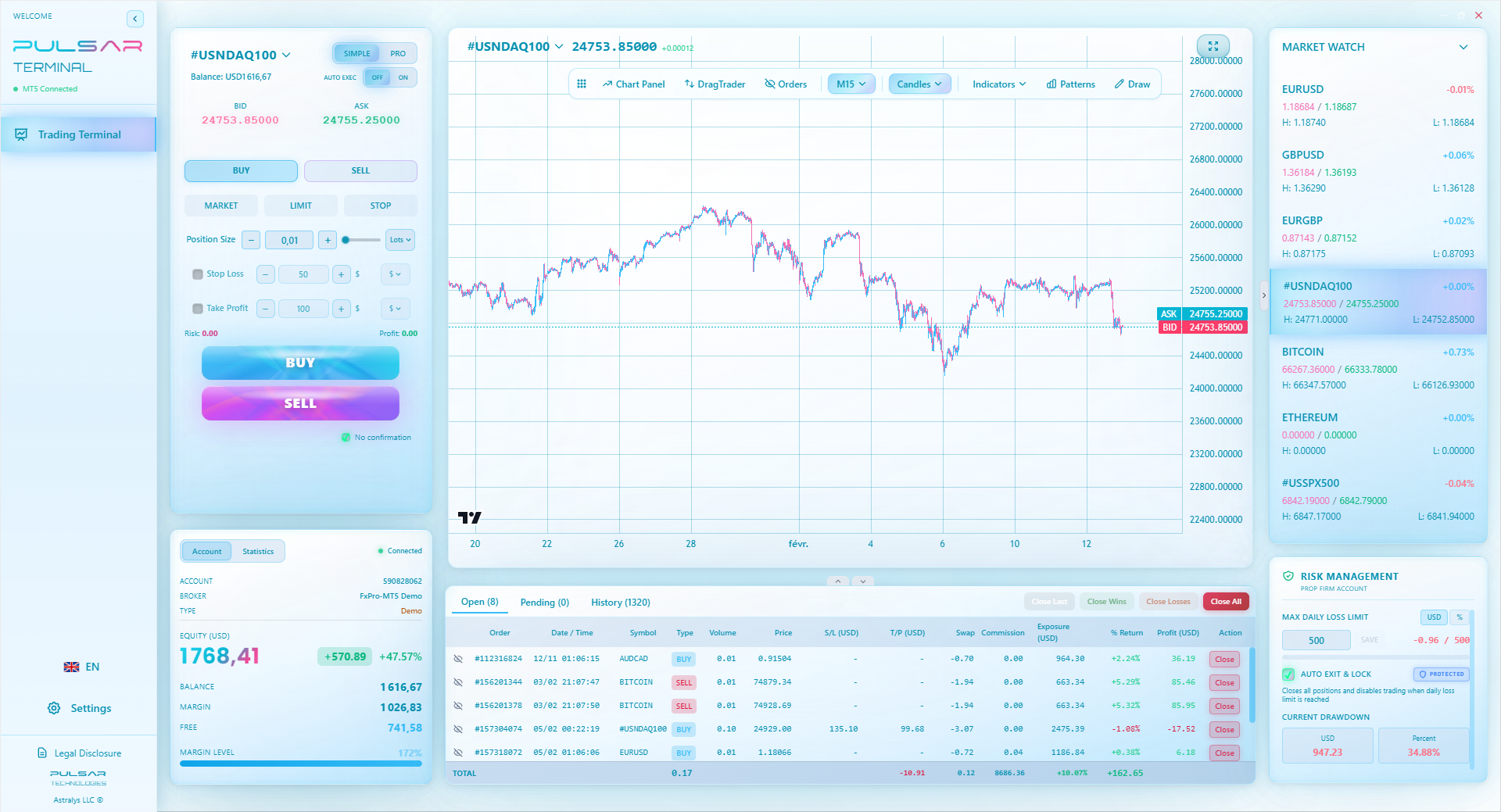
Sticking to a trading plan with hard daily loss limits is the only way to survive, and tools like Pulsar Terminal can automate this protection directly on your MT5 platform.
Pulsar Terminal
The all-in-one MT5 companion: drag-and-drop orders, multi-TP/SL, trailing stop, grid trading, Volume Profile, and prop firm protection. Used by 1,000+ traders daily.
“Sustainable wealth is built from consistent 1-2% monthly gains, not 100% weeks.”
The MBA Forex event should be a permanent lesson for the Nigerian trading community. Hope is not a strategy. Trust must be verified.
The path forward is boring, careful, and slow.
- Education Over Hype: Learn what a pip really is, how margin works, what the MACD or RSI actually measures. Don't just buy signals.
- Verification Before Deposit: Spend more time checking your broker's license than picking your first trade.
- Community Wisdom: Connect with other serious traders. Not the 'to the moon' Telegram groups, but communities that discuss risk management and broker issues. They're often the first to spot withdrawal problems.
- Accept the Grind: Sustainable wealth from trading is built from consistent 1-2% monthly gains, compounded over years. Not from 100% weeks. Aim for swing trading steady moves, not catching every pip.
The Nigerian market has huge potential. The hunger for financial opportunity is real. But that hunger makes you the target. Be the skeptical, careful, disciplined trader that the scammers can't touch. That's how you survive and eventually thrive in the real forex market.
FAQ
Q1Is forex trading legal in Nigeria?
Yes, it is legal for individuals to trade forex with their personal funds. However, the Central Bank of Nigeria (CBN) prohibits using official foreign exchange windows to fund trading accounts, and the SEC Nigeria does not yet specifically regulate online retail forex brokers, creating a significant gap in consumer protection.
Q2How much tax do I pay on forex profits in Nigeria?
You are required to pay a 10% Capital Gains Tax on your gross forex trading profits to the Federal Inland Revenue Service (FIRS). You must keep accurate records of all your trades and profits for tax purposes.
Q3What is the safest way to choose a forex broker in Nigeria?
Choose an international broker regulated by a top-tier authority like the UK's FCA, Australia's ASIC, or Cyprus's CySEC. Always verify the license number on the regulator's official website. Avoid any broker that guarantees profits or pressures you for larger deposits.
Q4What was the main reason the MBA Forex scheme collapsed?
It was a Ponzi scheme. They used new investors' money to pay fake 'returns' to earlier investors. When they couldn't attract enough new money to cover the withdrawals, the scheme collapsed, leading to over $462 million in losses for investors.
Q5What is a reasonable minimum deposit to start trading forex?
You can start with as little as $10-$50 with some brokers, but a more practical amount that allows for sensible risk management is between $500 and $1000. This lets you trade micro lots and withstand normal market volatility without being wiped out by a few bad trades.
Q6Can I use my Nigerian bank card to fund a forex account?
Sometimes, but many Nigerian banks have blocked or limited the use of Naira debit/credit cards for international forex broker transactions. More reliable methods include bank transfers, e-wallets (Skrill, Neteller), or cryptocurrencies, depending on what your chosen broker supports.
Prof. Winston's Lesson
Key Takeaways:
- ✓Verify every broker's license on the regulator's official site
- ✓Never risk more than 0.5% of your account on a single trade
- ✓Pay your 10% capital gains tax to FIRS without fail
- ✓Test withdrawal before you make a major deposit
How useful was this article?
Click a star to rate
Weekly Trading Insights
Free weekly analysis & strategies. No spam.
About the Author
Olumide Adeyemi
West African Trading Pioneer
One of Nigeria's most active forex trading educators. 8 years of experience trading from Lagos. Specializes in low-capital strategies and prop firm challenges for African traders.
Comments
Risk Disclaimer
Trading financial instruments carries significant risk and may not be suitable for all investors. Past performance does not guarantee future results. This content is for educational purposes only and should not be considered investment advice. Always conduct your own research before trading.
You Might Also Like

Cara Trading Forex Sukses: 7 Prinsip dari Trader Profesional
Cara trading forex sukses dengan 7 prinsip trader pro: manajemen modal, disiplin, journal trading, backtest. Data nyata, bukan janji profit palsu.
Jam Trading Forex Terbaik untuk Trader Indonesia: Panduan Lengkap dengan Tabel Waktu
Panduan jam trading forex untuk trader Indonesia. Tabel 4 sesi dunia, jam emas 20:00-00:00, sesi mana yang harus dihindari. Data akurat + tips dari trader berpengalaman.
Top 5 Sàn Forex Uy Tín Nhất 2026: Review Jujur dari Trader Indonesia
Top 5 sàn forex uy tín 2026 untuk trader Indonesia. Review jujur: spread, deposit, withdraw, dukungan lokal. Exness, XM, IC Markets & lebih.
Get Pulsar Terminal
All these calculators are built into Pulsar Terminal with real-time data from your MT5 account. One-click position sizing, automatic risk management, and instant calculations.
Get Pulsar Terminal