


Most traders think mean reversion is about buying low and selling high.

David van der Merwe
Emerging Markets Trader ·  South Africa
☕ 11 min read
What you'll learn:
- 1What Mean Reversion Really Means for a ZAR Trader
- 2The Tools: How to Spot a Real Extreme (Not Just a Dip)
- 3Trading ZAR Pairs: It's a Different Beast
- 4A Step-by-Step Trade Plan: Entry, Stop, and Target
- 5Mistakes I've Made (So You Don't Have To)
- 6Risk Management: The Only Thing That Matters
- 7Making it Stronger: Combining with Other Strategies
- 8Is a Mean Reversion Strategy Right for You?
Most traders think mean reversion is about buying low and selling high. They're wrong. It's about surviving the brutal, extended moves that come before the price finally snaps back. I've blown accounts trying to catch falling knives in USD/ZAR, convinced it 'had' to bounce. In this guide, I'll show you the disciplined, unsexy version of this strategy that actually works with our local market quirks and the FSCA's 30:1 use limit.
Forget the textbook definition. In the real world, a mean reversion strategy forex is the art of betting that an extreme price move is exhausted, and that price will return to its recent average. The 'mean' isn't some fixed line on a chart. It's a zone of recent equilibrium where the market has spent most of its time.
Here's the crucial part most new traders miss: the reversion doesn't happen on your schedule. A pair like USD/ZAR can trend for weeks, driven by local politics or commodity prices, making anyone trying to fade the move look like a fool. I learned this the hard way in 2020, shorting USD/ZAR at R18.50, convinced the Rand was oversold. It ran to R19.35 before finally turning. That paper loss was brutal.
The core idea is simple: price tends to oscillate around a fair value. When it stretches too far, too fast, it often snaps back. Your job is to define 'too far' with rules, not gut feel, and to manage risk so you're still standing when the reversion finally happens.

Warning: Mean reversion against a strong, fundamental trend is a sure way to lose money. In South Africa, never assume a ZAR move is 'over' just because of a technical indicator. Always check for scheduled news like SARB announcements or budget speeches first.

💡 Winston's Tip
The 'mean' isn't a line, it's a battlefield. Price doesn't politely return to it; it fights its way back through chaos. Your job is to be the sniper, not the soldier in the charge.
You need objective filters to avoid chasing every minor pullback. I use a combination of these, never just one.
Bollinger Bands
This is my primary visual tool. When price closes outside the outer bands, it's a signal, not a command to trade. The key is the quality of the touch. A sharp, spiky wick outside the band is more promising than a slow, grinding close outside. I look for this on the 4-hour or daily chart for swing trades.
The RSI Indicator
The classic overbought/oversold gauge. A reading below 30 or above 70 gets my attention. But the real magic happens with divergence. If USD/ZAR makes a new high but the RSI makes a lower high, that's a powerful warning the uptrend is losing steam. I've found the RSI indicator to be far more reliable when used this way, rather than just trading off the 30/70 lines alone.
Average True Range (ATR)
This measures recent volatility. I use it to gauge if a move is statistically large. If price has moved 1.5x the current 14-period ATR away from a key moving average, it's a more significant stretch than a 0.5x ATR move. This helps filter out noise.

Example: Let's say EUR/USD has a 14-day ATR of 70 pips. A sudden 105-pip (1.5 x 70) move away from the 20-day SMA would qualify as an extended move worthy of attention for a potential mean reversion setup.
No indicator is perfect. A strong trend will see price ride the Bollinger Band for ages. That's why confirmation and risk management are non-negotiable.
“Mean reversion isn't about buying low and selling high. It's about surviving the brutal, extended moves that come before the price finally snaps back.”
Trading USD/ZAR or EUR/ZAR with a mean reversion mindset requires extra caution. Liquidity is lower and spreads are wider, which eats directly into the profit potential of a short-term reversion play.
My rule of thumb: I only consider mean reversion on ZAR pairs on the daily chart timeframe or higher. The intraday noise is too punishing. I also need a much wider stop-loss. Where I might use a 20-pip stop on EUR/USD, I might need 80-120 pips on USD/ZAR to avoid being stopped out by normal volatility.
Remember the exchange control rules. As a South African resident, you're technically not supposed to speculate directly against the Rand. Most of us trade through international brokers' entities (like Exness or IC Markets global), but it's a regulatory grey area you should be aware of. Because of this, I often apply the mean reversion strategy forex principles to major pairs like EUR/USD or GBP/USD, where liquidity is high and costs are low, and treat ZAR pairs with more of a long-term, fundamental lens.
The FSCA's 30:1 use cap for retail traders is actually a blessing for this strategy. It prevents you from over-leveraging into a mean reversion trade that hasn't yet finished its extreme move. High use would have killed my account during that 2020 USD/ZAR trade.
Here’s the exact checklist I run through. Missing one step usually costs me money.
1. Identify the Extreme: Price must close outside the Bollinger Band on a 4H or Daily chart, with RSI confirming (above 70 or below 30, preferably with divergence).
2. Wait for a Pullback Signal: This is where I used to jump in too early. Don't enter the moment price is at the extreme. Wait for it to close back inside the Bollinger Band. This shows the initial exhaustion is starting. For a short entry (price was above the band), I wait for a bearish candlestick pattern or a break below a minor support level on a lower timeframe, like the 1-hour.
3. Place Your Entry and Stop: I enter on that pullback signal. My stop-loss goes beyond the recent extreme. If the high was at 1.0950, my stop goes at 1.0965 or 1.0970. You must give the trade room to breathe. Placing the stop too tight guarantees you'll get taken out by volatility. Always calculate your position size based on this stop distance and your risk-per-trade (I never risk more than 1%). Use a position size calculator every single time.
4. Setting Targets: I don't aim for the middle band. That's too optimistic. My first profit target is the opposite Bollinger Band? No. Too far. I aim for a 1:1.5 or 1:2 risk-to-reward ratio. If my stop is 30 pips away, my first target is 45-60 pips away. I often use the 20-period Simple Moving Average (which runs through the middle of the Bollinger Bands) as a secondary target or a level to move my stop to breakeven.
Real Trade Example (EUR/USD):
- May 15th: Price spikes to 1.0895, closing above the daily Bollinger Band. RSI hits 73.
- I wait. On May 16th, price pulls back, closes inside the band, and forms a bearish engulfing candle on the 4H chart at 1.0860.
- I enter short at 1.0860. Stop-loss at 1.0900 (40 pips above the extreme). Risk: $40 (1% of a $4,000 account).
- First target: 1.0800 (60 pips, 1:1.5 R/R). Price hits target two days later. Net profit: $60.
This structured approach removes emotion. It's boring. It's effective.
💡 Winston's Tip
If you find yourself calculating 'how much more it can go against me before it turns,' you've already lost. Your stop-loss is the only calculation that matters. The market doesn't owe you a reversion.
“A mean reversion signal at a support level, in line with the larger trend, is a trade worth taking a bit more size on.”
I've paid for these lessons. Learn from them.
Mistake 1: Reverting to the Mean in a Strong Trend. This is the killer. In early 2021, EUR/USD was in a powerful downtrend. Every time it got oversold on the 4H chart, I bought. It would bounce 20 pips, then crash another 100. I was picking up pennies in front of a steamroller. The fix? Only take mean reversion signals that are against the direction of the primary trend on the next higher timeframe. If the daily chart is trending down, only look for short-term sell signals on the 4H chart when it's overbought.
Mistake 2: Ignoring the News. I once had a perfect mean reversion setup on GBP/USD. Price was stretched, RSI was overbought. I shorted. Then, a surprise hawkish comment from the Bank of England hit the wires. The trend accelerated, and my stop was vaporized. Now, I always check an economic calendar. If a major news event (CPI, Central Bank decision) is within 12 hours of my potential entry, I skip the trade.
Mistake 3: Adding to a Losing Position. "It's even more oversold now, so it's a better buy!" This is the siren song of the losing mean reversion trader. Doubling down on a bad premise just digs a deeper hole. One entry. One stop. No exceptions. If you're wrong, you're wrong. Take the loss and wait for the next setup. This discipline is what separates the amateurs from the professionals, especially when dealing with the volatility of pairs like XAU/USD (gold).

Pro Tip: Keep a trading journal. Write down every mean reversion trade, the setup, and the outcome. After 20 trades, you'll see clear patterns in what works for you and what doesn't. You'll start to see the difference between a high-probability snapback and a doomed fade.
A mean reversion strategy forex can have a high win rate. You might win 60-70% of your trades. That feels great. The danger is that the 30% you lose can be huge if you're not careful, because you're often fading strong momentum.
Your risk management must be ironclad.
- Risk-Per-Trade: Never, ever risk more than 1-2% of your account on a single trade. With the FSCA's 30:1 use, this is easier to control, but you still must be vigilant. A R10,000 account should not lose more than R100-R200 on any one mean reversion play.
- Use a Trailing Stop: Once the trade moves in your favor by 1.5x your initial risk, consider moving your stop to breakeven. This turns a risky trade into a free roll. After that, you can trail the stop to lock in profits. Manually moving stops is a hassle; automation is key for consistency.
- Beware of the Margin Call: Mean reversion trades that go wrong can go wrong quickly. If you're over-leveraged, a sharp move against you can trigger a margin call before your stop is hit. The 30:1 use limit helps, but you should use far less - 10:1 or even 5:1 - for this specific strategy to give yourself a massive buffer.
- Correlated Pairs: Don't put on mean reversion shorts on EUR/USD, GBP/USD, and AUD/USD all at the same time. If the US dollar is broadly strengthening, they'll all go against you together. This is concentration risk, and it can blow up your account in a single session.
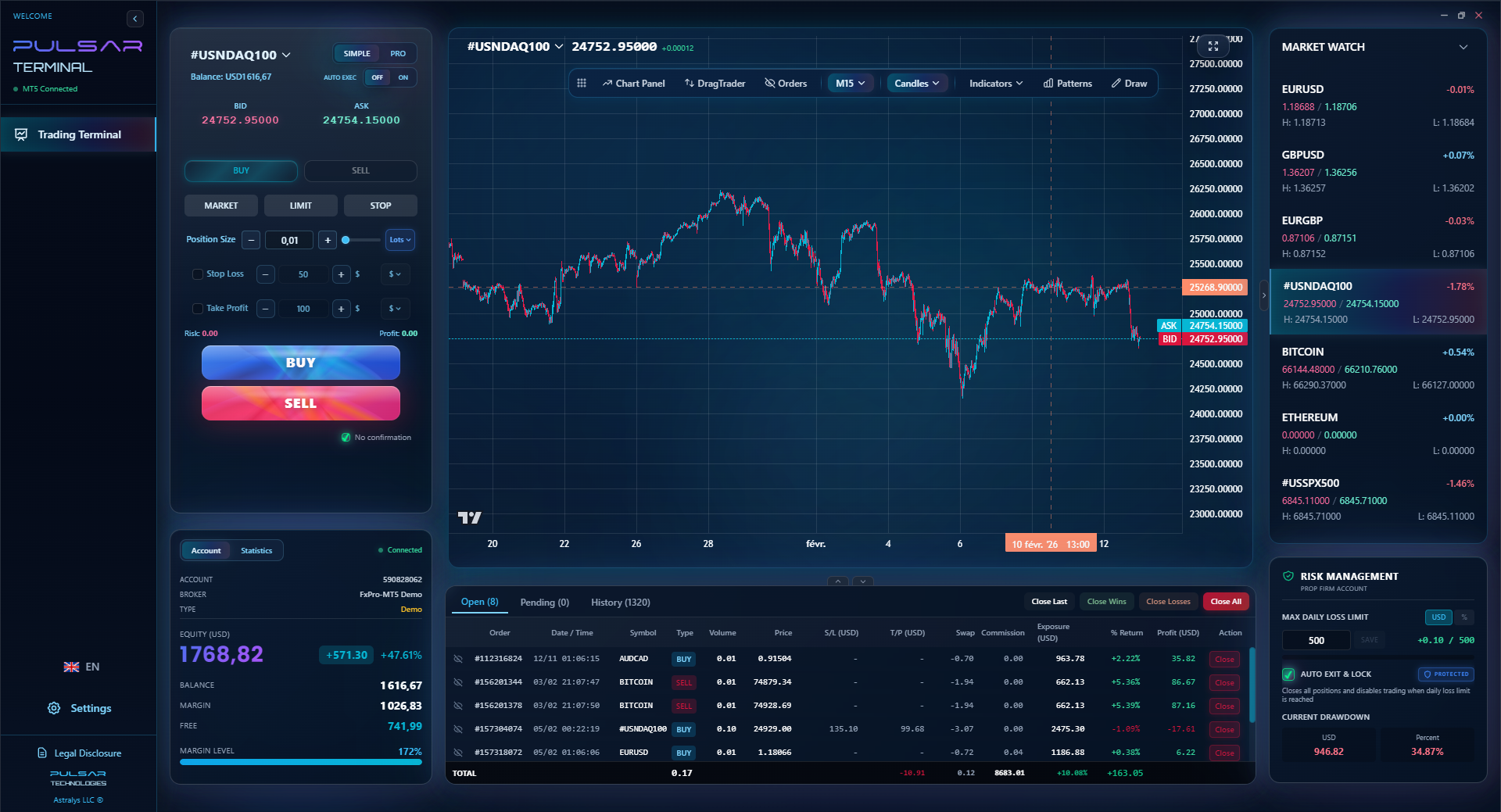
Managing multiple profit targets and trailing stops manually on mean reversion trades is a chore; Pulsar Terminal automates this directly on your MT5 platform, letting you focus on the analysis.
Pulsar Terminal
The all-in-one MT5 companion: drag-and-drop orders, multi-TP/SL, trailing stop, grid trading, Volume Profile, and prop firm protection. Used by 1,000+ traders daily.
“The FSCA's 30:1 use cap is a blessing for this strategy. It prevents you from over-leveraging into a trade that hasn't yet finished its extreme move.”
Pure mean reversion can be lonely. Combining it with other concepts creates a more strong system.
Mean Reversion within a Trend: This is my favorite hybrid. Identify the primary trend using the 200-day SMA or a trendline. Then, only take mean reversion signals in the direction of the trend on a lower timeframe. In an uptrend, you only look for buy setups when the market is oversold on the 4H chart. You're not fighting the tide, you're surfing the pullbacks. This is the core of many successful swing trading approaches.
Using Support and Resistance: A mean reversion signal is far more powerful if it occurs at a major historical support or resistance level. If EUR/USD becomes oversold (RSI < 30) right at a key support level that has held for months, the probability of a bounce is much higher. The support zone defines the 'mean' the price is reverting to.
Volume Confirmation: While harder in spot forex, if you see an extreme price move on declining volume, it suggests a lack of conviction. A reversion move that begins on increasing volume is more likely to have legs. I watch for this, especially when using a broker with good volume data like Pepperstone on their Razor account.
The goal isn't complexity. It's confluence. The more independent reasons you have for a trade, the higher its potential edge. A mean reversion signal at a support level, in line with the larger trend, is a trade worth taking a bit more size on (though still within your 1% risk rule!).
💡 Winston's Tip
A successful mean reversion trader has the patience of a heron and the exit speed of a mongoose. Most people get that backwards - they're impatient to enter and slow to exit a loser.
This isn't a strategy for everyone. It requires patience, discipline, and a high tolerance for being early.
You might like it if:
- You have the patience to wait for clear, high-probability setups (sometimes days between trades).
- You're comfortable being wrong and taking small losses frequently.
- You're disciplined with risk management and never deviate from your plan.
- You enjoy the analytical side of trading, studying charts and indicators.
You should avoid it if:
- You need action and want to trade every day. You'll overtrade and force bad setups.
- You can't handle a trade moving against you initially (which it often will).
- You're tempted to move your stop-loss further away 'just this once.'
- You're looking for a get-rich-quick scheme. This is a grind.
For South Africans, consider starting on a major pair with a micro account. Get a feel for the rhythm without ZAR's wild volatility. Practice the entry and exit rules in a demo until they're second nature. And remember, the goal isn't to be right on every trade. The goal is to have a positive expectancy over dozens of trades, with your winners being larger than your losers. That's how a mean reversion strategy forex, done right, slowly builds capital over time.
FAQ
Q1Is mean reversion trading legal in South Africa?
Yes, using a mean reversion strategy is a legal trading methodology. However, you must trade through a regulated broker. The FSCA is the main regulator, and they have rules like a 30:1 use limit for retail clients. Also, remember that South African exchange control regulations technically prohibit residents from speculating directly against the Rand (ZAR), so many traders use the international entities of brokers.
Q2What's the best timeframe for mean reversion in forex?
It depends on your style, but the 4-hour and daily charts are generally the most reliable for spotting meaningful extremes. Lower timeframes like the 15-minute or 1-hour are noisy and lead to many false signals, which can be costly due to the spread. For ZAR pairs, I strongly recommend sticking to the daily chart or higher to avoid being whipsawed by volatility.
Q3How do I know if a move is an 'extreme' and not just the start of a new trend?
There's no surefire way, which is why risk management is critical. Look for confluence: price closing outside Bollinger Bands, RSI in extreme territory (and preferably showing divergence), and the move happening as a sharp spike rather than a steady grind. Also, check the higher timeframe trend. A mean reversion signal that goes against a strong daily chart trend is far riskier.
Q4What's a realistic win rate with a mean reversion strategy?
A well-executed mean reversion strategy can have a win rate between 55% and 70%. However, don't focus on win rate alone. The key is your risk-to-reward ratio. If you risk 30 pips to make 45, a 60% win rate is very profitable. But if your wins are only 15 pips and your losses are 30, even a 70% win rate will lose you money over time.
Q5Can I use mean reversion for scalping?
You can, but it's very difficult and requires razor-sharp execution. The spreads become a much larger percentage of your profit target, and the noise on low timeframes leads to many false signals. I don't recommend it for beginners. If you're interested in fast-paced trading, study a dedicated scalping strategy built for that environment, rather than trying to force mean reversion onto a 1-minute chart.
Q6How does the FSCA's 30:1 use affect this strategy?
It's a positive constraint. Mean reversion trades often need wider stop-losses to survive volatility. High use would tempt you to use a tight stop to trade a larger position, which would get you stopped out constantly. The 30:1 limit forces more sensible position sizing. For this strategy, I often use even less use - 10:1 or 15:1 - to give my trades plenty of room.
Q7What's the biggest psychological challenge with this strategy?
Being early and watching the trade go against you before it turns. It requires immense faith in your system to see a 20-pip loss when you're short, knowing your stop is 40 pips away, and not panicking. You have to trust your analysis that the extreme move is exhausted, even as price briefly pushes further. This is where a rock-solid trading plan is your only anchor.
Prof. Winston's Lesson
Key Takeaways:
- ✓Wait for the close back inside the Bollinger Band before entering.
- ✓Only fade the trend on lower timeframes, not the primary trend.
- ✓Never risk more than 1% per trade, regardless of conviction.
- ✓Use a 1:1.5 risk-to-reward ratio as a minimum target.
How useful was this article?
Click a star to rate
Weekly Trading Insights
Free weekly analysis & strategies. No spam.
About the Author
David van der Merwe
Emerging Markets Trader
Johannesburg-based trader with 11 years in emerging market currencies. Specializes in ZAR pairs, FSCA-regulated trading, and South African market analysis.
Comments
Risk Disclaimer
Trading financial instruments carries significant risk and may not be suitable for all investors. Past performance does not guarantee future results. This content is for educational purposes only and should not be considered investment advice. Always conduct your own research before trading.
You Might Also Like

Cara Trading Forex Sukses: 7 Prinsip dari Trader Profesional
Cara trading forex sukses dengan 7 prinsip trader pro: manajemen modal, disiplin, journal trading, backtest. Data nyata, bukan janji profit palsu.
Jam Trading Forex Terbaik untuk Trader Indonesia: Panduan Lengkap dengan Tabel Waktu
Panduan jam trading forex untuk trader Indonesia. Tabel 4 sesi dunia, jam emas 20:00-00:00, sesi mana yang harus dihindari. Data akurat + tips dari trader berpengalaman.
Top 5 Sàn Forex Uy Tín Nhất 2026: Review Jujur dari Trader Indonesia
Top 5 sàn forex uy tín 2026 untuk trader Indonesia. Review jujur: spread, deposit, withdraw, dukungan lokal. Exness, XM, IC Markets & lebih.
Get Pulsar Terminal
All these calculators are built into Pulsar Terminal with real-time data from your MT5 account. One-click position sizing, automatic risk management, and instant calculations.
Get Pulsar Terminal