


I remember staring at my screen in 2018, convinced the USD/ZAR was about to collapse.

David van der Merwe
Emerging Markets Trader ·  South Africa
☕ 9 min read
What you'll learn:
I remember staring at my screen in 2018, convinced the USD/ZAR was about to collapse. I'd gone all-in short at R14.85, betting big on a bearish move. The pair dipped to R14.70, and I was up a nice chunk of change. Then, out of nowhere, a political headline hit the wires. The rand reversed. Hard. It didn't just erase my profit; it blew past my stop loss and kept going. I watched, frozen, as it climbed to R15.20. That trade cost me over R8,000. I'd misunderstood what a true bearish trend required. It's not just a feeling. It's a specific set of conditions, and getting it wrong hurts.
Let's cut through the jargon. In forex, 'bearish' means one thing: you believe the price of a currency pair is going down. Think of a bear swiping its paw downward. That's the visual. It's a market sentiment dominated by sellers. More people want to sell the base currency than buy it, so its value falls relative to the quote currency.
For us in South Africa, a bearish view on USD/ZAR means you think the US dollar will weaken against the rand. You'd sell the pair. If you're right and the price drops from, say, R18.50 to R18.00, you've made 50 cents per dollar traded (that's 500 pips). That's the core profit mechanism of a bearish trade: sell high, buy back lower.
It's crucial to separate this from just a 'dip' or a pullback. A true bearish trend is sustained. It has conviction. I learned this the hard way with that USD/ZAR trade. I sold a pullback in a larger ranging market, not an established downtrend. That's a rookie mistake that confuses a temporary drop with a genuine bearish shift.

Warning: Calling a market 'bearish' after two red candles is a great way to lose money. Real bearish trends have structure. They make lower highs and lower lows consistently. If you're not seeing that pattern, you're probably just catching a falling knife.

💡 Winston's Tip
A bear isn't defined by one swipe. It's defined by its relentless, downward pressure. Wait for the sequence of lower highs to appear before you call the market bearish.
So how do you know it's truly bearish and not just a blip? You look for evidence. I use a three-point checklist, and I won't enter a short trade unless at least two are screaming 'sell'.
Price Action is King
Nothing beats pure price. Draw your trendlines. In a bear market, every rally fails to make a new high. Each peak is lower than the last (lower high), and each drop sinks to a new low (lower low). Draw a line connecting those lower highs. If the price keeps respecting that line as resistance, you've got a bearish trend channel. USD/ZAR did this beautifully in late 2025, sliding from R19.40 to R18.20 in a clean channel.
Indicator Confirmation
Price tells you what is happening; indicators can suggest why and how strong it is. I keep it simple:
- Moving Averages: The price trading consistently below a key moving average (like the 50 or 200-period) is a classic bearish sign. When the shorter-term average (e.g., 20) crosses below the longer-term one (e.g., 50), that's a 'death cross' - a strong bearish signal.
- The RSI indicator: If the RSI is stuck below 50 and especially if it's failing to reach 60 on rallies, momentum is bearish. An RSI reading below 30 can signal an oversold condition, but in a strong trend, it can stay there for ages.
- The MACD indicator: When the MACD line (the fast one) is below the signal line and both are below the zero line, it confirms bearish momentum.
The Sentiment Gauge
Sometimes, the market feels overwhelmingly heavy. News is bad, economic data from the country of the base currency is weak, and the talking heads on CNBC Africa are pessimistic. This fundamental overlay can cement a technical bearish view. But be careful - sentiment can turn on a dime with one speech from the SARB or the Fed.
“A losing trade is a losing trade. Take the small loss and live to fight another day.”
Okay, you've identified a bearish market. Now what? You don't just jump in. You need a plan that fits your style and risk tolerance.
For the Patient Trader: Swing Trading the Downtrend
This is my bread and butter. I look for those 'lower high' points in a established downtrend to enter short positions. My last successful swing was on EUR/USD. I saw it reject the 1.0850 area (a previous support-turned-resistance), formed a clear lower high on the 4-hour chart, and entered short at 1.0835. I rode it down for 180 pips over a week.
Swing trading a bear market means you're holding for days or weeks, aiming for the meat of the move. Your stop loss goes above the most recent swing high, and you trail it down as new lows are made. It requires patience and the stomach to sit through counter-trend bounces.
For the Quick-Handed: Bearish Scalping
If you've got nerves of steel and love action, bearish scalping strategy can work. You're looking to profit from small, intraday downward moves. This often involves trading around key news releases or using very short-term charts (1-minute, 5-minute) to catch momentum breaks.
I'll be honest, I'm not a great scalper. I tried it early on with GBP/ZAR. The spreads are wider on exotic pairs, and the volatility ate me alive. I'd scalp for a 15-pip gain, but the 5-pip spread and a sudden 20-pip spike would wipe me out. It's a tough game. If you want to try it, stick to majors like EUR/USD where the spread definition is tight, often below 1 pip on good ECN accounts.

Pro Tip: No matter your strategy, always use a position size calculator. In a volatile bear move, prices can slide fast, but they can also snap back violently. If your position is too big, a single sharp rally can trigger a margin call. I never risk more than 1-2% of my account on any single bearish bet.
Trading from SA adds unique layers. Our market hours, our currency, our regulations - they all matter.
First, regulation. You must trade with an FSCA-regulated broker. It's non-negotiable for fund safety. Brokers like Exness (FSP No. 51024) and XM (FSP No. 49976) are popular choices here because they're regulated locally and understand our market. Their platforms offer ZAR-based accounts, which simplifies things.
When trading ZAR pairs like USD/ZAR or EUR/ZAR, remember the spread. It's wider than on EUR/USD. A 50-pip spread on USD/ZAR is normal. That means the price needs to move 50 pips in your favour just for you to break even on a round-trip trade. You need a larger bearish move to be profitable. This makes short-term scalping on these pairs exceptionally difficult.
Funding and withdrawals are easy if your broker supports local methods. EFTs are standard, and many now accept Ozow and PayFast. Withdrawing profits in rand to your FNB or Standard Bank account is usually seamless with a proper FSCA broker.
Finally, watch the SA economic calendar. SARB interest rate decisions, inflation data, and political stability reports can cause massive, sudden bearish or bullish moves in ZAR pairs. A bearish view on USD/ZAR is a bullish view on the rand's strength, so you need to watch for SA-positive news.
💡 Winston's Tip
The most expensive lesson in trading is trying to prove you're right. If your bearish short is losing and you're thinking of adding more, you're no longer trading - you're gambling. Close it.
“The goal isn't to trade every potential bear move; it's to trade the high-probability ones with strict discipline.”
Let me save you some money by sharing where I've gone wrong.
Mistake 1: Shorting Too Early. This is the classic. You see a top forming, get excited, and jump in short while the price is still making higher highs. You're not bearish; you're early. The market grinds higher, stops you out, and then turns down. Wait for the structure to confirm. Let it make that first lower low.
Mistake 2: Ignoring the Higher Timeframe. You see a beautiful bearish setup on the 15-minute chart, but the weekly chart is in a raging bull trend. Guess who wins? The bigger trend. Always zoom out. A bearish move on a small timeframe within a larger bull market is just a buying opportunity for bigger players.
Mistake 3: Not Having an Exit Plan. You caught the bearish move! It's down 200 pips. Greed whispers, 'It'll go another 200.' Then it reverses. You watch your profit vanish. Decide your profit target before you enter. Use a risk-reward ratio of at least 1:2. If you risk 50 pips, aim for 100 pips of profit. And consider using a trailing stop to lock in profits as the move extends.
Mistake 4: Averaging Down on a Losing Short. This is a killer. Your short trade goes against you. Instead of admitting you're wrong, you 'double down' and add more shorts at a worse price, thinking you're lowering your average entry. In a true bullish reversal, this will destroy your account. A losing trade is a losing trade. Take the small loss and live to fight another day.
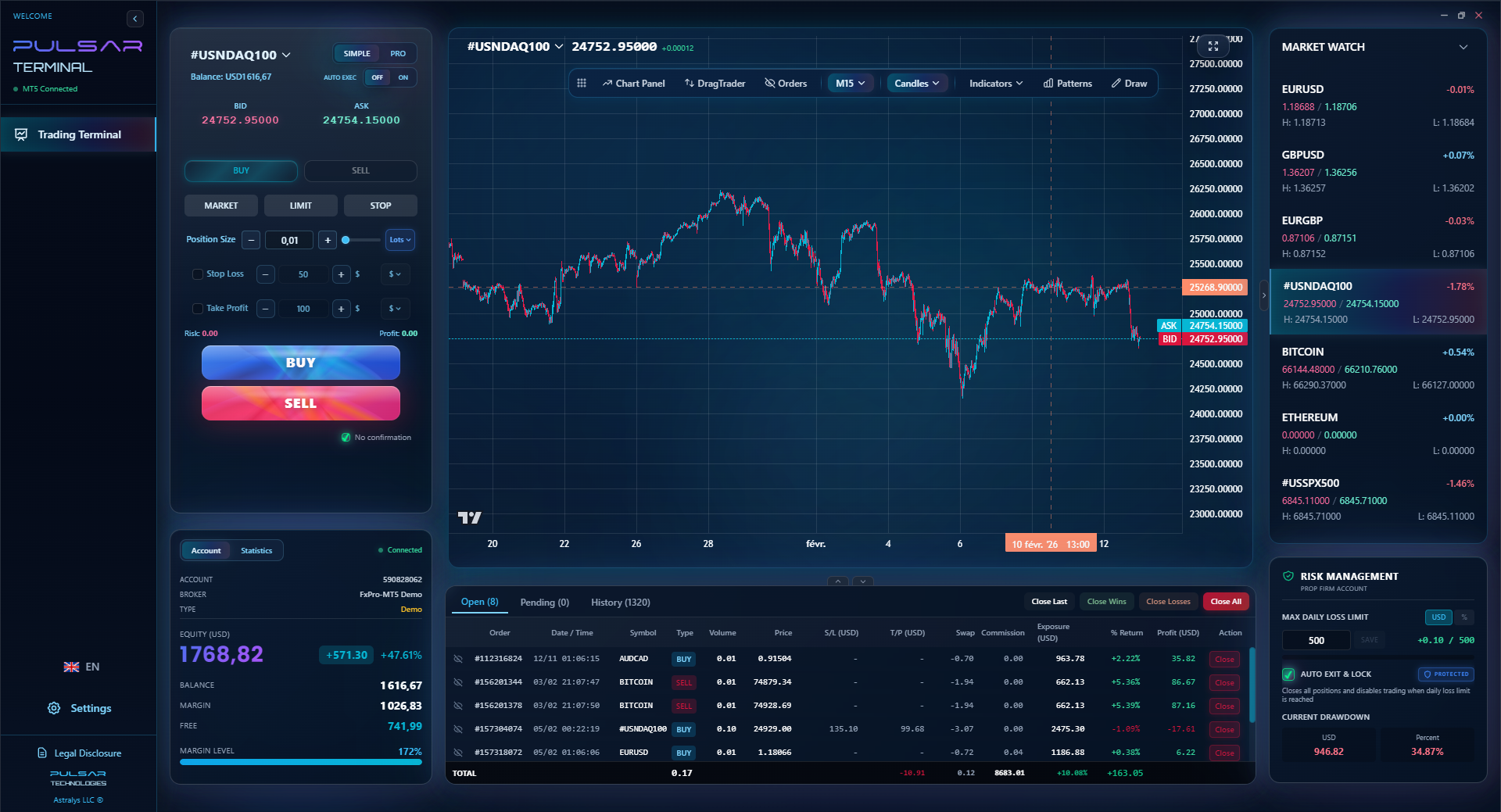
Managing multiple short positions and trailing stops in a fast bear market is complex, but tools like Pulsar Terminal automate this directly on your MT5 platform.
Pulsar Terminal
The all-in-one MT5 companion: drag-and-drop orders, multi-TP/SL, trailing stop, grid trading, Volume Profile, and prop firm protection. Used by 1,000+ traders daily.
Before you click 'sell,' run through this list. It's the condensed version of everything we've covered.
- Trend Confirmation: Is the price making consistent lower highs and lower lows on your chosen timeframe? (Yes/No)
- Higher TF Alignment: What is the trend on the next timeframe up (e.g., if trading 4-hour, check the daily)? Is it at least not strongly bullish against your idea?
- Indicator Back-Up: Are key indicators (like price below MA, RSI < 50) supporting the bearish momentum?
- Entry Zone: Are you entering at a logical level? (e.g., a retest of a broken support level, now acting as resistance, or a rejection from a downward trendline).
- Risk Defined: Is your stop loss placed at a logical point that, if hit, proves your bearish thesis wrong? (Typically above the last swing high).
- Reward Defined: Is your take-profit target set with a solid risk-reward (1:2 or better)?
- Position Size: Have you calculated your position size so this trade risks no more than 1-2% of your account? Use a position size calculator.
If you can't tick at least 5 of these, especially 1, 4, 5, and 7, step away. The bearish opportunity isn't clean enough. There will always be another setup. The goal isn't to trade every potential bear move; it's to trade the high-probability ones with strict discipline. That's how you survive and eventually thrive in the forex market, right here from South Africa.
FAQ
Q1What's the difference between 'bearish' and a simple price drop?
A price drop is a single event. 'Bearish' describes a sustained trend with a structure of lower highs and lower lows. A drop could be a brief pullback in a bull market, while a bearish trend implies selling pressure is in control over time.
Q2As a South African, should I focus on trading ZAR pairs like USD/ZAR?
Not exclusively. While it's familiar, ZAR pairs often have wide spreads (50+ pips) and can be extremely volatile due to local politics. It's often easier and cheaper to learn the ropes trading majors like EUR/USD or XAU/USD (Gold), which have much tighter spreads and more predictable liquidity, before tackling the exotic ZAR pairs.
Q3I'm bearish on the Euro. Which pair should I trade?
If you believe the Euro will weaken, you want to sell it against a currency you think will stay strong or strengthen. EUR/USD is the most liquid and common pair for this view. You'd sell EUR/USD, profiting if the pair goes down. Check our specific EUR/USD guide for its unique behaviours.
Q4How does use affect a bearish trade?
use magnifies everything. On a winning bearish trade, it amplifies your profit in Rands. On a losing one, it amplifies your loss. With the FSCA's protective limits, use is still significant. A sharp counter-trend rally can wipe out a leveraged short position very quickly. Always use use cautiously and in line with your risk management.
Q5Can I use a bullish strategy in a bearish market?
Yes, but carefully. You'd be looking for counter-trend 'bounces' or pullbacks upwards within the larger downtrend. This is generally considered more advanced and risky, as you're trading against the dominant market direction. Most beginners should focus on trading with the bearish trend, not against it.
Q6What's the first thing I should do if my bearish trade goes wrong?
Look at your stop loss. If you placed it correctly (at a point that invalidates your idea), and the price hits it, you exit. Immediately. Do not move the stop, do not add more. The market told you your bearish thesis was wrong for now. Take the predefined loss, review what happened, and wait for the next clear setup.
Prof. Winston's Lesson
Key Takeaways:
- ✓Bearish means sustained selling pressure, not just a red candle.
- ✓Always confirm with lower highs & lower lows on the chart.
- ✓Wider ZAR pair spreads require larger moves for profit.
- ✓Never risk more than 2% on a single short trade.
- ✓Let your stop loss define your wrongness, not your ego.
How useful was this article?
Click a star to rate
Weekly Trading Insights
Free weekly analysis & strategies. No spam.
About the Author
David van der Merwe
Emerging Markets Trader
Johannesburg-based trader with 11 years in emerging market currencies. Specializes in ZAR pairs, FSCA-regulated trading, and South African market analysis.
Comments
Risk Disclaimer
Trading financial instruments carries significant risk and may not be suitable for all investors. Past performance does not guarantee future results. This content is for educational purposes only and should not be considered investment advice. Always conduct your own research before trading.
You Might Also Like

Cara Trading Forex Sukses: 7 Prinsip dari Trader Profesional
Cara trading forex sukses dengan 7 prinsip trader pro: manajemen modal, disiplin, journal trading, backtest. Data nyata, bukan janji profit palsu.
Jam Trading Forex Terbaik untuk Trader Indonesia: Panduan Lengkap dengan Tabel Waktu
Panduan jam trading forex untuk trader Indonesia. Tabel 4 sesi dunia, jam emas 20:00-00:00, sesi mana yang harus dihindari. Data akurat + tips dari trader berpengalaman.
Top 5 Sàn Forex Uy Tín Nhất 2026: Review Jujur dari Trader Indonesia
Top 5 sàn forex uy tín 2026 untuk trader Indonesia. Review jujur: spread, deposit, withdraw, dukungan lokal. Exness, XM, IC Markets & lebih.
Get Pulsar Terminal
All these calculators are built into Pulsar Terminal with real-time data from your MT5 account. One-click position sizing, automatic risk management, and instant calculations.
Get Pulsar Terminal