


Most Nigerian traders think free margin is just leftover cash.

Olumide Adeyemi
West African Trading Pioneer ·  Nigeria
☕ 12 min read
What you'll learn:
- 1What Free Margin Actually Is (And What It Isn't)
- 2Calculating Free Margin: Real Examples with Naira & Dollars
- 3Free Margin vs. Margin Level: Knowing the Difference Saves Accounts
- 4Why Free Margin Matters More for Nigerian Traders
- 5Practical Strategies to Manage Your Free Margin
- 6Free Margin in Practice: A Quick Look at Nigerian Brokers
- 7The Top Free Margin Mistakes (I've Made Them All)
Most Nigerian traders think free margin is just leftover cash. They're wrong, and that mistake is why so many accounts get wiped out before the market even blinks. Free margin isn't just a number on your MT4 screen, it's your financial lifeline, your risk buffer, and the single clearest warning sign you're about to get a margin call. I've seen traders with six-figure Naira balances ignore it and lose everything in a single volatile session. In this guide, I'll break down the real meaning of free margin in forex, show you exactly how to use it to survive Nigeria's unique market conditions, and share the brutal lessons I learned the hard way.
Let's cut through the broker jargon. Your free margin is the money in your trading account that's actually yours to use. It's not your total balance. It's not your profit. It's what's left after your broker takes its cut as collateral for all your open trades.
Think of it like this: you walk into a bureau de change on Allen Avenue with ₦500,000. You want to buy $1000 worth of GBP/USD. The trader says, "Give me ₦50,000 as a deposit (margin), and I'll give you the position." Your used margin is that ₦50,000 held as collateral. Your free margin is the remaining ₦450,000 in your pocket. That ₦450,000 is what you can use for another trade, or what will absorb losses if your GBP/USD bet goes south.
The official formula is simple: Free Margin = Equity - Used Margin.

Warning: Equity is NOT your balance. Equity is your balance PLUS or MINUS any floating profit/loss from open trades. This is where new traders get tripped up. You see a green floating profit and think your free margin is huge, but if the market reverses before you close, that "profit" evaporates and your free margin shrinks instantly.
I learned this painfully in 2018. I had a $5,000 account with Exness, heavily long on EUR/USD. My floating profit was +$800, so my equity showed $5,800. My used margin was $500. I calculated my free margin as $5,300 ($5,800 - $500) and arrogantly opened another large position. Then, some unexpected ECB comments hit the wire. My profit vanished in minutes, turning into a -$300 loss. My equity crashed to $4,700, and my free margin - the real amount - plummeted to $4,200. I was suddenly over-leveraged and had to close a trade at a loss just to avoid a margin call. The meaning of free margin in forex, for me that day, was a slap in the face from reality.
“Free margin isn't just leftover cash, it's your financial lifeline and the clearest warning sign you're about to get a margin call.”
Theory is fine, but let's get practical with numbers you'll recognize. We'll run through two scenarios: one with a local Naira-denominated account and one with a standard USD account.
Example 1: The Naira Account (Using HFM's NGN Account)
Let's say you deposit ₦200,000 into an HFM Cent account. You decide to go long on USD/NGN (yes, you can trade that).
- Account Balance: ₦200,000
- You open 1 lot (100,000 units) of USD/NGN. The broker's margin requirement is 5%.
- Used Margin: 5% of ₦200,000 = ₦10,000
- You have no other trades, so your equity is still ₦200,000 (no floating P/L yet).
- Free Margin: ₦200,000 (Equity) - ₦10,000 (Used Margin) = ₦190,000
That ₦190,000 is your breathing room. Now, let's say the rate moves against you, and you have a floating loss of ₦25,000.
- New Equity: ₦200,000 - ₦25,000 = ₦175,000
- Used Margin: Still ₦10,000 (your collateral doesn't change with P/L).
- New Free Margin: ₦175,000 - ₦10,000 = ₦165,000
See how the loss came directly out of your free margin? That's it in action.
Example 2: The Standard USD Account (Trading EUR/USD)
You have $1,000 with IC Markets. You open a 0.5 lot position on EUR/USD.
- Balance: $1,000
- Margin required per lot: $400 (this varies by broker and use).
- Used Margin for 0.5 lots: $200
- Equity: $1,000
- Initial Free Margin: $1,000 - $200 = $800
Now, your trade goes well, and you have a floating profit of $150.
- New Equity: $1,000 + $150 = $1,150
- Used Margin: Still $200
- Free Margin with Profit: $1,150 - $200 = $950
That increased free margin gives you more cushion or allows another trade. But never forget, that $950 includes unrealized profit. It's not cash in hand. Always use a position size calculator to keep this straight.

Example: Quick Mental Check. If your Equity is $2,000 and your Used Margin is $1,500, your Free Margin is $500. If your floating losses reach $500, your Free Margin hits zero. That's the danger zone.

💡 Winston's Tip
Free margin is your oxygen tank. If you see it dropping fast, you're in a storm. Close a position, don't open another one. Greed kills more accounts than bad analysis.
“High use means tiny used margin, which makes your free margin look artificially huge. It's a trap that makes you feel rich while setting you up for a wipeout.”
This is critical. Free margin is an amount (like ₦50,000 or $200). Margin level is a percentage. Your broker doesn't call you when your free margin is low, they call you (or just close your trades) when your margin level hits their threshold.
Margin Level = (Equity / Used Margin) x 100%
Let's go back to our Naira example where we had a ₦25,000 loss.
- Equity: ₦175,000
- Used Margin: ₦10,000
- Margin Level: (₦175,000 / ₦10,000) x 100% = 1,750%.
That's super safe. Now, let's say you got greedy. With your initial ₦190,000 free margin, you opened more and more USD/NGN positions until your Used Margin ballooned to ₦160,000. Your Equity is still ₦175,000.
- New Margin Level: (₦175,000 / ₦160,000) x 100% = 109.4%.
You're now skating on thin ice. Most brokers have a margin call level at 100% and a stop out level (where they automatically close trades) at 20-50%. If your equity falls just a bit more, you're in trouble.

Pro Tip: Watch Margin Level, not just Free Margin. Set a personal red line at 150%. If your margin level dips below that, you're over-exposed. Close some positions or add funds. Never let it approach 100%. I treat 120% as a panic button.
A buddy of mine learned this trading gold (XAU/USD) with XM. He was focused on his free margin of $1,000, thinking he was fine. He didn't notice his margin level had crept down to 105% because his used margin was so high. A $50 spike against his position triggered an automatic stop-out on his largest trade. He lost it all because he ignored the percentage.
“High use means tiny used margin, which makes your free margin look artificially huge. It's a trap that makes you feel rich while setting you up for a wipeout.”
Our market isn't like trading from London or New York. We have unique pressures that make managing free margin a survival skill.
1. Currency Volatility & The Naira: You're trading global pairs, but your life is in Naira. When the CBN makes a move, like the recent shift to a "willing-buyer, willing-seller" framework, volatility can be insane. A 500-pip swing in USD/NGN can happen in a week. If you're trading majors like EUR/USD, you might think you're safe, but such huge moves in your home currency can affect broker deposits/withdrawals and your own psychology. Big volatility eats free margin for breakfast.
2. High use Traps: Brokers here offer crazy use - 1:1000, 1:2000, even "unlimited." It's a double-edged sword. High use means tiny used margin, which makes your free margin look artificially huge. You feel rich and open more positions. But the risk on those positions is still full-sized. A small move against you can wipe out that inflated free margin and your equity in seconds. That high use is why your margin call comes out of nowhere.
3. Payment Delays: If your free margin hits zero and you get a margin call, you need to fund the account FAST to save your positions. With bank transfers taking time and card issues common, you might not be able to deposit quickly enough. That means your carefully planned trades get liquidated by the broker's system. You need a bigger free margin buffer than a European trader just to account for funding friction.
4. Tax Implications: Remember, profits are subject to 10% Capital Gains Tax. If you're calculating your real profit for tax purposes, you need to factor in that successful trades that grew your free margin will eventually have a 10% haircut paid to FIRS. Don't count all that free margin as spendable profit.
💡 Winston's Tip
Nigerian traders love high use. It's the fast lane to a margin call. Cap your use at 1:100 yourself, no matter what the broker offers. Your free margin will thank you.
“If your free margin drops by 5% from the day's starting equity, you must stop trading for the day. Full stop. Discipline saves accounts.”
Knowing what free margin is isn't enough. You need a system to manage it. Here's what works for me.
1. The 5% Rule: Never let your Used Margin exceed 5% of your total account Equity. If you have ₦500,000, your used margin across all trades should be ₦25,000 or less. This automatically guarantees you have a massive 95% free margin buffer. It forces you to trade small, which is boring but profitable over time. This rule alone would have saved me 80% of my early losses.
2. Use a Stop-Loss on Every. Single. Trade. This is non-negotiable. A stop-loss defines your maximum loss on a trade before you even enter. This lets you calculate the worst-case impact on your free margin. If a potential loss would drop your free margin below your comfort zone, reduce your position size.
3. Monitor Margin Level Religiously: Have it displayed on your main chart. As I said, my panic level is 120%. My close-positions level is 150%. It's on my screen at all times.
4. Scale In, Don't Dump In: Instead of opening one huge position, open smaller ones at different price levels. This averages your entry and uses margin more gradually. If the trade goes against you early, your used margin (and risk) is lower. This is a core concept in grid trading (though grids come with their own risks).
5. The Prop Firm Hack: If you're doing a prop firm challenge, they have strict daily loss limits (like 5%). Your free margin is your key metric here. If your free margin drops by 5% from the day's starting equity, you must stop trading for the day. Full stop. Tools that automate this shutdown can save your challenge account. It's about discipline, not just analysis.
Pro Tip: After a big win, withdraw your profits. Seriously. Move 20-30% of your net profit out of your trading account. This physically reduces your balance and your available free margin, preventing you from reckless over-trading on a winning streak. It's the best form of forced discipline.
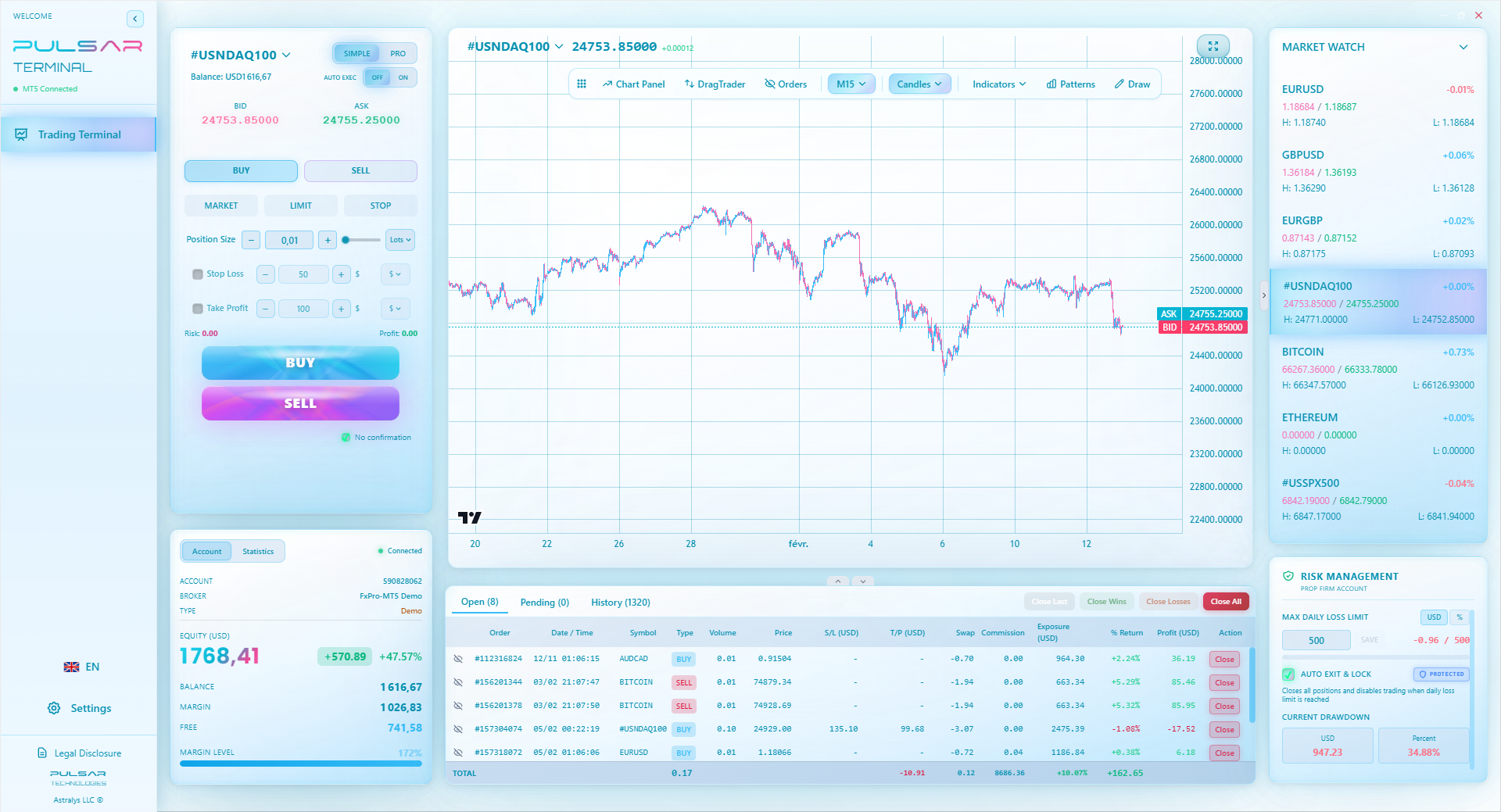
Managing free margin requires strict trade management, and Pulsar Terminal automates this with features like one-click breakeven stops and partial closures to lock in profit and free up margin directly on your MT5 chart.
Pulsar Terminal
The all-in-one MT5 companion: drag-and-drop orders, multi-TP/SL, trailing stop, grid trading, Volume Profile, and prop firm protection. Used by 1,000+ traders daily.
“If your free margin drops by 5% from the day's starting equity, you must stop trading for the day. Full stop. Discipline saves accounts.”
Not all brokers treat margin the same way. Here’s a quick reality check on a few popular ones for Nigerian traders. Remember, lower minimum deposits and higher use can tempt you into poor free margin management.
| Broker | Min. Deposit (Approx.) | Max use (Typical) | Key Point for Free Margin |
|---|---|---|---|
| HFM | ₦4,000 (processor min) | 1:2000 | Offers NGN accounts. High use means tiny used margin, making free margin deceptively large. Risk is magnified. |
| Exness | $10 | 1:Unlimited | "Unlimited" use is a marketing gimmick. You can use almost no margin, but your free margin will evaporate instantly if you're wrong. Extreme danger for beginners. |
| XM | $5 | 1:1000 | Low minimums are accessible, making it easy to open an account with too little capital. With $10, even 0.01 lots can use a big chunk of margin. |
| IC Markets | $200 | 1:500 | Higher minimum deposit filters out some recklessness. Their raw spreads are good, but remember to factor in commission as a cost that reduces your equity (and thus free margin). |
| Pepperstone | $0 | 1:400 (under SCB) | Sensible use caps compared to others. Their Razor account has tight spreads, which helps because wider spreads eat into your equity on entry. |
The lesson? Don't choose a broker just for high use or low minimums. Choose one that offers the tools (like clear margin reports) and sensible defaults that help you manage your free margin effectively. I started with the craziest use I could find and paid for it. Now I use Pepperstone and cap my own use at 1:100, regardless of what they offer.
💡 Winston's Tip
The best way to increase free margin? Take profits. A closed winning trade turns risky floating equity into safe, usable balance. Be a profit-taker, not a dreamer.
“The meaning of free margin in forex is about respect for the market's power and the mathematical reality that if you don't guard this number, you won't be trading for long.”
Let me save you some money and heartache. Here are the classic errors that drain free margin.
Mistake 1: Adding to a Losing Position (Averaging Down). This is the killer. Your EUR/USD trade is down 50 pips. "It'll come back," you think, and you double your position to lower your average entry. You've just DOUBLED your used margin on a losing trade. Your free margin gets hammered twice: first by the initial loss, second by the new margin commitment. One more leg down and you're staring at a margin call. I turned a $200 loss into a $2,000 catastrophe doing this in 2015.
Mistake 2: Ignoring Overnight Financing (Swap Rates). You hold a trade over Wednesday night (when most swaps are tripled). Those small daily charges get deducted from your balance. Over time, they slowly erode your equity, and thus your free margin. It's a drip-feed loss you don't notice until your buffer is gone.
Mistake 3: Trading Without a Clear Margin Plan. You just open trades based on "feeling" or signals. You have no idea what your total used margin is, or what your free margin would be if trade A hits its stop-loss and trade B goes against you. You're flying blind. Use a trading journal that tracks your potential maximum drawdown.
Mistake 4: Confusing Free Margin with "Available to Withdraw." You can't withdraw your free margin if it's supporting open positions. That money is still acting as a potential loss buffer. If you withdraw it, your margin level plummets, and the broker will likely issue an immediate margin call. Withdraw only from realized profits on closed trades.
The meaning of free margin in forex, in the end, is about respect. Respect for the market's power, respect for your own capital, and respect for the mathematical reality that if you don't guard this number, you won't be trading for long.
FAQ
Q1Is free margin the same as profit?
Absolutely not. Free margin includes your floating (unrealized) profits, but those profits are not yours until you close the trade. If the market reverses, that profit disappears from your free margin. Only realized profits from closed trades are actual profit.
Q2What happens when my free margin reaches zero?
When free margin hits zero, your equity equals your used margin. This means you have no buffer left to absorb further losses. Your broker will then issue a margin call, demanding you deposit more funds immediately. If you don't, they will start automatically closing your losing positions (a 'stop out') to bring your margin level back above their required threshold.
Q3What is a good free margin level for a beginner in Nigeria?
Aim to keep your Used Margin below 5% of your account Equity. This means your Free Margin should always be 95% or more of your equity. For a ₦100,000 account, don't let your used margin exceed ₦5,000. This gives you a huge ₦95,000 buffer to withstand volatility and learn without constant panic.
Q4Can I increase my free margin without depositing more money?
Yes, by closing profitable trades (turning floating profit into real balance), or by closing some losing trades to free up the used margin they're holding. You can also adjust use on new trades (lower use uses more margin per lot, so it's not helpful), but the best way is to manage your open positions and take profits strategically.
Q5Do swap rates affect my free margin?
Yes, indirectly. Swap rates (overnight financing charges) are deducted from or added to your account balance daily. This changes your Equity. Since Free Margin = Equity - Used Margin, any change in Equity from swaps will change your Free Margin. It's usually small, but over time it matters.
Q6Why did my free margin go down even though my trade is in profit?
This can happen if you have multiple trades open. While one trade is in profit, another might be in a larger loss, dragging your overall equity down. Or, your broker might have increased margin requirements for the instrument you're trading due to higher volatility, increasing your Used Margin. Always check all your positions.
Q7Is trading forex with free margin legal in Nigeria?
Yes, trading forex with your own capital is 100% legal for individuals in Nigeria. The Central Bank of Nigeria (CBN) regulates the FX market, and you are allowed to use international brokers. Just remember to declare any profits for tax purposes (10% Capital Gains Tax typically applies).
Prof. Winston's Lesson
Key Takeaways:
- ✓Free Margin = Equity - Used Margin. Equity includes floating P/L.
- ✓Watch Margin Level (%), not just Free Margin ($). Set a 150% red line.
- ✓Never let Used Margin exceed 5% of your total account equity.
- ✓High use (1:1000+) is a free margin trap for Nigerian traders.
- ✓A stop-loss on every trade defines your maximum free margin drain.
How useful was this article?
Click a star to rate
Weekly Trading Insights
Free weekly analysis & strategies. No spam.
About the Author
Olumide Adeyemi
West African Trading Pioneer
One of Nigeria's most active forex trading educators. 8 years of experience trading from Lagos. Specializes in low-capital strategies and prop firm challenges for African traders.
Comments
Risk Disclaimer
Trading financial instruments carries significant risk and may not be suitable for all investors. Past performance does not guarantee future results. This content is for educational purposes only and should not be considered investment advice. Always conduct your own research before trading.
You Might Also Like

Cara Trading Forex Sukses: 7 Prinsip dari Trader Profesional
Cara trading forex sukses dengan 7 prinsip trader pro: manajemen modal, disiplin, journal trading, backtest. Data nyata, bukan janji profit palsu.
Jam Trading Forex Terbaik untuk Trader Indonesia: Panduan Lengkap dengan Tabel Waktu
Panduan jam trading forex untuk trader Indonesia. Tabel 4 sesi dunia, jam emas 20:00-00:00, sesi mana yang harus dihindari. Data akurat + tips dari trader berpengalaman.
Top 5 Sàn Forex Uy Tín Nhất 2026: Review Jujur dari Trader Indonesia
Top 5 sàn forex uy tín 2026 untuk trader Indonesia. Review jujur: spread, deposit, withdraw, dukungan lokal. Exness, XM, IC Markets & lebih.
Get Pulsar Terminal
All these calculators are built into Pulsar Terminal with real-time data from your MT5 account. One-click position sizing, automatic risk management, and instant calculations.
Get Pulsar Terminal