


I watched my screen in disbelief as my account equity dropped from ₦450,000 to ₦82,000 in under three hours.

Olumide Adeyemi
West African Trading Pioneer ·  Nigeria
☕ 12 min read
What you'll learn:
- 1Margin is Not Free Money: It's a Performance Bond
- 2The Key Terms: Margin, Equity, Free Margin, and The Killer – Margin Level
- 3use and Margin: Two Sides of the Same Dangerous Coin
- 4How Nigerian Rules and Reality Affect Your Margin
- 5Calculating Your Real Margin Needs: From Theory to Lagos Reality
- 6Practical Strategies to Manage Margin Risk and Survive
- 7The Three Biggest Margin Mistakes Nigerian Traders Make
I watched my screen in disbelief as my account equity dropped from ₦450,000 to ₦82,000 in under three hours. It was 2021, and I had a 'sure thing' short on GBP/JPY. With 1:500 use from my broker, I'd used almost all my free margin to open a huge position. A sudden news spike ripped through the market, and I got a margin call before I could even react. That ₦368,000 lesson taught me the brutal, real-world meaning of margin in forex. It's not free money. It's a risk manager's tool that, when misunderstood, becomes a guaranteed path to a zero balance. Let's break down what it really is, how it works with our Naira, and why getting it wrong is the number one reason traders here fail.
The biggest misconception in Lagos trading groups is that margin is extra buying power the broker gifts you. It's not. Think of it like a security deposit for an apartment. You don't own the apartment, but you put down a chunk of cash to show you're good for the rent and won't trash the place. In forex, the broker is lending you the bulk of the trade's value. Your margin deposit is your collateral, proving you can cover potential losses.
When you trade with 1:100 use, you're only putting up 1% of the position's total value as margin. The broker fronts the other 99%. This is why a $10,000 (roughly ₦14.5 million at current rates) trade might only need $100 in margin. Sounds great, right? The problem is, you are 100% liable for 100% of the losses on that full $10,000 position. Your tiny margin is just the first bit of your money that gets vaporized if the trade moves against you.

Warning: High use advertised by brokers like Exness or HFM (up to 1:2000) is a marketing tool, not a trading strategy. Using it fully is like driving a Formula 1 car in Lagos traffic - you will crash.
I learned this the hard way with that GBP/JPY trade. My margin was about ₦45,000. The loss that wiped out ₦368,000 came from the notional value of the trade - the full amount I controlled. The margin was just the entry fee to a much larger risk.
“Margin is not free money. It's a risk manager's tool that, when misunderstood, becomes a guaranteed path to a zero balance.”
Your trading platform shows these terms constantly. If you don't know what they mean in real time, you're flying blind.
Used Margin: This is the total collateral currently locked up in all your open positions. Open three trades, and the sum of their required margins is your Used Margin. It's gone from your available balance until you close the trades.
Equity: This is your account's real-time value. It's your Balance plus/minus your floating Profit/Loss. If you have a losing trade open, your Equity is less than your Balance. This is the most important number on your screen.
Free Margin: This is your available trading capital. It's calculated as Equity minus Used Margin. If Free Margin hits zero, you cannot open new positions. It's your breathing room.
The Margin Level: Your Account's Vital Sign
This is the percentage that decides if you stay in the game. The formula is:
Margin Level = (Equity / Used Margin) x 100%
Let's say you have ₦200,000 Equity and ₦40,000 Used Margin. Your Margin Level is (200,000 / 40,000) x 100 = 500%. Healthy.
Now imagine your trades go south. Your Equity drops to ₦50,000, but your Used Margin is still ₦40,000. Your Margin Level is now (50,000 / 40,000) x 100 = 125%. You're getting dangerously close to a margin call.
Most brokers have a Margin Call level at 100% and a Stop Out level around 20-50%. At 100%, you get a warning. At the Stop Out level, the broker starts automatically closing your losing positions, starting with the biggest loser, to protect their money. You don't get to choose. This is how accounts get liquidated.

Example: You deposit $200 (₦~290,000). Using 1:500 use, you buy 2 mini lots of EUR/USD. Required margin is maybe $80. Your Equity drops to $81 due to losses. Margin Level = (81 / 80) x 100 = 101.25%. One more small tick against you triggers a margin call. That's how fast it happens.
Understanding your margin level is non-negotiable. It's the single best gauge of your immediate risk.

💡 Winston's Tip
Margin is the rent you pay to occupy a risky position. The longer you stay and the bigger the space, the higher the rent. Ask yourself every hour: 'Is this trade still worth the rent?'
“High use advertised by brokers is a marketing tool, not a trading strategy. Using it fully is like driving a Formula 1 car in Lagos traffic - you will crash.”
use is the ratio. Margin is the cash requirement. They are inversely related. This is the core math every Nigerian trader must internalize.
| use Offered | Margin Requirement | What It Means for a $10,000 (1 mini lot) Trade |
|---|---|---|
| 1:10 | 10% | You need $1,000 of your own cash as margin. |
| 1:100 | 1% | You need $100 of your own cash as margin. |
| 1:500 | 0.2% | You need just $20 of your own cash as margin. |
See the temptation? With 1:500, your ₦29,000 can control a position worth ₦14.5 million. A 1% move in your favor yields a 500% return on your margin. But that 1% move against you wipes out your entire margin five times over. This is the asymmetry that destroys accounts. You're chasing 500% gains but are only ever one bad trade away from a 100% loss.
Local brokers and international ones serving Nigeria, like XM or IC Markets, often advertise these extreme leverages. They're legally allowed to offer them because they're regulated offshore. It's your job to exercise restraint. I now never use more than 1:30 use on my main account, regardless of what's offered. It forces me to commit meaningful capital to each idea, which filters out the low-conviction, reckless trades.
High use is particularly seductive with our volatile Naira pairs. Seeing USD/NGN move thousands of pips makes you think you can get rich quick. But that volatility will eat a highly leveraged position for breakfast. A proper swing trading approach with sensible use is far more sustainable than trying to scalp these wild moves.
“High use advertised by brokers is a marketing tool, not a trading strategy. Using it fully is like driving a Formula 1 car in Lagos traffic - you will crash.”
You can't talk about trading capital in Nigeria without discussing the practical hurdles. Our regulatory environment directly impacts how you fund your margin.
The Central Bank of Nigeria (CBN) does not allow local banks to help forex transactions for speculation. This means you can't just walk into Zenith or UBA, ask for forex to fund your Exness account, and get it. They'll say no. This pushes traders to use fintech bridges.
Common Funding Methods:
- Fintech Apps (Grey, Geegpay, etc.): You fund your Naira wallet, convert to a virtual USD balance, and transfer to the broker. Fees apply (1-3%), and processing can take hours.
- Cryptocurrency: Some traders use USDT (Tether) as a transfer medium. You buy USDT on a local exchange, send it to the broker's crypto address. Speed varies, and crypto volatility adds another risk layer.
- International Transfers: Possible but often slow, expensive, and may attract questions from your bank.
Why This Matters for Margin: If you get a margin call and need to deposit more funds to maintain your positions (a practice called 'meeting a margin call' which I generally advise against), you can't do it instantly. That transfer delay means your positions might be stopped out before your funds arrive. This makes managing your margin level before a crisis even more critical.
Also,, the CBN's new Nigeria Foreign Exchange Code and the Electronic Foreign Exchange Matching System (EFEMS) are about institutional, wholesale markets. They aim to bring transparency to the official rates. For you, the retail trader, it means the official and parallel market rates might behave differently, but you'll still be accessing the global spot market through your international broker.
Finally, remember the taxman. The FIRS expects 10% Capital Gains Tax on your net profitable withdrawals. When calculating your true profit for margin purposes, factor this in. A ₦1,000,000 profit isn't ₦1,000,000; it's ₦900,000 after tax. Your future margin calculations should be based on your post-tax equity.
💡 Winston's Tip
If you can't explain your margin level and its trajectory to a 10-year-old, you have no business having an open trade. Complexity in risk management is just disguised ignorance.
“Your Margin Level is the single best gauge of your immediate risk. If you don't know it in real time, you're flying blind.”
Let's move from theory to your MT4 screen. How much margin does a trade actually need? It depends on the pair, lot size, and your broker's specific requirements.
The Basic Formula: (Trade Size / use) = Required Margin in the Account's Currency
But brokers calculate it per pair. A standard lot is 100,000 units of the base currency.
Example 1: Trading EUR/USD with a USD Account
- You want to buy 1 standard lot (100,000 EUR) at 1:100 use.
- Margin = (100,000 / 100) = 1,000 EUR.
- But your account is in USD, so convert: 1,000 EUR * 1.0850 (EUR/USD rate) = $1,085 required margin.
Example 2: Trading USD/NGN with a USD Account (The Local Angle) This is where it gets interesting for us. Let's say USD/NGN is at 1450.00.
- You want to sell 1 mini lot (10,000 USD). use is 1:100.
- Margin = (10,000 / 100) = 100 USD.
- No conversion needed. Your margin is $100 (about ₦145,000).
But look at the pip definition value. On USD/NGN, a 1 pip move (0.01) on a mini lot is worth 100 NGN. A 100-pip move (common) is ₦10,000 profit or loss on just a $100 margin. That's a 10% move on the pair translating to a 1000% gain or loss on your margin. This is the extreme risk.

Pro Tip: Never calculate your position size based on 'how much margin I have left.' Always use a position size calculator based on your account equity and a fixed percentage risk per trade (e.g., 1%). Let the calculator tell you the lot size, and then you'll see the margin it requires. If the required margin looks tiny compared to your equity, you're probably using too much use.
I keep a simple spreadsheet. Before any trade, I plug in my entry, stop-loss, and account size. It tells me the max lot size to risk 1%. If that lot size requires margin that feels too small, I know I'm being tempted by use, not by the quality of the trade setup.
“Your Margin Level is the single best gauge of your immediate risk. If you don't know it in real time, you're flying blind.”
Knowing the meaning of margin in forex is useless without a system to manage it. Here’s what works, learned from blowing up and slowly rebuilding.
1. The 5% Rule: Your Used Margin should never exceed 5% of your total account Equity. If you have ₦1,000,000, never have more than ₦50,000 locked up as margin across all trades. This automatically limits your use and gives you a huge buffer against margin calls. It forces you to be selective.
2. Use a Lower use Cap: In your broker's settings, manually lower your account use from 1:1000 to 1:50 or 1:30. This isn't for the broker; it's for you. It removes the temptation in the heat of the moment.
3. Monitor Margin Level Religiously: I have my Margin Level displayed large on my chart. My personal rule: if it falls below 300%, I review all open positions and consider closing the weakest one. If it falls below 200%, I don't open any new trades until it's back above 300%. This creates a defensive circuit breaker.
4. Understand Broker Hierarchy: When markets go crazy and your Margin Level plummets, brokers don't close your positions randomly. They start closing the biggest losing position first to reduce required margin the fastest. Knowing this, you should never have one 'monster trade' that dwarfs all others. Diversify your risk across smaller positions.
5. Correlation is a Margin Killer: Opening multiple buys on EUR/USD, GBP/USD, and AUD/USD feels like diversification, but they're all correlated to USD strength. If the dollar rallies, all your positions lose at once, crushing your Equity and Margin Level simultaneously. Real diversification involves uncorrelated assets or different strategies.
Tools like advanced platforms can help manage this risk. For instance, setting a trailing stop or a breakeven order can automatically protect profits and free up margin without you staring at the screen. Some trading terminals automate this based on your rules, which is crucial when you can't be online 24/7.
These strategies turn margin from a threat into a measured tool. They move you from being a gambler hoping for a win to a manager controlling your exposure. It's the difference between surviving the next Naira volatility spike and being wiped out by it.
💡 Winston's Tip
The market doesn't care about your margin call. It has no mercy. Your broker's risk department has one job: protect the firm's capital, not yours. You are the only one looking out for your Naira.
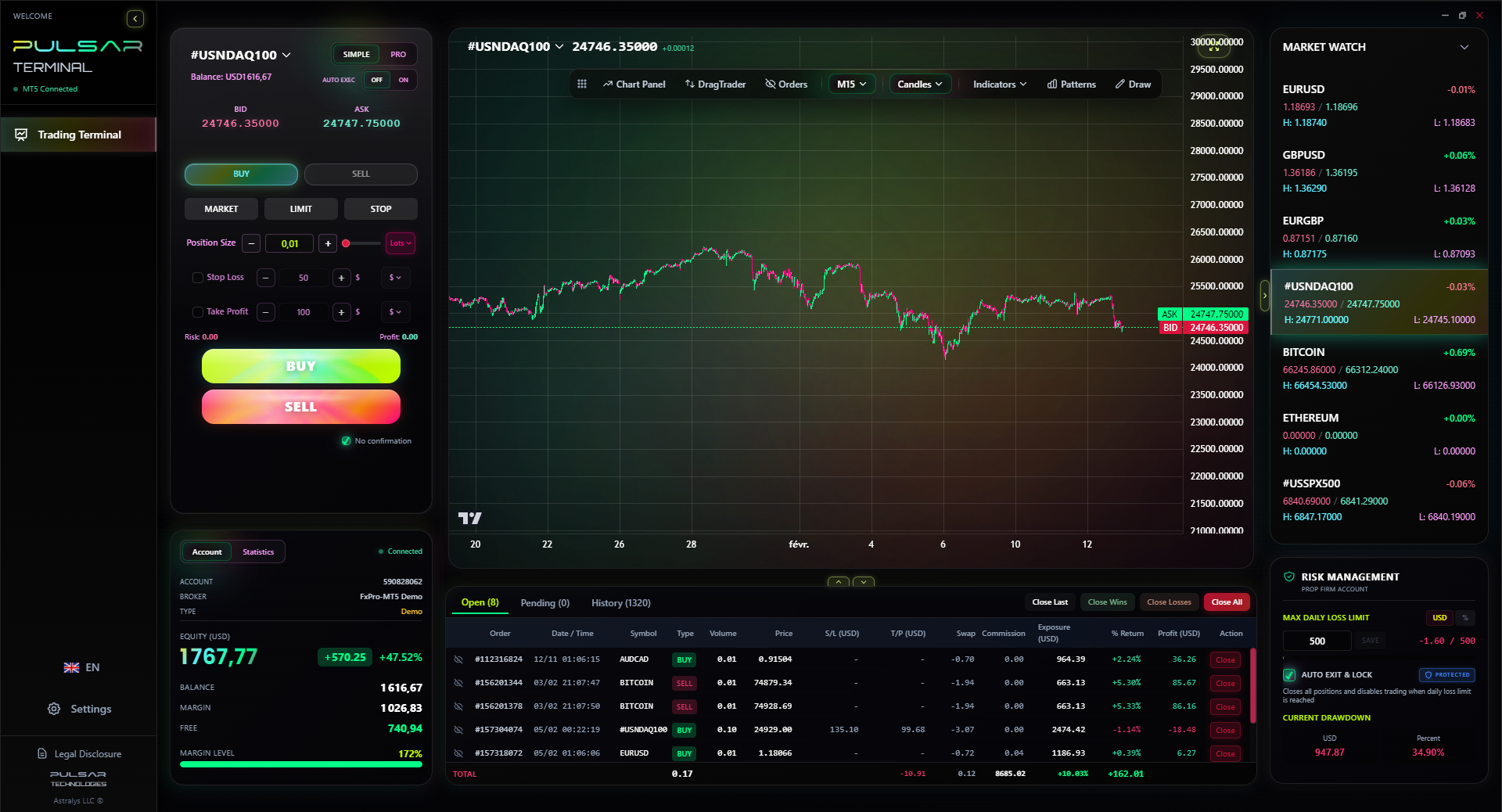
Managing multiple trades and their margin requirements manually is stressful; a tool that lets you set automated trailing stops and breakeven orders ensures your margin is protected even when you're offline.
Pulsar Terminal
The all-in-one MT5 companion: drag-and-drop orders, multi-TP/SL, trailing stop, grid trading, Volume Profile, and prop firm protection. Used by 1,000+ traders daily.
“Free Margin is not a challenge to be used up. It's your safety net. Leave it alone.”
After mentoring traders in Abuja and Port Harcourt, I see the same errors on repeat.
Mistake 1: Treating Free Margin as 'Spendable' Money. You see ₦150,000 in Free Margin and think, 'I have ₦150k to play with.' So you open another trade that uses ₦140k of it. Now your Used Margin is huge, and your Margin Level is precariously low. You've committed almost all your capital to the market. Free Margin is not a challenge to be used up. It's your safety net. Leave it alone.
Mistake 2: Chasing Losses with Increased use. You lose ₦50,000 on a trade. Emotionally, you want it back. So you take your remaining ₦200,000 and use even higher use on the next trade to 'make back the loss faster.' This is the death spiral. You're now taking more risk with a damaged psychological state and less capital. The probability of a second, catastrophic loss skyrockets.
Mistake 3: Ignoring the Currency of Margin. If your account is in USD but you're funding it with Naira, you face a hidden risk. If the Naira weakens significantly, the Naira value of your USD margin deposit shrinks. You might think you have enough, but in local purchasing power terms, you're poorer. Conversely, a strengthening Naira can help. Always be aware of which currency your risk is measured in - your local spending power.
Avoiding these mistakes is more important than finding the perfect MACD indicator or RSI indicator setting. Risk management, centered on understanding margin, is what separates those who last from those who are just passing through the market.
FAQ
Q1Is forex trading legal in Nigeria, and how does that affect my margin?
Yes, trading with your personal funds through international brokers is legal. However, the CBN prohibits Nigerian banks from facilitating forex for speculation. This doesn't make your trades illegal, but it affects how you deposit/withdraw. The practical impact on margin is that you cannot instantly top up your account during a margin call via bank transfer, making pre-emptive margin management absolutely critical.
Q2What is a good use level for a beginner in Nigeria?
Forget what the broker offers. Start with no more than 1:10 or 1:20. Yes, it seems boring. Your goal for the first year is not to get rich; it's to learn market mechanics and survive. With 1:10 use, a 100-pip loss on a standard lot costs you $1000 of your own $10,000 margin. With 1:100, the same loss wipes out a $1,000 margin deposit. The lower use forces discipline and gives you room to be wrong, which you will be.
Q3How do I calculate margin for pairs like GBP/NGN or EUR/NGN?
The principle is the same, but you must account for the cross-rate. If your account is in USD and you're trading GBP/NGN, the broker will first convert the margin requirement into GBP (based on the GBP/USD rate), and you'll see the USD equivalent. It's complex, which is why you should always use your trading platform's order window or a calculator. Input your lot size and use, and it will show the 'Margin Required' in your account currency before you click 'Buy' or 'Sell.' Never guess.
Q4What happens if I don't have enough margin to keep a trade open?
You will receive a 'Margin Call' notification when your Margin Level hits 100% (or your broker's specified level). This is a final warning. If your equity continues to fall and hits the 'Stop Out' level (often 20-50%), your broker's system will automatically start closing your open positions, beginning with the largest loser, until your Margin Level is back above the Stop Out level. You have no control over this process.
Q5Do I pay tax on the margin I use?
No. You pay Capital Gains Tax (10% to FIRS) on your net profitable withdrawals - your actual realized gains. The margin itself is just collateral. However, when calculating your trading capital and risk, you should be aware of the tax liability on future profits, as it reduces your net equity, which in turn affects your safe margin levels.
Q6Can I lose more money than I have in my account because of margin?
With a standard retail forex account, you generally cannot lose more than your account balance due to automatic stop-outs. However, in periods of extreme volatility (like a market 'gap' over the weekend), the price can jump past your stop-loss, resulting in 'slippage' and a loss larger than expected. While rare, this can technically create a negative balance. Most reputable brokers now offer 'negative balance protection' to ensure you don't owe them money, but always check your broker's policy.
Prof. Winston's Lesson
Key Takeaways:
- ✓Margin is collateral, not cost. You're liable for 100% of the loss.
- ✓Never let Used Margin exceed 5% of your account Equity.
- ✓Manually cap your use at 1:30 or lower, regardless of offers.
- ✓A Margin Level below 200% is a red alert. Close something.
- ✓Funding delays mean you must manage margin proactively, not reactively.
How useful was this article?
Click a star to rate
Weekly Trading Insights
Free weekly analysis & strategies. No spam.
About the Author
Olumide Adeyemi
West African Trading Pioneer
One of Nigeria's most active forex trading educators. 8 years of experience trading from Lagos. Specializes in low-capital strategies and prop firm challenges for African traders.
Comments
Risk Disclaimer
Trading financial instruments carries significant risk and may not be suitable for all investors. Past performance does not guarantee future results. This content is for educational purposes only and should not be considered investment advice. Always conduct your own research before trading.
You Might Also Like

Cara Trading Forex Sukses: 7 Prinsip dari Trader Profesional
Cara trading forex sukses dengan 7 prinsip trader pro: manajemen modal, disiplin, journal trading, backtest. Data nyata, bukan janji profit palsu.
Jam Trading Forex Terbaik untuk Trader Indonesia: Panduan Lengkap dengan Tabel Waktu
Panduan jam trading forex untuk trader Indonesia. Tabel 4 sesi dunia, jam emas 20:00-00:00, sesi mana yang harus dihindari. Data akurat + tips dari trader berpengalaman.
Top 5 Sàn Forex Uy Tín Nhất 2026: Review Jujur dari Trader Indonesia
Top 5 sàn forex uy tín 2026 untuk trader Indonesia. Review jujur: spread, deposit, withdraw, dukungan lokal. Exness, XM, IC Markets & lebih.
Get Pulsar Terminal
All these calculators are built into Pulsar Terminal with real-time data from your MT5 account. One-click position sizing, automatic risk management, and instant calculations.
Get Pulsar Terminal