


Every other 'metatrader 5 brokers list' you find online is a trap for Indian traders.

Rajesh Sharma
Senior Forex Analyst ·  India
India
☕ 12 min read
What you'll learn:
- 1The Legal Reality Check: What You Can Actually Trade
- 2The Real SEBI-Regulated MT5 Brokers
- 3The Offshore Illusion: Why They're Tempting & Dangerous
- 4Costs Breakdown: The Real Numbers (Legal vs. Offshore)
- 5MT5 on NSE: A Practical Guide to Setup & Trading
- 6Risk Management in a Regulated Box
- 7The Future: Is the Wall Coming Down?
- 8Final Verdict & Your Path Forward
Every other 'metatrader 5 brokers list' you find online is a trap for Indian traders. They'll happily list offshore brokers offering 500:1 use on EUR/USD, completely ignoring the fact that using them is illegal for you. I've watched too many traders get their accounts frozen or face legal notices because they followed bad advice. Let's set the record straight. This isn't just a list; it's a risk management guide that separates the legal, SEBI-regulated path from the dangerous, offshore gamble.
If you're in India and thinking about forex, forget everything you've seen on YouTube or international forums. Our market is walled off for a reason – to control capital outflow and protect retail investors (whether you think it's overprotective or not is a different debate).
The Reserve Bank of India (RBI) and SEBI are the only authorities that matter here. They've drawn a very clear, non-negotiable line.
Legal Trading (The Only Game in Town):
- Where: On recognized Indian exchanges – the National Stock Exchange (NSE), Bombay Stock Exchange (BSE), or the Metropolitan Stock Exchange (MSE).
- What: Currency derivatives (futures and options), not spot forex.
- Pairs: Primarily INR pairs. USD/INR is the big one. You can also trade EUR/INR, GBP/INR, JPY/INR. Some cross-currency futures like EUR/USD are available, but they are exchange-traded derivatives, not the spot market.
- use: Capped at around 20:1. This isn't a suggestion; it's the rule.
Illegal Trading (The Offshore Trap):
- What: Sending money to a broker in Cyprus, Australia, or the Seychelles to trade spot EUR/USD, GBP/USD, or Gold (XAU/USD).
- The Risk: You're violating the Foreign Exchange Management Act (FEMA). Consequences range from your bank freezing the transaction and questioning you, to penalties. You also have zero investor protection. If that offshore broker like Exness or IC Markets decides to withhold your withdrawal, you have no SEBI to complain to.

Warning: The RBI publishes an 'Alert List' of unauthorized entities. Finding a broker on a generic internet list means nothing. Finding them on the RBI's list means everything. I've seen traders lose access to their bank accounts for trying to fund these platforms.
The first filter for any metatrader 5 brokers list in India must be this: Are they SEBI-registered and a member of the NSE/BSE? If not, they're not on your list. It's that simple.

💡 Winston's Tip
A regulated market with 20:1 use isn't a cage, it's a training gym. The ones who learn to win here develop muscles that don't atrophy when the real storm hits.
Here’s the actual, legal metatrader 5 brokers list for an Indian resident. These brokers provide MT5 as a platform to access the currency derivatives segment on Indian exchanges.
| Broker | Key Point for Traders | Typical Brokerage (Currency Futures) |
|---|---|---|
| Angel One | One of the largest discount brokers, very popular for its tech and low costs. | Around ₹20 per executed order. |
| 5paisa | Another major discount player, competitive on pricing and also offers its own platform. | Similar, starting from ~₹20 per order. |
| ICICI Direct | Full-service broker from a major bank. Higher costs, but offers research and advisory. | Percentage-based or higher fixed fee. |
| HDFC Securities | Similar to ICICI Direct, a bank-backed full-service option. | Not the cheapest, but trusted brand. |
| Kotak Securities | Another banking giant's brokerage arm. | Varies, check their latest plan. |
A crucial note on Zerodha: Zerodha, India's largest broker, uses its own excellent platform called Kite. They do not offer MT5. If a list includes them for MT5, it's wrong.
My experience? I used a full-service broker when I started. The peace of mind was worth the extra ₹50 per trade. Later, I moved to a discount broker like Angel One for my scalping strategy on USD/INR futures because every rupee in brokerage saved is profit. You need to match the broker to your style.
Funding these accounts is seamless – UPI, NetBanking, it's all in INR. There's no currency conversion hassle or questioning from your bank. The trade-off? You're trading a different product (derivatives on an exchange) in a different environment. The spread definition still applies, but the market dynamics are unique to the NSE.
“The 20:1 use limit is the best risk management tool forced upon you.”
Let's talk about the brokers you'll find on every other global list. I'm talking about Vantage, Pepperstone, FP Markets, XM. They advertise directly to Indians, often in Hindi or Tamil. Why are they so tempting?
The Siren Song:
- High use: 500:1, 1000:1. Compared to our 20:1, it feels like you're being given a superpower. It's not a superpower; it's a debt trap on fast-forward.
- Low Minimum Deposit: "Start with $5!" This is marketing genius. It lowers the barrier to a dangerous activity. I fell for this early on. I deposited $50 with one such broker, turned it into $300 scalping the EUR/USD guide, and felt like a genius. Then I couldn't withdraw. The 'verification' process became a nightmare. I wrote off the $50 as a tuition fee.
- Tight Spreads & More Instruments: They'll offer raw spreads from 0.0 pips on EUR/USD guide and access to Nasdaq, Tesla, and XAU/USD guide. The variety is intoxicating.
- The Platform: It's the genuine MT5 with all its tools. This is the cruelest part. The platform is real, the prices are real, but your legal standing to be there is not.
The Cold Reality:
- No Protection: If the broker goes under or decides to keep your money, you have no recourse. Your local police station can't file a report against a firm in Vanuatu.
- Funding/Withdrawal Risks: Your bank may flag and block the international transfer. The RBI tracks these flows. I know a trader who had his entire savings account put on hold for 45 days after trying to send $1,000 to an offshore broker. The bank's compliance department is not your friend in this scenario.
- Tax & Legal Grey Zone: How do you file taxes on profits from an illegal activity? You create a whole new set of problems.

Pro Tip: If you're looking at an offshore broker's MT5 review, just check the RBI's alert list. If they're on it, that's the only review you need. The promised low spread definition is meaningless if you can't legally access it.
Let's get specific. Everyone chases low spreads, but that's just one piece. Here’s what trading really costs on both paths.
Trading Legally on NSE via SEBI Broker (e.g., Angel One on MT5):
- Brokerage: ₹20 per executed order is standard for discount brokers.
- Exchange Charges: NSE fees, SEBI turnover fee. These are tiny, often a few rupees per crore of turnover.
- STT (Securities Transaction Tax): This is the big one. It's 0.001% on the sell side of futures. On a ₹80 lakh USD/INR futures contract, that's ₹80. It's a cost of doing business here.
- GST: 18% on the brokerage and exchange charges.
- Spread: The USD/INR future typically has a 0.0025-0.0050 (2.5 to 5 paise) spread. That's your immediate friction.
The Offshore Illusion (e.g., a Raw Account on IC Markets or Pepperstone):
- Spread: Can be 0.0 pips on majors. Genuinely good.
- Commission: Often $3.50 per lot per side. So a round turn is $7. On a standard lot (100k), that's 0.7 pips cost.
- Funding Cost: Currency conversion fees from INR to USD (2-3% from your bank or payment gateway). This is a hidden killer.
- Withdrawal Fee: Some charge, some don't.
- Inactivity Fee: Common after 3-6 months. HYCM charges $10/month.
- The Big Hidden Cost: Stress and Risk. The cost of worrying about legality, withdrawals, and bank flags. I can't put a number on it, but it affects your trading psychology. You'll overtrade to 'get your money out fast.'
My Comparison: For a 10-lot trade in USD/INR futures (lot size: $1000 * 10 = $10,000 equivalent):
- Legal (NSE): Brokerage ₹20 + STT (if selling) ~₹8 + other taxes ≈ ₹30-35. Clear, final.
- Offshore (Spot): Commission ~$0.70 (for mini lots) + potential 3% on funding/withdrawal currency conversion. The latter can be ₹250+ on a $100 transfer. The variable cost is huge.
The offshore route seems cheaper on spread/commission but gets you on the funding rails. The legal route is all-inclusive and above board. Use a position size calculator for both scenarios. The difference in required stop-loss distance due to use alone will shock you.
💡 Winston's Tip
Your first calculation for any trade should be 'What is the STT + brokerage cost?' If your expected profit isn't at least 3x that, you're just working for the taxman.
“If you're waiting for the gates to open to trade spot Gold legally, you might be waiting forever.”
So you've chosen the legal route with a broker like Angel One. Here’s how MT5 works in this environment. It's not the MT5 you see in YouTube tutorials.
Getting Connected
You don't download MT5 from MetaQuotes. You download it from your broker's website. It's a branded version configured to connect only to their servers, which are linked to the NSE/BSE. Your login credentials are provided by the broker, not created on the MT5 platform itself.
What You'll See (And Won't See)
- Symbols: Look for
USDINR,EURINR,GBPINRfollowed by the expiry month (e.g.,USDINR OCT25). These are the futures contracts. - No Spot Forex: You will not find
EURUSDas a spot pair. You might findEURUSD OCT25as a cross-currency future, but liquidity is different. - Charts & Analysis: This is where MT5 shines. All 38+ indicators, 21 timeframes, and the MQL5 community indicators work. You can backtest strategies on USD/INR futures data. The analytical power is identical.
- Order Types: Market, Limit, Stop. Good enough for most strategies.
The Trading Experience
Market hours are 9:00 AM to 5:00 PM IST. No 24-hour trading. This forces discipline, honestly. You can't sit up all night chasing London session moves. You analyze, place your trade, set your stop, and walk away.
The MACD indicator or RSI indicator will work the same. But the price action is unique to the NSE's liquidity pool. Support/Resistance, trends – they all exist, but you need to study the USD/INR futures chart, not the spot USD/INR chart from an international feed.

Example: My most consistent setup is on the 15-minute USD/INR future chart. I wait for a consolidation, then use a combination of the 20-period EMA and volume to catch a breakout. The 20:1 use means my position size calculator output is sensible, not suicidal. A 10-paise move (0.10 on the quote, or about 0.12%) is a meaningful trade.
The 20:1 use limit is the best risk management tool forced upon you. It prevents the instant blow-up that's so common offshore. But you can still lose methodically.
Key Rules for Trading INR Derivatives:
- Respect the STT: Since it's only on the sell side, factor it into your profit targets. If you're swing trading and plan to sell to close, your target needs to be beyond the STT cost.
- Overnight Risk: Futures expire. You cannot hold a position forever. You need to roll over to the next contract before expiry, which involves closing the current one and opening the next. This creates slippage and extra costs.
- Gap Risk: While less volatile than spot, the market can still gap open based on global USD/INR movement or RBI intervention. Your stop-loss is a limit order on the exchange, not a guaranteed price.
- Margin Calls: They exist. Your broker will square off your positions if your losses eat into the required margin. You can't just 'add more funds' indefinitely if the move is against you. Know your broker's margin call policy inside out.
My worst trade on NSE? I shorted USD/INR expecting a dovish Fed. The Fed was hawkish, and the pair gapped up 30 paise at open. My stop was 20 paise away. I was filled at the open, 10 paise worse than my stop. That's a 0.125% loss that became a 0.1875% loss instantly. On a large position, it hurt. It taught me to never leave a position open before a major USD event if I couldn't handle the gap.
The limitation forces creativity. You can't rely on 500:1 to make money from tiny moves. You have to be right about direction and have the patience for a real move to develop.
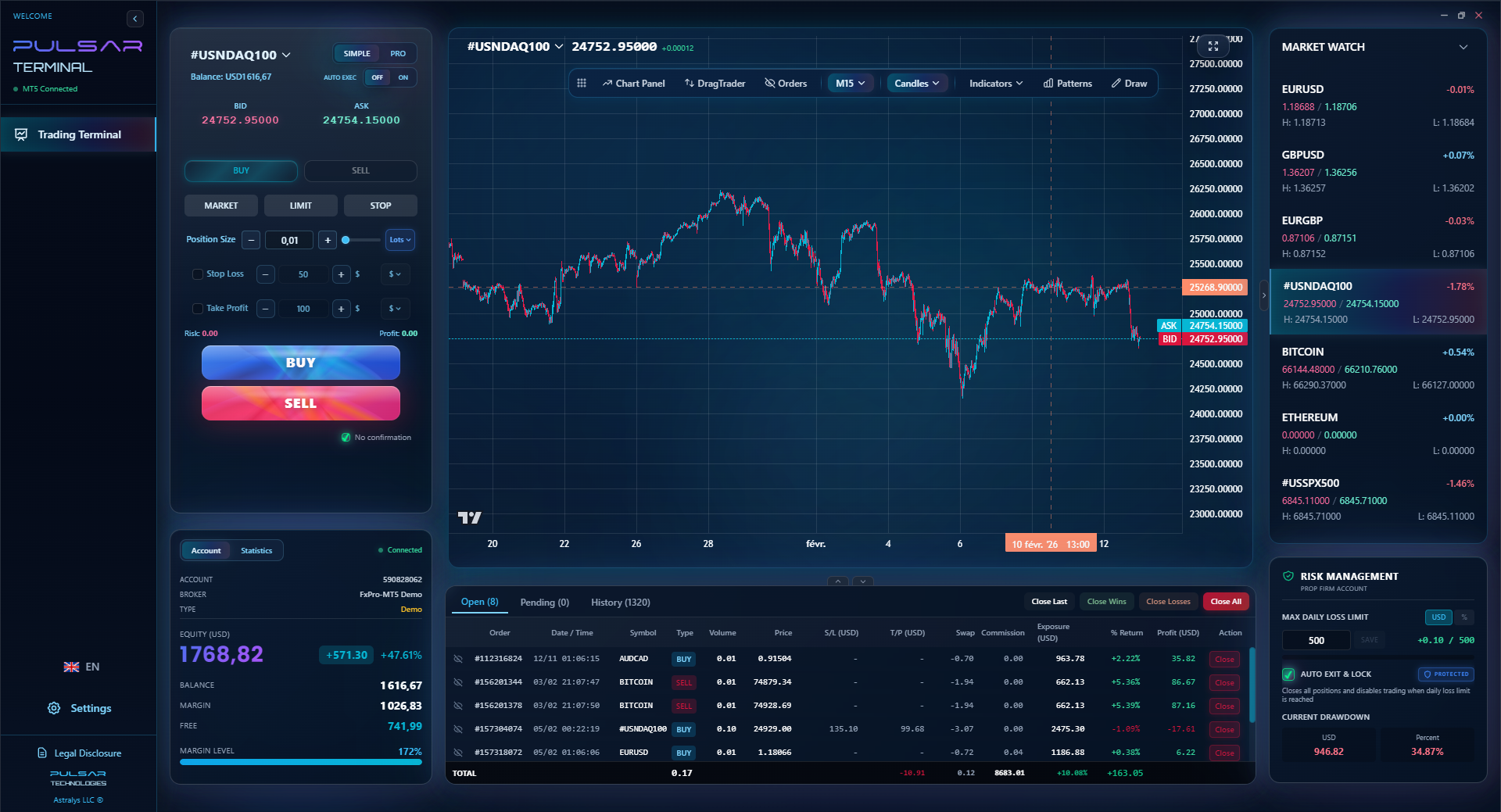
Managing risk on NSE's fixed hours requires precise tools, and Pulsar Terminal's advanced order types and real-time analytics plug directly into your legal MT5 to give you that edge.
Pulsar Terminal
The all-in-one MT5 companion: drag-and-drop orders, multi-TP/SL, trailing stop, grid trading, Volume Profile, and prop firm protection. Used by 1,000+ traders daily.
“The offshore route seems cheaper on spread but gets you on the funding rails.”
Traders always ask: will India ever legalize international spot forex? I'm not a policymaker, but I can read the tea leaves. The trend is towards more regulation, not less. SEBI is constantly tightening rules on derivatives themselves to protect retail.
The growth of MT5 in India (38% market share, processing 2.5 million trades daily) is happening within the legal framework. Brokers are adopting it for equities and commodities as well. The platform's future here is as the premier analytical terminal for all exchange-traded products, not as a backdoor to global markets.
If you're waiting for the gates to open to trade XAU/USD guide spot legally, you might be waiting forever. It's more productive to master the market you have access to. USD/INR is one of the most traded currency pairs in the world when you combine onshore and offshore volumes. There's more than enough opportunity and volatility to build a career on, without looking over your shoulder for a regulatory notice.
Focus on becoming an expert in the USD/INR future. Understand how RBI intervention, oil prices, and FII flows affect it. That domain knowledge is your edge. Chasing illegal access to a hundred instruments you don't understand is a recipe for a quick loss. I've seen it a hundred times.
💡 Winston's Tip
The most dangerous phrase in an Indian trader's mind is 'But everyone else is doing it.' In markets, 'everyone else' is usually about to become a statistic.
Here is your actionable metatrader 5 brokers list: Angel One, 5paisa, ICICI Direct, HDFC Securities, Kotak Securities. Full stop.
Your path forward is clear:
- Pick a broker from the short list above. Open a demat and trading account.
- Download their MT5 terminal and spend a week on demo. Learn the symbols, the contract sizes, the expiry cycles.
- Develop a strategy specifically for USD/INR futures. Don't copy a EUR/USD strategy blindly. Test it on demo, then with tiny real size.
- Manage risk religiously. Use the 20:1 use as a ceiling, not a target. A 2% risk per trade rule is even more important here.
- Ignore the noise. The ads for offshore brokers are just noise. The 'freedom' they sell is an illusion wrapped in legal risk.
Trading is hard enough when it's legal and above board. Why make it impossible by adding regulatory jeopardy? The tools (MT5), the market (USD/INR), and the opportunity are all here, legally. Your job is to build the skill, not hunt for a forbidden backdoor that will likely slam shut on your fingers.
FAQ
Q1Can I legally use international brokers like Exness or IC Markets if I have an NRI account?
The rules change if you are a Non-Resident Indian (NRI) with funds in an NRO/NRE account. NRIs are often permitted to trade with international brokers, but you must declare your NRI status and follow the broker's compliance process. For Resident Indians, using these brokers with domestic bank accounts is the violation.
Q2What's the difference between trading USD/INR on NSE and trading it as a 'forex pair' with an offshore broker?
On NSE, you're trading a standardized futures contract with a fixed expiry date and lot size, settled in INR on the exchange. With an offshore broker, you'd be trading the spot forex pair (if offered), which is a 24-hour over-the-counter market with no expiry, often settled in USD. The price correlates but is not identical, and the legal framework is completely different.
Q3Are there any legal ways to trade Gold or international stocks from India?
Yes, but not through spot forex brokers. You can trade Gold futures and options on Indian commodity exchanges (MCX) using SEBI-regulated brokers. For international stocks, SEBI has allowed direct access to some foreign exchanges through Indian brokers under the LRS scheme, but with strict annual limits and thorough documentation. It's not the same as opening an account with a foreign CFD broker.
Q4Why do international MT5 brokers still accept Indian clients if it's illegal?
They operate under the jurisdiction of their home country (e.g., Cyprus, Australia). Their terms often state it's the client's responsibility to ensure local law compliance. They profit from the business until enforcement action makes it untenable. The risk and legal liability fall entirely on you, the Indian resident.
Q5Is MetaTrader 5 better than MetaTrader 4 for trading in India?
For trading INR derivatives on Indian exchanges, it doesn't matter much, as both platforms connect to the same exchange feed. However, MT5 is the newer, more powerful platform with more timeframes, indicators, and a better backtester. Since most Indian brokers now offer MT5, it's the logical choice for future-proofing.
Q6What happens if I get caught trading with an offshore broker?
The immediate consequence is usually at the banking level. Your transaction may be blocked, your account frozen for investigation, and you may be fined for violating FEMA rules. In severe cases of large, repeated violations, it could lead to more serious legal penalties. The broker won't help you; you'll be on your own.
Prof. Winston's Lesson
Key Takeaways:
- ✓Your only legal MT5 brokers are SEBI-registered NSE/BSE members.
- ✓Offshore spot forex trading violates FEMA – the risk is real.
- ✓Legal use is capped at ~20:1 on Indian exchanges.
- ✓Factor STT (0.001% on sell) into every profit target.
- ✓USD/INR futures offer more than enough opportunity for a career.
How useful was this article?
Click a star to rate
Weekly Trading Insights
Free weekly analysis & strategies. No spam.
About the Author
Rajesh Sharma
Senior Forex Analyst
Trading Indian and South Asian markets for over 10 years. Started with NSE currency derivatives before moving to international forex. Specializes in USD/INR and emerging market pairs.
Comments
Risk Disclaimer
Trading financial instruments carries significant risk and may not be suitable for all investors. Past performance does not guarantee future results. This content is for educational purposes only and should not be considered investment advice. Always conduct your own research before trading.
You Might Also Like

Cara Trading Forex Sukses: 7 Prinsip dari Trader Profesional
Cara trading forex sukses dengan 7 prinsip trader pro: manajemen modal, disiplin, journal trading, backtest. Data nyata, bukan janji profit palsu.
Jam Trading Forex Terbaik untuk Trader Indonesia: Panduan Lengkap dengan Tabel Waktu
Panduan jam trading forex untuk trader Indonesia. Tabel 4 sesi dunia, jam emas 20:00-00:00, sesi mana yang harus dihindari. Data akurat + tips dari trader berpengalaman.
Top 5 Sàn Forex Uy Tín Nhất 2026: Review Jujur dari Trader Indonesia
Top 5 sàn forex uy tín 2026 untuk trader Indonesia. Review jujur: spread, deposit, withdraw, dukungan lokal. Exness, XM, IC Markets & lebih.
Get Pulsar Terminal
All these calculators are built into Pulsar Terminal with real-time data from your MT5 account. One-click position sizing, automatic risk management, and instant calculations.
Get Pulsar Terminal