


Let's cut through the noise.

Olumide Adeyemi
West African Trading Pioneer ·  Nigeria
☕ 12 min read
What you'll learn:
- 1What Momentum Forex Really Is (And Isn't)
- 2The Legal & Tax Landscape in Nigeria (2024-2026)
- 3Building Your Core Momentum Strategy
- 4Essential Tools & Indicators for the Nigerian Trader
- 5Risk & Money Management: Protecting Your Naira
- 6Choosing a Broker in Nigeria: The Real Considerations
- 7The Psychology: Staying Disciplined in a Volatile Market
Let's cut through the noise. The biggest mistake I see Nigerian traders make with momentum forex is thinking it's about chasing every green candle. That's a surefire way to get your account liquidated. Momentum isn't about being first in; it's about being right in when the move has real juice and getting out before it reverses on you. I've blown accounts trying to be a hero, and I've made consistent returns by being patient. This guide will set the record straight on what momentum trading actually is, how to do it legally here in Nigeria, and how to not get wrecked by taxes and bank restrictions.
Forget what you've seen on social media. Momentum forex isn't gambling on news headlines or buying just because a chart is going up. That's reactionary trading, and it's how you get caught at the top.
True momentum trading is about identifying and riding a trend that has already proven it has strength and is likely to continue. You're not predicting the start; you're confirming the middle. The core idea is simple: assets in motion tend to stay in motion until a force acts upon them. Your job is to identify that motion early in its cycle and hop on.
The Two Types of Momentum
There are two main flavors, and confusing them is a classic error.
Price Momentum: This is what most people think of. It's the raw speed and direction of price movement. A currency pair breaking through a key resistance level on high volume? That's price momentum. You often use tools like the Average Directional Index (ADX) to gauge its strength. A reading above 25 usually suggests a trend worth trading.
Rate of Change (ROC) Momentum: This is subtler. It measures how quickly the price is accelerating or decelerating. The momentum is still positive if the price is rising, but if the rate of climb is slowing, that's a warning sign. The MACD indicator is brilliant for this, showing the relationship between two moving averages and their acceleration.

Warning: A strong trend doesn't mean it goes straight up. Even the best momentum moves have pullbacks. If you panic-sell every 10-pip retracement, you'll miss the 100-pip move that follows. You need a plan for these dips.
I learned this the hard way trading GBP/JPY in early 2023. The pair was in a clear uptrend, but I kept getting stopped out on minor dips. I was using a 15-pip stop loss on a pair known for 30-pip swings. I lost $450 over three trades trying to be "precise." When I finally widened my stop to 35 pips and focused on the higher-timeframe trend, I caught a 220-pip move that netted $1,100. The lesson? Trade the trend's character, not your ideal scenario.

💡 Winston's Tip
Momentum is a measure of mass in motion. A slow-moving trend (low ADX) has little mass behind it and is easily stopped. Wait for the ADX to rise above 25 to confirm the trend has real weight.
You can't trade smart if you're trading scared of the law or the taxman. Here’s the lay of the land right now.
Forex trading is legal for individuals in Nigeria. The Central Bank of Nigeria (CBN) and the Securities and Exchange Commission (SEC) are the main watchdogs. The CBN's new Nigerian Foreign Exchange Code, effective from December 2024, is a big deal. It's aimed at wholesale players and banks, but it signals a move towards more structured markets overall.
For you, the retail trader, the key points are:
- You can use international brokers. Most Nigerian traders do. The SEC hasn't fully defined rules for retail CFD trading yet, so brokers regulated offshore (like by the FCA, CySEC, or ASIC) are the standard. Our reviews of brokers like Exness, IC Markets, and XM cover who accepts Nigerian clients.
- You must pay tax. This is non-negotiable. The Federal Inland Revenue Service (FIRS) wants 10% Capital Gains Tax on your gross trading profits. If you make ₦1,000,000 profit in a year, you owe ₦100,000. Keep detailed records.
- Funding is your biggest headache. The CBN prohibits using official forex windows to fund trading accounts. Many Nigerian banks have also clamped down on Naira card international transactions. This pushes traders towards alternatives: domiciliary accounts, e-wallets (Neteller, Skrill), or even crypto transfers. It adds a layer of complexity and sometimes cost.

Pro Tip: Open a domiciliary account in USD. Fund it through legitimate means (family support, export proceeds, etc.), then transfer from there to your broker. It's cleaner for tracking and avoids constant card declines.
“True momentum trading is about identifying and riding a trend that has already proven it has strength and is likely to continue.”
Strategy isn't a fancy indicator collection. It's a rules-based process for finding, entering, managing, and exiting trades. Here's a framework that works.
Step 1: Find the Tide (The Higher Timeframe Trend) Never, ever trade momentum against the dominant trend on the 4-hour or daily chart. It's like swimming against a rip current. Use the daily chart to answer one question: what is the trend? Is price above or below its 50 and 200-period Exponential Moving Average (EMA)? That's your primary filter.
Step 2: Spot the Wave (The Entry Timeframe) Move down to the 1-hour or 4-hour chart. Look for consolidation or a pullback within the daily trend. This is the wave building. You want to see volatility contracting - like a spring coiling.
Step 3: Confirm the Break (The Trigger) Wait for price to break out of that consolidation with conviction. I look for two things: 1) A clean break of a recent swing high (in an uptrend) or low (downtrend). 2) Confirmation from an oscillator. My favorite combo is the RSI indicator coming out of oversold territory (below 30) during a pullback in an uptrend, then crossing back above 40. It shows selling pressure is exhausted.
Step 4: Manage the Trade (This is Where You Make Money) This is the whole game. Your entry is just the ticket.
- Stop Loss: Place it below the recent consolidation or swing low that just got broken. Never base your stop on a random dollar amount. Use market structure.
- Take Profit: Use a risk-reward ratio of at least 1:2. If your stop is 30 pips away, your first profit target should be 60 pips away. Better yet, use a multi-level approach. Take 50% off at 1:1.5 RR, move your stop to breakeven, and let the rest run.

Example: In June 2024, I traded EUR/USD on a momentum breakout. Daily trend was up. On the H4, it pulled back to 1.0780 and consolidated. Breakout above 1.0820. Entered at 1.0825. Stop at 1.0790 (35 pips risk). Took 50% profit at 1.0878 (53 pips). Moved stop to breakeven. Final exit at 1.0910 for a total gain of 85 pips on the remaining half. Net gain: 69 pips. Used a position size calculator to risk 1.5% of my account.
This method requires patience. You might only get 2-3 clear signals a week on a major pair like EUR/USD. That's fine. Quality over quantity.
You don't need 20 indicators cluttering your screen. You need 2-3 that you understand deeply. Here’s my toolkit.
| Indicator | What It Tells You | How I Use It for Momentum |
|---|---|---|
| Moving Averages (50 & 200 EMA) | The overall trend direction & dynamic support/resistance. | Price above both = bullish bias. Look for pullbacks to the 50 EMA as potential entry zones in the trend direction. |
| Average Directional Index (ADX) | The strength of a trend, not its direction. | When the ADX line (usually orange) is above 25, the trend has meaningful momentum. Below 20, the market is choppy - avoid momentum trades. |
| Relative Strength Index (RSI) | Whether price is overbought or oversold within a trend. | In an uptrend, I look for RSI to dip to 40-50 (not 30) and then turn back up. In a downtrend, look for a rise to 50-60 and then turn down. It keeps you in the trend. |
| Volume | The conviction behind a price move. | A breakout on higher-than-average volume is more likely to be genuine. A weak breakout on low volume is often a fakeout. |
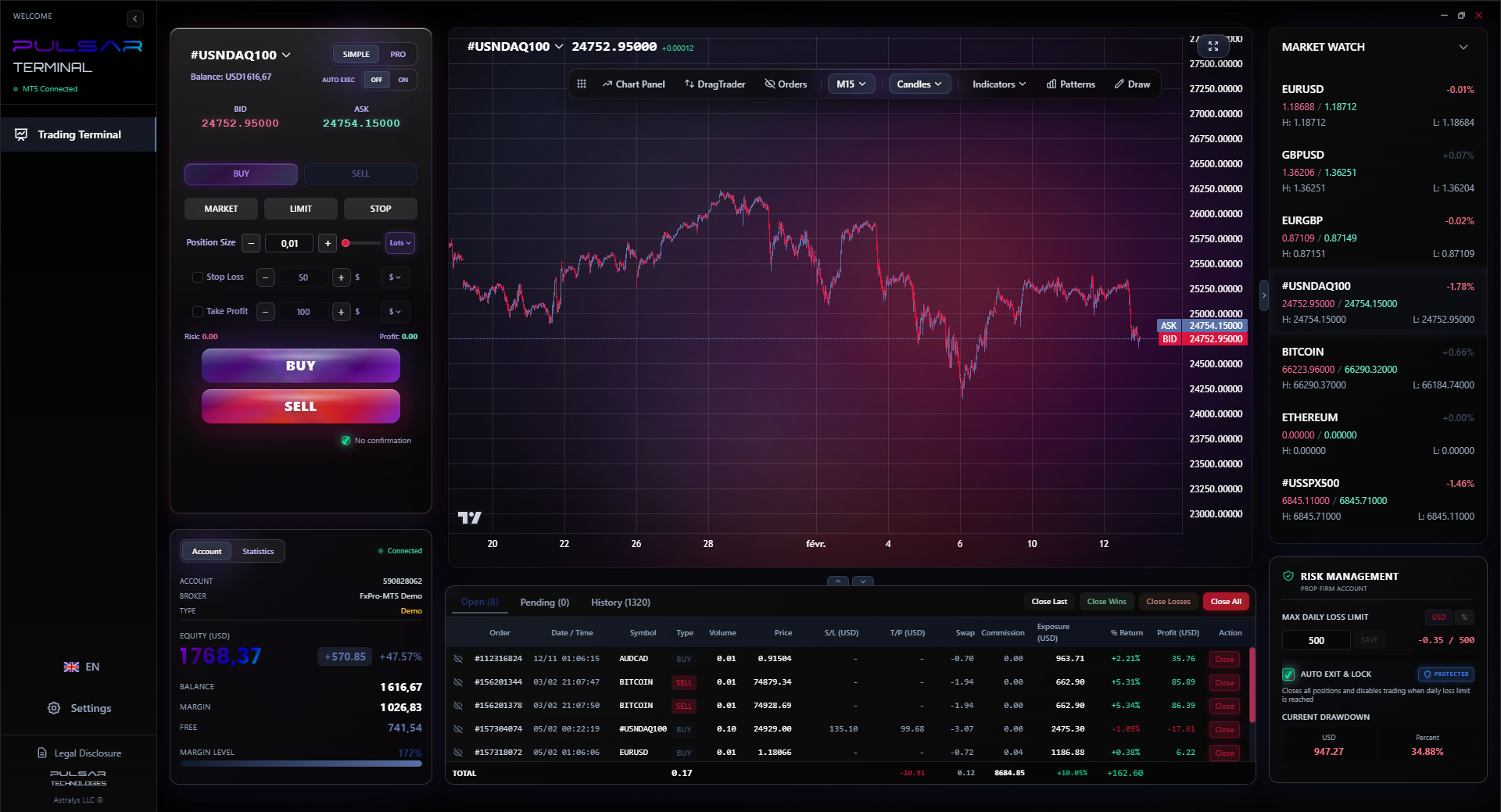
Platforms? MetaTrader 4 and 5 are king in Nigeria for a reason. They're stable, widely supported, and most brokers offer them. For momentum trading, the charting is more than adequate. Tools like Pulsar Terminal can add powerful order management features on top of MT5, which is crucial for executing multi-level profit strategies efficiently.
A personal mistake: I used to have Bollinger Bands, Stochastic, MACD, and Ichimoku all on one chart. It was a mess of conflicting signals. I'd get paralyzed. I stripped it back to just Price, 50 EMA, 200 EMA, and ADX. My win rate didn't change much, but my confidence and ability to pull the trigger improved dramatically.
💡 Winston's Tip
Your stop loss isn't a suggestion. It's a pre-paid insurance policy. If you move it or ignore it, you've just decided to gamble, not trade.
“You can be wrong half the time and still be profitable if you manage risk correctly.”
This section is more important than any entry strategy. You can be wrong half the time and still be profitable if you manage risk correctly.
The Golden Rule: Never Risk More Than 1-2% Per Trade. I don't care if you have a ₦50,000 account or a $10,000 account. On a ₦200,000 account, 2% is ₦4,000. That's your maximum loss on any single trade. This protects you from a string of losses wiping you out. Use a position size calculator every single time.
use: Your Double-Edged Sword. Brokers offer insane use here - up to 1:3000 with some. This is a trap for the inexperienced. High use amplifies both gains AND losses. For momentum swing trading (holding trades for days), I rarely use more than 1:30 use. For very short-term scalping, maybe 1:50. Anything higher and a normal market wiggle can cause a margin call.
The Nigerian Reality Check: Your trading capital is hard to come by. Bank restrictions make depositing a hassle. This makes preserving what you have absolutely critical. You're not just trading against the market; you're trading against the operational difficulty of reloading your account. That means your risk tolerance should be lower, not higher.
Let me be blunt: I once broke my own rule. I had three losing trades in a row on USD/NGN futures (a volatile beast). Frustrated, I tripled my position size on the fourth trade to "make it back quickly." The trade went further against me. I lost 11% of my account in one afternoon. It took me two months of disciplined 1% risk trading to climb back. The emotional toll was worse than the financial one.
Managing multiple profit targets and moving stops to breakeven is core to momentum trading, and Pulsar Terminal automates this directly on your MT5 charts.
Pulsar Terminal
The all-in-one MT5 companion: drag-and-drop orders, multi-TP/SL, trailing stop, grid trading, Volume Profile, and prop firm protection. Used by 1,000+ traders daily.
Regulation, spreads, and deposit methods are your holy trinity. Don't just pick the one with the flashiest ads on Nigerian websites.
1. Regulation & Safety of Funds: Your broker must be regulated by a reputable authority. Tier-1 regulators like the UK's FCA or Australia's ASIC are gold standards. Tier-2 like Cyprus's CySEC or South Africa's FSCA are also solid. This ensures they hold client funds in segregated accounts and have some oversight. Check our Pepperstone review for an example of a strongly regulated broker popular globally.
2. Costs: Spreads & Commissions: For momentum trading, you need tight spreads. Slippage on entry can kill your risk-reward ratio. Look for average spreads on EUR/USD below 1.0 pip. Many offer "raw" accounts with spreads from 0.0 pips but charge a commission (e.g., $3-6 per lot). Do the math. A 0.8 pip spread with no commission might be cheaper than a 0.1 pip spread with a $5 commission, depending on your trade size.
3. Deposit & Withdrawal in Naira: This is the deal-breaker. Can you fund the account reliably?
- Local NGN Accounts? Some brokers like HFM and FXTM offer them. This simplifies things but check the conversion rates and internal fees.
- International USD Accounts: More common. You'll need a domiciliary transfer or e-wallet. Confirm the broker accepts deposits from Neteller/Skrill funded with your Naira card (if it works).
- Withdrawal Speed & Fees: How long to get your profit back to Nigeria? 1-3 business days is good. Are there fees? The best brokers charge none on their end.
4. Platform & Tools: MT4/MT5 is a must. Also check if they allow third-party tools if you plan to use advanced trade management software.
Start small. Open a demo, then a live account with a minimal deposit to test the deposit/withdrawal process before committing serious capital. I learned this after depositing $500 with a broker that had a beautiful platform but took 14 days and a $30 fee to process my withdrawal. Never again.
💡 Winston's Tip
The market's job is to make you feel wrong. A good momentum entry will often be tested immediately. If your analysis is sound, hold firm. Volatility is the price of admission.
“Your trading capital is hard to come by in Nigeria. That means your risk tolerance should be lower, not higher.”
Momentum trading tests your patience and your stomach. The market will try to shake you out.
Fear of Missing Out (FOMO): This is the #1 killer. You see a pair rocketing up, you jump in late near the top, and it reverses. The move is over. Real momentum traders wait for the setup, even if it means watching a big move start without them. There's always another wave.
Revenge Trading: After a loss, the urge to "get back to even" is overwhelming. You start breaking your rules, increasing size, trading outside your strategy. This is how accounts die. When you take a loss, shut down the platform. Go for a walk. The market will be there tomorrow.
Overconfidence: A few winning trades in a row can make you feel invincible. You start seeing setups that aren't there, or you stop using your stop loss because "you know it'll come back." This is the prelude to a catastrophic loss. Stick to your process, win or lose.
My trick? I keep a trading journal. Not just entries and exits, but my emotional state. "Felt anxious, entered early." "Was overconfident, sized too big." Reviewing it weekly shows you your personal patterns of failure. It's humbling, but it's the fastest way to improve.
Momentum forex in Nigeria is a viable path, but it's not a get-rich-quick scheme. It's a skill that requires study, capital you can afford to lose, and iron-clad discipline. The market doesn't care about your rent or your plans. It only responds to one thing: other people's money. Your job is to follow the smart money's momentum, not try to create your own.
FAQ
Q1Is forex momentum trading legal in Nigeria?
Yes, it is legal for individuals. The activity is overseen by the CBN and SEC. Most Nigerian retail traders use internationally regulated brokers, which is a common and accepted practice. However, you must declare and pay 10% capital gains tax on your profits to the FIRS.
Q2What is a good starting capital for momentum trading in Nigeria?
While you can technically start with $10 or $50, it's not practical for proper risk management. A realistic minimum is between $500 to $1,000 (roughly ₦700,000 to ₦1.4 million at current rates). This allows you to risk 1-2% per trade on standard lots (0.01 or 0.1) without being wiped out by a few losses or high relative spreads.
Q3Which currency pairs are best for momentum trading?
Major pairs like EUR/USD, GBP/USD, and USD/JPY are excellent because they have high liquidity and tight spreads, which means cleaner momentum moves with less slippage. Avoid exotic pairs that include the Naira unless you have specific expertise, as they can be illiquid and prone to sharp, unpredictable spikes.
Q4How do I fund my forex trading account from Nigeria?
Given CBN restrictions on Naira cards, the most reliable methods are: 1) Transfer from a USD domiciliary bank account. 2) Use e-wallets like Neteller or Skrill (if your bank allows funding them). 3) Some brokers accept direct bank wire transfers or even cryptocurrency deposits. Always check your broker's specific options for Nigerian clients.
Q5What's the most common mistake Nigerian momentum traders make?
Using excessive use. Brokers offer 1:1000 or more, and new traders see it as a way to make huge profits from a small account. In reality, it magnifies losses and leads to quick margin calls. Sticking to conservative use (1:30 or below) for swing trading is crucial for survival.
Q6Can I use MT4 or MT5 for momentum trading?
Absolutely. MetaTrader 4 and 5 are the most popular platforms in Nigeria and are perfectly suited for momentum trading. They provide all the necessary charting tools, indicators (like ADX and RSI), and order types. Many advanced traders use them as a base, enhanced with third-party tools for trade management.
Prof. Winston's Lesson
Key Takeaways:
- ✓Trade confirmed momentum, not initial breakouts.
- ✓Never risk more than 2% of your capital per trade.
- ✓Use use under 1:50 for swing trading.
- ✓Factor in Nigeria's 10% capital gains tax on all profits.
- ✓ADX above 25 signals a tradable trend.
How useful was this article?
Click a star to rate
Weekly Trading Insights
Free weekly analysis & strategies. No spam.
About the Author
Olumide Adeyemi
West African Trading Pioneer
One of Nigeria's most active forex trading educators. 8 years of experience trading from Lagos. Specializes in low-capital strategies and prop firm challenges for African traders.
Comments
Risk Disclaimer
Trading financial instruments carries significant risk and may not be suitable for all investors. Past performance does not guarantee future results. This content is for educational purposes only and should not be considered investment advice. Always conduct your own research before trading.
You Might Also Like

Cara Trading Forex Sukses: 7 Prinsip dari Trader Profesional
Cara trading forex sukses dengan 7 prinsip trader pro: manajemen modal, disiplin, journal trading, backtest. Data nyata, bukan janji profit palsu.
Jam Trading Forex Terbaik untuk Trader Indonesia: Panduan Lengkap dengan Tabel Waktu
Panduan jam trading forex untuk trader Indonesia. Tabel 4 sesi dunia, jam emas 20:00-00:00, sesi mana yang harus dihindari. Data akurat + tips dari trader berpengalaman.
Top 5 Sàn Forex Uy Tín Nhất 2026: Review Jujur dari Trader Indonesia
Top 5 sàn forex uy tín 2026 untuk trader Indonesia. Review jujur: spread, deposit, withdraw, dukungan lokal. Exness, XM, IC Markets & lebih.
Get Pulsar Terminal
All these calculators are built into Pulsar Terminal with real-time data from your MT5 account. One-click position sizing, automatic risk management, and instant calculations.
Get Pulsar Terminal