


I was staring at my screen on October 26th, 2023.

David van der Merwe
Emerging Markets Trader ·  South Africa
☕ 12 min read
What you'll learn:
I was staring at my screen on October 26th, 2023. The USD/ZAR had just ripped through R19.00, a level everyone said was a ceiling. My short position was bleeding. I'd bet against the dollar, convinced the rand would strengthen on local politics. The market didn't care about my conviction. That loss, a cool R8,500, wasn't just a bad trade. It was a tuition fee. It taught me that in South Africa, your money moves in forex trading aren't just about charts. They're about navigating SARB rules, dodging tax pitfalls, and understanding that the rand has a mind of its own. Let's talk about how to make moves that actually put money in your pocket.
Forget what you see on those slick Instagram ads. Trading forex from South Africa isn't a free-for-all. It's a tightly regulated game, and if you don't know the rules, you'll get penalized before you even place a trade. The first rule? Your broker matters. A lot.
You need a broker regulated by the Financial Sector Conduct Authority (FSCA). This isn't a nice-to-have; it's your only real protection. An FSCA license means they have to keep your money in a separate account (so they can't gamble with it), and they must stick to the use caps. Speaking of which, the FSCA capped retail use at 30:1 a few years back. That means with R10,000, you can control a position worth R300,000. It sounds limiting compared to offshore brokers offering 500:1, but trust me, that cap has saved more South African accounts than any indicator ever could. It forces you to use sensible position size calculator.
Here's the kicker, though. You are absolutely forbidden from speculating against the rand. SARB's rules are crystal clear on this. You can't just open a USD/ZAR trade hoping the rand collapses. That activity is reserved for banks and authorized dealers. Your legal play is to trade major pairs like EUR/USD guide or XAU/USD guide, where the rand isn't one of the currencies. So, all those dreams of getting rich off a rand crash? Park them. That's not a money move; it's a fast track to getting your account frozen.

Warning: Using an unregulated offshore broker might give you higher use, but you have zero recourse if they disappear with your funds. The FSCA can't help you. I learned this the hard way with a small test deposit years ago; the platform just vanished one day. Poof. R2,000 gone.
Your money moves start with a legit foundation. Check out brokers that operate properly here, like Exness review or IC Markets review, both of which have FSCA-regulated entities.

💡 Winston's Tip
Your first R10,000 in the market is for paying tuition, not buying a car. Expect to lose it while learning. If you can't afford to lose it, you can't afford to trade.
You think your profit or loss is just the difference between your entry and exit? Think again. In South Africa, the costs of trading can eat a beginner alive. Let's break down where your rand gets nibbled away.
First, the spread. This is the difference between the buy and sell price. On a volatile day for GBP/ZAR, I've seen spreads widen to 80 pips. That's R800 gone on a standard lot before your trade even moves. You need to factor this in as a direct cost. A tight spread is non-negotiable.
Then there's the overnight financing charge, or swap. If you hold a position past 10 PM GMT (midnight our time in summer), you either pay or earn a small interest fee. This is based on the interest rate differential between the two currencies. Holding a long EUR/ZAR position (where you're borrowing ZAR to buy EUR) often incurs a negative swap because of South Africa's higher interest rates. I once held a trade for two weeks for a 150-pip gain, only to find the swap fees had taken nearly 40 pips of it. It was a win, but a much thinner one.
The Silent Killer: Currency Conversion
This one catches everyone off guard. You deposit in rands. Your broker converts it to USD (or EUR) to trade. You make a profit in USD. You withdraw, and they convert it back to ZAR. Each conversion has a fee and uses the broker's exchange rate, which is rarely the spot rate you see on Google. Over time, this double conversion shaves a consistent 1-3% off your real returns. It's a silent tax on every transaction.
| Cost Type | What It Is | Typical Impact (Example) |
|---|---|---|
| Spread | Broker's fee built into price | 15-80 ZAR pips on ZAR pairs |
| Swap/Overnight | Interest for holding positions | Can be R50+ per lot per night |
| Currency Conversion | Fee to change ZAR to/from USD | 1-3% of transaction value |
| Inactivity Fee | Charged if you don't trade | R200+ per month after X months |
Always read the fee schedule. That boring document tells you exactly how the broker plans to make money from you, regardless of whether you win or lose.
“In South Africa, your money moves in forex trading aren't just about charts. They're about navigating SARB rules, dodging tax pitfalls, and understanding that the rand has a mind of its own.”
Here's the part most new traders ignore until it's too late: SARS wants its share. There's no such thing as tax-free trading profits unless you're trading within a Tax-Free Savings Account (TFSA), and you can't trade forex in those.
SARS views frequent, speculative trading as generating income. That means your net profits (after deducting all those costs we just talked about) get added to your other income and taxed at your marginal rate. That could be 18%, 26%, 31%, or higher. If you're making consistent money, you need to be setting aside a portion for tax from day one. I didn't in my second year, and facing a R23,000 tax bill from profits I'd already spent was a brutal lesson in cash flow management.
You must keep impeccable records. Every single trade confirmation. Every deposit and withdrawal statement from your bank and broker. Every monthly statement. You need to convert all your foreign currency profits and losses to rands using the official exchange rate on the date of each transaction. It's a admin nightmare if you're not organized.

Pro Tip: Open a separate spreadsheet or use a trading journal software from your very first trade. Log the date, pair, profit/loss in the trade currency, and the USD/ZAR rate that day. Doing it weekly takes 10 minutes. Trying to reconstruct a year's worth of trades in February is a special kind of hell.
Can it be capital gains? Possibly, if your trading is infrequent and more long-term (think swing trading over months). But the burden of proof is on you. SARS will default to income tax. Get an accountant who understands trading. It's worth the fee.
Okay, so you're legal, you know the costs, and you're saving for tax. Now, how do you actually make money moves forex trading? It's not about finding a magical signal. It's about consistency and edge.
Forget trying to predict the rand. Focus on the major pairs where liquidity is high and spreads are low. My bread and butter for years has been EUR/USD and GBP/USD. The charts are cleaner, the news flow is predictable, and the spread definition is often under 1 pip on good brokers like Pepperstone review.
Your strategy needs three things: a clear trigger, a defined risk, and a profit target. Don't just wing it. Here's a simple framework I used when starting:
- Find the Trend: Use the 4-hour chart. Is price mostly above the 50-period moving average? That's a potential uptrend. Below? Downtrend.
- Wait for a Pullback: In an uptrend, wait for price to dip back towards that moving average or a key support level.
- Look for Confirmation: Use a basic momentum indicator like the RSI indicator dipping near 40 (but not oversold at 30) in an uptrend, or a MACD indicator histogram starting to turn back up.
- Execute with Discipline: Enter on a 15-minute candle close above the high of the pullback. Your stop-loss goes below the low of the pullback. Your take-profit should be at least 1.5 times the distance of your stop.
This isn't glamorous. It's boring. But boring makes money. The money move isn't the trade itself; it's the relentless discipline to only take trades that fit your plan. I once sat for 3 days without a single trade because the market didn't give me my setup. That patience saved me from 5-6 probable losing trades.
💡 Winston's Tip
The rand is a political instrument, not just a currency. Trying to trade it based on charts alone is like trying to read a book while someone is shaking your chair.
“Risk management isn't a feature of trading; it *is* trading.”
This is the chapter that separates the survivors from the blowouts. You can have a mediocre strategy and excellent risk management and still be profitable. The reverse is never true.
Your number one rule: Never risk more than 1-2% of your trading capital on a single trade. Let me give you a real example. In early 2024, I had a R100,000 account. My rule is 1% max risk. That's R1,000 per trade. I saw a setup on USD/JPY. My stop-loss distance was 25 pips. To risk only R1,000, I had to calculate my position size so that 25 pips of loss equaled R1,000.
Using a position size calculator, that meant trading 0.4 standard lots. The trade went against me and hit my stop. Loss: R1,000. Account balance: R99,000. It stung, but it was a manageable sting. I was still in the game. If I'd thrown on 2 lots because I was 'sure,' that loss would have been R5,000 - a 5% account hole that's incredibly hard to climb out of psychologically.
The Trailing Stop Dilemma
Knowing when to let profits run is harder than knowing when to cut losses. A fixed take-profit can leave money on the table. A manual trailing stop is emotionally taxing. This is where tools can help you execute a plan without emotion. For instance, automating a trailing stop that moves up as price moves in your favor locks in profit while giving the trade room to breathe. It turns a subjective decision into a mechanical rule.

Example: You buy EUR/USD at 1.0850 with a 30-pip stop (1.0820). It rises to 1.0900. You could move your stop to breakeven (1.0850). A trailing stop of 20 pips would automatically move your stop to 1.0880 (1.0900 - 0.0020). If it then rises to 1.0920, your stop moves to 1.0900, locking in 50 pips of profit. It removes the 'should I close it now?' panic.
Always know where your margin call level is. With 30:1 use, a few concurrent losing trades can get you there faster than you think. Risk management isn't a feature of trading; it is trading.
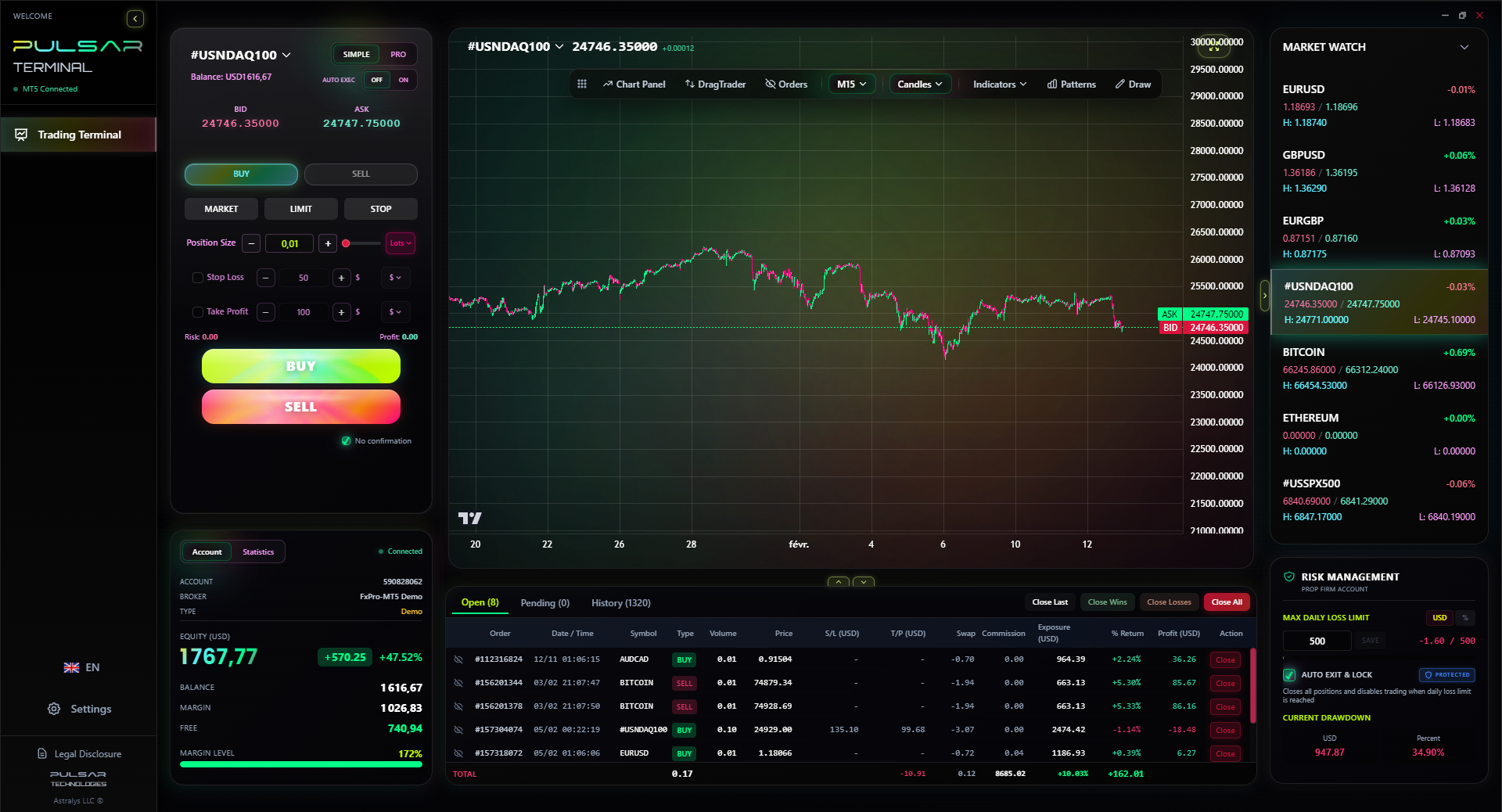
Executing disciplined risk management rules like trailing stops and breakeven orders is critical, and tools like Pulsar Terminal automate these directly on your MT5 platform, removing emotion from the process.
Pulsar Terminal
The all-in-one MT5 companion: drag-and-drop orders, multi-TP/SL, trailing stop, grid trading, Volume Profile, and prop firm protection. Used by 1,000+ traders daily.
We trade in a unique environment. Load-shedding can knock out your internet during a critical move. The rand's own drama can spill over into global risk sentiment, affecting all your pairs. You're also likely trading alone, without a floor of colleagues. The psychology is brutal.
Your biggest enemy will be FOMO - Fear Of Missing Out. You'll see USD/ZAR screaming higher and, despite the rules, you'll want a piece. Or you'll see a friend post a screenshot of a winning gold trade and jump into XAU/USD guide without a plan. I've done it. It never ends well.
The flip side is revenge trading. After a loss, you immediately jump back in with a bigger size to 'make it back.' This is how 2% losses turn into 20% drawdowns in an afternoon. After that R8,500 loss I mentioned at the start, I made this exact mistake. I took two more rushed trades within the hour, losing another R3,000. I had to physically walk away from my desk for the rest of the day.
The money move here is to have a daily loss limit. Mine is 3% of my account. If I hit that, I'm done. No arguments. The platform gets closed. This rule has saved my account more times than I can count. Trading is a marathon of survival, not a sprint to get rich.
“The money move isn't the trade itself; it's the relentless discipline to only take trades that fit your plan.”
Let's stop talking theory and build your first real money move.
Step 1: Get Your House in Order. Open a bank account specifically for trading. Use it only for deposits and withdrawals. Choose an FSCA-regulated broker. Start with a demo account, but know that it's only for learning the platform. The psychology is totally different when real money is on the line.
Step 2: Start Small, Painfully Small. Fund your live account with an amount you can afford to lose completely. I'm talking R5,000 or R10,000. Not R100,000. Your goal in the first six months is not to make money. Your goal is to not lose money. Learn to execute your plan, manage your risk, and keep your records.
Step 3: Define ONE Strategy. Pick one currency pair. Pick one time frame (like the 4-hour chart for direction and the 1-hour for entry). Pick two indicators to confirm entries. Write down the exact rules for entry, stop-loss, and take-profit. Trade only that setup. Ignore everything else. This focus is how you learn what works.
Step 4: Journal Relentlessly. After every trade, win or lose, write down:
- The setup (did it match your rules?)
- Your emotional state (calm, fearful, greedy?)
- The outcome
- What you learned
This journal is your most valuable tool. It turns random outcomes into data you can improve upon.
Real money moves forex trading in South Africa is a grind. It's about stacking small, disciplined advantages while fiercely controlling your downside. It's not sexy. But it's the only way the money actually moves into your account and stays there, even after SARS takes its cut.
💡 Winston's Tip
Your trading journal is more important than your strategy. A bad strategy with good records can be fixed. A 'good' strategy with no records is just gambling with a fancy name.
FAQ
Q1Is forex trading legal in South Africa?
Yes, but with strict rules. You must use a broker regulated by the FSCA, and you are prohibited from speculating directly against the South African Rand (e.g., shorting USD/ZAR). Trading major foreign pairs like EUR/USD is perfectly legal.
Q2How much tax do I pay on forex trading profits?
SARS typically treats frequent trading profits as income, taxed at your marginal tax rate (from 18% to 45%). You must declare your net profit (profits minus losses and trading costs). Long-term, infrequent trades might qualify for capital gains tax, but the burden of proof is on you. Always consult a tax professional.
Q3What is the best broker for South African traders?
The 'best' broker is one that is properly regulated by the FSCA, offers tight spreads on the pairs you trade, has reliable local deposit/withdrawal options in ZAR, and a stable platform. Brokers like Exness, IC Markets, and Pepperstone have FSCA-regulated entities worth researching. Never trade with an unregulated offshore broker.
Q4Can I use my R10 million foreign investment allowance for forex trading?
Technically, you could use part of this allowance to fund an international trading account. However, the primary purpose of the allowance is for investment, not speculation. More critically, the SARB rules still forbid you from using those funds to speculate against the ZAR. The legal and reporting complexities are significant, so get professional financial advice before attempting this.
Q5What's a realistic monthly return from forex trading?
Anyone promising you a fixed monthly return is lying. A realistic, sustainable target for a skilled retail trader is 2-5% per month on average, after all costs. Some months you'll make 10%, others you'll lose 3%. The key is consistent risk management to ensure the losing months don't wipe you out. Aim for consistency, not get-rich-quick returns.
Q6I keep blowing my account. What am I doing wrong?
You're almost certainly risking too much per trade and/or revenge trading after losses. Go back to basics: risk a maximum of 1% of your account per trade, have a daily loss limit of 3%, and use a written trading plan for every entry. Your problem isn't the markets; it's a lack of personal trading rules.
Prof. Winston's Lesson
Key Takeaways:
- ✓Use only FSCA-regulated brokers; it's your first line of defense.
- ✓Never risk more than 1-2% of your capital on a single trade.
- ✓SARS taxes trading profits as income - set aside 25-30% from day one.
- ✓You are legally forbidden from speculating against the ZAR.
- ✓A daily loss limit of 3% will save your account from yourself.
How useful was this article?
Click a star to rate
Weekly Trading Insights
Free weekly analysis & strategies. No spam.
About the Author
David van der Merwe
Emerging Markets Trader
Johannesburg-based trader with 11 years in emerging market currencies. Specializes in ZAR pairs, FSCA-regulated trading, and South African market analysis.
Comments
Risk Disclaimer
Trading financial instruments carries significant risk and may not be suitable for all investors. Past performance does not guarantee future results. This content is for educational purposes only and should not be considered investment advice. Always conduct your own research before trading.
You Might Also Like

Cara Trading Forex Sukses: 7 Prinsip dari Trader Profesional
Cara trading forex sukses dengan 7 prinsip trader pro: manajemen modal, disiplin, journal trading, backtest. Data nyata, bukan janji profit palsu.
Jam Trading Forex Terbaik untuk Trader Indonesia: Panduan Lengkap dengan Tabel Waktu
Panduan jam trading forex untuk trader Indonesia. Tabel 4 sesi dunia, jam emas 20:00-00:00, sesi mana yang harus dihindari. Data akurat + tips dari trader berpengalaman.
Top 5 Sàn Forex Uy Tín Nhất 2026: Review Jujur dari Trader Indonesia
Top 5 sàn forex uy tín 2026 untuk trader Indonesia. Review jujur: spread, deposit, withdraw, dukungan lokal. Exness, XM, IC Markets & lebih.
Get Pulsar Terminal
All these calculators are built into Pulsar Terminal with real-time data from your MT5 account. One-click position sizing, automatic risk management, and instant calculations.
Get Pulsar Terminal