


I remember watching the EUR/USD chart on a Tuesday morning in late 2023, just as the US session was about to overlap with London.

David van der Merwe
Emerging Markets Trader ·  South Africa
☕ 12 min read
What you'll learn:
I remember watching the EUR/USD chart on a Tuesday morning in late 2023, just as the US session was about to overlap with London. The price was hovering around 1.0950, and the market felt dead quiet. Then, the 10:30 AM EST US data hit. Within 90 seconds, the pair dropped 45 pips, filled a massive buy order block, and snapped right back up. The volume was insane. That's liquidity in action - the ability to get in and out of a trade with minimal slippage, even when the market is moving fast. For us trading from SA, understanding which pairs give you that smooth ride versus which ones can leave you stuck is half the battle. Let's break down the most liquid forex pairs, why they matter for your bottom line, and where our beloved ZAR fits into the picture.
When traders talk about the most liquid forex pairs, they're not just throwing around jargon. They're talking about cold, hard cash savings and better trade execution. Think of it like this: you're trying to sell a rare, niche collectible versus a current-generation iPhone. The iPhone has a massive market of ready buyers and sellers, so you get a fair price instantly. The collectible? You might have to wait, and the price you get can be all over the shop.
In forex, liquidity is measured by daily trading volume. A highly liquid pair has billions of dollars traded every day. This translates directly to three things for you:
- Tighter Spreads: This is your primary cost of doing business. The bid-ask spread on EUR/USD can be as low as 0.0 pips on a raw account. On a less liquid pair, that spread can be 5, 10, or even 20 times wider. Over dozens of trades, that difference eats into your profits like nothing else.
- Minimal Slippage: When you click 'buy' at 1.1050, you want to get filled at 1.1050, not 1.1053. In liquid markets, your orders are filled at or very near your requested price. In illiquid markets, especially during news events, your stop-loss can get triggered at a much worse price than you set.
- Easier Order Execution: Large orders don't significantly move the market price in a liquid pair. You can get in and out of sizable positions without causing a ripple.

Example: Let's say you trade a standard lot (100,000 units). A 1-pip spread on EUR/USD costs you $10. A 5-pip spread on a less common pair costs you $50, just to open the trade. That's $40 gone before the market even moves.
For South Africans, this is crucial because every rand counts. Trading high-liquidity pairs is one of the simplest ways to reduce your fixed costs. It's why I always check the live spread on my broker's platform before entering a trade, not just the advertised 'from' spread. You can use a position size calculator to see exactly how spread costs impact your potential risk and reward on any pair.

💡 Winston's Tip
Liquidity is your silent partner. It doesn't shout, but it always takes its cut through the spread. Choose partners with a low overhead.
These are the pairs that move the world. They're all quoted against the US Dollar (USD) and make up about 75% of all forex volume. For a South African trader, these should be the core of your watchlist.
EUR/USD: The King
This is the big one. It often has the tightest spreads and the deepest order books. I find it reacts cleanly to technical levels and major economic data from the US and Eurozone. It's less prone to random, unexplained spikes than some other pairs, which makes it a favorite for strategies like swing trading. Its rhythm is fairly predictable - active during London, gets a second wind with New York, and quiet during Asia.
USD/JPY: The Samurai
A monster for liquidity, especially when Tokyo and New York are open. It has a strong tendency for trends, but you must watch out for intervention chatter from the Bank of Japan. They don't like wild, one-sided moves. I got caught in a nasty fake-out in early 2024 when price blasted through a key resistance at 150.80, only to reverse 120 pips in an hour on suspected intervention. Lesson learned: with USD/JPY, pay attention to the news headlines near big round numbers.
GBP/USD: The Cable
Liquid but volatile. It can trend beautifully, but when UK politics or Brexit-related news hits, it moves like a scalded cat. You need a wider stop-loss trading Cable. I learned this the hard way years ago, getting stopped out of a perfectly good long-term position because I used the same 20-pip stop I'd use on EUR/USD.
AUD/USD & USD/CAD: The Commodity Brothers
AUD/USD is your China/iron ore gauge. USD/CAD is your oil gauge. They're liquid but can gap at the open if commodity prices have moved sharply overnight. Their liquidity is best during the Asian session for the Aussie and the US session for the Loonie.
USD/CHF: The Safe Haven
Liquid, but often acts as a funding currency or a safety play. It tends to have an inverse relationship with EUR/USD. When the world gets scared, money flows into the Swiss Franc.
Here’s a quick comparison of what you can typically expect:
| Pair | Typical Spread (Pips) | Key Driver | Best Trading Session |
|---|---|---|---|
| EUR/USD | 0.0 - 1.2 | US/EZ Economics, ECB/Fed Policy | London & NY Overlap |
| USD/JPY | 0.2 - 1.5 | BoJ Policy, US Yields, Risk Sentiment | Tokyo & NY Overlap |
| GBP/USD | 0.8 - 2.0 | UK Politics, BoE, UK Inflation | London Session |
| AUD/USD | 0.5 - 1.8 | China Data, Iron Ore, RBA | Asian Session |
| USD/CAD | 0.8 - 2.0 | Oil Prices (WTI), BOC, US Data | NY Session |
| USD/CHF | 1.0 - 2.5 | Risk Sentiment, SNB, EU Politics | London Session |

Warning: Don't be fooled by the 'typical spread.' Always check the live market spread on your platform, especially outside of peak liquidity hours. That '0.0 pip' spread can widen to 3 pips at 2 AM SA time.
“USD/ZAR is what we call an 'exotic' pair. It combines a major currency with an emerging market currency, and volatility is the norm.”
Now, let's talk about our home turf. USD/ZAR is, without a doubt, the most traded pair within South Africa. The Rand is a top 20 global currency, and the daily volume flowing through our market is huge - over $80 billion. That creates decent liquidity, but with a massive asterisk.
USD/ZAR is what we call an 'exotic' pair. It combines a major currency (USD) with an emerging market currency (ZAR). This means:
- Wider Spreads: Don't expect EUR/USD tightness here. Spreads of 30-50 pips are common, and they can blow out to 100+ pips during local political uncertainty or global risk-off events. That's R100-R500 cost per standard lot just on the spread.
- Volatility is the Norm: The Rand is sensitive to local politics, Eskom news, commodity prices (we're a big exporter), and global investor sentiment toward emerging markets. A tweet from a rating agency can move it 2% in a heartbeat.
- Carry Trade Potential: Because of South Africa's historically higher interest rates, holding a ZAR-long position (like in EUR/ZAR) used to earn you a positive swap. This has attracted carry traders for years. But remember, a positive swap can be quickly wiped out by a sharp move against you.
I trade USD/ZAR, but I treat it differently. My position size is always smaller, my stop-losses are wider in terms of pips, and I'm hyper-aware of the local economic calendar. Trading it requires a stomach for volatility that the majors just don't demand. The recent strength in the ZAR (up over 15% against the USD in the last year) has been a great trend, but it's been a bumpy ride.

Pro Tip: If you want exposure to ZAR moves but with slightly better liquidity, look at EUR/ZAR. It's still an exotic, but it often has a slightly tighter spread than USD/ZAR and can offer different technical setups. Just remember you're now exposed to both Eurozone and SA risks.
💡 Winston's Tip
The market's opinion of risk changes by the hour. A 50-pip stop on EUR/USD is a statement. The same 50 pips on USD/ZAR is a prayer.
You can't talk trading in South Africa without talking about the Financial Sector Conduct Authority (FSCA). They're the sheriff in town, and their rules directly impact which pairs you can trade and how.
The big one for us is the 30:1 use cap for retail traders. This applies to all FSCA-licensed brokers. It means if you deposit R10,000, the maximum you can control in the market is R300,000. This is a protective measure. It forces you to use sensible position size calculator and dramatically reduces your risk of a margin call from a single bad trade.
I'll be honest, when this rule first came in, I hated it. I was used to 100:1. But you know what? It made me a better trader. I stopped over-leveraging on hunches and started focusing on quality setups. My drawdowns got smaller.
When choosing a broker, you have two paths:
- A Local FSCA-Licensed Broker: This is the safest route. Your funds are protected under South African law, client money must be segregated, and you get the 30:1 use. Brokers like Exness (which has an FSCA license) or others on the FSCA register fall here.
- An International Broker: Many South Africans also use top international brokers like IC Markets, Pepperstone, or XM. These are often regulated in places like Cyprus or Australia. They might offer higher use (like 500:1) to SA clients because the FSCA cap doesn't apply to their offshore entities. This is a riskier choice. You're trading under a foreign regulator. If something goes wrong, your recourse is more complicated.
My advice? Start with an FSCA-regulated broker. Get your strategy working with the 30:1 discipline. The security is worth it. All the brokers I just mentioned offer ZAR accounts, which saves you on currency conversion fees when you deposit and withdraw.
💡 Winston's Tip
A rule that limits your potential for disaster is not a cage; it's the fence at the edge of the cliff. Trade long enough, and you'll be grateful for it.
“The 30:1 use cap made me a better trader. I stopped over-leveraging on hunches and started focusing on quality setups.”
Liquidity isn't just about cost, it's about opportunity. Different strategies shine in different liquidity environments.
For the major pairs (EUR/USD, USD/JPY), you can do almost anything:
- Scalping: This is where tight spreads are non-negotiable. A scalping strategy aiming for 5-10 pips will be destroyed by a 3-pip spread. On EUR/USD, it's feasible. I've had sessions scalping the EUR/USD guide around London open where I took 20+ trades, and my total spread cost was under $50.
- Algorithmic/EA Trading: Bots need consistent, predictable spreads and minimal slippage. They thrive on the majors.
- News Trading: When high-impact news drops, the majors see enormous volume. If you have a fast platform and a good broker, you can trade the volatility. The key is knowing the exact time of the release and having orders ready.
For USD/ZAR, different rules apply:
- Swing Trading & Position Trading: This is my preferred approach. The wide spreads make short-term trading very expensive. Instead, I look for larger moves over days or weeks. I might use the MACD indicator on a daily chart to identify trend direction and the RSI indicator on a 4-hour chart to find entry points during pullbacks.
- Fundamental/Event-Driven Trading: This is huge for the Rand. Trading around the SARB interest rate decision, the national budget speech, or major credit rating announcements. You're not trading the chart as much as you're trading the market's reaction to the news.
Pro Tip: No matter the pair, I always place my stop-loss and take-profit orders as limit orders, not market orders. This guarantees my exit price and prevents slippage from turning a winning trade into a loser, or a small loss into a big one.
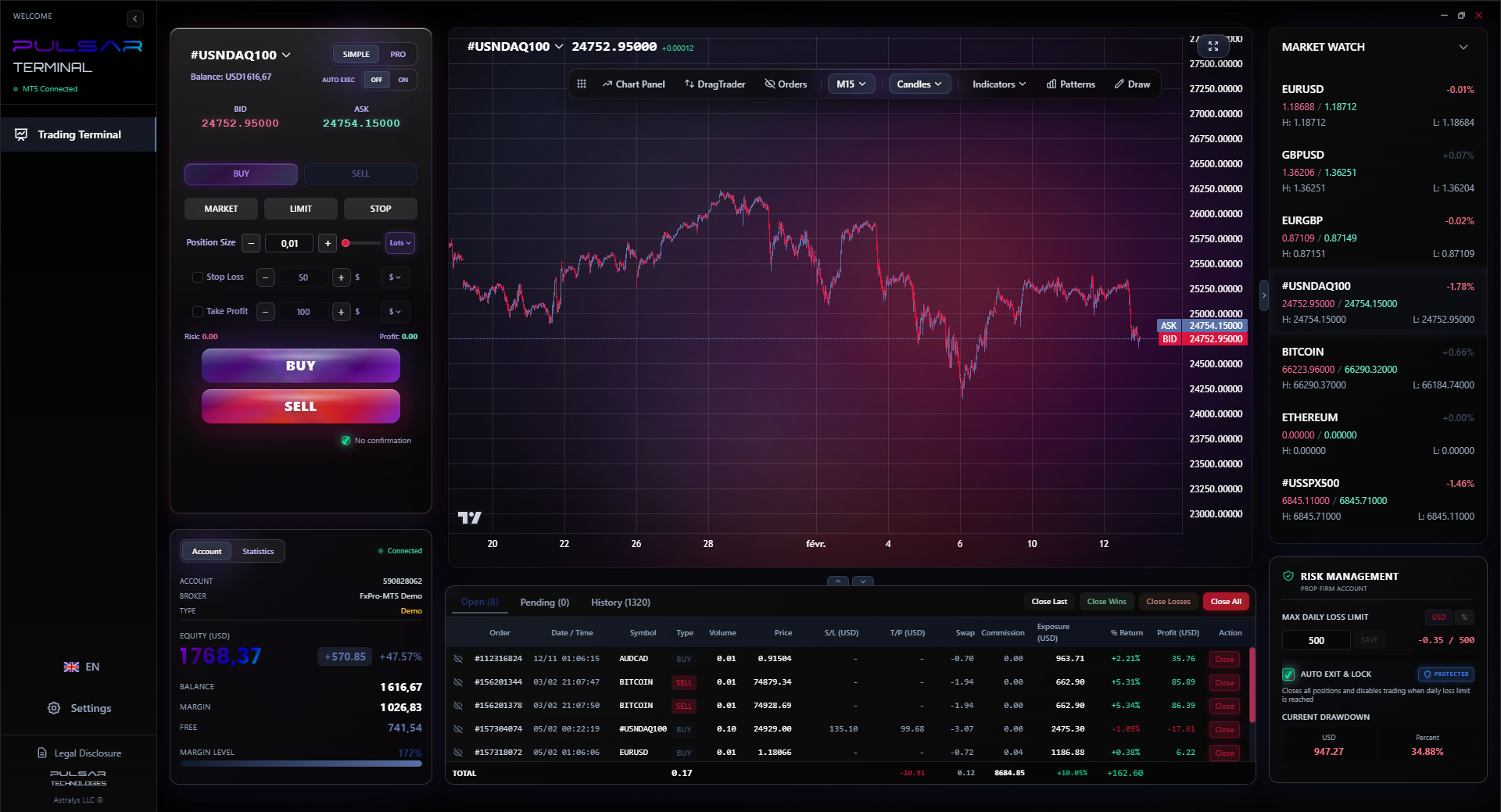
Managing multiple take-profit levels and trailing stops on volatile pairs like USD/ZAR is complex, but Pulsar Terminal automates it all directly within your MT5 platform.
Pulsar Terminal
The all-in-one MT5 companion: drag-and-drop orders, multi-TP/SL, trailing stop, grid trading, Volume Profile, and prop firm protection. Used by 1,000+ traders daily.
Let me save you some money and frustration by sharing a couple of my own blunders.
Pitfall 1: Trading Exotics Like Majors. My first major loss on USD/ZAR came from using a 20-pip stop-loss. The pair had a normal daily range of 300 pips, and my stop was just noise. It got taken out, the price reversed, and went straight to where my take-profit would have been. I was right on direction, but wiped out on volatility. The fix? Use Average True Range (ATR) to set stops based on the pair's recent volatility, not a fixed number.
Pitfall 2: Chasing Illiquid Pairs for 'Opportunity'. Early on, I thought I was clever trading obscure crosses like NZD/SEK. The charts looked clean! What I didn't realize was the 15-pip spread meant I started every trade R750 in the hole on a standard lot. The 'clean' chart was just a lack of trading activity. I made a few small wins, but the spreads guaranteed I lost over time.
Pitfall 3: Ignoring the Session. Trying to scalp EUR/USD during the dead Tokyo session is painful. The spread widens, and the price just drifts. No momentum, no volume. I'd sit for hours forcing trades that weren't there. Now, I match my strategy and pair to the active session. Asia for AUD and JPY, London for EUR and GBP, New York for everything with USD.
Pitfall 4: Not Understanding Swap/Rollover. I once held a USD/ZAR short position over a long weekend, not realizing the triple swap charges. Instead of earning a small credit, I paid a hefty fee that erased my paper profits. Always check the swap rates on your platform before holding a position overnight, especially on Wednesday nights (when most brokers charge triple for the weekend).
FAQ
Q1What is the most liquid forex pair in the world?
The EUR/USD (Euro/US Dollar) is by far the most liquid forex pair globally, making up over 20% of all daily forex trading volume. It consistently has the tightest spreads and deepest market, making it the preferred pair for many strategies, especially scalping.
Q2Is USD/ZAR a good pair for beginners in South Africa?
I'd advise caution. While it's our home currency and you might follow the news easily, USD/ZAR is an exotic pair with wide spreads and high volatility. This can be punishing for beginners who use stops that are too tight. It's better to start practicing on majors like EUR/USD to learn discipline with lower costs, then graduate to ZAR pairs with smaller position sizes.
Q3What is the maximum use I can use in South Africa?
If you trade with a broker regulated by the South African FSCA, the maximum use allowed for retail clients is 30:1. This is a strict rule for your protection. Some international brokers may offer higher use to SA clients, but you then lose the direct protection of the FSCA.
Q4Why are spreads on USD/ZAR so much wider than on EUR/USD?
Spreads are a function of liquidity and risk. EUR/USD has a massive, global market of buyers and sellers. USD/ZAR has less liquidity globally and carries higher perceived risk (emerging market currency, political volatility, etc.). The wider spread is the broker's and liquidity provider's compensation for taking on that risk when they help your trade.
Q5Can I trade gold (XAU/USD) with good liquidity?
Absolutely. Gold (XAU/USD) is a highly liquid commodity CFD. It trades almost like a major currency pair, with very tight spreads during active hours. It's a great alternative asset that often moves independently of forex pairs. You can learn more in our dedicated XAU/USD guide.
Q6What's the best time of day to trade forex from South Africa?
The best liquidity and movement occur during the overlap of major financial centers. For SA, that's the London session (10:00 AM - 7:00 PM SAST) and the London/New York overlap (3:00 PM - 5:00 PM SAST). This is when EUR/USD, GBP/USD, and USD pairs are most active. The Asian session (2:00 AM - 11:00 AM SAST) is good for AUD and JPY pairs.
Q7Do I pay tax on forex trading profits in South Africa?
Yes. The South African Revenue Service (SARS) views forex trading as a form of investment. Your net profits (after deducting losses and expenses like spreads and data fees) are considered taxable income and must be declared in your annual tax return. It's crucial to keep detailed records of all your trades.
Prof. Winston's Lesson
Key Takeaways:
- ✓Prioritize EUR/USD & USD/JPY for lowest costs & cleanest execution.
- ✓Treat USD/ZAR with respect: use smaller size & wider stops (100+ pips).
- ✓The FSCA's 30:1 use is a protective tool, not a limitation.
- ✓Match your strategy to the pair's liquidity: scalp majors, swing exotics.
- ✓Always check live spreads, not just advertised 'from' rates.
How useful was this article?
Click a star to rate
Weekly Trading Insights
Free weekly analysis & strategies. No spam.
About the Author
David van der Merwe
Emerging Markets Trader
Johannesburg-based trader with 11 years in emerging market currencies. Specializes in ZAR pairs, FSCA-regulated trading, and South African market analysis.
Comments
Risk Disclaimer
Trading financial instruments carries significant risk and may not be suitable for all investors. Past performance does not guarantee future results. This content is for educational purposes only and should not be considered investment advice. Always conduct your own research before trading.
You Might Also Like

Cara Trading Forex Sukses: 7 Prinsip dari Trader Profesional
Cara trading forex sukses dengan 7 prinsip trader pro: manajemen modal, disiplin, journal trading, backtest. Data nyata, bukan janji profit palsu.
Jam Trading Forex Terbaik untuk Trader Indonesia: Panduan Lengkap dengan Tabel Waktu
Panduan jam trading forex untuk trader Indonesia. Tabel 4 sesi dunia, jam emas 20:00-00:00, sesi mana yang harus dihindari. Data akurat + tips dari trader berpengalaman.
Top 5 Sàn Forex Uy Tín Nhất 2026: Review Jujur dari Trader Indonesia
Top 5 sàn forex uy tín 2026 untuk trader Indonesia. Review jujur: spread, deposit, withdraw, dukungan lokal. Exness, XM, IC Markets & lebih.
Get Pulsar Terminal
All these calculators are built into Pulsar Terminal with real-time data from your MT5 account. One-click position sizing, automatic risk management, and instant calculations.
Get Pulsar Terminal