


You've probably heard the wild claims.

Olumide Adeyemi
West African Trading Pioneer ·  Nigeria
☕ 10 min read
What you'll learn:
You've probably heard the wild claims. The 'gurus' on Instagram flashing stacks of dollars, promising you can turn 50k NGN into 5 million in a month. Let's get one thing straight: 90% of retail traders lose money. The real story of the most successful forex traders in the world isn't about Lamborghinis and private jets you see online. It's about boring consistency, brutal risk management, and understanding that the market doesn't care about your feelings. For a Nigerian trader, this game has extra layers - regulatory shifts, Naira volatility, and finding a broker that actually works here. I've blown accounts and I've made profits that felt unreal. Let's talk about what actually works.
Success in forex isn't a single massive trade. It's a track record. When we talk about the most successful forex traders in the world, we're talking about people who have generated consistent, risk-adjusted returns over years, not weeks. For you in Nigeria, success also means navigating local realities: the 10% capital gains tax on every profit, the CBN's ever-changing rules, and funding your account without getting your card blocked.
Forget net worth figures you read online. They're mostly fiction. Real success metrics are percentages: a consistent 15-25% annual return is phenomenal. I once chased 100% a month. I blew up a $2,000 account in three weeks. My most successful year ever? I made 28%. It felt slow, but the compound effect is where the real magic happens.

Warning: Any 'trader' who shows you a screenshot of a balance but never shows a verified, multi-year track record from a broker like IC Markets or Pepperstone is selling you a dream, not a strategy. The SEC's new powers under the ISA 2025 are slowly cleaning house, but you still need to be your own first line of defense.
George Soros: The Macro Monster
Soros didn't stare at a 5-minute chart. He traded macroeconomic shifts. His famous 1992 bet against the British Pound (breaking the Bank of England) was a lesson in conviction and position size. He saw a fundamental misalignment and attacked it with enormous size. The lesson for you? Understand the big picture. The CBN hiking rates by 875 basis points to 27.50% in 2024? That's a Soros-level macro event that moves currencies for months, not minutes.
Paul Tudor Jones II: The Risk Manager
Jones is famous for his 1987 crash prediction, but his real genius is risk management. He's quoted as saying, "I'm always thinking about losing money as opposed to making money." He uses a core strategy: never risk more than 1% of his capital on a single trade. I adopted this rule after my early disasters. On a 500,000 NGN account, that's 5,000 NGN max risk per trade. It forces discipline. Use a position size calculator for every single entry.
Stanley Druckenmiller: The Flexibility Guru
Druckenmiller, who worked with Soros, has one golden rule: "Thematic investing." Find a strong economic theme and trade it. But his secret weapon is flexibility. He said, "It's not whether you're right or wrong that's important, but how much money you make when you're right and how much you lose when you're wrong." I learned this trading USD/NGN. I was right on the long-term devaluation trend, but I got stopped out three times on violent short-term rallies before the move finally happened. I had to be flexible enough to re-enter.
These guys aren't scalping for 5 pips. They're playing chess while most retail traders are playing checkers.

💡 Winston's Tip
Success isn't about the trades you take; it's about the trades you have the discipline to avoid. The market will always offer another opportunity tomorrow.
“Your edge isn't in finding a secret pair; it's in mastering your execution on the major ones.”
The local scene has its own icons. Their stories are more relevant to your journey than any international billionaire's.
Uche Paragon: Often cited as one of Nigeria's wealthiest traders. His estimated net worth is debated, but his influence isn't. He emphasizes education and system building. He didn't just trade; he built a brand and a community around structured learning. The lesson? Treat trading like a business, not a gamble.
David Akinleye (DaddyTrades): Known for his technical analysis prowess and educational content. He focuses on price action and clear risk-reward setups. His public approach demystifies charts for thousands of Nigerians.
What these local successes show is a pattern: they all moved from random trading to creating a systematic edge, and then they scaled it. They also understand the local broker landscape, using platforms that offer NGN accounts and local payment methods. A broker like Exness, with its unlimited use, might be tempting, but that's a tool for experts, not beginners. Most started on more conservative settings.

Let's get concrete. The legends' principles translate into actionable strategies you can test.
1. Trend Following with Price Action: This is Jones' territory. You identify a clear trend on a higher timeframe (like the daily chart). You then wait for a pullback to a key support or resistance level, and enter on a confirming price action signal (like a pin bar or engulfing candle). Your stop-loss goes below the recent swing low. The goal is to ride the trend for a 2:1 or 3:1 risk-reward. Simple. Not easy. It requires patience I often lacked early on.
2. Macro-Driven Swing Trading: This is Soros/Druckenmiller style. You follow central bank decisions (like the CBN's), interest rate differentials, and geopolitical events. For example, when the CBN was unifying exchange rates in 2024-2026, that created massive swing trading opportunities in USD/NGN pairs offered by international brokers. You hold trades for days to weeks. Your analysis is 80% fundamental, 20% technical for timing.
3. Risk-First Position Sizing: This isn't a strategy for making money; it's a strategy for surviving. It's the most important tool. Here’s a real example from my journal:
- Account Balance: 1,200,000 NGN
- Risk per Trade: 1% = 12,000 NGN
- Trade: Sell EUR/USD at 1.0850
- Stop Loss: 1.0880 (30 pips risk)
- Pip Value per Lot: $10 (approx. 15,000 NGN at the time)
- My Max Risk in NGN (12,000) / (Pip Risk 30 * Pip Value in NGN ~1,500) = 0.26 lots. I would trade 0.26 lots. Not 1 lot because I "felt sure." This math keeps you in the game.
Most retail traders do the opposite. They determine their position size by how much they want to make. That's a guaranteed path to a margin call.
“You determine your position size by how much you want to make. That's a guaranteed path to a margin call.”
You can have Soros' strategy and Jones' risk model, but if your psychology is weak, you'll fail. Here’s what they don't put in the biography.
Fear of Missing Out (FOMO): You see a rocket emoji in a Telegram group and jump in late. The trade reverses, and you're stuck holding a loss. I've done this on Bitcoin pairs more times than I care to admit. The solution? Have a written trading plan with entry rules. No plan, no trade.
Revenge Trading: You take a loss. Your ego is bruised. You immediately jump into another trade twice the size to "make it back." This is how accounts are vaporized. After a loss, I shut down the platform. Go for a walk. The market will be there tomorrow.
Overconfidence After a Win: This is just as dangerous. You make three winning trades in a row and start thinking you're invincible. You increase your lot size arbitrarily. The next trade wipes out the last three profits. Your system should dictate your size, not your mood.
The local element? The pressure from family and friends in Nigeria expecting quick returns can distort your psychology even further. You start trading to meet social expectations, not market realities.
💡 Winston's Tip
Your trading journal is your most important tool. If you're not reviewing your losing trades more than your winners, you're not learning.
Your broker is your lifeline. With the SEC's new regulatory push, choosing a reputable one is critical. Here’s a blunt comparison based on what matters for sustainability, not just flashy bonuses.
| Broker | Key Feature for NG Traders | The Catch | Good For... |
|---|---|---|---|
| XM | Low min. deposit ($5), strong regulation. | Spreads can be wider on standard accounts. | Beginners testing the waters. |
| Exness | Unlimited use, NGN accounts. | Unlimited use is a double-edged sword. Can wipe you out fast. | Very experienced, disciplined traders. |
| HFM | use up to 1:2000, NGN accounts. | Same high-use warning as Exness. | Traders who understand use risk. |
| IC Markets | Raw spreads, great execution. | $200 min deposit is higher. | Serious scalping and active trading. |
| Pepperstone | Top-tier regulation, Razor account. | Might not have dedicated NGN funding. | Traders prioritizing safety and tight spreads. |
Platforms: MT4/MT5 are king here for a reason. They're stable and have every indicator you need, like the RSI or MACD. Don't get distracted by fancy new platforms until you've mastered the basics on these.
Funding: This is a major local hurdle. Use brokers with solid local bank transfer or P2P options. Avoid funding with international debit cards if you can; the CBN limits and charges are a headache.
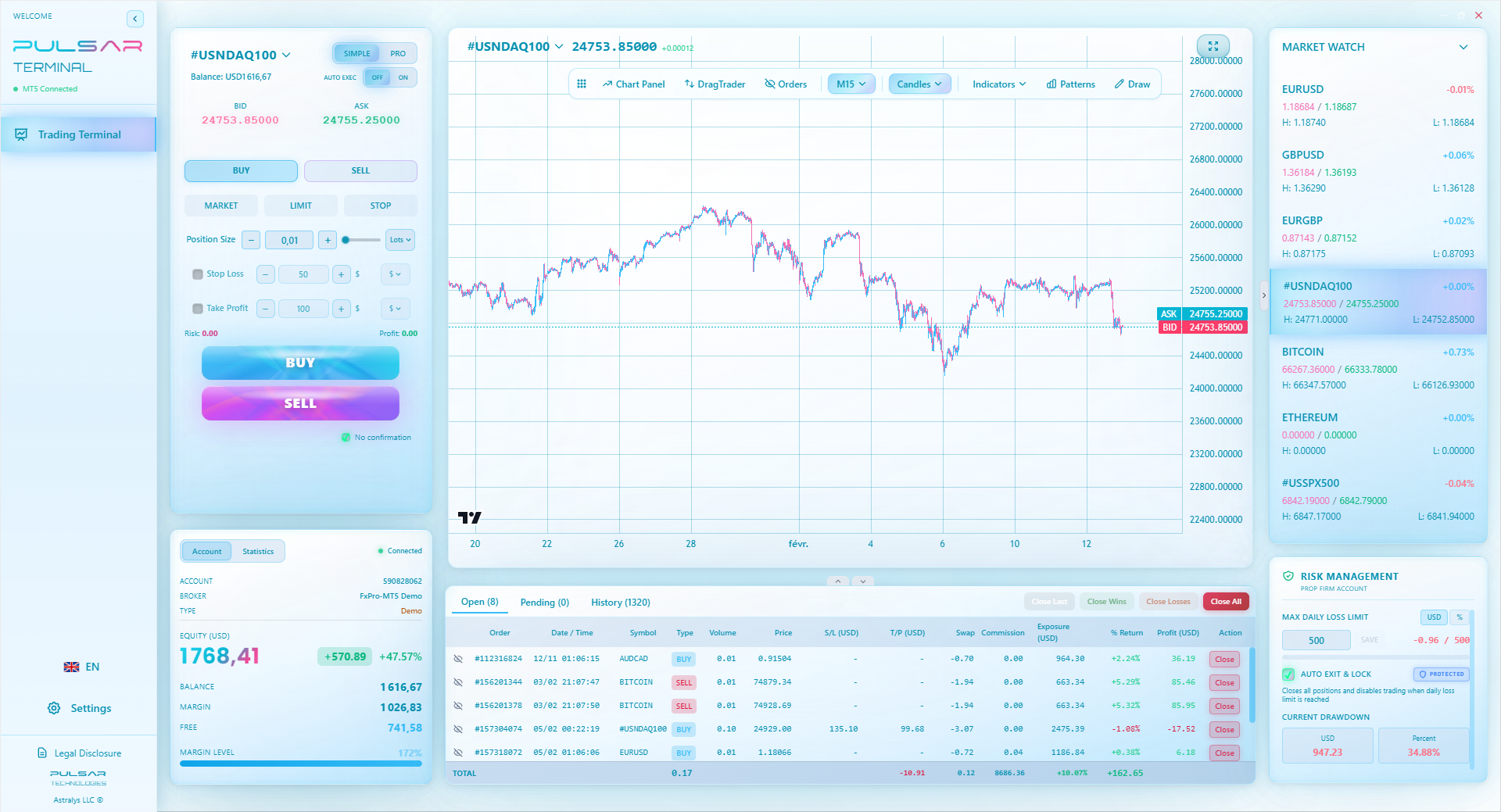
Managing complex trades and strict risk rules is easier with tools that automate the process, letting you focus on strategy instead of manual clicks.
Pulsar Terminal
The all-in-one MT5 companion: drag-and-drop orders, multi-TP/SL, trailing stop, grid trading, Volume Profile, and prop firm protection. Used by 1,000+ traders daily.
“Aim for the first milestone: three consecutive months of not losing money.”
You won't wake up as George Soros. You build success trade by trade. Here's your action plan.
- Start in Simulation: I don't care how confident you are. Trade a demo account for 3 months. Your goal isn't profit; it's to execute your plan perfectly 100 times in a row. No deviating.
- Go Live Small: Fund a live account with money you can afford to lose completely. Your first live goal is to preserve capital for 6 months, not to double it. This changes everything.
- Journal Relentlessly: Every trade. Entry, exit, spread, reason, emotional state. I review my journal every Sunday. My biggest improvements came from spotting my own stupid patterns in that journal.
- Specialize: Don't trade 28 pairs. Master one or two major pairs. Understand their daily rhythm, their average range. Become an expert in that tiny slice of the market.
- Scale Slowly: Only add to your position size or account capital after a proven, profitable quarter. Not a week. A quarter.
The new SEC regulations mean the wild west days are ending. Building a verifiable, clean track record is becoming more important. It's a good thing. It separates the professionals from the gamblers.
Look, I've been where you are. I've watched those "most successful forex traders in the world" videos feeling a mix of inspiration and jealousy. The truth is, their success is a product of time, compounded learning, and surviving mistakes you haven't made yet.
Your journey in Nigeria has unique challenges - taxes, funding, volatility - but also unique opportunities in a massive, growing market. Focus on what you can control: your education, your risk per trade, your psychology.
Forget the Lamborghini. Aim for the first milestone: three consecutive months of not losing money. Then aim for three consecutive months of 2% net growth. That's the unsexy, real path. The legends weren't built in a day. They were built one well-managed, boring trade at a time. Now go review your last ten trades. Be brutally honest. That's where your real education begins.
FAQ
Q1Who is the richest forex trader in Nigeria?
Exact net worths are private and often exaggerated online. Uche Paragon is frequently cited as one of the wealthiest, with estimates (which should be taken skeptically) ranging from $16-20 million. More important than his net worth is his publicly documented approach: building systems and focusing on education over get-rich-quick schemes.
Q2Is forex trading taxable in Nigeria?
Yes. You are subject to a 10% Capital Gains Tax on all your gross trading profits. This applies whether you use a local or international broker. Keep detailed, dated records of all your trades, deposits, and withdrawals for tax purposes. Ignoring this can lead to penalties.
Q3What is a realistic monthly return from forex trading?
Anything between 5-10% per month is exceptionally good and sustainable for a skilled retail trader. Anyone promising you consistently more is lying. I target 3-5% monthly. A 20% annual return is considered world-class by professional fund standards. Focus on consistency, not astronomical percentages.
Q4Which broker is best for beginners in Nigeria?
Beginners need a blend of low barriers to entry, good educational resources, and strong regulation. XM is a solid starting point due to its $5 minimum deposit and strong regulatory framework. Avoid brokers offering extreme use (like 1:2000) at the start; it's a tool for disaster when you're learning.
Q5How much money do I need to start forex trading in Nigeria?
You can start with as little as 20,000-50,000 NGN with some international brokers. However, I recommend starting with at least 200,000-500,000 NGN for a meaningful live experience. This allows for proper position sizing and psychological comfort. The amount is less important than only risking 1% of it per trade.
Q6Has the new SEC law (ISA 2025) made forex trading safer in Nigeria?
It's a step in the right direction. The ISA 2025 gives the SEC power to regulate online FX platforms, which should help weed out scams. However, enforcement takes time. You are still your own best protector. Always verify a broker's international regulation (like FCA, CySEC, ASIC) in addition to any local registration.
Q7What's the biggest mistake Nigerian forex traders make?
Using excessive use. They see brokers like Exness offering 'unlimited' and think it's free money. use amplifies losses just as fast as profits. Pair that with poor risk management, and it's the fastest route to a zeroed account. The second biggest mistake is trading based on Telegram signals without understanding the strategy behind them.
Prof. Winston's Lesson
Key Takeaways:
- ✓Risk max 1% of capital per trade. Always.
- ✓A 20% annual return is world-class performance.
- ✓Master 1-2 pairs, not 20.
- ✓Journal every trade, especially the losers.
- ✓use is a tool, not a strategy.
How useful was this article?
Click a star to rate
Weekly Trading Insights
Free weekly analysis & strategies. No spam.
About the Author
Olumide Adeyemi
West African Trading Pioneer
One of Nigeria's most active forex trading educators. 8 years of experience trading from Lagos. Specializes in low-capital strategies and prop firm challenges for African traders.
Comments
Risk Disclaimer
Trading financial instruments carries significant risk and may not be suitable for all investors. Past performance does not guarantee future results. This content is for educational purposes only and should not be considered investment advice. Always conduct your own research before trading.
You Might Also Like

Cara Trading Forex Sukses: 7 Prinsip dari Trader Profesional
Cara trading forex sukses dengan 7 prinsip trader pro: manajemen modal, disiplin, journal trading, backtest. Data nyata, bukan janji profit palsu.
Jam Trading Forex Terbaik untuk Trader Indonesia: Panduan Lengkap dengan Tabel Waktu
Panduan jam trading forex untuk trader Indonesia. Tabel 4 sesi dunia, jam emas 20:00-00:00, sesi mana yang harus dihindari. Data akurat + tips dari trader berpengalaman.
Top 5 Sàn Forex Uy Tín Nhất 2026: Review Jujur dari Trader Indonesia
Top 5 sàn forex uy tín 2026 untuk trader Indonesia. Review jujur: spread, deposit, withdraw, dukungan lokal. Exness, XM, IC Markets & lebih.
Get Pulsar Terminal
All these calculators are built into Pulsar Terminal with real-time data from your MT5 account. One-click position sizing, automatic risk management, and instant calculations.
Get Pulsar Terminal