


Everyone and their uncle is looking for the 'most trusted forex broker in South Africa.' The problem? Most of the lists you find online are just recycled marketing junk, written by people who've never placed a real trade.

David van der Merwe
Emerging Markets Trader ·  South Africa
☕ 11 min read
What you'll learn:
- 1Trust is FSCA Regulation. Period.
- 2Breaking Down the Real Costs of Trading
- 3Top FSCA-Regulated Brokers for South Africans (2026)
- 4ZAR Accounts, Deposits, and the Practical Stuff
- 5use: The Double-Edged Sword
- 6Platforms and Tools: What You Really Need
- 7Red Flags and How to Avoid Scams
- 8Putting It All Together: Your Action Plan
Everyone and their uncle is looking for the 'most trusted forex broker in South Africa.' The problem? Most of the lists you find online are just recycled marketing junk, written by people who've never placed a real trade. They'll tell you trust is about fancy platforms or low spreads. That's rubbish. Real trust, the kind that lets you sleep at night when your money is on the line, starts and ends with one thing: the FSCA. I've traded through unregulated nightmares and watched friends get cleaned out. Let me set the record straight on what 'trusted' actually means for a South African trader.
Forget brand recognition or slick advertising. In South Africa, the bedrock of trust is a valid Financial Sector Conduct Authority (FSCA) license. This isn't a nice-to-have; it's the only thing that legally separates a legitimate broker from a bucket shop.
An FSCA license means the broker is held to South African law. They must segregate your client funds from their own operating capital (so your money isn't used to pay their office rent). They have to follow strict capital adequacy rules. They're subject to audits. And crucially, they provide a formal channel for dispute resolution if things go sideways.
I learned this the hard way early on. Chasing "too good to be true" bonuses from an offshore outfit, I deposited R10,000. When I tried to withdraw R15,000 in profits, the excuses started: "processing delays," "verification issues." The money never came. That R10,000 lesson was cheaper than some I've heard of.

Warning: A broker saying they "accept South African clients" is NOT the same as being FSCA-regulated. Many international brokers operate here under their global licenses (like CySEC or ASIC). While often reputable, you are not protected by South African law if you sign up with their international entity. Always check for the specific FSCA FSP number.
You must verify this yourself. Go to the FSCA website, use their "Search For An FSP" tool, and type in the broker's registered company name. If it doesn't show up with an active license for "Discretionary Financial Services" or similar, walk away. This two-minute check is the most important trade you'll ever make.

💡 Winston's Tip
Trust is verified, not advertised. That FSCA license check takes two minutes. Skipping it to read one more review is like not checking the brakes on a used car because the salesman has a nice smile.
Trust also means transparent, fair pricing. You can't trust a broker that hides how they make money. In South Africa, your costs come from three main places: the spread, commissions, and swaps.
The Spread: Your Entry & Exit Toll
This is the difference between the buy and sell price. For major pairs like EUR/USD, top FSCA brokers offer raw spreads from 0.0 pips (on ECN accounts) to around 1.0 pip on standard accounts. But here's the local kicker: you're likely trading ZAR pairs.
Pairs like USD/ZAR and EUR/ZAR have inherently wider spreads due to lower liquidity. Don't be shocked to see 5-15 pips as the norm. I once tried scalping USD/ZAR, thinking my scalping strategy would work. The wide spreads ate my profits before the price even moved. It was a quick way to turn R2,000 into R1,800.
Commissions: The Professional's Fee
On raw/ECN accounts, you pay a small commission per trade instead of a marked-up spread. It's often clearer. For example, a broker might charge $3 per lot, per side. On a standard lot (100,000 units), that's a known cost.
The Silent Killer: Swap Rates
Holding a position overnight? You'll pay or earn a swap fee, based on the interest rate differential between the two currencies. These rates can be significant, especially on ZAR pairs. If you're a swing trading enthusiast holding for weeks, always check the swap calculator before entering. A negative swap can slowly bleed a profitable idea dry.

Example: Let's say you buy 1 standard lot of USD/ZAR at Pepperstone. The spread is 5 pips. At roughly R18.50 to the dollar, 1 pip is about R185. So, your immediate cost to enter the trade is 5 pips * R185 = R925. That's a hefty starting handicap. Always use a position size calculator to factor this in before you click buy.
“A broker saying they 'accept South African clients' is NOT the same as being FSCA-regulated.”
Based on regulation, track record, and local suitability, here are the brokers that consistently earn a trusted reputation. Remember, 'best' depends on your needs: are you a high-volume scalper or a casual weekend trader?
| Broker | Why It's Trusted (FSCA-wise) | Best For... | Key Local Consideration |
|---|---|---|---|
| IG Markets | FSCA licensed, plus global Tier-1 regulation (FCA, ASIC). Massive, publicly-listed company. | Beginners & all-rounders. Excellent education, strong platform. | Higher minimum deposit (£250/R5,000+). The gold standard for security. |
| Tickmill | Holds a clear FSCA license. | Low-cost, raw spread traders. | Their Raw Account offers spreads from 0.11 pips on EUR/USD + small commission. A favorite for active traders. |
| AvaTrade | Long-standing FSCA license (FSP #45984). | Traders who want fixed spreads and peace of mind. | Offers a wide range of platforms, including MT4/MT5 and their own user-friendly AvaTradeGO app. |
| Exness | FSCA regulated. | Traders with small starting capital. | Known for very low minimum deposits (from R15) and flexible account types. Our Exness review details their local operations. |
| Pepperstone | FSCA licensed. | ECN trading and fast execution. | Consistently top-rated for execution speed and the cTrader platform. Check our deep Pepperstone review. |
Other notable FSCA-regulated names include Plus500, XM Group, and FP Markets. XM, in particular, is popular for its low minimum deposit and extensive educational resources, which we've covered in our XM review.
The point isn't to just pick the top name. It's to pick the one from this regulated pool that fits your style. A scalper needs Tickmill's or Pepperstone's tight spreads. A beginner might prefer IG's or AvaTrade's structured environment.
A truly trusted broker for South Africans makes the money part easy and cheap. This means offering a ZAR-denominated trading account.
Why does this matter? If your account is in USD and you deposit in Rand, your bank hits you with a foreign conversion fee (often 2-3%). When you withdraw, they do it again. That's a 4-6% tax on your money before you even trade. With a ZAR account, you deposit and withdraw in Rand directly with the broker, who gets a wholesale conversion rate. You save a fortune.
Minimum deposits are all over the show. You'll see ads for "Trade from R50!" Sure, you can. But should you? With a R50 account, a 10-pip loss on a micro lot might wipe out 20% of your capital. It's a recipe for frustration and blown accounts. My blunt advice: if you're serious, start with at least R5,000. This allows for proper position size calculator use and sane risk management without facing a margin call on your first trade.
Funding methods are usually straightforward: EFT (Electronic Funds Transfer) directly into the broker's South African bank account is common, fast, and free. Credit/debit cards and e-wallets like Skrill are also options. The FSCA's rules make this process reliable.

Pro Tip: Always make a small test withdrawal before you commit large capital. A trustworthy broker processes withdrawals smoothly and without drama. If there's any hassle pulling out R500, imagine the nightmare trying to get R50,000.
💡 Winston's Tip
Your first withdrawal is more important than your first deposit. A trustworthy broker processes it smoothly. If they don't, you've just paid a very cheap price for a very valuable lesson.
“If you think you need 1:500 use to succeed, you're focusing on the wrong thing.”
This is where many South African traders get confused, and brokers often muddy the waters. The FSCA has a strict rule: for retail clients, maximum use is 1:30 on major forex pairs.
This is a protective measure. At 1:30, a 3.33% move against you wipes your margin. That's still risky, but it's far more survivable than the 1:500 or 1:1000 you see advertised.
Here's the catch: many international brokers offer their South African clients the option to sign up under their global entity (e.g., their Cyprus or Seychelles company). That entity can offer 1:500 use because it's not bound by FSCA rules. But remember our first section? If you do that, you are voluntarily stepping outside of FSCA protection. You're trading with their offshore arm.
I used to chase high use. I thought it was free power. Then, on a 1:500 account trading XAU/USD, a $15 sudden spike against my position triggered a margin call so fast I couldn't even react. I lost the entire R8,000 in that account in under 10 seconds. The trade eventually went my way, but my account was already gone. use doesn't just amplify profits; it amplifies the speed of your losses.
Sticking with an FSCA-mandated 1:30 forces discipline. It makes you think about position size. For 99% of traders, it's more than enough. If you think you need 1:500 to succeed, you're focusing on the wrong thing.
💡 Winston's Tip
use is a multiplier for your mistakes. The FSCA's 1:30 limit isn't a restriction; it's a seatbelt. You might complain it's uncomfortable until the moment you need it.
MetaTrader 4 (MT4) is the undisputed king in South Africa. MT5 is gaining ground. A trusted broker offers at least one of these. Why? Because they're stable, ubiquitous, and support countless custom indicators and automated trading systems (EAs).
But the native MT4/MT5 desktop platforms are, frankly, a bit clunky for advanced order management. This is where external tools become game-changers for managing risk - which is the core of lasting trust in your own process.
Let's say you're in a winning trade and want to move your stop loss to breakeven, then trail the rest. Doing that manually on MT4 while watching other charts is stressful and error-prone. Automation creates trust in your own execution.
Similarly, if you're in a prop firm challenge, the daily drawdown limit is a sword hanging over you. Manually calculating that after every trade is a nightmare. You need tools that automate this protection, so you can focus on analysis, not arithmetic.
Pro Tip: Don't get seduced by a broker's flashy proprietary platform unless it offers something MT4/MT5 truly doesn't for your strategy. Stick with the standard. It ensures you can move your skills and tools between brokers if you ever need to. The real edge comes from how you use the platform, not the platform itself. Learning to use the MACD indicator or RSI indicator effectively on MT4 is worth more than any fancy GUI.
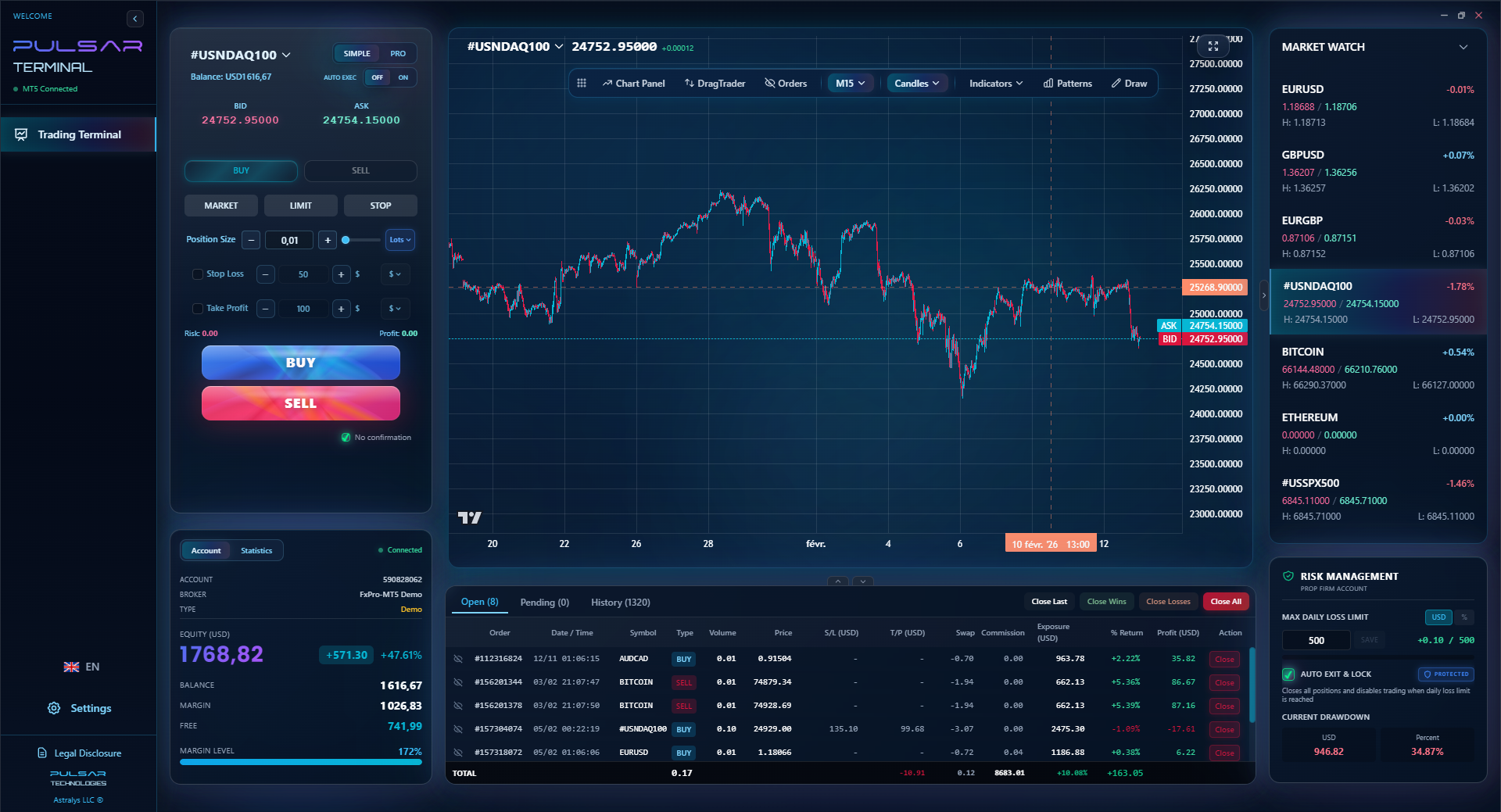
Managing complex trades and prop firm rules manually on MT4 is error-prone; Pulsar Terminal automates trailing stops, breakeven moves, and daily loss protection directly on your charts.
Pulsar Terminal
The all-in-one MT5 companion: drag-and-drop orders, multi-TP/SL, trailing stop, grid trading, Volume Profile, and prop firm protection. Used by 1,000+ traders daily.
“Your first withdrawal is more important than your first deposit.”
Even with an FSCA framework, you need to keep your eyes open. Trust is earned, but skepticism is your default setting.
Major Red Flags:
- Guaranteed Profits or "No Risk": Trading is risk. Anyone saying otherwise is lying.
- Unsolicited Contact: If someone calls, WhatsApps, or emails you out of the blue pushing a broker or "managed account" service, block them. Legitimate brokers don't need to cold-call.
- Pressure to Deposit More to "Unlock" Withdrawals: This is a classic scam tactic. Your withdrawal should never be conditional on making another deposit.
- Overly Complex or Opaque Fee Structures: If you can't easily understand how they make money, they're probably making money from you in a bad way.
- Fake FSP Numbers: Some outfits will list a fake or expired number. Verify it yourself on the FSCA website every single time.
I once reviewed a "broker" that had a stunning website, 24/7 chat support, and offered 1:1000 use. Their listed FSP number was for a completely different company that had been deregistered years prior. They were a clone firm, a total fraud. A few minutes of checking saved potential victims.
Your trust should be placed in regulated, transparent businesses that see you as a client, not a mark. The FSCA does its part, but you must do yours. If something feels off, it probably is. Walk away. There are plenty of legitimate, trusted forex brokers in South Africa to choose from.
Finding the most trusted forex broker in South Africa isn't about finding a perfect score. It's about a systematic checklist that protects you.
Here’s your step-by-step plan:
- Regulation First: Compile a shortlist of 3-4 brokers from the reputable lists in this article. Immediately go to the FSCA website and confirm each one's active license. Discard any that don't check out.
- Cost Analysis: For the remaining brokers, look at their real pricing for the assets you'll actually trade. Don't just look at EUR/USD. Check the spread on USD/ZAR if you'll trade it. See if they have ZAR accounts to save on conversion fees.
- Test the Waters: Open a demo account with your top 2 choices. Get a feel for their platform execution, how their spreads behave during the London open (3 PM SAST), and their customer service response.
- Make a Small Real Deposit: Start with a live account using a small amount of capital you can afford to lose - maybe R1,000-R2,000. Execute a few trades, then immediately test the withdrawal process. A broker that makes withdrawing easy is a broker that's confident in its service.
- Scale Up Gradually: Only once you're completely comfortable with the platform, costs, and withdrawal process should you consider depositing more significant capital.
Trust is built through verification and experience, not through a slick sales page. Take your time, do the homework, and you'll find a broker that's a partner, not a predator. Your future trading self will thank you for the due diligence.
FAQ
Q1Is forex trading legal and safe in South Africa?
Yes, forex trading is completely legal in South Africa. Its safety for an individual trader, however, depends almost entirely on using a broker regulated by the Financial Sector Conduct Authority (FSCA). This regulation provides legal protections like client fund segregation and formal dispute resolution. Trading itself is always risky, but a regulated broker ensures the playing field is fair.
Q2Can I use international brokers like IC Markets or Exness in South Africa?
Yes, many international brokers like IC Markets and Exness accept South African clients. The critical question is under which entity you join. Both have FSCA-regulated local entities (you can see this in our Exness review and IC Markets review). You must ensure you open your account specifically with their FSCA-licensed South African company to get local legal protection, including the 1:30 use limit. If you sign up with their global site, you may get higher use but forfeit FSCA safeguards.
Q3What is the minimum deposit to start forex trading in South Africa?
Technically, you can start with as little as R50-R100 with some brokers offering micro accounts. Practically, this is a terrible idea. With such a small amount, proper risk management is impossible, and fees/spreads will eat you alive. A realistic minimum for a beginner to learn properly without constant margin pressure is between R5,000 and R20,000. This allows for meaningful position sizing and room to breathe.
Q4Why are spreads on USD/ZAR so much wider than on EUR/USD?
Spreads are a function of liquidity and trading volume. EUR/USD is the most traded currency pair in the world, with massive liquidity from banks, funds, and corporations. USD/ZAR, while liquid for an emerging market pair, has far less volume. This lower liquidity means brokers face higher costs to execute the trade, which is passed on as a wider spread. It's normal to see spreads of 5-15 pips on USD/ZAR versus under 1 pip on EUR/USD.
Q5What is the best trading platform for beginners in South Africa?
MetaTrader 4 (MT4) remains the best for most beginners. It's stable, widely supported by all FSCA-regulated brokers, and has a simpler interface than MT5 for basic forex trading. The sheer amount of free educational content, tutorials, and indicators available for MT4 is unmatched. It's the common language of retail trading here.
Q6How do I verify a broker's FSCA license?
Go directly to the official FSCA website (www.fsca.co.za). Find the "Search For An FSP" function (usually under "Public Register"). Enter the broker's exact registered company name (e.g., "IG Markets South Africa Limited"). The search result should show an active license status and list the authorized financial services, which should include "Discretionary Financial Services" or similar for forex/CFD trading.
Q7Are there any taxes on forex trading profits in South Africa?
Yes. Profits from forex trading are considered taxable income by the South African Revenue Service (SARS). You are liable for income tax on your net trading profits (profits minus losses and allowable expenses). It's crucial to keep detailed, accurate records of all your trades, deposits, and withdrawals for tax purposes. Consult with a tax professional familiar with trading income.
Prof. Winston's Lesson
Key Takeaways:
- ✓Verify the FSCA license yourself. Every time.
- ✓Use a ZAR account to avoid 4-6% in bank fees.
- ✓Start with at least R5,000 for realistic risk management.
- ✓Test the withdrawal process with a small amount first.
- ✓1:30 use is a protective seatbelt, not a limitation.
How useful was this article?
Click a star to rate
Weekly Trading Insights
Free weekly analysis & strategies. No spam.
About the Author
David van der Merwe
Emerging Markets Trader
Johannesburg-based trader with 11 years in emerging market currencies. Specializes in ZAR pairs, FSCA-regulated trading, and South African market analysis.
Comments
Risk Disclaimer
Trading financial instruments carries significant risk and may not be suitable for all investors. Past performance does not guarantee future results. This content is for educational purposes only and should not be considered investment advice. Always conduct your own research before trading.
You Might Also Like

Cara Trading Forex Sukses: 7 Prinsip dari Trader Profesional
Cara trading forex sukses dengan 7 prinsip trader pro: manajemen modal, disiplin, journal trading, backtest. Data nyata, bukan janji profit palsu.
Jam Trading Forex Terbaik untuk Trader Indonesia: Panduan Lengkap dengan Tabel Waktu
Panduan jam trading forex untuk trader Indonesia. Tabel 4 sesi dunia, jam emas 20:00-00:00, sesi mana yang harus dihindari. Data akurat + tips dari trader berpengalaman.
Top 5 Sàn Forex Uy Tín Nhất 2026: Review Jujur dari Trader Indonesia
Top 5 sàn forex uy tín 2026 untuk trader Indonesia. Review jujur: spread, deposit, withdraw, dukungan lokal. Exness, XM, IC Markets & lebih.
Get Pulsar Terminal
All these calculators are built into Pulsar Terminal with real-time data from your MT5 account. One-click position sizing, automatic risk management, and instant calculations.
Get Pulsar Terminal