


Ever watch a chart and feel like you're missing the real action? You're probably trading the wrong pairs.

Olumide Adeyemi
West African Trading Pioneer ·  Nigeria
☕ 11 min read
What you'll learn:
- 1What Makes a Currency Pair Volatile? It's Not Just News
- 2The Usual Suspects: Top 5 Most Volatile Forex Pairs
- 3How to Measure Volatility: Practical Tools for Your Charts
- 4Trading Strategies for High Volatility
- 5Risk Management: The Non-Negotiable Rules for Survival
- 6Best Brokers in Nigeria for Trading Volatile Pairs
- 7Conclusion: Start Slow, Respect the Market

Ever watch a chart and feel like you're missing the real action? You're probably trading the wrong pairs. For years, I stuck to EUR/USD and GBP/USD, thinking I was being 'smart' and 'safe.' The truth is, I was just bored and leaving serious money on the table. The real moves, the adrenaline, and yes, the bigger profits (and losses) happen with the most volatile currency pairs in forex. This guide is about finding those pairs, understanding why they move like they do, and most importantly, how to trade them without blowing up your account. Let's talk about where the market's pulse really is.
Volatility isn't just about big headlines. It's the market's breathing pattern. For a Nigerian trader, understanding this is the difference between catching a wave and getting wiped out.
First, liquidity (or lack thereof). Major pairs like EUR/USD have massive daily volume, which usually dampens wild swings. Exotic pairs, or pairs involving currencies from smaller, less stable economies, have thinner markets. A few large orders can send them flying. Think of it like pushing a wheelbarrow versus pushing a parked truck.
Second, economic divergence. When two countries' central banks are moving in completely opposite directions, the pair between them becomes a battleground. If the Bank of England is hiking rates while the Bank of Japan is printing money, GBP/JPY will be a rollercoaster.
Third, commodity dependence. Countries that live and die by one major export (like oil for Canada or Norway, copper for Chile) see their currencies get jerked around by those commodity prices. This creates inherent volatility in pairs like USD/CAD or USD/NOK.

Warning: High volatility doesn't mean 'easy money.' It often means wider spreads. Your broker's cost to execute your trade is higher on these pairs, so you start each trade in a deeper hole. Always check the typical spread before you enter. A 15-pip spread on a pair that moves 50 pips a day is a massive hurdle.
My early mistake? I saw high volatility and thought 'opportunity.' I didn't factor in the spread. I'd enter a trade on USD/ZAR, be down 10 pips immediately because of the spread, and then panic at the first retracement. I was fighting the broker's fee before I even fought the market.
“The real moves, the adrenaline, and the bigger profits happen with the most volatile currency pairs in forex.”
Based on average true range (ATR) over the last year, here are the champions of chaos. Remember, this list can shift, but these are consistently in the top tier.
| Currency Pair | Typical Daily Range (Pips) | Why It's Volatile |
|---|---|---|
| GBP/JPY | 150 - 250+ | The 'Dragon' or 'Beast.' Combines a volatile GBP with a funding currency (JPY). Carry trade unwinds cause massive moves. |
| USD/ZAR | 800 - 1500+ | South African Rand. Commodity-driven, high local interest rates, political risk. The spread is huge, often 15-30 pips. |
| USD/TRY | 1000 - 3000+ | Turkish Lira. Extreme inflation and unorthodox monetary policy. This is less trading and more speculation. |
| AUD/JPY | 100 - 180+ | Risk sentiment barometer. Tied to Chinese growth (AUD) and global risk appetite (JPY). |
| NZD/JPY | 100 - 170+ | Similar to AUD/JPY, but the Kiwi is even more sensitive to dairy prices and pure risk flows. |
A note on pips: For pairs like USD/ZAR where the quote is 18.5000, a 'pip' is typically 0.0010, or 10 points on the 4th decimal. A 1000-pip move is 1.0000. This is crucial for your position size calculator.
The GBP/JPY Lesson
I learned respect for GBP/JPY the hard way. In early 2023, I was short from 161.50, thinking it was overextended. The UK inflation data came in hot. Within 90 minutes, it ripped to 164.80. That's a 330-pip move against me. My stop-loss was at 162.20, so I got taken out for a 70-pip loss, only to watch it reverse and crash 400 pips over the next two days. The volatility didn't just hit my stop, it hunted it. This is why mental stops aren't enough with these pairs. You need an automated trailing stop or a very wide stop, which changes your entire position sizing math.

Pro Tip: Don't just look at the daily range. Look at the time of the move. GBP/JPY often sleeps through the Asian session and explodes during the London-Tokyo overlap or when UK data drops. Trade the sessions where your pair is most alive.
“High volatility doesn't mean 'easy money.' It often means wider spreads. You start each trade in a deeper hole.”
You can't manage what you don't measure. Guessing volatility is a surefire way to mis-size your trade. Here are the two tools I live by.
1. Average True Range (ATR): This is your best friend. It doesn't tell you direction, just how much the pair typically moves over a chosen period (14 days is standard). If GBP/JPY has a 14-day ATR of 180 pips, that's your playing field. My rule? I set my stop-loss to be at least 1x ATR away from my entry. If the ATR is 180, a 50-pip stop is just noise and will get taken out. This forces discipline.
2. Bollinger Bands: When the bands squeeze tight, volatility is compressing. A big move is coming, but you don't know the direction. When the bands expand, the move is happening. I use a squeeze as a signal to get ready, not to enter. Wait for the breakout, then look for a retest of the band.
Let me give you a real example from last month on USD/CAD (a pair that can get spicy with oil moves). The ATR was sitting at 55 pips. Price was coiling in a tight range. I placed a buy order above the range with a stop 60 pips below (just over 1x ATR). It triggered, ran 40 pips, and then reversed, hitting my stop. Loss: 60 pips. Why share a losing trade? Because the ATR told me the minimum risk I had to take. A tighter stop would have been a guaranteed loss. The tool did its job, I just picked the wrong direction.
Integrating these tools with a platform that gives you clear visuals is half the battle. Manually calculating ATR for multiple pairs is a chore.

💡 Winston's Tip
Volatility is a measure of energy, not direction. Use the ATR to size your container (position), then use price action to decide which way to pour.

“High volatility doesn't mean 'easy money.' It often means wider spreads. You start each trade in a deeper hole.”
Trading these pairs with a standard strategy is like using a bicycle on a Formula 1 track. You need to adapt.
For Swing Traders: Your edge is patience. Use higher timeframes (4H, Daily) to identify the major trend. Wait for a pullback to a key support or resistance level, confirmed by a momentum indicator like the RSI indicator coming out of oversold/overbought territory. Your stop must be wide, beyond recent swing highs/lows. Your profit target should be at least 1.5x to 2x your risk. This is a low-frequency, high-conviction game. It's about catching the big waves, not the ripples.
For Scalpers: You're playing a different game. You need ultra-fast execution and a broker with razor-thin spreads, even on exotics. Look at brokers like IC Markets review or Pepperstone review for this. Your strategy should be purely technical, focusing on liquid sessions. A common scalping strategy on volatile pairs is trading breakouts from a 5 or 15-minute consolidation during the London or New York open. Your profit target is small (10-20 pips), but your stop is even tighter (5-10 pips). You're trying to capture a quick burst of momentum, not a trend.
The Breakout Trap: A classic mistake with volatile pairs is chasing breakouts. You see USD/ZAR break a 4-hour high and jump in. Too often, that's the final exhaustion move before a vicious reversal. My lesson? Wait for the breakout, then wait for a pullback to retest the broken level as new support. If it holds, that's your higher-probability entry. It requires more patience, but it keeps you from buying the very top.

Example: Let's say you're swing trading GBP/JPY. ATR is 200 pips. You find a setup where a logical stop-loss is 220 pips away. On a standard $10,000 account risking 1%, that's $100. Your position size is $100 / 220 pips = $0.45 per pip. On GBP/JPY, a pip on a standard lot is about $8. So you'd trade 0.06 lots. This tiny size feels wrong when you're used to 0.5 lots on EUR/USD, but it's mathematically correct for the volatility. This is how you survive.
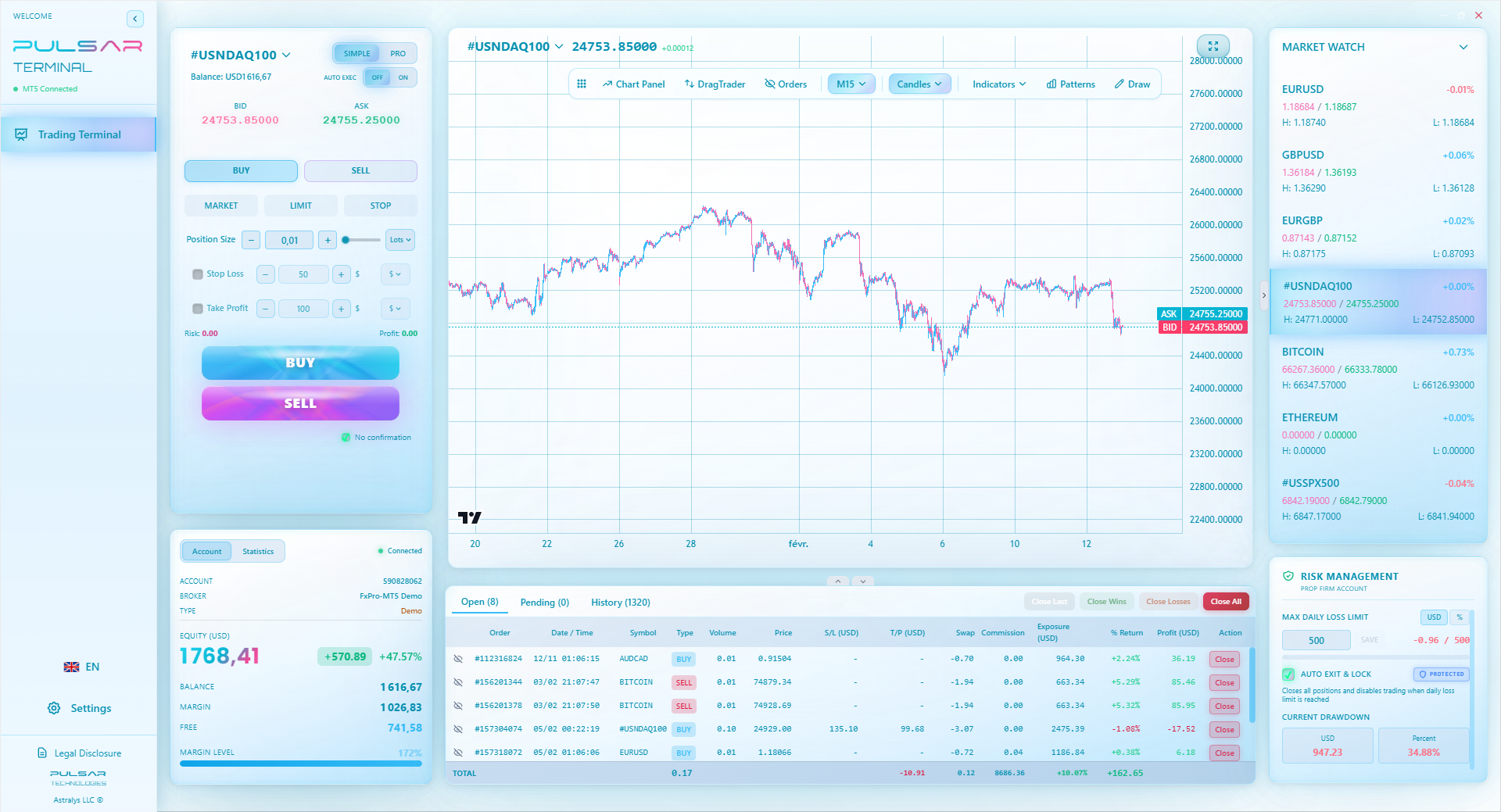
Managing multiple take-profit levels and trailing stops on fast-moving pairs is nearly impossible manually, which is where a tool like Pulsar Terminal, which automates this directly on your MT5, becomes essential.
Pulsar Terminal
The all-in-one MT5 companion: drag-and-drop orders, multi-TP/SL, trailing stop, grid trading, Volume Profile, and prop firm protection. Used by 1,000+ traders daily.
“Trading these pairs with a standard strategy is like using a bicycle on a Formula 1 track.”
This is the most important section. Get this wrong, and trading volatile pairs will be a very expensive, very short hobby.
1. Position Sizing is Everything: I said it above, but it's worth screaming. Your position size must be calculated based on the distance to your stop-loss (your risk), not your account balance alone. A 500-pip stop on USD/ZAR requires a position size 5 times smaller than a 100-pip stop on EUR/USD for the same dollar risk. Use a position size calculator religiously.
2. Embrace Wide Stops: You have to give the trade room to breathe. A tight stop on a volatile pair is a tax you pay to the market makers. If your analysis doesn't support a wide stop, you don't have a trade. Wait for a better entry.
3. Beware of Gaps: These pairs can gap massively over the weekend or after major news. If you're holding a position through an event, you could be opened miles away from your stop, facing a loss far greater than you planned. Either close before high-risk events or use a broker with guaranteed stop-losses (which cost extra).
4. Margin Call Danger: High volatility + poor position sizing = a fast track to a margin call. Your broker's margin requirements may also increase for exotic pairs. Check this before you trade.
I violated rule #3 catastrophically in 2020 with USD/TRY. I was holding a small long position over a weekend when the Turkish central bank made a surprise intervention. The pair gapped down over 2000 pips on Sunday open. My account was wiped out before I could even log in. The loss was more than my entire account balance. I was trading with a broker that didn't offer negative balance protection at the time. That lesson was free, but it cost me everything in that account.
💡 Winston's Tip
If the spread on a pair feels like a fair price for entry, it's probably too wide. Your edge must overcome the spread first. On exotics, that's a steep hill.

“Trading these pairs with a standard strategy is like using a bicycle on a Formula 1 track.”
Not all brokers are created equal for this niche. You need two things: reliable execution during chaos, and access to the exotic pairs. Many international brokers restrict Nigerian clients from trading certain pairs (like USD/TRY). Here's the lay of the land.
International Brokers (Accepting Nigerian Clients):
- Exness: They have a strong presence in Africa and offer many exotic pairs, including African crosses like USD/ZAR, GBP/ZAR. Their spreads can be competitive, but watch for widening during news. Read our full Exness review for details on their Naira deposit options.
- XM: Also popular here. They offer a wide range of instruments and often have promotional offers. Execution is generally solid.
- IC Markets & Pepperstone: As mentioned, these are top-tier for raw spreads and fast execution, crucial for scalping strategy. They may have fewer exotic pairs than Exness, but for the major volatiles like GBP/JPY, they're excellent.
The Local vs. International Dilemma: Some local platforms offer forex trading. Be extremely cautious. Ensure they are properly regulated (not just registered with CAC). The biggest risk with local platforms is slippage and requotes during volatile spikes. You might get a price you didn't ask for. With an internationally regulated broker, you have more recourse.
Funding Tip: Funding these accounts from Nigeria is its own challenge. I've had the most consistent success using USDT (Tether) transfers via crypto networks. It's fast, and the fees are predictable compared to bank wire transfers that can get stuck or attract unexpected charges. All the brokers listed above accept crypto deposits.
“Get position sizing wrong, and trading volatile pairs will be a very expensive, very short hobby.”
Trading the most volatile currency pairs in forex is not the next level, it's a different sport. It's thrilling, potentially more rewarding, but it demands more from you: more discipline, more patience, and a ruthless commitment to risk management.
My advice? Don't jump into USD/ZAR or GBP/JPY with your main account. Open a demo account, or allocate a tiny portion of your capital - a 'learning fund.' Practice measuring the ATR, placing wide stops, and managing your emotions when a trade moves 100 pips against you before coming back to profit. That emotional rollercoaster is the real test.
Start with the slightly less chaotic pairs, like AUD/JPY or even a volatile major like GBP/USD during high-impact news. Get comfortable there. Then, maybe, graduate to the beasts. Remember, the goal isn't to trade the most volatile pair, it's to trade volatility well. There are seasoned pros who make a great living just from swing trading GBP/JPY and nothing else. They know its personality inside out.
Find one or two pairs that resonate with your style, study them relentlessly, and trade them with precision. That's how you turn volatility from a threat into your ally.
FAQ
Q1What is the most volatile forex pair right now?
It changes, but USD/TRY (US Dollar/Turkish Lira) is consistently one of the most volatile due to extreme inflation and political factors. GBP/JPY and USD/ZAR are also almost always in the top five. Check the Average True Range (ATR) indicator on your trading platform for current rankings.
Q2Is it good to trade volatile currency pairs?
It can be good if you have the right strategy and risk management. They offer larger profit potential in shorter times, but the risk is equally larger. They are not suitable for beginners. You need experience, a calm temperament, and a strict trading plan that accounts for wide stops and sudden reversals.
Q3Which forex pair moves the most pips daily?
Exotic pairs involving currencies from emerging markets, like USD/ZAR (US Dollar/South African Rand) or USD/TRY, often move the most pips - sometimes 800 to 3000+ pips in a day. However, remember that a 'pip' for these pairs is often a 1-point move on the 2nd decimal (e.g., 18.50 to 18.51), not the 4th.
Q4How do I manage risk on highly volatile pairs?
Use a position size calculator based on your stop-loss distance, not just account balance. Set wider stop-losses (at least 1x the ATR value). Avoid holding positions over major news or weekends when gaps are likely. Never risk more than 1-2% of your account on a single trade with these pairs.
Q5Can I trade exotic pairs like USD/ZAR from Nigeria?
Yes, many international brokers like Exness and XM that accept Nigerian clients offer pairs like USD/ZAR, GBP/ZAR, and even USD/NGN sometimes. Always verify the broker's regulation, deposit/withdrawal methods for Nigeria, and the typical spreads on the exotic pairs before funding an account.
Q6What is the best time to trade volatile pairs like GBP/JPY?
The best volatility for GBP/JPY usually occurs during the overlap of the London and Tokyo sessions (around 7 AM - 9 AM WAT) and when major UK or global economic data is released. The Asian session can be quiet, while the London and New York sessions see the most action.
Prof. Winston's Lesson
Key Takeaways:
- ✓Measure volatility with ATR before every trade.
- ✓Size your position based on stop distance, not balance.
- ✓A tight stop on a volatile pair is a market maker tax.
- ✓Never hold exotic pairs over high-risk news events.
How useful was this article?
Click a star to rate
Weekly Trading Insights
Free weekly analysis & strategies. No spam.
About the Author
Olumide Adeyemi
West African Trading Pioneer
One of Nigeria's most active forex trading educators. 8 years of experience trading from Lagos. Specializes in low-capital strategies and prop firm challenges for African traders.
Comments
Risk Disclaimer
Trading financial instruments carries significant risk and may not be suitable for all investors. Past performance does not guarantee future results. This content is for educational purposes only and should not be considered investment advice. Always conduct your own research before trading.
You Might Also Like

Cara Trading Forex Sukses: 7 Prinsip dari Trader Profesional
Cara trading forex sukses dengan 7 prinsip trader pro: manajemen modal, disiplin, journal trading, backtest. Data nyata, bukan janji profit palsu.
Jam Trading Forex Terbaik untuk Trader Indonesia: Panduan Lengkap dengan Tabel Waktu
Panduan jam trading forex untuk trader Indonesia. Tabel 4 sesi dunia, jam emas 20:00-00:00, sesi mana yang harus dihindari. Data akurat + tips dari trader berpengalaman.
Top 5 Sàn Forex Uy Tín Nhất 2026: Review Jujur dari Trader Indonesia
Top 5 sàn forex uy tín 2026 untuk trader Indonesia. Review jujur: spread, deposit, withdraw, dukungan lokal. Exness, XM, IC Markets & lebih.
Get Pulsar Terminal
All these calculators are built into Pulsar Terminal with real-time data from your MT5 account. One-click position sizing, automatic risk management, and instant calculations.
Get Pulsar Terminal