


Most traders think volatility is just about big, fast moves and easy profits.

David van der Merwe
Emerging Markets Trader ·  South Africa
☕ 11 min read
What you'll learn:
Most traders think volatility is just about big, fast moves and easy profits. I used to think that too, until I blew up half my account on a wild ZAR/JPY swing I didn't understand. The truth is, knowing the most volatile pairs in forex isn't about chasing adrenaline; it's about knowing where the landmines are and, occasionally, where the gold is buried. Let's set the record straight on which pairs will really test your mettle and how you can trade them without getting shredded.
Volatility isn't just a fancy word for 'moves a lot.' It's the statistical measure of how much a price disperses from its average over time. In plain English, it's how wild and unpredictable the ride is. For us trading from SA, a few key ingredients cook up a volatile pair.
First up, liquidity - or the lack of it. Major pairs like EUR/USD are super liquid, which usually dampens volatility. It's the exotic and minor pairs, the ones with less trading volume, that tend to jump around more. A big buy or sell order can shove the price much further when there aren't many other traders to absorb it.
Then you've got economic and political instability. Currencies from countries with unpredictable politics, shaky economies, or surprise central bank decisions are prime candidates. Think about the Turkish Lira or the South African Rand on a bad day. When news hits, these currencies can react violently.
Finally, there's the trading session overlap. The London and New York session overlap (our 3 PM to 5 PM SAST) is famously volatile for pairs involving USD, GBP, and EUR. More traders are active, which means more orders and bigger price swings.

Warning: Don't confuse high volatility with high opportunity. It's high risk first. Trading the most volatile pairs in forex without a solid risk plan is a surefire way to hit a margin call faster than you can say 'spread widened.'
I learned this the hard way with USD/TRY. I saw it moving 200 pips a day and thought it was a scalper's dream. What I didn't account for was the spread, which could widen to 50 pips during news events. My brilliant 30-pip profit target was swallowed whole before my trade even had a chance. The broker's spread ate my lunch.
“Knowing the most volatile pairs in forex isn't about chasing adrenaline; it's about knowing where the landmines are.”
Let's get specific. Based on average true range (ATR) and my own trading logs, here are the usual suspects. Remember, volatility rankings can shift with global events, but these pairs are consistently on the naughty list.
The Volatile Majors & Crosses:
| Pair | Typical Daily Range (Pips) | Why It's Jumpy |
|---|---|---|
| GBP/AUD | 100 - 140 | A classic 'risk-on/risk-off' cross. Reacts heavily to commodity prices (AUD) and UK political drama (GBP). |
| GBP/JPY | 120 - 160 | Nicknamed 'The Beast.' Combines GBP's volatility with JPY's safe-haven flows. A monster during market stress. |
| AUD/JPY | 90 - 130 | Another key risk barometer. Aussie data and Chinese economic health vs. Japanese investor sentiment. |
| EUR/AUD | 90 - 120 | The Eurozone's economic twists versus Australia's commodity dependency. |
A Personal Story with GBP/JPY: Back in late 2022, I was swing trading GBP/JPY. The pair was in a clear downtrend. I shorted at 164.50, aiming for a 200-pip move. Overnight, some ambiguous BoJ commentary hit the wires. The pair spiked up 180 pips in minutes, stopping me out at 166.30. It then resumed its downtrend and fell 400 pips over the next week. My analysis was right, but the intraday volatility of one of the most volatile pairs in forex wiped me out before the trend could pay me. It was a brutal lesson in position sizing and stop placement.

Pro Tip: When trading these pairs, use wider stops. A 20-pip stop on GBP/JPY is just noise. I now use at least 1.5x the pair's average daily range as a guide for my stop distance. A good position size calculator is non-negotiable here to keep your risk per trade sane.
While EUR/USD is more stable, understanding its dynamics is crucial for context. You can see how in our dedicated EUR/USD guide.

💡 Winston's Tip
Volatility is not your enemy; it's your environment. A sailor doesn't blame the ocean for being wet. Trade the pair's personality, not your expectation of it.
“Trading the most volatile pairs in forex without a solid risk plan is a surefire way to hit a margin call.”
This is where the real rollercoasters live. Exotic pairs involve one major currency and one from a developing economy (like ZAR, TRY, MXN). They are the most volatile pairs in forex, full stop.
USD/ZAR (Dollar/Rand): This is our home game. The volatility here is deeply personal. It's driven by:
- Local Politics: ANC policy announcements, Eskom crises, budget speeches.
- Commodity Prices: As a major exporter of gold, platinum, and other minerals, ZAR strength is tied to these prices. I often watch XAU/USD as a leading indicator for ZAR sentiment.
- Global Risk Sentiment: When investors flee risky assets, they pull money out of markets like South Africa.
- SARB Decisions: Interest rate changes can cause immediate, sharp moves.
The daily range can easily exceed 200-300 pips during eventful periods. I once caught a 450-pip move on USD/ZAR after a surprise SARB rate hike, but I've also been stopped out by 150-pip false spikes during load-shedding announcements.
Other Volatile Exotics to Know:
- USD/TRY (Dollar/Turkish Lira): Possibly the wildest in the world. Hyper-inflation and unorthodox central bank policy make it incredibly unpredictable. Spreads are huge.
- EUR/TRY & GBP/TRY: Even more volatile than USD/TRY due to the cross-currency dynamics.
- USD/MXN (Dollar/Mexican Peso): Volatile around US economic data, oil prices, and Mexican political events.
Warning: Trading exotics requires a broker with deep liquidity in these pairs. Some international brokers offer them but with massive spreads (think 20-50 pips for USD/ZAR on a bad day). Always check the typical spread before you trade. Local brokers like those reviewed on our site, such as Exness or XM, often have better pricing for ZAR pairs.
“Trading the most volatile pairs in forex without a solid risk plan is a surefire way to hit a margin call.”
You can't trade a grenade like you trade a tennis ball. Your usual scalping strategy might need a complete overhaul.
Position Sizing is Your #1 Priority
This is the most important adjustment. If you usually risk 1% of your account on EUR/USD, consider risking 0.5% or even 0.25% on GBP/JPY or USD/ZAR. The bigger potential moves mean a losing trade can hurt more. I recalculate my position size for every single trade using a calculator. It's boring, but it saved my account.
Embrace Wider Stops and Targets
Trying to pick precise tops and bottoms on volatile pairs is a fool's errand. Use support/resistance zones instead of exact price levels. Allow the price room to breathe. Your profit target should be a multiple of your risk (e.g., aiming for 2R or 3R) to justify the wider stop.
The News Trading Trap
It's tempting to trade SARB announcements or US NFP on these pairs. The moves can be enormous. But so can the slippage and spread widening. Most brokers don't guarantee stops during high-impact news. I avoid market orders during these events altogether. If I trade news, I use pending orders placed well in advance, and I accept that I might get filled at a worse price.
Longer Timeframes Can Be Safer
It sounds counterintuitive, but a swing trading approach on the 4-hour or daily chart can smooth out some of the intraday noise. You're trading the broader trend driven by fundamentals, not the 5-minute chaos. This is how I finally found some consistency with AUD/JPY.

Example: Let's say your account is R20,000. You're trading USD/ZAR and decide to risk 0.5% (R100). Your stop-loss distance is 250 pips. The pip value for a standard lot (100,000) on USD/ZAR is roughly R7.40 (it varies). To find your position size: R100 risk / (250 pips * R7.40 per pip) = ~0.054 lots. So, you'd trade 0.05 lots. This keeps your risk contained despite the huge stop.
💡 Winston's Tip
The wider the possible swing, the smaller your position should be. If you feel the urge to increase your lot size because 'this one is a sure thing,' you've already lost.
“You can't trade a grenade like you trade a tennis ball.”
Where you trade matters as much as what you trade. The FSCA's 30:1 use cap for local brokers is a big deal for volatile pairs. Higher use might seem attractive for these big movers, but it's a double-edged sword - it amplifies losses just as fast. I actually think the 30:1 cap is a good forced discipline for trading these instruments.
Costs to Scrutinize:
- Spreads: This is your biggest enemy with volatile and exotic pairs. A pair like USD/ZAR might have a 15-pip spread during quiet hours and blow out to 50+ pips during SA market open or news. That's a R370 cost on a standard lot before you even start! Always check a broker's average and maximum spread for your chosen pair.
- Commissions: Some brokers offer raw spreads + commission. This can be cheaper for scalpers on majors but do the math on exotics. A fixed commission on a low-spread exotic might work.
- Overnight Financing (Swap): Holding volatile pairs overnight can incur huge swap fees, especially if you're trading against the interest rate differential. Check the swap rates in your platform before holding a trade for multiple days.
Broker Choice: You have two main paths:
- FSCA-Regulated Local/Intl Brokers: You get local consumer protection, ZAR accounts, and often better pricing on ZAR pairs. Your use is capped at 30:1. IC Markets (via its global entity) and Pepperstone are popular among serious SA traders for their tight spreads on majors and minors.
- International Brokers: May offer higher use (up to 500:1), but you lose FSCA protection. Your funds are held offshore, which adds another layer of complexity with the SARB's exchange controls (remember your R1 million discretionary allowance).
My advice? Start with a reputable international broker that welcomes SA clients and has a proven track record. Focus on their execution speed and spread stability on your chosen volatile pairs.
“You can't trade a grenade like you trade a tennis ball.”
Trading the most volatile pairs in forex without strict risk management is financial suicide. Here's your survival checklist.
1. The 1% Rule is a Maximum, Not a Target. On volatile pairs, I often risk 0.5% or 0.75%. This gives my account the durability to survive a string of losses caused by wild price whipsaws.
2. Use a Trailing Stop. Once a trade moves in your favor, a trailing stop locks in profits while giving the trade room to run. This is perfect for capturing big trends on pairs like GBP/JPY. Manually moving your stop is emotionally hard; automating it removes that burden.
3. Correlation is a Killer. Don't open a long GBP/JPY and a long AUD/JPY at the same time. They are highly correlated (both are JPY risk crosses). If the Yen strengthens on safe-haven flow, you'll get hit twice. It's not diversification; it's doubling down on the same risk.
4. Have a Daily Loss Limit. Mine is 3% of my account. If I hit it, I shut down the platform for the day. Volatile markets can induce frustration trading - trying to 'get back' losses quickly. This rule stops that death spiral.
5. Mind the Gaps. Exotic and minor pairs can gap significantly over the weekend or after major news. If you're holding a position, your stop order will be filled at the first available price after the gap, which could be much worse than your stop level. Consider closing risky positions before major unknowns.
These rules aren't exciting, but they're the reason I'm still trading after 12 years. They turn a dangerous game into a manageable business.
💡 Winston's Tip
Your first profit on a volatile pair is often luck. Your consistent profit is always discipline. The market will test which one you're relying on.
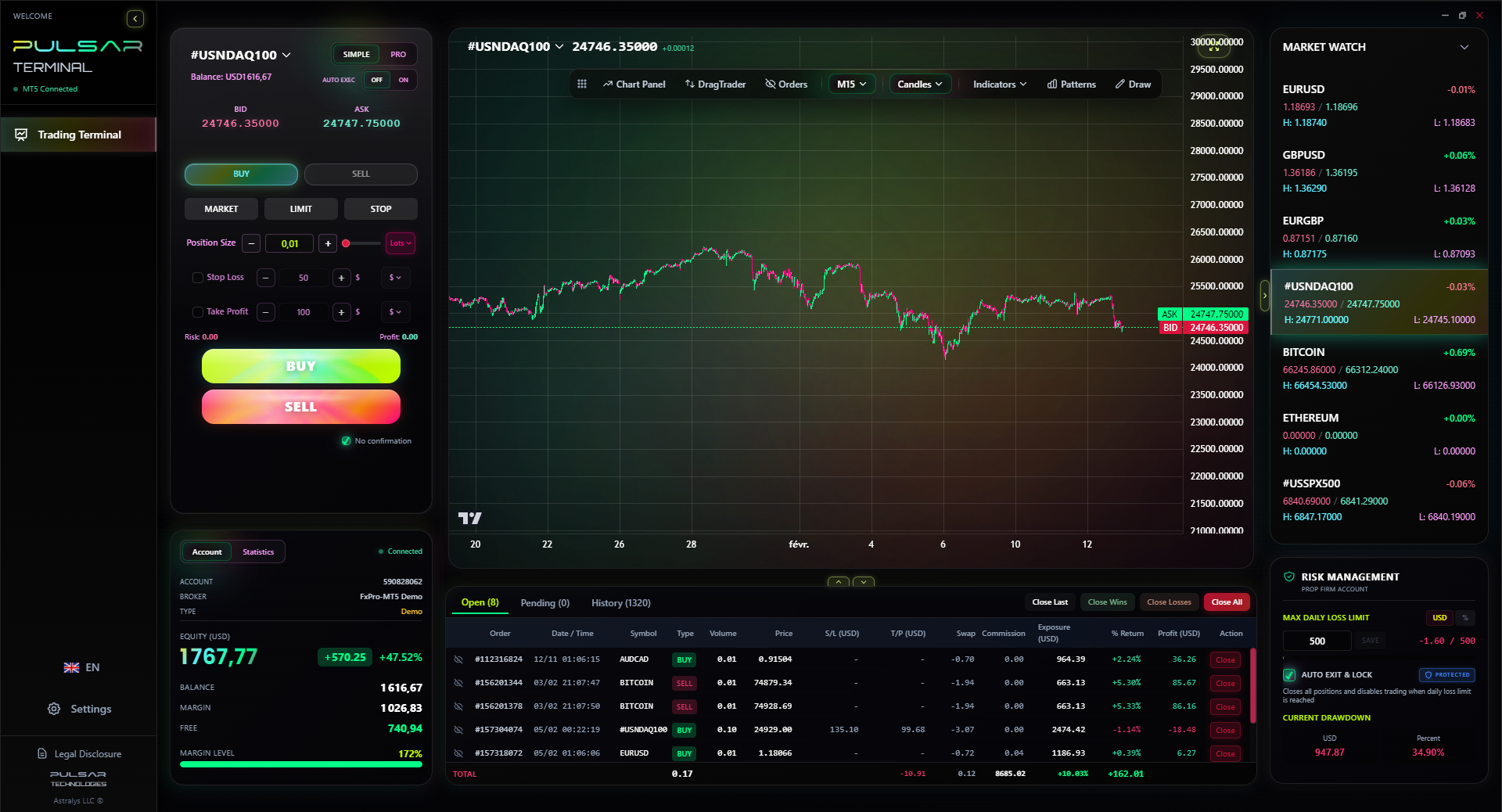
Managing risk on volatile pairs requires precise, emotion-free tools, and Pulsar Terminal's automated trailing stop and breakeven functions handle this directly on your MT5 charts.
Pulsar Terminal
The all-in-one MT5 companion: drag-and-drop orders, multi-TP/SL, trailing stop, grid trading, Volume Profile, and prop firm protection. Used by 1,000+ traders daily.
“Your first profit on a volatile pair is often luck. Your consistent profit is always discipline.”
Your standard moving averages might not cut it. You need tools that measure and adapt to the market's mood swings.
1. Average True Range (ATR): This is your best friend. It tells you the pair's current volatility in pips. I use it for two things:
- Setting Stops: I place my stop-loss at least 1.5 x the current ATR value away from my entry. This prevents me from being stopped out by normal market noise.
- Setting Targets: It helps gauge realistic profit expectations. If the ATR is 120 pips, a 30-pip target is too small; a 500-pip target might be greedy for a day trade.
2. Bollinger Bands: When the bands widen, volatility is increasing. When they contract, volatility is decreasing, and a big move is often brewing (a 'squeeze'). I don't use them for direct buy/sell signals on volatiles, but as a volatility gauge.
3. Keltner Channels: Similar to Bollinger Bands but based on ATR. I find them smoother and sometimes more reliable for trend-following entries in volatile markets.
4. Economic Calendar: This isn't an indicator, but it's the most important tool. You MUST know when high-impact news is due for the currencies you're trading. Trading USD/ZAR blind before a SARB meeting is asking for trouble.
A Note on RSI and MACD: Classic oscillators like the RSI indicator and MACD indicator can give false signals in strongly trending, volatile markets. RSI can stay overbought or oversold for a long time. I use them more for divergence signals than for direct overbought/oversold readings on these pairs.
FAQ
Q1What is the single most volatile forex pair?
Among commonly traded pairs, GBP/JPY ('The Beast') and exotic pairs like USD/TRY (Turkish Lira) or USD/ZAR are consistently at the top. USD/TRY often takes the crown due to extreme economic instability in Turkey, but its massive spreads make it very difficult to trade practically. For South African traders, USD/ZAR is the most relevant high-volatility pair.
Q2Is it a good idea for beginners to trade volatile pairs?
Absolutely not. It's one of the fastest ways for a beginner to lose their entire deposit. The emotional rollercoaster, wide spreads, and large, fast moves require disciplined risk management that most new traders haven't developed. Start with major pairs like EUR/USD to learn the basics of order execution and risk before even considering volatile minors or exotics.
Q3How does use affect trading volatile pairs?
use magnifies both profits and losses. On a highly volatile pair, a small price move against you can result in a much larger loss when use is high. The South African FSCA use cap of 30:1 for retail traders is actually a protective measure for these very pairs. Using excessive use on a pair like GBP/JPY can lead to a margin call in minutes.
Q4What time of day are forex pairs most volatile?
The peak volatility for pairs involving USD, EUR, and GBP typically occurs during the overlap of the London and New York trading sessions (approximately 3:00 PM to 5:00 PM SAST). For USD/ZAR, volatility often spikes around the Johannesburg Stock Exchange open (9:00 AM SAST) and during major South African news releases like budget speeches or SARB announcements.
Q5Can I make money faster by trading volatile pairs?
You can lose money faster. While the profit potential is higher per trade, the risk is exponentially greater. Consistent profitability comes from risk management and a high win-rate or favorable risk-to-reward ratio, not from the raw volatility of the instrument. Chasing fast money on these pairs is a common psychological trap.
Q6Do all brokers offer exotic pairs like USD/ZAR?
No. Many international brokers do not offer exotic currency pairs, or they offer them with very high minimum deposit requirements and extremely wide spreads. South African-regulated brokers and some major global brokers that cater to emerging markets are your best bet for finding decent liquidity and pricing on ZAR pairs.
Prof. Winston's Lesson
Key Takeaways:
- ✓Volatility is measured, not guessed. Use ATR (Average True Range).
- ✓Risk 0.5%-0.75% per trade on high-volatility pairs, not 1%.
- ✓Set stops using 1.5x the current ATR value.
- ✓Wider spreads on exotics can kill your strategy. Check them first.
- ✓The London/NY overlap (3-5 PM SAST) is peak volatility time.
How useful was this article?
Click a star to rate
Weekly Trading Insights
Free weekly analysis & strategies. No spam.
About the Author
David van der Merwe
Emerging Markets Trader
Johannesburg-based trader with 11 years in emerging market currencies. Specializes in ZAR pairs, FSCA-regulated trading, and South African market analysis.
Comments
Risk Disclaimer
Trading financial instruments carries significant risk and may not be suitable for all investors. Past performance does not guarantee future results. This content is for educational purposes only and should not be considered investment advice. Always conduct your own research before trading.
You Might Also Like

Cara Trading Forex Sukses: 7 Prinsip dari Trader Profesional
Cara trading forex sukses dengan 7 prinsip trader pro: manajemen modal, disiplin, journal trading, backtest. Data nyata, bukan janji profit palsu.
Jam Trading Forex Terbaik untuk Trader Indonesia: Panduan Lengkap dengan Tabel Waktu
Panduan jam trading forex untuk trader Indonesia. Tabel 4 sesi dunia, jam emas 20:00-00:00, sesi mana yang harus dihindari. Data akurat + tips dari trader berpengalaman.
Top 5 Sàn Forex Uy Tín Nhất 2026: Review Jujur dari Trader Indonesia
Top 5 sàn forex uy tín 2026 untuk trader Indonesia. Review jujur: spread, deposit, withdraw, dukungan lokal. Exness, XM, IC Markets & lebih.
Get Pulsar Terminal
All these calculators are built into Pulsar Terminal with real-time data from your MT5 account. One-click position sizing, automatic risk management, and instant calculations.
Get Pulsar Terminal