


If you've spent any time looking at trading charts, you've seen those wavy lines everyone calls moving averages.

Olumide Adeyemi
West African Trading Pioneer ·  Nigeria
☕ 11 min read
What you'll learn:
- 1What Exactly Is a Moving Average? (No Jargon, Please)
- 2Choosing Your Settings: Why 50 and 200 Aren't Holy Grails
- 3The #1 Rule: Trading With the Trend
- 4Crossovers: How to Use Them (Without Getting Whipsawed)
- 5The Nigerian Context: Taxes, Fees, and Realistic Goals
- 6Mistakes I Made (So You Don't Have To)
- 7A Simple, Actionable Trading Plan
If you've spent any time looking at trading charts, you've seen those wavy lines everyone calls moving averages. The biggest mistake I see new traders make? They slap a 50 and a 200-period moving average on their chart, see a crossover, and jump in expecting instant profits. It's not that simple, especially with the unique challenges we face trading from Nigeria. I lost money that way too, early on. This guide will cut through the noise and show you how to use moving averages in forex trading as a practical tool for finding direction, timing entries, and - crucially - protecting your capital in a market where every Naira counts.
Let's strip it back. A moving average (MA) is just a line that shows the average price of a currency pair over a specific number of past periods. It 'moves' because as each new candle closes, the oldest price drops off the calculation. Its main job is to smooth out all the market noise - those frantic up-and-down spikes - and show you the underlying trend. Think of it like looking at the road ahead through a slightly foggy window; you can't see every pebble, but you can clearly tell if you're going uphill or downhill.
There are two main types you need to know:
Simple Moving Average (SMA): This is the straightforward average. If you have a 20-period SMA, it adds up the closing prices of the last 20 candles and divides by 20. Simple. It's great for identifying clear support and resistance levels in a trend.
Exponential Moving Average (EMA): This one is a bit smarter. It gives more weight to recent prices. So, yesterday's price matters more than the price from 20 days ago. The EMA reacts faster to new price action. This makes it popular for scalping strategy or catching the early part of a new move.

Example: Let's say EUR/USD closed at 1.0800, 1.0810, 1.0790, 1.0820, and 1.0830 over the last 5 days. The 5-period SMA would be (1.0800 + 1.0810 + 1.0790 + 1.0820 + 1.0830) / 5 = 1.0810. The EMA calculation is more complex, but that 1.0830 close would pull the line up more aggressively.
You'll hear about the magical 50 and 200-period MAs everywhere. They work, but they're not a one-size-fits-all solution for every Nigerian trader. Your choice depends entirely on your trading style and the time you can dedicate to the screen.
Timeframe is Everything
Your chart timeframe dictates your MA periods. A 20-period MA on a 5-minute chart looks at the last 100 minutes of price action. That same 20-period MA on a daily chart looks at the last 20 days. They tell completely different stories.
Here’s a practical framework I’ve settled on after years of trial and error:
| Trading Style | Typical Chart Timeframe | Recommended MA Periods (SMA or EMA) | Purpose |
|---|---|---|---|
| Scalping | 1-min, 5-min, 15-min | 9 EMA, 21 EMA | Fast reaction to intraday momentum. |
| Day Trading | 1-hour, 4-hour | 20 EMA, 50 SMA | Defining the intraday trend and dynamic support/resistance. |
| Swing Trading | Daily, 4-hour | 50 SMA, 200 SMA | Identifying the primary market trend and major support zones. |
My personal wake-up call came in 2019. I was trying to day trade GBP/JPY using the 200 SMA on a 15-minute chart. The line was so slow it was practically useless for entries. I kept getting stopped out before the trend even acknowledged my trade. I switched to a 20 EMA and a 50 EMA, and suddenly I was trading with the intraday flow, not against a lagging relic.

Warning: Don't overload your chart. Start with one or two MAs. I've seen charts with five different colored lines - it's confusing and contradictory. More lines don't mean more insight.

💡 Winston's Tip
A moving average doesn't predict the future; it simply describes the recent past. Trade the reality it shows, not the hope of what might happen next.
“The moving average gives you discipline. When price is below the 200 SMA, looking for a long entry is a low-probability, high-stress game.”
This is the single most powerful use of a moving average in forex trading. It answers the simplest, hardest question: am I buying or selling right now?
The Basic Rule:
- Price ABOVE a key moving average (like the 50 or 200 SMA)? The trend is likely UP. Focus on buy signals and pullbacks.
- Price BELOW a key moving average? The trend is likely DOWN. Focus on sell signals and rallies.
It sounds obvious, but you'd be shocked how many traders fight this. When EUR/USD is grinding lower below its daily 200 SMA, looking for a long entry is a low-probability, high-stress game. The moving average gives you discipline. I use the 200 SMA on the daily chart as my ultimate trend filter. If I have a great scalping strategy setup on the 5-minute chart, but it's a buy while price is below the daily 200 SMA, I either pass or take a much smaller position.
The Moving Average as Dynamic Support/Resistance
This is where it gets practical. In a strong uptrend, price will often dip back to a rising moving average (like the 20 EMA) and bounce. That MA acts as dynamic support. In a downtrend, it acts as dynamic resistance. These are potential areas to look for your entry, with a stop loss placed just on the other side of the MA.

Pro Tip: The angle of the MA matters. A sharply rising 20 EMA shows strong momentum. A flat 200 SMA shows a ranging or consolidating market - maybe time to step aside or reduce position size.
The Golden Cross and Death Cross. They sound epic, right? A Golden Cross is when a faster MA (like the 50 SMA) crosses above a slower MA (like the 200 SMA), signaling a potential major bull trend. The Death Cross is the opposite. They are useful for identifying major trend shifts on higher timeframes (like weekly or daily charts).
However, here's the painful truth I learned: on lower timeframes, crossovers are lagging and will get you chopped up. The market moves, triggers the crossover, you enter, and then it reverses and crosses back. This is called a whipsaw, and it's a fast way to drain your account.
My Refined Crossover Approach:
- Use them as a CONFIRMATION tool, not an entry signal. Don't buy the moment the lines cross. Wait for price to make a new swing high after the crossover, or for it to retest the now-supportive slower MA.
- Align with higher timeframe trends. A Golden Cross on the 4-hour chart is far more powerful if price is already above the daily 200 SMA.
- Combine with other filters. I almost never take a crossover signal unless there's also a momentum confirmation from an indicator like the MACD indicator or a clear break of a price structure.
A real example: In early 2023, I saw a potential Golden Cross (50 crossing above 200) forming on the 4-hour chart for XAU/USD (Gold). Instead of jumping in, I waited. Price made the cross, then pulled back right to the 200 SMA. It held as support. That was my entry. I bought at $1824, placed my stop below the 200 SMA at $1815, and rode it to a target of $1860. The crossover told me the tide was turning; the pullback gave me a safe entry.
“Our 10% capital gains tax makes consistent, smaller gains from a reliable strategy far more valuable than chasing huge, risky wins.”
Talking about strategies is one thing. Making them work with Naira in your account is another. Our environment adds layers you must factor into every single trade.
First, the 10% Capital Gains Tax. The FIRS expects 10% of your gross trading profits. This isn't a maybe; it's the law. You must account for this in your profit calculations. If your moving average strategy yields a 15% return, your net is actually 13.5%. This makes consistent, smaller gains from a reliable strategy far more valuable than chasing huge, risky wins.
Second, broker spreads and fees. When you're trading based on precise MA bounces or crossovers, a wide spread definition can kill your edge. If your entry is based on a bounce off the 20 EMA, but your broker's spread is 3 pips on EUR/USD, you're already 3 pips in the hole. This is why choosing a broker with tight, reliable spreads is non-negotible. I've had good execution experiences with international brokers like IC Markets review and Pepperstone review that cater to Nigerians.
Finally, funding and withdrawals. With bank restrictions, you need a broker with reliable local payment options. Factor in any transfer fees as a cost of doing business. All this means your moving average strategy needs a healthy profit target to absorb these costs. It directly affects your position size calculator settings. A 20-pip target might be fine in London, but after spread and potential fees, you might need a 25-pip minimum target here to make the trade worthwhile.
💡 Winston's Tip
In Nigeria, your first profit target should always be 'breakeven plus costs.' Move your stop loss to entry once you're up by the amount of the spread plus potential fees. Then you're trading with the house's money.
Let me be blunt about where I went wrong, so you can skip the expensive lessons.
1. Trading Against the MA Trend: My most consistent losses came from trying to pick tops and bottoms in a strong trend. Price would be soaring above a rising 50 EMA, and I'd see an RSI indicator reading as 'overbought' and try to short. The moving average was screaming 'BUYING PRESSURE,' and I was ignoring it. The trend always has more power than an oscillator.
2. Using MAs in a Range: Moving averages shine in trends. In a tight range, they coil together, and price chops back and forth across them. Every crossover is a fakeout. I learned to identify ranging markets (flat MAs) and either switch to a range-bound strategy or stop trading until the next trend leg appeared.
3. Ignoring Price Action: I once had a perfect-looking Golden Cross on the 1-hour chart for AUD/USD. I bought without looking at the daily chart. The daily chart showed price was stuck below a massive resistance level. The 1-hour crossover failed immediately. The lesson? The moving average is a guide, but major swing trading highs and lows on a higher timeframe are the bosses.
4. No Stop Loss Discipline: This is the killer. You enter on an MA bounce, but price slices straight through it. Your thesis is broken. If you don't have a stop loss placed logically (e.g., below the MA), hope takes over. I've turned a 20-pip loss into a 200-pip disaster this way. The MA defines your trade idea; if price violates it, you're wrong. Exit.
“The trend always has more power than an oscillator. I learned this by losing money fighting it.”
Here’s a consolidated plan you can start testing on a demo account today.
Step 1: Find the Trend (The Big Picture)
- Open a Daily Chart of your chosen pair (e.g., EUR/USD guide).
- Apply a 50 SMA and a 200 SMA.
- Is price above both? Overall trend = UP. Below both? Trend = DOWN. In between? It's consolidating; be cautious.
Step 2: Find the Entry (The Timing)
- Switch to a 4-Hour or 1-Hour Chart.
- Apply a 20 EMA.
- In an UP trend (from Step 1), wait for price to pull back to the 20 EMA on the 4-hour chart.
- Look for signs of a bounce: a bullish pin bar, a small bullish engulfing candle forming at the EMA.
Step 3: Execute with Precision
- Entry: Place a buy order a few pips above the bounce candle's high.
- Stop Loss: Place your stop loss 10-15 pips below the 20 EMA.
- Take Profit: Aim for a risk-reward ratio of at least 1:2. If your stop is 15 pips, your target should be 30 pips minimum. Use the next obvious resistance level or a previous swing high as a guide.
Step 4: Manage the Nigerian Reality
- Before entering, check the live spread. Ensure your 30-pip target is still viable.
- Use your position size calculator so your risk per trade is never more than 1-2% of your account. This protects you from a margin call.
- Log the trade. When you take profits, immediately calculate and set aside the 10% for tax.
This plan won't win every time. No plan does. But it gives you a disciplined, repeatable framework based on the logic of moving averages, and it respects the real-world constraints of trading from Nigeria.
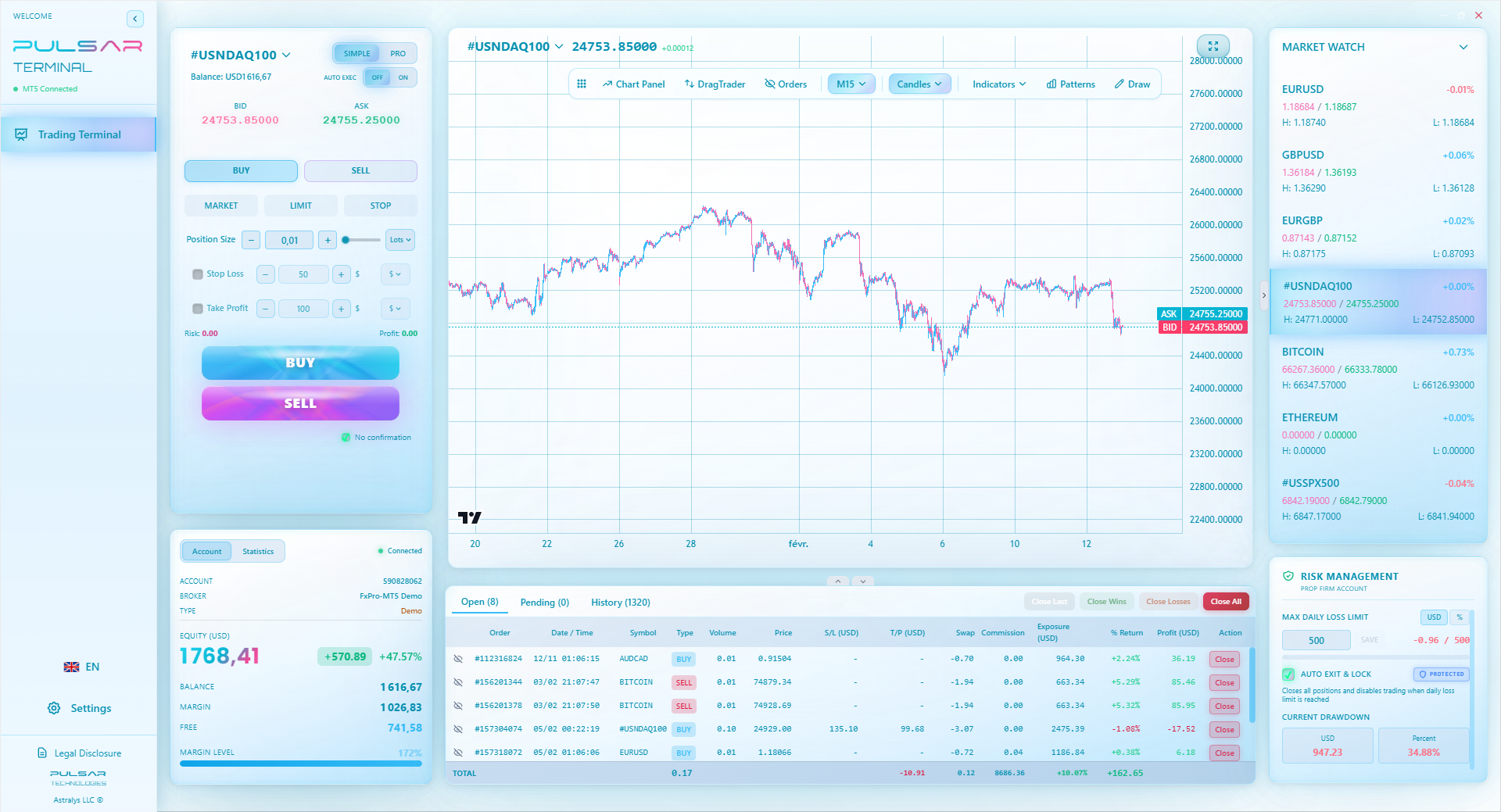
Executing a multi-target trade plan based on moving average levels is seamless with Pulsar Terminal's drag-and-drop order tools on your MT5 platform.
Pulsar Terminal
The all-in-one MT5 companion: drag-and-drop orders, multi-TP/SL, trailing stop, grid trading, Volume Profile, and prop firm protection. Used by 1,000+ traders daily.
FAQ
Q1Is the 200-period moving average the best for all forex traders?
No, absolutely not. It's a great tool for identifying the long-term trend on daily or weekly charts, but it's too slow for day trading or scalping. For faster timeframes, a 20 or 50-period EMA is far more responsive and useful.
Q2How do I avoid false signals from moving average crossovers?
Stop using them as your primary entry signal. Use crossovers to alert you to a potential trend change, then wait for price action confirmation. Look for a new higher high in an uptrend or a pullback to the slower MA that holds as support. Trading the confirmation, not the crossover itself, filters out most whipsaws.
Q3As a Nigerian, do I pay tax on forex trading profits from an international broker?
Yes. The 10% capital gains tax applies to your gross profits regardless of where your broker is based. You are responsible for declaring this income and paying the tax to the Federal Inland Revenue Service (FIRS). Keep detailed records of all your trades.
Q4Can I use moving averages alone to trade profitably?
You can, but it's harder. They are fantastic for defining trend and dynamic areas, but combining them with one or two other concepts makes you more strong. Use them with basic support/resistance levels, or a single momentum indicator like the RSI for confluence. Price action at the MA is the final trigger.
Q5What's the biggest mistake beginners make with moving averages?
Using too many of them. They add 3, 4, 5 different MAs to their chart, creating a mess of conflicting signals. Start with one or two. Understand what they tell you. More lines lead to confusion and paralysis, not clarity.
Q6Should I use SMA or EMA for swing trading?
For the core trend identification in swing trading, I prefer the Simple Moving Average (SMA), like the 50 or 200. It's smoother and less prone to giving false signals from short-term volatility. The EMA can be useful on a lower timeframe (like the 4-hour) to fine-tune entries within the larger swing trend.
Prof. Winston's Lesson
Key Takeaways:
- ✓Use the 200 SMA on daily for primary trend direction.
- ✓Combine EMA crossovers with price action confirmation.
- ✓Factor 10% tax into all profit calculations.
- ✓Never trade without a stop loss below the MA.
How useful was this article?
Click a star to rate
Weekly Trading Insights
Free weekly analysis & strategies. No spam.
About the Author
Olumide Adeyemi
West African Trading Pioneer
One of Nigeria's most active forex trading educators. 8 years of experience trading from Lagos. Specializes in low-capital strategies and prop firm challenges for African traders.
Comments
Risk Disclaimer
Trading financial instruments carries significant risk and may not be suitable for all investors. Past performance does not guarantee future results. This content is for educational purposes only and should not be considered investment advice. Always conduct your own research before trading.
You Might Also Like

Cara Trading Forex Sukses: 7 Prinsip dari Trader Profesional
Cara trading forex sukses dengan 7 prinsip trader pro: manajemen modal, disiplin, journal trading, backtest. Data nyata, bukan janji profit palsu.
Jam Trading Forex Terbaik untuk Trader Indonesia: Panduan Lengkap dengan Tabel Waktu
Panduan jam trading forex untuk trader Indonesia. Tabel 4 sesi dunia, jam emas 20:00-00:00, sesi mana yang harus dihindari. Data akurat + tips dari trader berpengalaman.
Top 5 Sàn Forex Uy Tín Nhất 2026: Review Jujur dari Trader Indonesia
Top 5 sàn forex uy tín 2026 untuk trader Indonesia. Review jujur: spread, deposit, withdraw, dukungan lokal. Exness, XM, IC Markets & lebih.
Get Pulsar Terminal
All these calculators are built into Pulsar Terminal with real-time data from your MT5 account. One-click position sizing, automatic risk management, and instant calculations.
Get Pulsar Terminal