


I watched my screen, frozen, as a £2,300 profit on a GBP/USD swing trade evaporated in 90 seconds.

Sarah Collins
Trading Strategist ·  United Kingdom
☕ 12 min read
What you'll learn:
- 1The UK Forex Landscape: Why Your Platform Choice Isn't Trivial
- 2MT4 Deep Dive: The UK Trader's Reliable Workhorse
- 3MT5 Unpacked: The Modern (But Misunderstood) Upgrade
- 4Head-to-Head: My Personal Ratings Breakdown
- 5Beyond the Software: Broker Integration is Everything
- 6The Real Costs: It's More Than Just the Software Price
- 7My Final Verdict & Recommended UK Setup
I watched my screen, frozen, as a £2,300 profit on a GBP/USD swing trade evaporated in 90 seconds. My MT4 platform had frozen during a major news spike. The chart showed a filled stop-loss, but my orders window was blank. By the time it recovered, I was stopped out at my entry price - a complete round trip to zero. That moment, back in 2018, wasn't just about a bad trade. It was a brutal lesson in platform reliability and why your choice of trading software isn't just about indicators. In the UK, where we trade everything from the Cable to the FTSE, getting your MT4 and MT5 ratings right is the difference between controlled execution and costly surprises.
Trading from London isn't just about having a fast internet connection. You're operating in the world's largest forex hub, where nearly 38% of all global daily volume - roughly $4.7 trillion - changes hands. The speed and reliability of your platform directly impact your fills, especially on volatile pairs like GBP/USD. I learned this the hard way during the 2016 Brexit vote. My home-brewed EA on MT4 lagged by over 3 seconds on quote updates from my broker. That delay turned a potential 180-pip gain on a short GBP/JPY trade into a 40-pip loss. The market moved faster than my software could process it.
The UK's regulatory framework adds another layer. The FCA's 30:1 use cap for retail traders on majors means you need precision. A wider spread or a slow execution can eat into your already-limited margin much quicker. I've found that UK-focused brokers, like Pepperstone or IG, often optimize their MT4/MT5 servers for the London session, which makes a tangible difference. That £2.25 per side commission on Pepperstone's Razor account? It's worth every penny if it means consistent 0.0 pip raw spreads and sub-30ms execution during the 8 AM London open.

Warning: Don't assume all MT4/MT5 installations are equal. A broker's server location and infrastructure matter more than the platform logo. Always check execution speed reports and whether they have UK-based servers.
Your platform is your gateway to this liquidity. Choosing based on superficial MT4 and MT5 trading software forex ratings without considering the broker's local infrastructure is a classic rookie mistake. I made it. I opened an account with a well-rated international broker, attracted by their 500:1 use offer (only to later realise I'd be classified as a retail client and capped at 30:1 anyway). Their MT5 server was in Cyprus. The ping was awful, and my stop-losses on the FTSE 100 were consistently slipped by a few points. It doesn't sound like much, but it adds up over hundreds of trades.
Let's be honest, MT4 is old. It was released in 2005. But here's the thing: it's like a perfectly broken-in pair of leather boots. It works, it's comfortable, and you know every creak. For pure forex and CFD trading, it's still incredibly effective. Its dominance in the UK isn't nostalgia; it's about a proven, stable environment.
Why UK Traders Still Love MT4
First, the Expert Advisors (EAs). The MQL4 community is massive. If you can imagine a trading robot, someone has probably coded it. Early in my career, I relied heavily on custom EAs for scalping strategies. I had one that would hunt for 5-pip moves on EUR/USD during the London/New York overlap. MT4 handled it flawlessly, placing and closing dozens of micro-lots an hour. The simplicity is key: fewer instruments meant the platform was laser-focused on forex execution.
Second, the charting. For drawing basic support/resistance, Fibonacci retracements, and trend lines, it's quick and intuitive. I can't count the number of times I've rapidly marked up a chart on the 15-minute GBP/USD ahead of a BoE announcement. The MACD indicator and RSI indicator are built-in and are all many traders need.
The Real Limitations I've Hit
It's not all perfect. The big one is that it doesn't offer native trading on UK shares or ETFs. You're stuck with forex, indices, commodities, and metals. Want to trade a specific FTSE 100 stock? You'll need another platform. Also, the back-testing engine, while good, is starting to show its age compared to modern solutions.

Example: My MT4 EA back-test from 2020-2022 on EUR/USD showed an 18% return. When I ported the same logic to a more advanced tester elsewhere, accounting for more precise spread modelling and liquidity gaps, the return dropped to 11%. That's a huge difference in expectation.
Finally, while stable, an MT4 platform can still choke. My infamous freeze happened because I had 12 charts open, each with 3 custom indicators, plus an EA running. I was overloading an old laptop. The lesson? Respect its limits. Use a VPS if you're running heavy EAs, especially for trading instruments like XAU/USD which can be volatile.

💡 Winston's Tip
A platform is a tool, not a strategy. I've seen traders spend £5,000 on a fancy MT5 VPS setup chasing a 1-pip scalping edge, while ignoring basic risk management. The software doesn't make you profitable; your discipline does.
“The initial friction with MT5 was just a learning curve. The increased analytical power was worth the switch.”
When MT5 launched, I, like many, dismissed it. "If it ain't broke..." But around 2020, I forced myself to switch for a month. My initial rating was low. It felt unfamiliar. The pip definition was the same, but everything else seemed different. I was wrong to dismiss it so quickly.
MT5 is fundamentally a more powerful piece of trading software. It's built for a multi-asset world. This is crucial for the modern UK trader. From my desk in London, I might want to trade GBP/USD, the FTSE 250 index, Brent Crude, and maybe some German Bund futures. MT5 can handle all those asset classes from a single platform. MT4 simply can't.
The Tangible Advantages
Depth of Market (DOM): This is a game-changer for understanding liquidity. Seeing the order book for the EUR/USD guide lets you spot where large stop-loss clusters might be sitting - a huge advantage.
More Timeframes & Better Back-testing: The economic calendar is integrated, and the strategy tester uses multi-threaded, real tick data. My testing became significantly more accurate.
Hedging Without a Hack: While the UK's FCA rules under ESMA banned binary options and restricted CFDs, hedging (holding both long and short positions on the same instrument) is still a valid strategy. MT5 allows it natively and cleanly.
The Sticking Point
Adoption. The MQL5 community is growing, but it's not as vast as MQL4. Some niche EAs or indicators I used simply weren't available. Also, some brokers, even major ones like XM review, offer slightly different product lists on MT4 vs MT5. Always check.
My verdict shifted after a quarter trading on MT5. The initial friction was just learning curve. The increased analytical power and stability were worth it. For any new trader starting today, I'd recommend MT5. It's the future, even if the present is still catching up.
Forget generic star ratings. Here's my breakdown based on 12 years of putting real money through both platforms in the UK market.
| Feature | My MT4 Rating (Out of 10) | My MT5 Rating (Out of 10) | The Real-World Impact for You |
|---|---|---|---|
| Forex/CFD Execution | 9 | 9 | Both are excellent. For pure forex, I notice zero difference on a good broker like IC Markets review. |
| Ease of Use | 10 | 7 | MT4 wins. It's simpler. MT5's depth can be overwhelming initially. |
| Charting & Analysis | 7 | 9 | MT5's additional drawing tools and built-in economic calendar are superior. |
| Automation (EAs/Robots) | 8 | 8 | MT4 has more pre-built EAs. MT5's back-testing is far more strong. A draw. |
| Multi-Asset Trading | 2 | 10 | MT4's fatal flaw. MT5 lets you trade shares, futures, forex from one screen. |
| Stability & Speed | 8 | 9 | MT5 feels more modern and handles multiple charts/indicators better. |
| UK Market Suitability | 7 | 9 | MT5's DOM and multi-asset support align better with a professional UK approach. |
Overall Winner? It depends.
- Choose MT4 if: You are a pure forex/CFD trader, you rely on a specific library of MQL4 EAs, you value absolute simplicity, and you're on an older computer.
- Choose MT5 if: You trade multiple asset classes (forex, indices, commodities), you value advanced analysis and back-testing, you are building a long-term professional setup, or you are just starting out and want the more future-proof option.
My personal journey mirrors the market's shift. I was an MT4 devotee for 8 years. Now, my primary terminal is MT5. I keep an MT4 installation running for one or two legacy EAs, but 95% of my trading happens on MT5.
💡 Winston's Tip
Test your setup during peak volatility. Don't just demo trade at midnight. Log in at 8:30 AM GMT when London is in full swing and the economic data hits. That's when you'll see the true spread widening and execution speed.
“Your platform should help your growth as a trader, not limit it. Choose the one that matches where you want to be.”
This is the part most MT4 and MT5 trading software forex ratings completely miss. The platform is just the interface. The broker's integration is the engine. You can have the best car body (MT5), but if the engine (broker servers) is weak, you'll lose every race.
Execution Speed & Spreads: A broker's spread definition and how they apply it on MT4 vs MT5 can differ. I've seen cases where the MT4 server had a 0.8 pip spread on EUR/USD, while the same broker's MT5 server showed 1.0 pips. Always compare live accounts. Brokers like Pepperstone review are renowned for their razor-sharp execution on both platforms, which is why they top many UK trader lists.
Asset Availability: As mentioned, check the instrument list. Your broker might offer 60 forex pairs on MT4 but only 50 on MT5, or vice versa. They might offer UK stocks only on MT5.
Deposit & Withdrawal Ease: The platform doesn't handle your money; the broker does. UK-friendly payment methods like Faster Payments, PayPal, and debit cards should be seamless. The minimum deposit is also a broker setting, not a platform one. While Exness review might have a low barrier, always ensure the broker is FCA-regulated for the crucial £85,000 FSCS protection.

Pro Tip: Before committing, open a demo account on both MT4 and MT5 with your chosen broker. Place simultaneous dummy trades on both during the volatile London open (8-9 AM). Compare the quoted spread, the speed of the order window pop-up, and the fill price. This 10-minute test tells you more than any online rating.
The worst margin call of my career came from a broker issue, not a platform one. Their risk engine malfunctioned and closed all positions during a temporary drawdown, locking in a £5,000 loss that would have recovered an hour later. The platform (MT4) was just the messenger. Your due diligence must be on the broker first, the platform second.
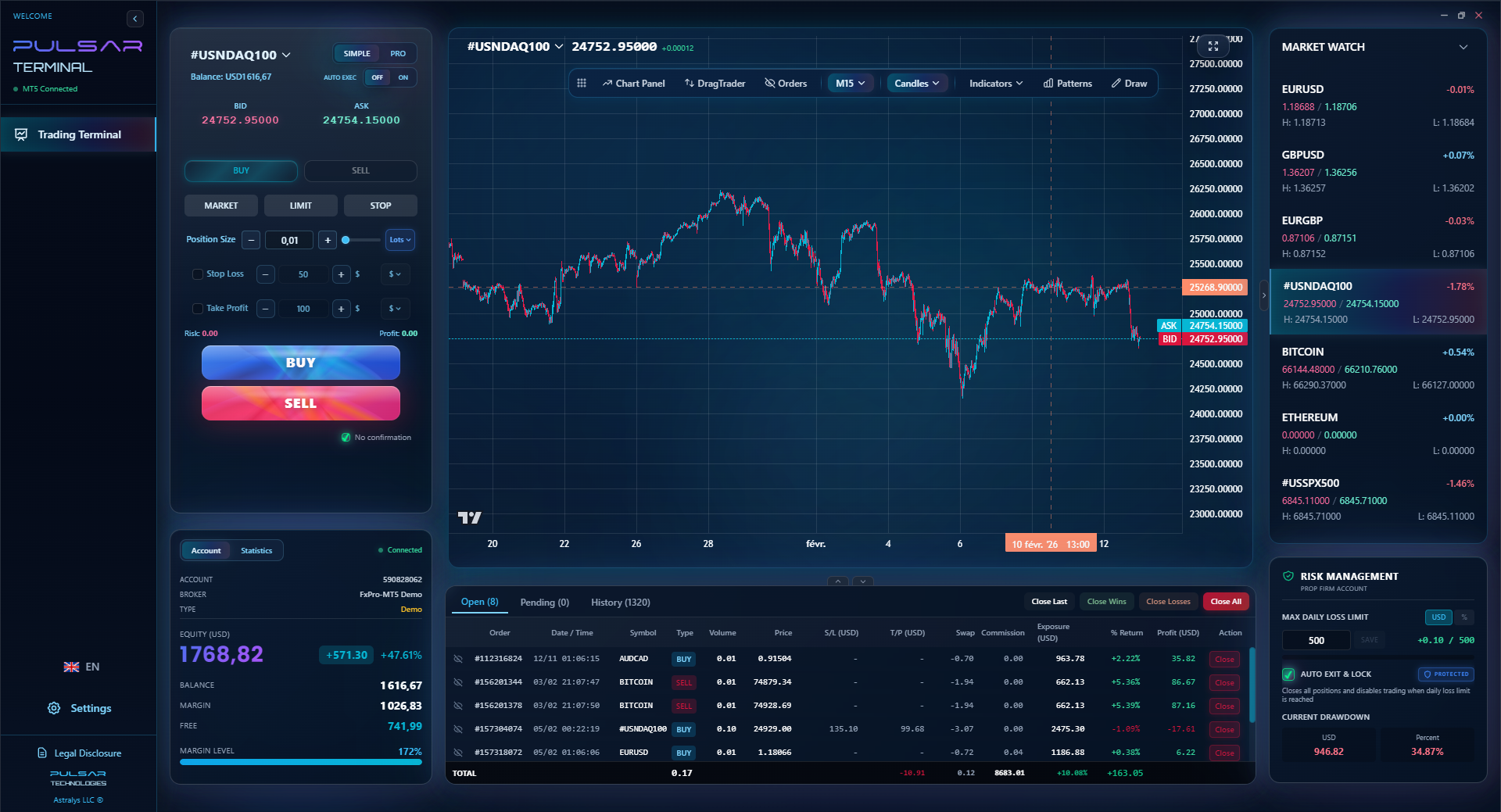
Managing complex multi-take-profit strategies and protecting against daily drawdowns, especially for prop firm challenges, is far simpler with tools like Pulsar Terminal that integrate directly with your MT5 platform.
Pulsar Terminal
The all-in-one MT5 companion: drag-and-drop orders, multi-TP/SL, trailing stop, grid trading, Volume Profile, and prop firm protection. Used by 1,000+ traders daily.
Both MT4 and MT5 are free to download and use. The costs are embedded in your trading. But they manifest differently, and understanding this is key to your bottom line.
The Commission vs. Spread Model: Many UK brokers offer two account types linked to the platforms.
- Standard Account: Wider spreads, no commission. On MT4, this might mean a 1.2 pip spread on GBP/USD.
- Raw/Razor Account: Tighter spreads (often from 0.0 pips), but you pay a commission per lot per side.
Here's the math I do for every new broker. Let's say I trade 10 standard lots of GBP/USD per month.
- Standard Account (1.2 pip spread): Cost = 10 lots * 1.2 pips * £8 per pip (for a standard lot) = £96 in spread costs.
- Raw Account (0.1 pip spread + £2.25 commission/side): Spread cost = 10 lots * 0.1 pips * £8 = £8. Commission = 10 lots * £2.25 * 2 (open & close) = £45. Total = £53.
The raw account is cheaper for my volume. But if you only trade 1 micro-lot a month, the standard account might be better. Use a position size calculator to model your own activity.
Data Fees: Usually free for retail traders. But if you want premium real-time data feeds for shares or futures on MT5, there might be a monthly fee.
VPS Costs: If you run EAs 24/5, you'll need a Virtual Private Server. Brokers often offer these for free if you maintain a certain monthly trading volume. If not, it's about £20-£40 per month. Factor it in.
💡 Winston's Tip
Your first £1,000 should go into education and a strong risk framework, not into chasing the 'perfect' EA on MT4. A simple trend-following system on a clean MT5 chart, with strict stops, will outperform a complex, unstable robot every time.
“A broker's server location matters more than the platform logo. A slow ping turns precise entries into expensive guesses.”
After over a decade, my view is clear. MT5 is the superior, more future-proof trading software for the serious UK trader. Its multi-asset capability, advanced analysis, and strong back-testing provide a foundation for growth that MT4 lacks. The initial learning curve is a small price to pay for the long-term benefits.
However, MT4 remains a phenomenal, battle-tested tool for the dedicated forex specialist. Its simplicity and massive EA library are legitimate advantages.
My Recommended UK Setup for 2026
- Primary Platform: MT5. Use it for your main analysis, swing trading journal, and multi-asset portfolio.
- Broker Choice: Select an FCA-regulated broker with a proven track record of fast UK server execution. Pepperstone, IC Markets, and City Index are consistently strong contenders. Verify their MT5 instrument list covers what you need.
- Account Type: Opt for a raw spread account if your trade volume justifies it. The savings are real.
- Hardware: Don't skimp. A reliable computer and a stable internet connection are non-negotiable. Consider a broker-provided VPS if you automate.
- Keep MT4 Alive: Install it on a secondary monitor or an old laptop. It's useful for accessing specific EAs or as a quick charting reference. But build your primary process on MT5.
The evolution from MT4 to MT5 mirrors a trader's own journey: from seeking simple tools to demanding professional-grade infrastructure. Your platform should help that growth, not limit it. Choose the one that matches where you want to be, not just where you are today.
FAQ
Q1Is MT4 being phased out in the UK?
Not imminently. While MetaQuotes (the developer) has stopped selling new MT4 licenses to brokers, existing licenses are still active. Most major UK brokers, like Pepperstone and IG, continue to fully support MT4. However, all development and innovation is focused on MT5. Think of MT4 as being in long-term maintenance mode, while MT5 is the actively developed platform.
Q2Can I use the same login for MT4 and MT5 with my UK broker?
Almost never. MT4 and MT5 use completely different server architectures. Your broker will issue you separate login credentials (server, login number, password) for each platform. You can often access the same trading account from both, but you'll need to connect using the specific details for each software.
Q3Which platform is better for beginners in the UK?
This is controversial, but I'd say MT5. While MT4 is simpler initially, starting on MT5 means you won't have to unlearn habits and migrate later. The core concepts of placing trades, setting stops, and reading charts are identical. MT5's built-in economic calendar and better charting tools are actually more helpful for a beginner learning market context.
Q4Are my custom indicators and EAs from MT4 compatible with MT5?
No, they are not directly compatible. MQL4 (MT4's language) and MQL5 (MT5's language) are different. Some simple indicators can be converted easily, but complex EAs often require a full rewrite by a programmer. This is a major reason why some traders stick with MT4.
Q5Do UK prop firms use MT4 or MT5?
Most major prop firms now offer MT5 as their primary platform, with some also supporting MT4. MT5's superior risk management tools and reporting capabilities are better suited for firms managing funded trader accounts. Always check the specific platform requirements of the prop firm's challenge.
Q6What's more important for speed: my internet or the broker's server?
The broker's server location and quality are far more important. You can have the fastest fibre broadband, but if your broker's MT5 server is in a distant data centre, you'll have high latency (ping). Always choose a broker that offers UK-based servers, ideally in the London LD4 data centre, which is the heart of forex liquidity.
Prof. Winston's Lesson
Key Takeaways:
- ✓MT5 is the future-proof choice for multi-asset UK trading.
- ✓Broker execution quality trumps minor platform feature differences.
- ✓Always test platform speed during the volatile 8 AM London open.
- ✓Calculate costs based on your volume: raw vs. standard accounts.
- ✓The FCA's 30:1 use makes precise execution non-negotiable.
How useful was this article?
Click a star to rate
Weekly Trading Insights
Free weekly analysis & strategies. No spam.
About the Author
Sarah Collins
Trading Strategist
London-based trading strategist with 12 years in financial markets. Former analyst at a City of London brokerage. Covers GBP pairs, European markets, and FCA-regulated trading.
Comments
Risk Disclaimer
Trading financial instruments carries significant risk and may not be suitable for all investors. Past performance does not guarantee future results. This content is for educational purposes only and should not be considered investment advice. Always conduct your own research before trading.
You Might Also Like

Cara Trading Forex Sukses: 7 Prinsip dari Trader Profesional
Cara trading forex sukses dengan 7 prinsip trader pro: manajemen modal, disiplin, journal trading, backtest. Data nyata, bukan janji profit palsu.
Jam Trading Forex Terbaik untuk Trader Indonesia: Panduan Lengkap dengan Tabel Waktu
Panduan jam trading forex untuk trader Indonesia. Tabel 4 sesi dunia, jam emas 20:00-00:00, sesi mana yang harus dihindari. Data akurat + tips dari trader berpengalaman.
Top 5 Sàn Forex Uy Tín Nhất 2026: Review Jujur dari Trader Indonesia
Top 5 sàn forex uy tín 2026 untuk trader Indonesia. Review jujur: spread, deposit, withdraw, dukungan lokal. Exness, XM, IC Markets & lebih.
Get Pulsar Terminal
All these calculators are built into Pulsar Terminal with real-time data from your MT5 account. One-click position sizing, automatic risk management, and instant calculations.
Get Pulsar Terminal