


If you've been told the Nigerian forex market is just a wild west of parallel rates and endless volatility, you're working with old information.

Olumide Adeyemi
West African Trading Pioneer ·  Nigeria
☕ 10 min read
What you'll learn:
- 1EFEMS Explained: Why This Isn't Just Another CBN Circular
- 2The Naira's Recovery: Reading the Real Price Action
- 3New Rules of the Game: What's Legal Now?
- 4Choosing Your Tools: Brokers, Platforms & Getting Money In/Out
- 5Adapting Your Trading Strategy for a Stabilizing Market
- 6Mistakes I See (And Made) in the New Market
- 7What to Watch Next: The Signals That Will Move the Market

If you've been told the Nigerian forex market is just a wild west of parallel rates and endless volatility, you're working with old information. The game changed in late 2024. The Central Bank's launch of the Electronic Foreign Exchange Matching System (EFEMS) wasn't just another policy paper, it was a structural overhaul that directly fueled the Naira's recovery. I'm going to walk you through exactly what the naira forex recovery efems launch means for you as a trader, cutting through the financial jargon to show you the real price action, the new rules of the road, and how to position your trades in this transformed environment.
Let's get straight to it. The Electronic Foreign Exchange Matching System (EFEMS) is an automated platform that matches buy and sell orders for foreign exchange between banks and authorized dealers. Before it launched on December 2, 2024, the interbank market operated on a more opaque, request-for-quote system (using Refinitiv). That lack of transparency created multiple exchange rates and allowed for massive spreads between the official and parallel markets.
The EFEMS changed that by creating a single, visible order book. Think of it like moving from a noisy, chaotic open-air market where every price is negotiated separately, to a modern stock exchange where everyone can see the best available bids and offers in real time. This visibility was the first critical step in the naira forex recovery efems launch story.

Example: Before EFEMS, a bank could quote wildly different rates to different customers. After EFEMS, every participant sees the same central price. This immediately squeezed out a lot of the arbitrage and speculation that was killing the Naira's value.
The CBN didn't just flip a switch. They ran a two-week test in November 2024, released detailed guidelines on November 25th, and integrated all the old FX windows (I&E, SME) into this one system. This wasn't a tweak, it was a complete rebuild of the market's plumbing.

Forget the headlines. Let's look at the charts, because the price told the real story of the EFEMS impact. In 2024, before the reforms, the Naira was in a brutal downtrend, losing over 40% of its value against the dollar on the official market. The parallel market was even worse.
Then the system went live. Within one month, the Naira gained N125 against the dollar. Let me put that in trader terms: if you had a short USD/NGN position (betting on Naira strength) at the launch, you'd have banked a serious move. On launch day, December 2, 2024, the dollar was quoted around N1,660. By January 3, 2025, it had fallen to N1,535. That's an 8% appreciation. In the parallel market, the move was from about N1,730 to N1,640 - a 5.2% rally.
What This Taught Me
I made a classic mistake when this news first broke. I saw "new system" and thought "bureaucratic delay, no immediate impact." I missed the first leg of the move, waiting for a pullback that didn't come with the same force. The market priced in the credibility of the reform fast. The lesson? When a central bank fundamentally changes the structure of a broken market, the first move can be explosive. Don't overthink it. I learned to respect that initial momentum, which is a principle I now apply to other major regulatory shifts.
This recovery wasn't just a lucky bounce. It was a direct result of increased transparency squeezing out distortion. It showed that for a currency under severe pressure, fixing the market mechanism itself can be more powerful than just throwing reserves at the problem.

💡 Winston's Tip
A market's first major move after a structural reform is often its most truthful. Don't argue with it; learn its language.

“The EFEMS changed the game by creating a single, visible order book. It moved the market from a chaotic bazaar to a modern exchange.”
The regulatory landscape shifted with the EFEMS. It's crucial you understand this, because trading in ignorance of local laws is a surefire way to get your accounts frozen or face penalties.
First, the big one: you cannot use foreign currency for daily transactions anymore. The CBN has enforced this strictly. Paying for groceries, rent, or a car in USD or GBP is illegal. The Naira is the sole legal tender. This matters for traders because it changes how you manage your capital. You can't just sit on a pile of physical dollars; you need to move money through formal channels.
For the interbank market that EFEMS serves, the minimum trade size is huge - $100,000, with increments of $50,000. This clearly isn't for retail traders like us. It's for banks and institutions. However, this wholesale market stability directly filters down to our retail trading environment by creating a more reliable benchmark rate.

Warning: Just because you trade USD/NGN on your international broker's platform doesn't mean you're trading on the EFEMS. You're trading a CFD or a synthetic price based on the underlying interbank rate. Your broker's quote is derived from this new, more stable benchmark, but your trade is with the broker, not the CBN's system.
Also launched in January 2025 was the Nigerian FX Code, which promotes ethical dealing. While aimed at institutions, it signals a broader push for transparency that affects the entire environment, including the brokers serving Nigerian clients. Always check your broker's regulatory status with bodies like the FCA or ASIC, as the CBN does not directly regulate international retail forex brokers. A good starting point is our Exness review or IC Markets review to see how global brokers operate here.
With the underlying Naira rate stabilizing, your choice of broker and platform becomes more about cost and execution than navigating chaotic volatility. Nigerian traders have good options.
Broker Considerations: Look for brokers that offer low spreads on major pairs like EUR/USD, as your edge will now come more from strategy than from wild currency swings. Brokers like Pepperstone and IC Markets are famous for tight spreads. Some brokers, like HFM, even offer Naira-denominated accounts, which can simplify things. Minimum deposits are low across the board - from $0 at XTB to $10 at Exness. Don't get sucked in by just the minimum deposit; check the average spread and commission structure.
Platforms: MT4 and MT5 are still the kings in Nigeria. The stability of the Naira means you can focus more on your technical analysis using tools like the RSI indicator or MACD indicator without a currency crash blowing up your charts. TradingView is also massively popular for charting.
Deposits & Withdrawals (The Practical Part): This is where local knowledge is key. You have several reliable options:
- Bank Transfer: Straightforward, but can be slow for international broker withdrawals.
- Debit/Credit Cards: Visa/Mastercard are widely accepted. Just watch for forex fees from your bank.
- E-wallets: Skrill and Neteller are common. Some brokers also accept cryptocurrencies like USDT, which can be very fast.
- Local Processors: Opay, Flutterwave, and Paystack integrations are becoming more common with brokers targeting the Nigerian market.
Always factor in the cost of converting Naira to your trading currency (usually USD) and back. A stable Naira rate makes these conversion costs more predictable, which is a hidden benefit of the EFEMS reforms.
💡 Winston's Tip
Your broker's USD/NGN chart is a derivative. The real story is in the EFEMS turnover data. Watch the source, not just the reflection.

“I missed the first leg of the Naira's recovery, waiting for a pullback that never came. The market priced in the reform's credibility fast.”
The pre-EFEMS market rewarded sheer guts and a high tolerance for risk. The post-EFEMS environment rewards precision and discipline. The wild, trending volatility in USD/NGN has been replaced by more contained ranges and reactions to specific data.
From Momentum to Mean Reversion: Instead of just riding a one-way Naira crash, you now need to identify the new equilibrium ranges. The EUR/USD guide principles become more relevant - trading support/resistance, economic data releases (like Nigerian GDP or oil prices), and central bank commentary. The Naira's recovery established a new baseline from which to trade.
Risk Management is Non-Negotiable: With less extreme volatility, over-leveraging is the quickest path to a margin call. Use a position size calculator religiously. If you were using 1:100 use before, consider dialing it back. The market may move slower, but a poor risk-to-reward trade will still wipe you out.
Timeframe Shift: Intraday scalping strategy based on tiny pip movements might become harder on USD/NGN as the spread relative to daily range could be less favorable. Swing trading over several days or weeks, capitalizing on reactions to CBN policy meetings or monthly FX turnover data from the EFEMS itself, might offer better setups.
My Personal Adjustment: I had to unlearn my tendency to add to losing USD/NGN shorts, expecting a continued collapse. I took a loss in early December 2024 by trying to short a pullback that never reached my entry, ignoring the new bullish momentum from the EFEMS launch. I now wait for clearer confirmations of trend continuation within this new regime.
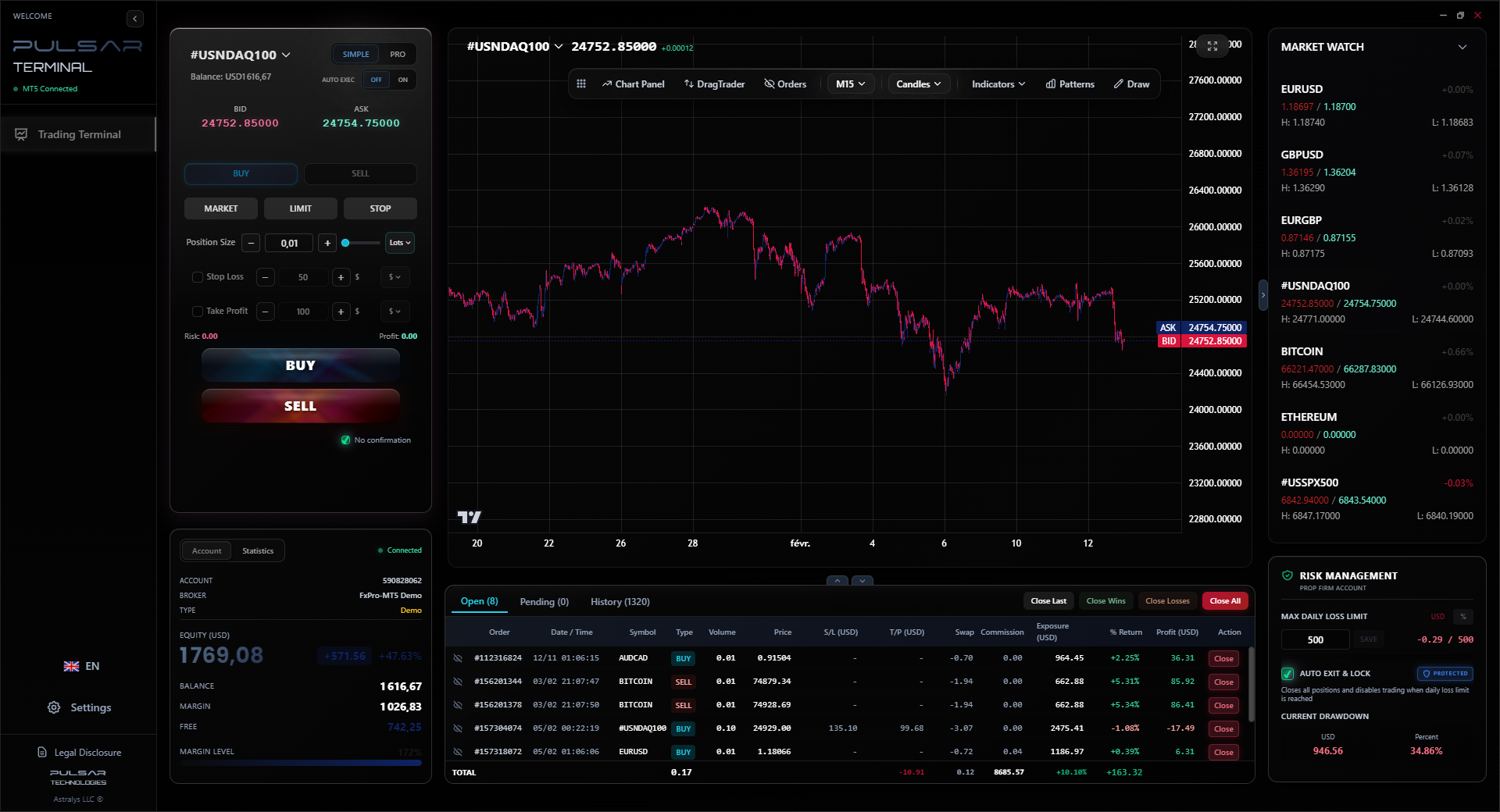
Managing multiple trades and setting precise stops in a stabilizing market is easier with tools that automate partial closures and trailing stops directly on your MT5 platform.
Pulsar Terminal
The all-in-one MT5 companion: drag-and-drop orders, multi-TP/SL, trailing stop, grid trading, Volume Profile, and prop firm protection. Used by 1,000+ traders daily.
Let's talk about the quickest ways to lose money now, so you can avoid them.
- Trading the Parallel Market Rate as Your Signal: This is a huge trap. The parallel market still exists, but its influence has diminished. The official EFEMS rate is now the primary benchmark. Basing your trades on old parallel market data points will mislead you. Focus on the official mid-rate and the turnover data published from the EFEMS platform.
- Ignoring the Minimums (For Your Own Size): Remember, the $100,000 minimum is for the interbank EFEMS. Don't let that scare you out of trading CFDs with your $500 account. They are different products. Your broker aggregates the underlying liquidity, so you get the benefit of the stable benchmark without needing the institutional ticket size.
- Underestimating Event Risk: A more stable market can make traders complacent. The next major move will likely come from a political event, a sharp move in oil prices (our main export), or a surprise CBN decision. Use wider stops during these event periods, even if the day-to-day volatility seems calm.
- Chasing the Recovery Too Late: The easiest money in the Naira recovery was made in the first 4-6 weeks post-launch. If you're coming to this now, you're trading a stabilized market, not a recovering one. Adjust your expectations and strategy accordingly. Don't keep buying Naira strength expecting the same 8% monthly gains.

Pro Tip: Keep a separate watchlist or chart for the official CBN mid-rate and the EFEMS turnover volume. This is your fundamental dashboard. Don't just stare at your broker's CFD chart all day. The real story starts with that underlying data.
💡 Winston's Tip
Stability doesn't mean safety. It often means the next big move will come from an unexpected corner. Keep your stops wide for event risks.
“The days of trading the Naira in a vacuum are over. Your analysis now needs a top-down component, starting with EFEMS liquidity.”
The naira forex recovery efems launch set a new foundation. The future trend depends on what happens next. Here’s what I’m watching like a hawk.
1. EFEMS Turnover Data: This is now the most important Nigerian FX metric. Is daily turnover increasing? That shows confidence and liquidity. Is it drying up? That’s a red flag that the system isn’t meeting market needs. The CBN publishes this, and you should too.
2. The True Convergence Test: The gap between the official and parallel rates narrowed after the launch. The key signal will be if this gap holds during a period of external stress, like a global dollar rally or a drop in oil prices. If the parallel market spikes away from the official rate again, it means the EFEMS needs more liquidity to maintain its price discovery role.
3. CBN’s Next Move: The CBN has shown it can implement structural reform. The next question is monetary policy. Will they feel confident enough in the stable FX market to potentially lower interest rates to stimulate growth? Or will they hold firm to defend the new equilibrium? Their MPC meeting statements are now must-read material.
4. Institutional Inflows: The whole point of this reform was to attract foreign investment. Watch for announcements of large foreign direct investment (FDI) or portfolio inflows. That’s the ultimate vote of confidence and would provide the dollar supply to sustain the Naira’s strength, creating potential long-term trends you can ride.
For retail traders, this means your analysis needs a top-down component. Start with the EFEMS health (liquidity), check the CBN policy stance, then look at your technical charts on XAU/USD or EUR/USD for correlated moves. The days of trading the Naira in a vacuum are over.
FAQ
Q1Can I, as a retail trader, trade directly on the EFEMS platform?
No, absolutely not. The EFEMS is an interbank platform for authorized dealers like commercial banks and large institutions, with a minimum trade size of $100,000. As a retail trader, you trade CFDs or other derivatives offered by international brokers. Their prices are based on the underlying rates from markets like the one EFEMS facilitates, but you are not a direct participant.
Q2Has the EFEMS launch eliminated the parallel market?
No, it hasn't eliminated it, but it has significantly reduced its influence and the gap between the official and parallel rates. The parallel market still exists for smaller transactions and cash demands. However, its role as the primary price discovery mechanism has been weakened. For serious trading analysis, the official EFEMS rate is now the benchmark to watch.
Q3What's the best way to fund my international forex broker account from Nigeria now?
It depends on your broker's supported options. Common and efficient methods include using a debit/credit card (Visa/Mastercard), e-wallets like Skrill, or direct bank transfer. Some brokers also accept cryptocurrency deposits (e.g., USDT), which can be very fast. Always check for any specific Naira payment gateways (like Opay or Flutterwave) your broker might support to simplify the currency conversion.
Q4Should I still trade USD/NGN, or focus on major pairs like EUR/USD?
It depends on your style. USD/NGN is now a more stable, policy-driven pair. It may offer fewer wild swings but clearer trends around CBN actions. Major pairs like EUR/USD offer deeper liquidity, tighter spreads, and are influenced by global macro events. Many Nigerian traders use a mix: trading majors for technical setups and using USD/NGN for longer-term, fundamental views on the local economy. Don't limit yourself.
Q5How does the prohibition on using foreign currency domestically affect my trading?
It mainly affects your cash flow and profit-taking. You can't withdraw USD profits from your broker and spend them directly in Nigeria. You'll need to convert profits to Naira through your broker's withdrawal process or a formal channel. This makes choosing a broker with smooth, low-cost withdrawal methods in Naira more important than ever. It also emphasizes that your trading capital should be money you can afford to cycle through the formal financial system.
Q6What was the single biggest impact of the EFEMS on trading?
Transparency. Before EFEMS, the interbank market was opaque, leading to multiple unreliable rates and massive spreads. EFEMS created a visible, centralized order book. This reduced arbitrage opportunities for speculators, which in turn reduced downward pressure on the Naira, allowing its recovery to begin. For traders, it means the underlying asset you're speculating on has a more honest and efficient price.
Prof. Winston's Lesson
Key Takeaways:
- ✓Structural reform can trigger faster price moves than incremental policy.
- ✓Transparency in the underlying market reduces retail trading noise.
- ✓Always separate the interbank benchmark from your broker's CFD price.
- ✓Adapt risk management when volatility regimes change.
How useful was this article?
Click a star to rate
Weekly Trading Insights
Free weekly analysis & strategies. No spam.
About the Author
Olumide Adeyemi
West African Trading Pioneer
One of Nigeria's most active forex trading educators. 8 years of experience trading from Lagos. Specializes in low-capital strategies and prop firm challenges for African traders.
Comments
Risk Disclaimer
Trading financial instruments carries significant risk and may not be suitable for all investors. Past performance does not guarantee future results. This content is for educational purposes only and should not be considered investment advice. Always conduct your own research before trading.
You Might Also Like

Cara Trading Forex Sukses: 7 Prinsip dari Trader Profesional
Cara trading forex sukses dengan 7 prinsip trader pro: manajemen modal, disiplin, journal trading, backtest. Data nyata, bukan janji profit palsu.
Jam Trading Forex Terbaik untuk Trader Indonesia: Panduan Lengkap dengan Tabel Waktu
Panduan jam trading forex untuk trader Indonesia. Tabel 4 sesi dunia, jam emas 20:00-00:00, sesi mana yang harus dihindari. Data akurat + tips dari trader berpengalaman.
Top 5 Sàn Forex Uy Tín Nhất 2026: Review Jujur dari Trader Indonesia
Top 5 sàn forex uy tín 2026 untuk trader Indonesia. Review jujur: spread, deposit, withdraw, dukungan lokal. Exness, XM, IC Markets & lebih.
Get Pulsar Terminal
All these calculators are built into Pulsar Terminal with real-time data from your MT5 account. One-click position sizing, automatic risk management, and instant calculations.
Get Pulsar Terminal